One thing I didn't mention in the discussion of Canada's exit strategy was the question of the extension of Employment Insurance benefits. Last September, the House of Commons voted for a temporary extension in the duration of the eligibility period, and this temporary measure is set to expire next month. The US just passed a proposal to extend benefits; should Canada do the same?
It's important to make the stock-flow distinction when talking about unemployment. In a given month, a certain number of workers lose their jobs, and a certain number of unemployed people find jobs. What the LFS reports is not these flows, but the net changes in the number of of unemployed. This is important when considering the fact that roughly 1.5m Canadians were unemployed in July 2009, and a slightly smaller number were unemployed a year later. It is tempting – but wrong – to conclude that upwards of 1.4 million people have been unemployed for 12 consecutive months.
What is special about recessions is not that people lose their jobs: people are always losing jobs. What happens during downturns is that employers sharply reduce their hirings. The net effect of course is to increase the number of people who are looking for a job, and to increase the average time it takes to find new employment.
Long-term unemployment is a problem, and not just because of the hardships it imposes on the person who suffers it. At some point, skills deteriorate and/or become less relevant, so the prospect of finding a job comparable to the one he lost becomes more remote. So when US policy-makers see this graph (courtesy of Calculated Risk)
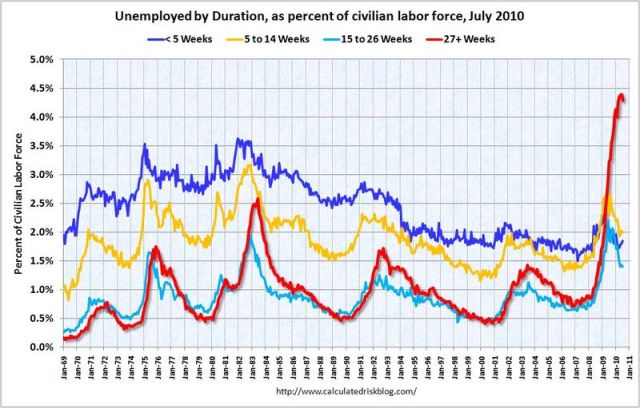
the only proper response is to despair at the enormity of the problem they are facing.
Thankfully, the situation is nowhere near as dire in Canada. The Canadian data are taken from CANSIM table 282-0047, and for reasons that will become clear shortly, they are not adjusted for seasonal patterns:
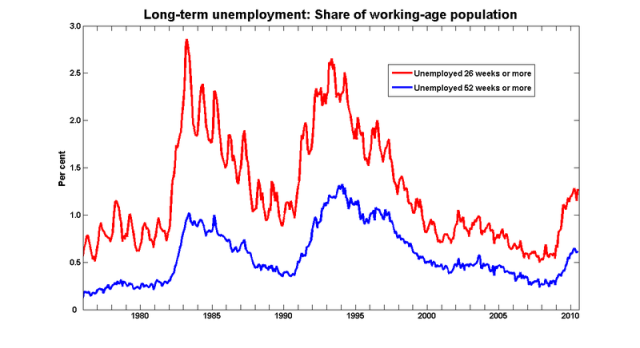
You can see why Statistics Canada doesn't even attempt to deseasonalise these series. The huge swings in the mid-1980's tell a story in which something like one working-age Canadian in 250 was in seasonal employment, and supplemented this income by Unemployment Insurance during the off-season. These workers accounted for a very small number of those who used the UI system, but they accounted for a very large percentage of those receiving benefits at a given point in time (see this discussion paper). The reforms of the 1990s were largely successful in thwarting this sort of gamesmanship, so the swings are much less pronounced in the latter part of the sample.
Anyway, here is how long-term unemployment has evolved as a share of total unemployment:
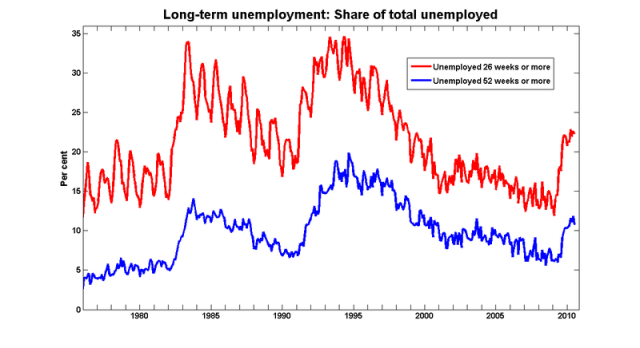
According to the BLS, 43% of those who were unemployed in July had been so for 27 weeks or more, and 29% had been looking for work for more than a year. Canada has never seen such numbers, not even in the the depths of the 1990s recession.
Back when EI reform was a Big Political Deal (remember the spring of 2009?), the Liberals decided to insist on reducing the eligibility requirements for EI. I roundly denounced this proposal ([1], [2], [3]), because eligibility requirements were the easiest elements of EI to game, and because changing them was among the least-effective counter-cyclical policies we could imagine. Far better, I argued, to advocate the extension of the eligibility period.
There is, of course, a point at which extended benefits will be counterproductive, but that point can only come after it has been made clear that jobs are being produced in significant numbers. So for the US, the decision to extend benefits was a slam-dunk – or at least, it should have been.
But what about Canada? Looking at these graphs, we could plausibly argue that the problem of long-term unemployment has peaked, but that's not really the question. Although employment growth has been not unsatisfactory, it hasn't yet been robust enough to prevent a significant accumulation in the number of long-term unemployed.
If I had to choose a date for ending the extension of EI benefits, I'm pretty sure I wouldn't choose September 2010: we're not out of the woods just yet. If someone would propose (say) a six-month extension out to March 2011, then I'd be pleased to endorse it.


 Worthwhile Canadian Initiative
Great stuff!
Setting the Lucas Critique aside, would it make sense to make the duration of benefits based on either the % of people on long-term unemployment, or the change in % rather than determining it on an ad-hoc basis? Or does the whole ‘rule vs. discretion’ debate from monetary policy show why a strictly rule based approach would have problems here as well?
I dunno. If I were to make some sort of rule, it would probably be based on the rate of gross job creation, and we don’t have data for that.
We don’t have data on gross job creation? I find that surprising. Any reason why not?
We used to, but that survey was cut a few years ago. I once asked StatsCan what the story was, and they said something about problems with the survey and cost considerations.
And why is it all or nothing? Why don’t benefits decay over time?
I don’t think it has to be. IIRC, the current benefits extension is supposed to be phased out starting in September.
Another question is how many people are holding on to EI instead of downgrading their employment? Also Patick raises an interesting question, as well.
One of the issues for a lot of people is that the duration of benefits is based on regional unemployment rates which may or may not be a good indicator of the likelihood that you personally are going to find a job. Would it make sense to increase duration across the board, or would it make more sense to extend duration more in areas where the durations are currently low?
That’s a good point. I should look up the geographical concentrations of the long-term unemployed.
But isn’t it somewhat illogical to extend benefits in areas of high unemployment, essentially allowing people to continue to stay there, when if there were no benefits available, they might be forced to move to other areas and find employment ?
Thanks for posting this comparison of unemployment durations; it’s really helped to drive home to me how different our economies are at the moment.
It should be noted that there’s another factor about extending EI benefits which should be considered, which could and perhaps should be the only part that gets extended. And that’s: sponsored training…
… which is when the provinces’ (to whom a lot of the HRSDC’s EI programs have devolved) employment counsellors approve sponsoring someone eligible for EI into an approved training program (mostly at the college / trade school level for an applied trade or para-profession), in which case the province pays for the tuition & the person gets to keep collecting EI as long as they keep up with the course.
Without that sponsorship, someone taking FT courses is ineligible for EI because it makes them unavailable for work, which makes it pretty hard for someone phased out of a “sunset industry” to retool themselves to get decent paying work again. And with this time-limited benefits extension program, for the first time, they really extended the timeline and consequently also the types of training programs people could be eligible for: to like, 2 or 3 years, instead of just 8 months, which was the norm before, esp. when people’s severance or buyouts was factored in.
The gov’t should seriously consider extending that portion of the new package (meaning, not give those already on it another year of potential training, but let the long term employed people who are still getting laid off if there’s a second dip this coming year be eligible for that extended sponsored training option).
But it probably shouldn’t just tack on an extra 6 months or year of benefits for those who are “waiting for Godot” — i.e., for their old job back, if that particular plant or industry simply ain’t comin’ back. Cuz all that time on pogey is just turning them into a discouraged worker & making them more unemployable in the eyes of those looking at the big gap on their resume, so it’s not really doing anyone any great favour (unless they’re using the time productively to take care of their kids or parents, or something).
P.s., these other aspects of the extensions for the “long tenured workers” (those w. lots of work & not too many EI claims over the past 7 years or so*) may also be confounding your analysis of the recovery, Prof. Gordon, since they also extended the total window of time people could still be eligible for benefits even if they got a massive buyout package (e.g., 2-year’s salary) (during which time they’re probably not looking for work; just licking their wounds), _and_ putting a lot more people in a lot longer training programs, so again, the fact that they’re not employed yet even 2 or 3 years after being laid off doesn’t show they couldn’t have got a job if they tried, just that they hadn’t found one, yet (since they didn’t need to, yet), but they would still be counted as unemployed.
* http://www.servicecanada.gc.ca/eng/goc/ltw/index.shtml
What is truly unfortunate is that we have no real time data on EI exhaustion. We do know that beneficiaries as a percentage of the unemployed has fallen from a peak of just over 50% to just 45% and I note that it has fallen quite rapidly in some very hard hit communities such as Windsor. At a minimum the extra 5 weeks that runs out in September should be kept in place.
Andrew, good to see you on the blog, Frances
Ottawa ends enhanced EI program
http://www.thestar.com/news/canada/article/858415–stephen-harper-cuts-enhanced-ei-program?sms_ss=blogger