I did a round of interviews for CBC radio on Tuesday after the federal government's fiscal update was released, and it was often remarked that the 2009-10 deficit of $55.6b was the largest ever. I suppose I should have said that it sounds even larger if you say it was 5.56 trillion cents.
These numbers aren't really informative without context, so here's some. The data are taken from the Department of Finance's Fiscal Reference Tables, also updated on Tuesday:
First up is the federal budget balance, scaled as a share of GDP and in terms of per capita 2010 dollars:

The 2009-10 number is bad, but we've seen worse. Indeed, we had a string of 18 years in a row starting in 1977 where the deficit was a larger share of GDP than it was last year.
Here is the federal debt:

That upward tick will be something to watch in the next couple of years. A temporary blip is nothing to worry about. A sustained trend is.
I've found it instructive to look at spending and revenues using both methods of scaling the data.
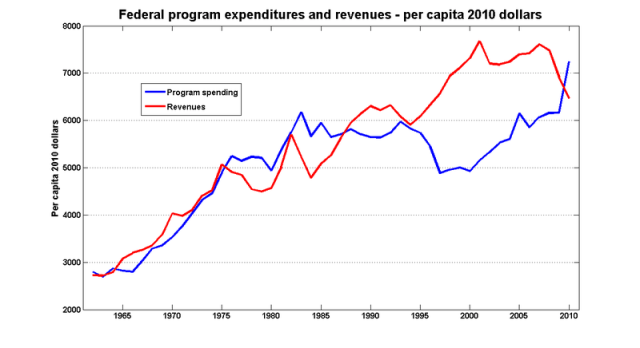
After almost 30 years of drifting sideways, real per-capita spending jumped sharply. The stimulus program is set to expire in 2011, so the spending should stay in that region before falling back again (how far?) in 2011-12. Unsurprisingly, revenues fell during the recession, but they've already started coming back.
Here are the same series expressed as a share of GDP:

Once again, we see that jump in spending, but only back up to levels we saw twenty years ago.
I have to say that I can't get too excited by the swings at the end of those graphs, even if they do persist through the current fiscal year. On both the revenue and spending sides, the shifts are temporary and will recede during FY 2011-12. There's a better-than-even chance that the deficit will not go entirely away on its own and that further measures will need to be taken, but these decisions don't have to be made right away.


 Worthwhile Canadian Initiative
Agreed. And isn’t that last $5.6b some sort of accounting thingy, due to HST?
I think we should be worrying more about Bill Robson’s (CD Howe) projection of $2.8trillion extra spending from the interaction of demographics and healthcare. http://www.cdhowe.org/pdf/eBrief_106_Robson.pdf
Q: Tax cutting in the last decade. Where does it show up in these graphs, and how would one measure if it was effective? Or can one measure it in these graphs? Is it reflected in the declining revenue as pct of GDP in the last graph, and what about the 4 x multiplier for corporate tax cuts that MM referenced in an earlier Finance study (c 2004)? Shouldn’t the multiplier tend to flatten the red line, or is the downward slope mostly the effect of GST cuts?
Nick makes an good point. The demographic that is going to benefit most from that $2.8T is also the largest demographic and the one that votes. I think it’s pretty unlikely that they’ll decide to spend less on themselves, and any politician who suggests it will be committing career suicide.
Patrick: until the boomers slowly die off, and lose their voting clout. And then the late boomers will probably get the short end of the stick, yet again.
JvfM: I assume you’re talking about the Conservative tax cut to the corp. income tax rate (and not earlier ones?)
21% before January 1, 2008
19.5% effective January 1, 2008
19% effective January 1, 2009
18% effective January 1, 2010
16.5% effective January 1, 2011
15% effective January 1, 2012
At absolute worst, all else being equal, a 10% reduction in rates (say from 20 to 18%) would lead to a 10% reduction in revenue collected (in reality, it will be a smaller reduction, for all the ECON 1000 reasons). Corporate income tax revenue total is 30-40B a year, so we’re talking about a reduction in 3-4B in revenue collected. Of course, not all else is equal, so the economy is growing (or shrinking), so corp. income tax revenue is changing due to that.
Canadian GDP is around is around 1200B a year. You’d need one heck of a multiplier to see the effects of a 4B tax cut in a 1200B economy by just looking at the raw data.
The federal Liberals did some fairly substantial income tax cuts during their tenure as well. However, revenue seems to have continued to increase as the economy was expanding during those times.
Why don’t you have a chart of the deficit as a percentage of jellybeans in Canada? It would be just as meaningful to this discussion as your other ones. There is only one measure that matters; the deficit as a percentage of government revenue. Every other comparison is econononsense.
Robert,
Debt and revenue as a percentage of jellybeans would not show how capable we are of carrying the debt, but against our economy it does and per capita it does.
If government revenue was only $100 total and was spending $150, your graph would show the same data as the gov’t collecting $100B and spending $150B. How useful is that? It wouldn’t show past information on whether balances were won via spending cuts or tax increases, as well. Now who’s spouting econononsense?
MM, I was under the impression corp tax cuts were also undertaken prior to 2008 by Chretien/Martin gov’ts, no?
The problem I have is your earlier suggestion in another blog (agreed to by SG) that to determine optimal CIT you cut and then re-evaluate where you’re at. But, how do you do that? And how do you account for favourable terms of trade due to higher commodity prices? I’ll have to look at his more recent blog posting a bit closer. My initial thought is that reporting numbers as a % of GDP hides some of the subtleties of tax policy.
“MM, I was under the impression corp tax cuts were also undertaken prior to 2008 by Chretien/Martin gov’ts, no?”
Yep, which is why I had to ask which ones you meant.
“The problem I have is your earlier suggestion in another blog (agreed to by SG) that to determine optimal CIT you cut and then re-evaluate where you’re at. But, how do you do that?”
You have to account for those other factors – start parsing things out. You’re not going to just look at the raw data.
But, you would agree however, pre-parsing, that with significantly rising commodity prices over the past decade that you MAY have ended up giving up more than you gained through CIT cuts? Hindsight being 20/20.
Debt and revenue as a percentage of jellybeans would not show how capable we are of carrying the debt, but against our economy it does and per capita it does.
No it doesn’t, as a percentage of revenue does that. Lets look at two examples.
1) Deficit of 50% of revenue and 1% of GDP.
2) Deficit of 10% of revenue and 5% of GDP.
Which would you prefer?
“But, you would agree however, pre-parsing, that with significantly rising commodity prices over the past decade that you MAY have ended up giving up more than you gained through CIT cuts?”
I’m not sure what, exactly, you mean by ‘giving up more than you gained’, but naturally I wouldn’t rule anything out a priori. But I’d need to see your model. What’s your reasoning? How do these things interact? What are the underlying assumptions?
Well, my basic model is that when you cut CIT – your main objective is to promote/encourage more local investment (and presumably more employment – but not necessarily so if investment is in productivity related equipment). The 4x multiplier, I presume, was claiming that a $1 tax cut results in $4 more tax revenue, no?
But, there will be free riders – those that will invest irrespective of the CIT cuts. And in resource based economies, these things can’t move (primary extraction and related investment). Secondary and tertiary industries less so, but more dependent upon other factors.
If the CIT revenue given up to the free riders exceeds the value of the 4x multiplier, then you’re worse off, tax revenue wise, no?
“Well, my basic model is that when you cut CIT – your main objective is to promote/encourage more local investment (and presumably more employment – but not necessarily so if investment is in productivity related equipment). The 4x multiplier, I presume, was claiming that a $1 tax cut results in $4 more tax revenue, no?”
Whoah.. no.. nobody is making a Laffer curve argument here.
It wasn’t a multiplier. The point of the study is that collecting an extra dollar of taxes through a corporate income tax is more damaging to the economy than collecting an extra dollar from a sales tax (or conversely, collecting one less dollar of corporate income taxes leads to a great economic benefit than cutting one less dollar of sales tax).
Ok, so I misunderstood the 4x multiplier. Still don’t know why it was called that, then, if it was.
But, what about the example I provided? Is it possible that less overall tax was collected due to the CIT cuts, looking back with hindsight over the past decade?
“Is it possible that less overall tax was collected due to the CIT cut”
Relative to what? If there hadn’t been a cut? Almost certainly. Again, I don’t know of any researcher in Canada who has made the claim that corporate income tax cuts are self-financing.
Relative to what? If there hadn’t been a cut? Almost certainly.
OK, so, give me a 140 character explanation of why it is essential in 2010 to continue on cutting as per your schedule outlined earlier, 2008-2012. Or is the whole CIT cut argument based solely upon tax shifting? Sorry, I’m a bit thick sometimes.
“OK, so, give me a 140 character explanation of why it is essential in 2010 to continue on cutting as per your schedule outlined earlier, 2008-2012. Or is the whole CIT cut argument based solely upon tax shifting?”
The case made by the paper (and dozens of other studies like it) is largely that if you raise taxes, raising that tax will provide the greatest damage to the economy. If you lower taxes, lowering that tax will provide the greatest economic benefit. Of course, that leads to the idea of a tax shift, as you describe, that you could raise one (say the GST), lower corporate taxes, and come out economically ahead.
OK, but given that CIT tax cuts are not self financing, if they are applied without an offsetting tax hike (GST for example) does this not make the deficit worse?
“OK, but given that CIT tax cuts are not self financing, if they are applied without an offsetting tax hike (GST for example) does this not make the deficit worse?”
If you assume they’re not self financing (which they probably aren’t), then yes, by definition.
So, if “they probably aren’t”, can you definitively state that cutting CIT without a GST hike is better than not cutting CIT and leaving GST also unchanged?
What happens when you aggregate the provincial balance sheets together? I believe the total government debt-to-GDP ratio in Canada, including all levels of government, is something approaching 90%. Remember, Ontario has a provincial deficit that is almost as large — in nominal — terms as the Federal deficit
MM, you still there? Why no reply? You were previously so punctual. Let me know when the paint dries and you can come out of the corner. 🙂
But don’t forget that during the 1980’s our high interest rates on the debt were in turn worsening the annual deficits.
Today, we have record low interest rates, and our deficits are still big.
And then we have all those future unfunded payments to make, assuming we don’t simply renege on them. More likely, of course, we’ll simply inflate while rigging the CPI numbers, as we’ve already begun to do.
We actually blew it in the 1990’s. There should never have been any tax cuts. We should have run bigger supluses and paid down more debt. But people only seem to be Keynesian in the bad part of a cycle.
“So, if “they probably aren’t”, can you definitively state that cutting CIT without a GST hike is better than not cutting CIT and leaving GST also unchanged?”
Better on what dimension? Not sure what you’re getting at.
Next election will have CPC, which cut dumbest tax to cut (GST) vs LPC, which wants to increase dumbest tax to raise (corp taxes)? What fun!…Can’t anyone play this game? If you want to cut taxes, cut corp taxes first. If you want to increase revenues, increase GST first.
Which is better? Or less worse? In your opinion? Where we are today. 2010.
Cut corporate taxes (Conservative party) or not cut corporate taxes (Liberal party) – both leaving GST as is?
.
.
aside- did you happen to see this story from Wed’s G&M –
An innovative strategy for Canada
http://www.theglobeandmail.com/report-on-business/economy/growth/an-innovative-strategy-for-canada/article1754203/
No talk of corporate tax cuts – but rather targeted tax credits for R&D
Nick: Maybe. Though I suspect it’ll be today’s two year olds who will get the short end of the stick in the form of underfunded everything-that-isn’t-health-care.
BTW, population pyramids are here:
http://www.statcan.gc.ca/kits-trousses/animat/edu06a_0000-eng.htm
Mike Moffatt: I know of many papers that argue/demonstrate empirically that CIT is inefficient and falls principally on labour in an open economy. But states compete on CIT and the world is a closed economy. So while any one state may get a significant temporary advantage and efficiency gain through a cut, over the long term the only outcome is a global drop in CIT and a resulting shift in burden from capital to labour. As to the optimal mix of tax burden between capital and labour in a closed economy, that depends on their relative marginal returns on investment. But the answer is certainly not 100% on labour and 0% on capital which will be the ultimate result of tax competition in a world of perfect capital mobility and zero labour mobility. This is a classic prisoner’s dilemma.
“Next election will have CPC, which cut dumbest tax to cut (GST) vs LPC, which wants to increase dumbest tax to raise (corp taxes)? What fun!…Can’t anyone play this game? If you want to cut taxes, cut corp taxes first. If you want to increase revenues, increase GST first.
Which is better? Or less worse? In your opinion? Where we are today. 2010.
Cut corporate taxes (Conservative party) or not cut corporate taxes (Liberal party) – both leaving GST as is?”
Can you clarify what you mean here – you’re quoting cutting the GST, then leaving it in tact. Am I judging a GST cut, a non-GST cut. What, exactly?
And I’m still not sure what you mean by better. Better on what dimension? Better for what? The economy? Government revenues?
Sorry if this seems dense, but I’ve read the above about 10 times and I’m still not sure, what, exactly you’re asking. I need something more specific.
K:
What you described is the impact of corporate tax in a SMALL open economy (like Canada)which can’t affect the global return on capital. Keep in mind that the incidence of corporate income tax is different in a LARGE open economy (say, the US), because capital can’t move out of those jurisdictions without driving down the global price of capital. That means that, in a large open economy, at least some of the incidence of corporate income tax is shifted to foreign owners of capital (which is probably why, for example, the US has one of the highest statutory and effective corporate income tax rates in the developed world – they are able to tax foreigners who don’t get a vote).
In any event, the suggestion that moving to a zero-rate on corporate income tax would mean shifting taxes from capital to labour is not correct. As you correctly noted, in small open economies, the bulk of the incidence of corporate income tax is already borne by labour, so reducing the statutory tax rate doesn’t change that (although it that make that point more transparent).
The two main political parties in Canada differ on one fundamental point. Both the Conservatives and the Liberals will neither raise nor lower the GST.
But, the Conservatives will continue on with CIT cuts. The Liberals won’t at this time- claiming the economy needs more time to recover/balance the books.
From what you told me earlier, the Conservative’s CIT cuts in all likelihood will ADD to the deficit, they being non self financing.
I find the Liberal position entirely defensible at this time, especially if they focus on targeted R&D tax credits instead of across the board CIT cuts – the latter having been demonstrated over the past decade as being ineffective in promoting productivity investments in Canada. So, the better or least worse platform. Do you agree? If not, why not?
So, if “they probably aren’t”, can you definitively state that cutting CIT without a GST hike is better than not cutting CIT and leaving GST also unchanged?
Better how? Cutting the CIT has some benefits, not cutting it and using the additional revenue for some other purpose presumably has benefits as well. How you weight those benefits is, presumably, a political question and depends on your preferences and the alternatives being presented.
I think if you’re going to ask Mike if cutting the CIT is “better” you really have to propose an alternative against which to compare it and a basis on which to assess “better-ness”.
Hey, did you just get back from vacation? 🙂
OK – across the board CIT cuts vs. targeted R&D tax credits to promote productivity/foster innovation.
Just, if the choice is between a CIT cut and R&D tax credits, than I would definitely choose the CIT cut. Canada already has a ridiculously generous R&D tax credit system, which system has been singularly ineffective at promoting productivity growth (not surprisingly, because most of the R&D money goes to 1% of all Canadian businesses, and 100 Canadian companies collect 56% of it). Far better to provide a more favourable business environment for all businesses than to continue to toss money than the R&D tax credit well.
As an aside, the single most effective tax policy to improve productivity is one that the Tories have already implemented, namely helping to get rid of provincial sales taxes.
OK, so I presume you agree with the findings in the earlier linked article – Innovation strategy for Canada – which argues a reallocation of existing funding.
Several of the key recommendations centre on getting more out of Ottawa’s popular $3-billion-a-year Scientific Research and Experimental Development (SRED) tax credit – its costliest R&D program. The coalition wants Ottawa to make the credit available to public companies, expand eligible innovation-related expenses, and give refundable credits to companies that hire R&D workers. To make the changes “fiscally neutral,” Ottawa could lower the credit cap, now set at 35 per cent, according to the coalition.
Currently, companies that go public are ineligible. And credits can only be used to offset profits, making it of marginal value to thousands of money-losing startups with good ideas.
What about this trade-off – CIT cuts (which adds to the deficit) vs balancing the books sooner, then cutting?
“What about this trade-off – CIT cuts (which adds to the deficit) vs balancing the books sooner, then cutting?”
Obviously there’s a tradeoff there, but if the government is looking for ways to balance the books sooner, there are a lot more effective ways of doing so (such as, a rise in the GST).
“OK – across the board CIT cuts vs. targeted R&D tax credits to promote productivity/foster innovation.”
With any ‘targeted’ plan, the devil is in the details – hard to make a broad generalization.
“But, the Conservatives will continue on with CIT cuts. The Liberals won’t at this time- claiming the economy needs more time to recover/balance the books.
I find the Liberal position entirely defensible at this time, especially if they focus on targeted R&D tax credits instead of across the board CIT cuts – the latter having been demonstrated over the past decade as being ineffective in promoting productivity investments in Canada. So, the better or least worse platform. Do you agree? If not, why not?”
Your questions are self-contradictory Dot. First we’re talking about doing nothing to ‘recover/balance the books’, then we’re talking about ‘focus on targeted R&D tax credits’, which presumably is going to cost money.
I’d be happy to answer your questions, but you’re all over the place here, so I don’t know what you want me to answer.
Obviously there’s a tradeoff there, but if the government is looking for ways to balance the books sooner, there are a lot more effective ways of doing so (such as, a rise in the GST)
Aha. But I made not raising GST a priori (a safe assumption in the current political climate).
Anyway, what I can conclude is that either political platform has its tradeoffs – and neither is definitively better or worse than the other. Fair conclusion?
“Anyway, what I can conclude is that either political platform has its tradeoffs – and neither is definitively better or worse than the other. Fair conclusion?”
No idea, because I still don’t know what these platforms are.
No idea, because I still don’t know what these platforms are.
So doggedly advocating CIT cuts, in the absence of a full platform, is premature. In your opinion. Fair?
“So doggedly advocating CIT cuts, in the absence of a full platform, is premature. In your opinion. Fair?”
No – not at all. I’m trying to understand your question.
This is like trying to nail jello to a wall. I’ll move on. 🙂
“This is like trying to nail jello to a wall. I’ll move on. :)”
Please do. I can’t follow what you’re asking – it’s different in every single text. Sometimes there’s R&D tax credits, sometimes there’s not. Sometimes there’s two ‘platforms’ to compare to each other, sometimes there’s a lone tax cut to consider. It’s making me dizzy.
If you find this complex, then you should indeed lie down for a spell.
This whole thing reminds me of this:
Barlow: Mayor Quimby, you’re well-known, sir, for your lenient stance on
crime. But suppose for a second that your house was ransacked
by thugs, your family tied up in the basement with socks in
their mouths, you try to open the door but there’s too much
blood on the knob —
Quimby: What is your question?
Barlow: My question is about the budget, sir.
“Anyway, what I can conclude is that either political platform has its tradeoffs – and neither is definitively better or worse than the other. Fair conclusion?”
If the contrast is between cutting the CIT and implementing additional R&D tax credits, the former is unambiguously better than the latter. No question about it.
If it’s between cutting the CIT and spending the savings on other program spending (which is what the Liberals have been suggesting recently – i.e., old age care), than, yes, it’s hard to say that one is unambiguosly better than the other, because the assessment of the merits of the alternatives are really subjective).
Some people also feel that adherents of purely economic theory is comical.
“Some people also feel that adherents of purely economic theory is comical.”
Even if this were just theory, that’d be unfair. But it’s not just theory – we have posted applied studies using historical observations and data.
I’d probably get a 2 in your course that you teach part time. Case studies, that often use real data and external info to complement theory, never have a definitive right or wrong answer – despite what some instructors like to claim. Kinda like Canada’s economy in 2010.