The veterinarian called at 2:30 a.m with an update on our dog's status. The bladder stone was still stuck in Micky's urethra. Did we want to go ahead with surgery, or…? The unstated alternative: euthanasia.
As I sank back on the pillow I thought "I've been teaching health economics wrong all these years."
There's a diagram in many economics textbooks that purports to demonstrate that health insurance causes excessive consumption of health care services. 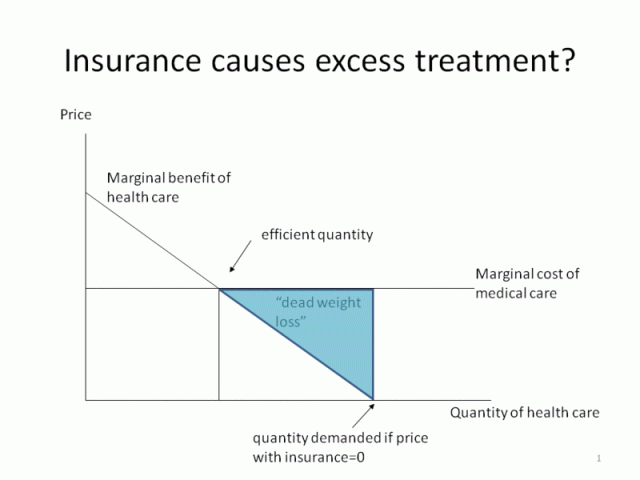
The curve "marginal benefits of health care" represents consumers' demand for health care – what people are willing to pay for an extra unit of health care on the margin. The curve "marginal costs" represents firms' health care supply – firms are willing to supply medical care as long as the price that they receive per unit of care is greater than or equal to the marginal cost of providing that care.
If, because of health insurance, it costs the consumer nothing to see a doctor, people will seek medical care until the marginal benefit of additional treatment is zero. At this point, people are consuming health care for which the marginal benefits (zero) are less than the costs. Inefficiency results. There is a deadweight loss, indicated by the blue shaded triangle, representing care for which the costs exceed the benefits – mammograms on symptom-free 30 year olds, for example.
Students typically love this diagram, because it's clear, easy to understand, and makes an argument that many agree with. Unfortunately, it fails to capture the nature of end-of-life health care decisions.
My 2:30 a.m. phone call was not about a marginal treatment – I didn't have a choice about having slightly more care or slightly less care. I didn't have the option of going to an alternative health care provider. The hospital was in a position to make a take it or leave it offer: take the surgery on offer at the price we name, or leave your dog to die. That picture looks a little bit different:
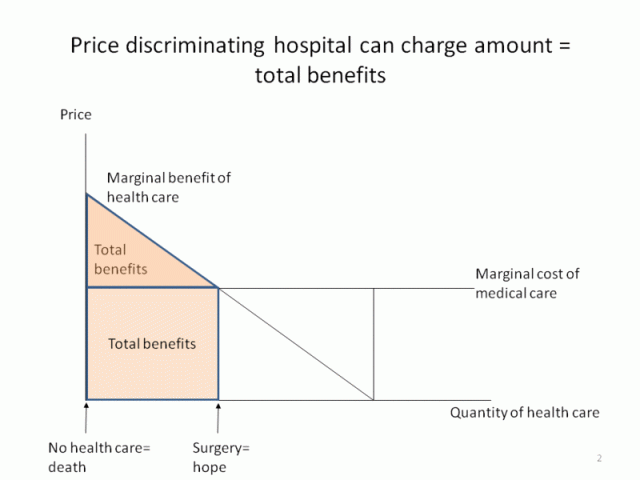
The amount I am willing to pay for surgery is the total benefits of treatment – the money value I place on the love my family has for our dog. That's a fair chunk of change.
Yet even this second "price discrimination" diagram is flawed as a depiction of health care. Drawing a demand curve and using it to represent the benefits of care assumes that my decisions reflect rational choices. But when a loved one is in pain, our animal brains kick in, and rationality goes out the window.
"Hyperbolic discounting" is a term behavioural economists use for our tendency to place a low value on future pain and a high value on present gain. If you had asked me five years ago "would you spend $3,000 to give your elderly dog another year of life" I might have said no, there are better ways of using that money. The dog won't live forever anyways.
Buying surgery will (possibly) prevent me having to suffer grief and pain and loss today. And that's all I care about – the future is far away. Sufficient unto the day is the evil thereof. As I recite my credit card number over the phone I feel relief – Micky will be o.k. – and I don't worry about how I'll pay the bills, or the fact that he's an old dog who will die within a few years anyways. Or that he could be replaced by an adorable puppy for a fraction of the cost of surgery.
Are there any limits to what a hospital can charge for services? What about economists' assumption that the price charged for, say, surgery, is equal to the marginal cost to the hospital of providing services, for example, the cost of the surgeon's time and of anesthetics?
In a competitive market, if prices are greater than marginal costs, firms will make profits, and more firms will enter the market. With the increased capacity, firms will cut prices so that they can sell the goods they produce. Prices will fall, until firms are just covering their costs.
But information failures, together with barriers to entry through licensing and training requirements, means that health care markets are far from competitive. I do not know what the marginal benefit of health care is, nor the true quality of care offered by different veterinary clinics. If I knew how to diagnose and treat my pet, I would not be seeing a veterinarian in the first place. I put my faith in the person in the white lab coat, and hope Micky will be all right.
Is it right to equate animal care and human care? From a moral point of view, spending so much on animal care is problematic. The hundreds or thousands of dollars that I am spending on my dog's life could, if spent on mosquito nets or chickens or wells, measurably improve the lives of people – and surely human life is worth more than animal life?
Yet I have learned a valuable lesson from the animal hospital. Grief hurts. Some day I will lose Micky. But there are few limits to what I will pay to put off that suffering until tomorrow. And that time inconsistency – that discrepancy between what my rational self would have wanted, planning ahead and making choices ahead of time, and what I decide in the here and now – is a major barrier to controlling health care costs.
Post script: it is now three days since Micky's surgery, and so far he appears to be making a good recovery – thanks to the excellent care he received.


 Worthwhile Canadian Initiative
Frances, The idea that some people use the medical system needlessly is often used as a reason to introduce user fees, though it will not be the families with money who become disadvantaged because of fees, should it happen. Need is not really the issue, when it comes to this. It’s about getting access to scarce (for some) doctors and medical care.
Another diffference between humans and pets, thinking about end of life issues, is that invariably, the pet is loved. If it weren’t it would be long gone. No so with family members who might be the subject of decision-making at the end of life. You have said yourself that you would be willing to pay and keep paying through the nose to keep your pet with you. In the case of humans, however, unless the person dying is a ‘pet’, or a child, it is quite likely the rational decision-making process kicks in. Bring in that other variable also – inheritance, which may be a confounding variable – or not. These thoughts may explain the gift-giving behaviour also (see Frances Woolley | October 22, 2010 at 12:13 PM )
Francis writes:
Low? Which countries? What middle-class?
You have to understand that this is an active political issue in the states where you had one side that really cared a lot about getting a certain policy enacted. So for instance you had certain oft circulated quotes about their being 46 million uninsured Americans when the actual number was closer to 30 million. Of those 30 million, roughly half were already eligible government health care and would be automatically enrolled if they ever showed up at a hospital. Of the remaining, almost all have incomes over 50K–nearly half over 75K or are under the age of 34. What’s amusing is that all of those numbers actually come form the census bureau. Its just people don’t bother to read what the definitions are.
Data mining. Its been the plague of economics for a hundred years. Whenever I read something on a ‘political issue’, I start downing the grain of salt at every sentence. You should too.
Frances, turns out you aren’t the only one willing to pay big vet bills: http://www.timescolonist.com/Blind+attacked+cougar+guide+Buddy/3753933/story.html