The website charitynavigator.org rates US charities. Although it's now changing its rating system, a charity that spends a low percentage of its budget on fundraising and administration will usually get a high rating.
It's not clear how much influence sites like charitynavigator have. A recent article reported that only 10 percent of Americans consulted a site like charitynavigator before donating.
But that 10 percent probably includes major donors.
It is, in any event, almost certain that far more people consult well-publicized and easy to use charitynavigator.org than dig through Canada Revenue Agencies' charities listings – the one place I know of where financial information about Canadian charities can be obtained.
There are a few reasons to be skeptical about the value of rating charities according to their fundraising to total expenditures ratios.
First, charities can choose how to categorize expenditures, and the difference between fundraising, administration and program expenditures is often not clear cut. For example, if an environmental protection group distributes information about the dangers of climate change, is this education (a charitable activity) or fundraising?
March of Dimes (Canada) shows how serious this issue can be. Their 2009/10 annual report shows on p. 29 that 95.4% of "your money" goes to programs and services. To check those numbers, I looked up March of Dimes Canada (they are registered under a different name, so I used their business number, BN 87958 5214 RR0001) on CRA's charities listing, and dug up Schedule 6 of the T3010 return – the charitable information return every charity is required to submit each year. I then calculated funding expenditures divided by total expenditures. According to the numbers reported to the Canada Revenue Agency, over a third of March of Dimes Canada's spending goes to fundraising.
I trust the information charities submit to Canada Revenue Agency/the Internal Revenue Service more than the charity's annual reports, since CRA and IRS have guidelines about how to categorize expenditures. Also, there is an incentive to be honest, as submitting a deliberately misleading charitable information return could cause a charity to lose its charitable status.
Even so, there is some room for discretion in the categorization of expenditures, and the presence of rating websites like charitynavigator.org might change the ways in which charities report their numbers.
A second reason to be careful about interpreting "fundraising efficiency" numbers is that a charity with other sources of income – government funding, an endowment, support from other charitable organizations, will tend to have a low ratio of fundraising to expenditures. For example, if Development Works spends $10,000 on fundraising, gets $5,000 in donations as a result of its fundraising, and also applies for and receives a $200,000 government grant for its international development work, it will have a fundraising/expenditures ratio of under 5 percent, even though its fundraising is ineffective.
This is a particular problem if charities have opportunities to pad their total expenditure numbers. Suppose, for example, Midlife Crisis Care is a charity that accepts donations of old sports cars, fixes up the cars using volunteer labour, and donates them to people experiencing a midlife crisis. If Crisis Care values those old cars at an inflated value each, both their revenues (in kind donations) and expenditures (gifts to needy individuals) will rise, so fundraising divided by total expenditures will fall. (This strategy is used in the real world by charities that receive surplus/unsold/near expiry date medications from pharmaceutical companies and redistribute them to needy individuals).
Third, Canada and the US are different – US charities, for example, might be able to take advantage of greater economies of scale, or it might be easier to persuade Americans to give. Also, religious belief and church attendance is higher in the US than Canada, and that likely affects the nature of charitable activity.
But having said all that, in a miniscule, non-random survey, how do comparable American and Canadian charities stack up? Does the presence of sites like charitynavigator.org mean that American charities spend less on fundraising and administration? The table below shows US numbers, and puts them side-by-side Canadian numbers calculated using an identical methodology – fundraising expenditures divided by total expenditures based on numbers from the charity's charitable information return.
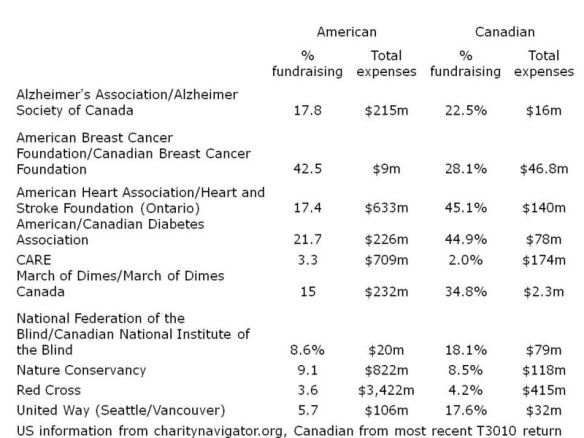
Going out on a limb, and recklessly generalizing from a small sample, my hypothesis is that, for a typical charity spending less than 10 percent of its budget on fundraising, the existence of sites like charitynavigator.org has a relatively small impact on expenditure decisions. First, getting three stars instead of four stars on charitynavigator.org probably doesn't make much difference to total donations. Also, charities do not have complete control over their revenues and expenditures (sometimes a fundraising drive will go well, other times it won't).
But a Canadian charity can, on a long-term basis, spend a very high percentage of its total budget on fundraising, without serious adverse consequences. An American charity that spends over 40 percent of its revenue on fundraising risks the charitynavigator death spiral.
A bit of digging into the history of American Breast Cancer Foundation shows how it happens. Two years ago, the American Breast Cancer Foundation was spending 37 percent of its budget on fundraising, and received two stars.
But then it had another bad year, and its charitynavigator rating continued to fall – from two star to one star. Once one reaches the one star level, large donors begin to get scared away (Would you give $10,000 without clicking on charitynavigator? I don't think so). Donations start to drop.
Charity navigator also gives points to charities based on the growth rate of their donations – so falling donations create a double-whammy, increased fundraising/revenues ratios and negative growth rates. Soon, a charity is labelled "inefficient" and given no stars at all – the situation the American Breast Cancer Foundation is in right now – at which point fundraising becomes extremely difficult.
It's hard for a Canadian to get a sense of how competitive and cut-throat the US charities marketplace is. Charitynavigator.org's front page has a link to an article on charities working to cure and prevent breast cancer. It lists 24 charities. The American Breast Cancer Foundation is bottom of the list, one of just two with no stars. If I worked for them, I'd be polishing my c.v. and sending it to the four-star Breast Cancer Research Foundation (fundraising as percentage of total expenses, 5.2%, total expenses, $32 million). Indeed, at one level it's just deja vu all over again – the small Canadian marketplace makes for domination by a relatively small number of relatively inefficient firms.
The possibility of a charitynavigator-type death spiral makes me think that perhaps I'm doing harm publicizing these fundraising ratios – perhaps I'll do serious damage to worthwhile Canadian charities.
So why am I writing this? It's because this whole charity business is driving me crazy. I want to be a good person, and saying "no thank you" to charity makes me feel like a selfish, bad, Scrooge-like person. But I can't support everything. And I don't want to give to a charity that spends 45% of their budget on fundraising – there's far better ways of using those funds. Yet, at the same time, I don't have time to sit down and look up dozens of charities' T3010 information and calculate fundraising efficiency ratios.
So this blog is a way of getting out my frustrations.
My next post on the Globe and Mail's Economy Lab describes how to use CRA's charity listings.


 Worthwhile Canadian Initiative
There’s also http://givewell.org/ in case you haven’t seen them. Their downside is that they’ve only recommended 10 charities.
Jeffrey, thanks, that’s interesting. What they do is look at how effectively a charity is actually using its money – e.g. do aid dollars end up improving life in the village or the lives of the plutocrats? So it’s not surprising that they only look at a few charities. I think in Canada we aren’t even scratching the surface of these transparency and accountability issues, let alone being in a position to do this kind of detailed analysis.
I did actually (inspired by your comment) do another search and found this site: http://www.charityintelligence.ca. There’s also this one: http://list.moneysense.ca/rankings/charities/2010/health/Default.aspx?sp2=1&d1=a&sc1=0 (I have to say that one is kind of amusing, there’s all these health charities that get a “D” for “fundraising efficiency grade” and an “A+” for “reserve fund size grade.”
But who has an incentive to actually go in and rake up this muck? Lots of dollars spent on fundraising translates into lots of advertising revenue for mainstream (and other) media outlets, so they hardly have an incentive to bite the hands that feed them.
That link to Moneysense didn’t work, try http://www.moneysense.ca/2010/06/17/the-charity-100-where-is-your-money-going/
Fund-raising efficiency is an EXTREMELY poor measure of effectiveness. Would you rank the effectiveness of a college on the basis of the ratio of its annual fund-raising expenses to its annual total expenses? My guess is that fund-rasing efficiency depends on how well established a college/charity is – i.e., a brand new organization will need to spend most of its resources on fund-raising in order to pay for fixed costs and achieve economies of scale.
Also, an organization supporting an obscure but worthy cause would have a harder time raising funds. For instance, thousands of impoverished people die EVERYDAY due to lack of micronutrients but as this happens everyday, there is no media attention (it’s not news if it’s a daily occurence). On the other hand, organizations helping victims of a single newsworthy natural disaster would have an easier time raising funds due to widespread awareness and shock.
Anyone contemplating issues related to charitable organizations would do well to check out the book Uncharitable by Dan Pallota (or atleast visit its companion site – uncharitable.net
I understand that metrics are hard to construct – looking at a financial statement is woefully inadequate as that categorizes all the costs of the organization without revealing much about the benefits to society generated. Although it would be an impossible task, I think economists should try to quantify benefits in terms of aggregate improvements to quality of life (or some other appropriate welfare measure).
In fact I will go so far to say that an excessive reliance on financial statements is not just useless, it is counter-productive for such an approach creates incentives for charitable organizations to focus disproportionately on cost allocations rather than on societal benefits generated.
I’m not saying that audits are not useful or that transparency should be shunned. We need to look at financial statements to detect fraud and understand costs – but we also need to concurrently evaluate the value of benefits generated.
Shyamgs: “Would you rank the effectiveness of a college on the basis of the ratio of its annual fund-raising expenses to its annual total expenses?”
The difference between 3% and 10% would, I agree, probably not tell me much about a college’s effectiveness.
But if a college was spending 45% of its budget on fundraising – and then an additional chunk on administration – I would not donate. And I’d think that there were better ways of raising money.
Several points about the micronutrient initiative:
– it is truly a worthwhile Canadian initiative, e.g. iodization of salt in Bangladesh has achieved remarkable success, and may be part of the explanation of that country’s growth
– it was actually someone who works for the micronutrient initiative who was telling me about how charities use the strategy of placing a high value on in-kind donations to minimize fundraising/expenditures ratios – people who work in the charity business can tell some interesting stories
– the micronutrient initiative demonstrates how difficult it can be to quantity the benefits generated. Iodizing salt affects the development of young children now – the benefits of a smarter generation of workers won’t be reaped for 20 or 30 years. Moreover, economists are only starting now to grapple with the idea that simple policy interventions (like adding iodine to salt) can make people smarter, and that in turn can promote democracy (increasing civic engagement), savings (decreased rate of time preference).
And the search for accountability just generates a whole other layer of bureaucrats whose job it is to scrutinize the work that is being done. Indeed there’s a little industry out there of consultants who know how do write things like “the output indicators we will use will be…”
The existence of worthwhile charities like the micronutrient initiative (at least, I think they’re worth while, they don’t have any financial or program information in their T3010 return) makes me feel even more frustrated by the fundraising machines.
If you look at the comments on my Globe and Mail column on this subject (http://www.theglobeandmail.com/report-on-business/economy/economy-lab/the-economists/how-to-make-an-informed-choice-for-charity/article1817097/) you’ll see that there’s a real groundswell of opinion out there – people who are just fed up.
And if charities don’t do something, more and more people will just start throwing every single one of those funding requests on the bin, and slamming the phone down on every caller.
Good points, Frances. Please do check out ‘Uncharitable’ by Dan Pallota. That book really made me rethink charitable organizations.
http://www.uncharitable.net/
Here’s another simple thought experiment:
A person should not buy any product whose manufacturer’s major costs relate to advertizing and marketing (e.g. soda). Cleary, if Pepsi or Coke are spending so much money on marketing, the amount of resources that go into the actual product must be miniscule. Ergo, the actual value of the product itself must be negligible relative to its price.
Yet people buy tons of soda. Perhaps, it does not matter to people that most of what they pay to soda companies actually goes towards marketing (and overheads and profits) and only a negligible amount goes towards the cost of raw materials and product development.
When I pay to a charitable organization, I am buying for myself the satisfaction that I get from increased social welfare. When I buy soda I am buying for myself the satisfaction that I get from soda consumption. My only real concern should then be how much satisfaction do I get for the marginal dollar spent – (how the soda company or charitable organization runs its business internally is secondary).
Side note: I’m ignoring the (important) effect of advertizing on my utility function.
The comments on your Globe and Mail column are depressing. What to do – unfortunately the only signal that people have of the quality of the product (charity) they are consuming (donating to) comes from the financial statements of the producer (organization).
And hence how much money is spent on advertizing or how much the CEO is paid determine consumption (donation) decisions.
A far from perfect solution in a far from perfect world.
Shyamgs – yes, I agree with you 100% on not buying products whose manufacturer’s major costs relate to advertising and marketing – products my father always describes as “water standing upright.” (“What’s the best way to make money? Make water stand upright” – as in a soda bottle.)
I don’t know what to do about spending on soda – there’s massive opposition to a soda tax in the US, ending agricultural subsidizes to corn would help as soda is basically water+corn syrup, but there’s also a massive need for education in developing countries, where soda is seen as a status symbol, an icon of development and progress…
Clearly we need to form a charity whose goal is to end soda consumption 😉
Frances: “Clearly we need to form a charity whose goal is to end soda consumption”
And pharmaceuticals…
Shyamgs – I just checked out uncharitable. I’d like to think that there’s a happy medium between the Canadian situation where there is very little monitoring and accountability – and as a result major charities spend huge amounts on fundraising – and the US situation as described by uncharitable, where charities are tempted to cook their books to avoid the charitynavigator (or similar) death spiral.
K – it is the medical charities that are definitely the worst in terms of fundraising+administration/total expenses. Part of that may be because they don’t do service delivery for government – a $75 million government grant, as received by the micronutrient initiative, will do wonders for fundraising/expenditure ratios.
Frances: Sorry, I was unclear. I was talking about industries that spend way more money on marketing than product development and production. Pharmaceuticals, like soda, fit in that category.
K – no, I understood, and I (mostly) agree – thalidomide (now being used in cancer treatment) is one of the most egregious examples, with people paying tens of thousands of dollars for a drug that was developed 50 years ago and costs pennies to make.
The comparison between US and Canadian charities requires at least one more key fact to be helpful.
HIGHER COST HERE: The US Postal Service provides a deep discount on stamps for US charities. Canada Post does not.
In the US charities can send letters for as little as 11.2¢ each,
The cheapest rate for bulk mail in Canada is about 33¢.
In addition Canada Revenue Agency requires Canadian charities to send receipts by first class mail, currently 57¢ plus tax, By the way, stamps are going up to 59¢ on Jan. 17 2011.
Since direct mail letters are still the primary way of raising money for most charities in both countries, this drives up the cost of fundraising considerably on the maple leaf side of the border