Well, there have been some great comments regarding my post on whether Ontario is in decline. Alot of good points have been raised including how output is attributed to regions as well as how important the effect of oil prices has been. One comment in particular by Kosta piqued my curiosity.
Kosta writes:
"for presentation purposes I think the message is confounded by keeping track of both Ontario's share of (Canada's) GDP and Ontario's share of (Canada's) population. It might be easier to simply track the ratio of these two measures, that is, Share of GDP/Share of Population. This measure could be readily compared."
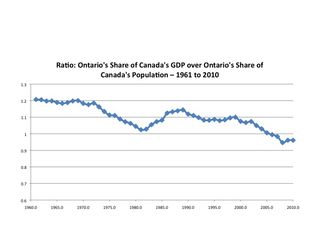
That is a really good idea – thanks very much for the suggestion. Down below, I have taken the numbers from 1961 to 2010 and used them to plot a graph showing the ratio of Ontario's Share of Canada's GDP/Ontario's Share of Canada's Population. What I find interesting is that it appears that a downward trend in the ratio over the period 1961 to 2010 is quite pronounced in this graph – more so than when Ontario's share of GDP is considered on its own. There is a recovery of the ratio in 1980s (though not to the level of the 1960s) but starting in 1989, a downward trend resumes and continues pretty much unabated. While there are still fluctuations, one has to conclude that over a fifty year period, Ontario's share of population has increased faster than its share of GDP. Again, the productivity implications are worrisome.


 Worthwhile Canadian Initiative
That’s a pretty sharp inflection point in 1980. Any idea why?
D’oh. Just went and looked at oil prices. That’s the oil shock. Presumably that is when Alberta got its streets paved with gold, relative to Ontario.
This seems highly correlated with high oil prices. It worsens in the 2000’s as oil prices rise too. Which makes sense as Ontario has a similar economy to neighbouring northern US States with manufacturing bases and service economies, not resource-based Alberta.
Oddly enough, there’s a downwards trend that starts more or less with the signing of the Canada/US free trade agreement in 1988….
The graph bottoms very close to 1, and has indeed flattened since crossing that line in 2007, which suggests that Ontario has simply gone from being Canada’s superstar to being Canada’s average.
While this is a relative decline, the answer can be as easily attributed to better productivity outside of Ontario as worse productivity within it. As others have pointed out, Alberta’s terms of trade seem to have a major impact on Ontario’s relative productivity.
A BC Alberta comparison would interesting too. Since I believe 2001 Alberta has had a larger GDP than BC even though BC still has a higher population. A Quebec Ontario comparison would also be worthwhile as Quebec has historically had similar economic development patterns as the New England states which recovered enormously due the growth of high tech industries since 1980(My sense is the same thing is happening in QC but at a much slower rate) whereas the Midwestern States that Ontario has historically been similar to have declined in relative share of the US economy since 1980 after growing much faster than NE in the earlier part of the twentieth century
Useful, but since productivity is measured in dollars, the price of oil varies in dollars, and the comparison (simplistically) a function of how much Alberta is getting for its oil, does this really tell us that Ontario’s productivity has been declining? Or that it has roughly been growing in trend with the rest of Canada, after correcting for oil prices?
Here’s a way to picture that may compare – how about doing the same graph for Alberta, add oil prices in to this graph? Possibly then the same graph for Alberta and Ontario with a regression against the price of oil.