Looking at only one province’s share of GDP and population over time is probably not enough given the immeasurable majesty of the Canadian federation. It is time to expand the analysis to take all the other provinces into account to gain insight on the evolution of the Canadian economy.
What I’ve done below is gather data on population and GDP for all ten provinces for the period 1981 to 2010. I calculated for each province, its share of population and its share of GDP and then took the ratio of the share of GDP to the share of population. The results are plotted in two graphs: one for Quebec and the east and the other for Ontario and the west.
Figure 1

The results show Quebec declining slightly over the 1981-2010 period while PEI, Nova Scotia and New Brunswick climbed a bit during the 1980s but have since stayed stable. The really remarkable one is of course Newfoundland & Labrador, which has seen an Alberta-like rise in its ratio. The next graph shows Ontario and British Columbia declining overall during the 1981 to 2010 period (with some fluctuations in between) while Manitoba has stayed generally flat. As for Alberta and Saskatchewan, they both show a decline until the late 1980s and then their ratio begins to soar.
Figure 2
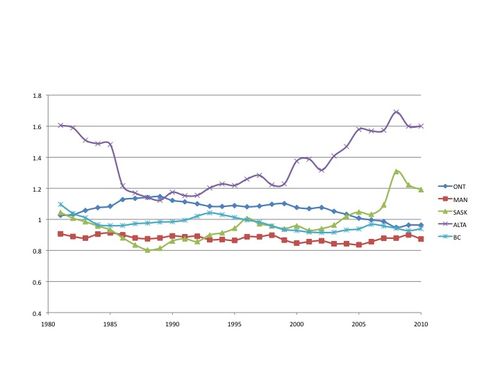
The common link between Alberta, Newfoundland and Saskatchewan is the upturn in oil, potash and commodity prices, which has supercharged their GDP growth. British Columbia, despite also being a resource-producing province, has had the wrong resources for this time period (no oil or potash), but that could change down the road. An upturn in lumber markets and rising demand for mining products could boost the economies of both BC and Ontario (its North is the target of much prospecting and potential development) which in turn could fuel an upturn in their ratios. Interestingly enough, Nova Scotia, which has also benefitted from oil recently has not experienced a performance similar to Newfoundland. And Manitoba, despite rising food prices, has also remained a fairly ‘steady as she goes’ performer.
Anyway, it looks like the resource boom in energy prices has certainly been a key factor in the recent shifting distribution of GDP across the Canadian federation particularly as can be seen in the recent shift towards Alberta, Saskatchewan and Newfoundland & Labrador. If Ontario is indeed in some type of decline, it has some company from Quebec and British Columbia. On the other hand, if it is all due to a resource price effect then it is really not a decline but a response to current market conditions and prices for Canadian resources. Another interesting question is why Manitoba has not done better. Of course, we then come down to the ultimate question. Despite all the talk about the shift to a knowledge economy, is Canada fundamentally still dependent mainly on natural resources for its long-term prosperity and if so does that really matter as long as we can be prosperous?


 Worthwhile Canadian Initiative
Harald Innis identified this trend in Canada over 80 years ago. We’re still a fundamentally resource-based country. This makes the national economic very open to resource shocks and boom and bust cycles. It’s getting even worse, considering the sheer amount of fixed capital (hundreds of billions of dollars worth) invested in oil sands infrastructure. Alberta should be trying to use their oil wealth over the next few decades to try to create an economy that’s no so dependent on oil, but I don’t see any evidence of the political will to do that.
Livio, how much does population aging explain the BC and Quebec trends?
I’m trying to work out the effect of migration and immigration on all of this.
It’s interesting that the non-immigrant receiving provinces, PEI, NS, NB, have done relatively well, compared to big immigrant destinations such as Ontario, BC, Quebec. But then again, the economies of PEI, NS, NB are generously subsidized by the big immigrant destinations of Ontario, BC,….
If people figure there are more jobs in BC or Ontario than in NB, then they’ll move west, and I’m wondering if there could be some kind of over-shooting?
Kathleen Day and Stan Winer have done some nice work on interprovincial migration.
Ontario peaked in 1988 – which tells you something – FTA came into effect the next year. Ontario seemed to improve in the late 90s – the auto sector and high tech before the meltdown, I guess.
I assume that this leaves out transfer payments/equalisation. I also wonder about the impact of immigration on Ontario at a time when the Maritimes seemed to be prospering – though if you look at unemployment rates you see that the rural areas in the maritimes are still doing poorly but the cities in NB and in particularl Halifax in NS are healthy.
Mulroney changed immigration policy, particularly around 1990. In Trudeaus last years, immigration dropped below 100,000 for several years, as immigration was tied to unemployment, but since 1990, it has always been well over 200,000 per year. The city of toronto has a data file in exccel at http://www.toronto.ca/invest-in-toronto/labour_force_overview.htm – prior to 1990, the unemployment rate in toronto was always well below the national average, but it skyrocketed in the early 90s, and in the last few years as well, so that the GTA instead of being fairly stable and with low unemployment now has higher unemployment and the unemployment rate is highly volatile depending on the overall business cycle.
I find the shift to natural resources/staples to be particularly worrying, as it does seem like we ar emoving backwards. Plus, with increasing foreign ownership in those sectors – mining as well as oil and gas, it means that if prices go up, other than any gains in employment, the profits won’t stay here. Plus we face declining returns as resources become scarcer and more difficult and costly to extract.
What will happen to NL when the oil runs out… and what will happen to Alberta if it ends up with 6 or 7 million people, and eventually conventional oil and gas runs out and even the tarsands become undesireable or uneconomic due to rules relating to carbon emissions!
I’m still confused about whether the cdn financials are good bad or even. That’s 40% of profits. Probably more is natural resources. Much of the inefficencies of CPC corporate tax rates could be undone by an Auzzie style resource tax. Of course would be attacked. The logic is financial companies use leverage de facto. This has been demostrated (maiming GOP and global affiliates) to be risky enough to not function optimally under a 0% corporate rate. IDK what % of resource extraction is technology, but likely much of it is simple land rent, that should be taxed and can be neutral if revenue applied to other wealth-generating industries. Que has companies that plate metals; tax miners more and them less (at least for innovations). Turbines can be made without using rare earth metals; here you could tax copper mines more and give them or someone revenue for lower metal footprint blueprints. If I prospect and develop a Potash mine in MB I should be taxed, but incentived if revenue to fertilizer-fixing crops. Why did AB combine methane and oil and tar administrative approval. Considering the lifetime of a mine, isn’t it delusional to ignore carbon pricing over a mine R+D lifetime?
btgraff: “What will happen to NL when the oil runs out…”
As a follow on – do equalization formulae and the political tinkering with programs like EI dissuade provinces like NL from creating future countercyclical fiscal room by running up surpluses in good times, because this erodes support in Ottawa for continuing support long enough to achieve sustainable fiscal balance?
Frances: Demographics and migration certainly may be factors. I do have some data on proportion of population over age 65 that I am using for some health related research. What is interesting is for the period 1965 to 2008, the average percentage of population aged 65 and over is 11.6 for BC, 10.0 for Quebec compared to the provincial average of 11.0 percent. Alberta has the lowest average proportion of population aged 65 and over during this period at 8.3 percent while Saskatchewan and PEI have the highest at 12.7 and 12.5 percent respectively.
Could the rise in resource prices be partially responsible for the decline of non-resource rich provinces via a dutch-disease type effect? It would be my first reaction. There is an ungated paper avaliable here: http://www.economie.uqam.ca/pages/docs/Beine_Michel.pdf which I haven’t had time to read but I thought I’d throw it out there.
FTP:
“We show that 63 percent of the manufacturing employment loss
due to exchange rate development between 2002 and 2007 are related to a Dutch disease
phenomenon. The remaining 37 percent can be ascribed to the weakness of the US
currency.”
Great charts Livio, thanks for posting them!
(a small nit-pick, the two figures have different scales for the y-axes. At first glance it looks like Nfld has as much GPD share/capita as Alberta, and then I noticed the scales are different).
Can I conclude that Nfld per capita GDP is higher than that of Ontario?
Does this mean that Nfld has a higher per capita real income than Ontario or do foreign workers and foreign capital drain off some of the income?
Ontario still makes up a remarkbly high percentage(almost 40 percent) of Canadian economic activity compared to other regions of other federations/federal states. California for example only makes up 7 or 8 percent of US GDP while NSW in Australia makes up around 20 percent. I suspect this causes a lot of the “big bad Ontario” feelings in Canadian politics even though Ontario’s share of GDP has gone down over the years.
BC is an interesting case too. Since about 2000 Alberta now has a larger economy even though Alberta has fewer people. One observation I have heard from the likes Jack Mintz is that uniquely in Canada BC is becoming a retiree/service sector/real estate driven economy akin to US sunbelt states. While there is a possibility of forestry prices recovering I think many in BC view forestry as being in terminal decline. BC does have significant oil and gas reserves but there are all in Northeastern part of province which is much more economically tied to Alberta than Vancouver and the Lower Mainland.
You know, when I look at how high newfoundland is compared to other eastern provinces, then it makes the obvious flaw in this analysis stand out.
This is based on GDP, not GNP.
So yes, Newfoundland does have a high GDP, but then much of that flows out of the province in income paid to the oil companies that have invested so much in Hibernia. The same is true of Alberta to a lesser extent. And also, much flows out in terms of provincial government debt service too.
If Canada was a country full of wealthy investors, then income would be flowing in and GNP would be higher than GDP. This is a flaw of using GDP, it ignores the cumulative impact of foreign investment, or of governments and industry borrowing money from foreign sources.
And this is a problem we fail to recognise – look at our balance of payments history (according to the B of C) and more money flows out of this country than flows in – we need to run a trade surplus just to pay for that, or else we end up borrowing more or selling off more of our assets in order to fund imports of consumer goods, digging us even deeper into the hole.
Buying consumer goods from others, while they in turn only buy up our assets, is no way to prosper – remember that in comparative advantage, the assumption is no flows of capaital, but essentially pure barter rules. And so, even if commodity prices increase, we won’t benefit if the income just flows out to the owners and all we get is the money from some crummy jobs.