As an economic historian by training, I’m always aware of the unique ground straddled by practitioners of the cliometric craft. We are economists by training and in terms of many of the questions we are interested in, but much of our research focuses on collection and analysis of primary sources.
Case in point, my own work using census-linked probate records to study nineteenth century wealth and lifecycle behaviour. We are also historians and often focus on institutions and the evolution of processes over time. Straddling the middle ground between economics and history, one might think some type of academic Hotelling Law would kick in and more researchers would flood into economic history from both economics and history. Yet, quantitative economic history or cliometrics has grown to be a relatively minor part of economics and it has also been in retreat in history departments over the last thirty years.
The summer 2011 issue of Social Science History has a special section titled “The Past, Present and Future of Economics for History,” which was inspired by a session at the 32nd Annual Meetings of the Social Science History Association which featured an interdisciplinary exchange between the panelists – mainly economists who do economic history – and the more diverse audience. The essence of the debate was whether or not there could be more collaboration between historians and economists. Rob Whaples argued that involving historians in economic history was problematic not just because of their minimal understanding of economic theory but more importantly because of their actual hostility to the dismal science. Philip Coelho and James McClure argued that the divergence between historians and economists is fueled by the preoccupation of economists with models and theory rather than empirically testing new ideas with data and the fact that historians in general are not partial to the idea that universal models can describe human behaviour. At the same time, the historian view that economists are not empirical seems to be odd for an economist and may have more to do with what historians view as empirical work given their lack of statistical training.
All of this seems to me a puzzling situation. Economic history seems fundamental to understanding the evolution of economies and policy and yet its study has been deemphasized both in economics and history. The recent fiscal crisis seems to have highlighted the importance of institutions and their evolution over time but there has not been a spark in interest even in terms of student enrollment in economic history courses. I was always of the view that economic history was in the middle between economics and history and therefore should over time have more practitioners move to the middle ground. (See Figure 1).
Figure 1
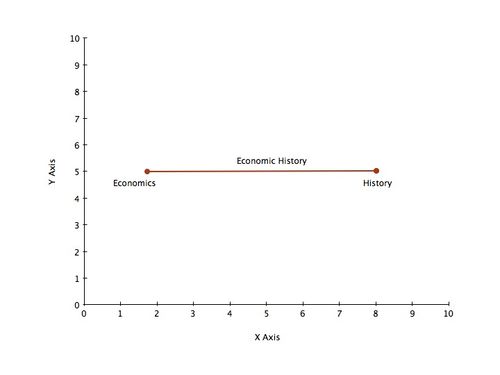
But perhaps I am mistaken and am simply guilty of linear thinking. I was assuming some type of uniform distribution of interests across the line that provided an advantage to moving to a middle position. Perhaps economic history is not really a middle point on a straight line but a border area around the two disciplines with some overlap at the intersection between the two disciplines (See Figure 2).
Figure 2
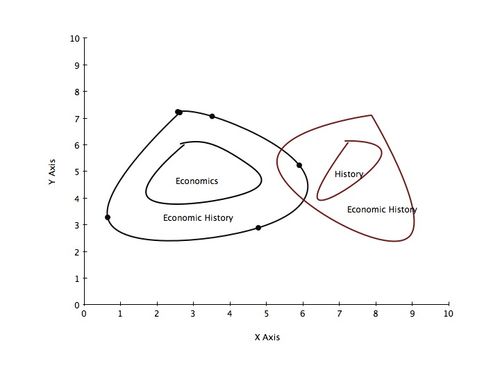
Economic history is a border region for economists but historians who do economic history are also in the borderland of their own discipline. Thus, the interface between historians doing economic history and economists doing economic history is not so much the middle of a linear process but a small overlap of border areas surrounding two disciplinary cores. This would suggest the scope for interaction is limited indeed and depending on the direction the two disciplines move over time liable to shrink even further.


 Worthwhile Canadian Initiative
I like your Figure 2. What I think it illustrates also is that the core skills a student needs to be a good economist or a good historian may be very different, and only a very small subset of the population is good at both. For example, I enjoy history, and think it’s important. But I’m just really bad at it. I’m reading a book on the Anglo Saxons now, just for fun, but I keep getting hopelessly lost and confused with all the names, even though it’s a book aimed at the general reader.
I think, in every field, studying the history of that field should be required training. In some philosophy departments, you have “history of philosophy” positions, etc. A friend of mine is a medical doctor who also got a PhD in the history of medicine, and now teaches history of medicine.
I would draw a big bubble called “economics”, and within that bubble I would put a smaller one called “History, of”.
Then I would draw a big bubble around history, and put a smaller one called “of, Economics”.
That would be the appropriate meeting ground, where an economist with a specialization in history or a historian with a specialization in economics could hold the same position, and economics students as well as history students would be required to learn some economic history.
Perhaps the disciplines don’t like to share the same turf? Perhaps there is something about not playing well with the other social sciences.
After many years as macroeconomist, my feeling is that “a sense” of history is necessary for not to commit many mistakes.
We hear that economics historians have been the first in seeing the crisis.
But a “sense” of history is always very subjective.
The last history book I´ve just read has give me a profound vision of the interwar period: “Paris 1919”, by Margaret MacMillan. It is not an economic book, but absolutly necessary to understand the economy of the period.
Many economic facts are due to political decision no related to the economy. Perhaps the history give a sense of imperfectability of human actions, a sense of “unintended consequences” not contemplated in the pure economy.
“…but there has not been a spark in interest even in terms of student enrollment in economic history courses.”
I just graduated from Carleton University. I’ll be pursuing a graduate a degree and a condition to my admittance to the program is ECON 1000, which I am taking this summer. I would love to learn economic history – be it the history of the field in general, or the economic history of Canada, etc. I like to think I’m not alone, and from what my peers tell me they would be interested in taking such courses too. Unfortunately, Carleton doesn’t seem to offer any courses in economic history. On the undergraduate calendar there are a few mentioned but they aren’t being offered either in the summer or for the academic year of 2011-2012.
I would normally say that students like myself should be creating the demand for these courses, however, most undergraduate students don’t know a thing about their field and as such they would hardly understand the importance, relevance, or interest in studying economics from a historical perspective. Having completed the first semester of ECON 1000 today, I cannot recall any significant attempts at introducing students to economic history (a part from naming some economists and how or why they came up with a particular theory).
Maybe pairing excerpts of Adam Smith, David Hume, Friedrich Hayek, Milton Friedman, Ricardo (forgive the order I put them in) and the like with some of the readings from the text would help to contextualize economics within a historical framework and expose students to another way of approaching their studies of economics. Having read these authors I know some of their work can be difficult, however, some passages are very manageable and can expose students to the historical paradigm or rationality that developed an economic theory or idea. I could be wrong though…
My point: I really don’t think the onus is on the students to develop an interest in studying economic history because, especially as an undergraduate in his/her first year, we know very little. How is a recent high school student, who has probably never been introduced to economics, supposed to have an interest in studying economics from a historical perspective? In my respectful opinion, expose students to economic history earlier in their degrees and demonstrate to them how powerful and useful it is and then the interest and demand for such courses will follow. This could start as early as ECON 1000!
As an econometrician I find that our students have a very real interest in the history of this sub-discipline. It seems to bring the subject alive for them. That’s why I often include a bit of history in some of my econometrics blog posts at davegiles.blogspot.com
Of course it brings the subject alive! That’s why I love history. Why settle for fiction when fact is better?
Seriously, particularly in Macro history matters, a lot. If you want to understand Keynes and why macro evolved the way it did, you need to understand history. That’s why if you scratch the surface of macro you get politics.
I find it useful to provide some historical background whenever I can, because that’s usually the best way to motivate why a certain theory or model was developed: to address a real, pressing problem.
At our five-year reunion,almost all of the guys in our promotion who had gone into pure econometrics told us they had only one regret: not having done Economic history and History of economic thought. Too busy doing Analysis IV and graph theory, they realised how true Fortin’s principle (“No equation without behavior, no behavior without equation”) was. They had understood too late how they didn’t had a clue about what they were modeling.
We are currently seeing the sad results of not knowing history.
Where do economics and history cross the most?
IMO, wealth/income inequality and debt.
I don’t mean to derail, but I went and read some of the discussion to which Livio refers and am baffled by the comments of the economists rather than those of the historians. Consider the quote below. Coelho and McClure (who are economists!) contend economists “offer no quarter to quantification” and avoid “real-world data.” I’m not going to bother arguing against that shockingly wrong claim, but I understand the hostility that some historians apparently display towards economists a little more given economists are telling them the outrageous falsehood that economists “offer no quarter to quantification.” (The cited paper, incidentally, documents the fact that the phrase “lemma 1” has become more common in the post-war period, it of course does not demonstrate economists avoid data.)
The second paper in the session, by Philip R. P. Coelho and James E. McClure,
argues that “pure” economists have also gravitated toward theoretical discussions
that offer no quarter to quantification. What the authors show in their essay,
“Lotta Lemmata: A Sour Harvest,” is that the most prominent economists and economic
journal editors have shown little interest in empirically testing ideas with
real-world data. Mathematically complex lemmas—“proposition[s] assumed or
demonstrated which [are] subsidiary to some other” (Oxford English Dictionary)—
that are unlikely to be modeled or tested with real-world data have
come to dominate top economic journals. What are apparently valued are
“elegant,” “original,” “imaginative,” “innovative,” or “suggestive” models
that ignore the “ugly facts” presented by real-world data.
Good lord. Apparently applied econometricians don’t exist.
poofs in a whiff of smoke
I knew Stephen Gordon was just a figment of my imagination. 😉
Perhaps part of the problem is that cliometrics should be viewed as a subfield of economic history rather than as equivalent to the field itself. Those who believe that many of the most important economic history questions can’t be addressed by quantifiable data — either because it is unquantifiable, or because it is uncollectible, as in part of private collections that are lost forever or simply inaccessible — are interested in economic history questions that (horror of horrors) cannot be tested properly.
Economics…we often ignore the simple reality that we all want a piece of the pie, unfortunately some people want a bigger piece.