On a recent visit to a small Bulgarian town, I was struck by the gardens. There were no lawns or hostas. Instead every inch of every garden was planted with fruit and vegetables.
To me, this is an interesting topic. Why are Bulgarians so much more prone to vegetable gardening than Canadians?
Yet how can that topic be turned into a research hypothesis?
Research can describe people's behaviour, explain people's behaviour, or both.
Economic descriptions involve painting by numbers. What percentage of Bulgarians have gardens? How much is produced in these gardens? What is the value of that output? The web abounds with data; good sites include the World Bank, the United Nations Human Development Report, Eurostat, World Values Survey, the International Social Survey Programme, the US Census, and many other sites listed here.
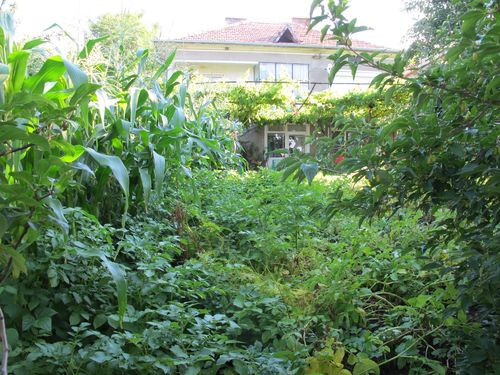
Unfortunately I couldn't find any numbers for "own account production" or "subsistence agriculture" or "home-grown tomatoes per capita" in these databases, but I didn't look very hard. Still, that doesn't mean the information is impossible to obtain. Google Earth provides satellite views of every place on earth. It's certainly possible to use Google Earth to detect backyard swimming pools; using it to detect backyard tomato plants might be more difficult.
Describing the world is a legitimate research enterprise. There are numerous papers that do no more than, say, describe the distribution of income or the amount of poverty within a country. Bulgarian incomes are low enough that the value of household production could make a significant difference to measured poverty rates, especially in rural areas. Documenting this would be a contribution to knowledge.
But explaining the world is much more fun.
Economic explanations — at least the micro ones – are based on the idea of individual choice. The first step in turning an interesting topic into a research hypothesis is to:
1. identify the choice that is being made. Who is choosing? What is being decided?
In my example, people are choosing to grow vegetables rather than hostas.
But what if you're studying something like unemployment, and you're thinking "but people don't choose to be unemployed"? There are always alternatives: Moving to where the jobs are. Crime. Upgrading skills. Perhaps you might need to look around to find someone who is making a choice, for example, firms are choosing whether or not to hire workers. If you can't identify a choice that's being made, you may have to stick with description, or take a macro-economic approach.
Once you've identified a choice, the next task is to explain it. Economists typically explain choices assuming as little as possible about people's preferences. A bad explanation of the popularity of vegetable gardening in Bulgaria would be "Bulgarians like vegetable gardening" or "it's their culture." These are non-explanations, because they assume (a taste for gardening) what they attempt to explain (gardening). A good economic explanation takes a very general view of people's aspirations: as much of the good things in life as possible – consumption, other pleasures – at the minimum possible cost.
Within this general framework — maximize benefits, minimize costs — people's actions can be explained in terms of the costs that they face, or the benefits that they enjoy. This is step 2:
2. Identify people's objectives, goals or aspirations, and the constraints that they face. One way to think about this is in terms of the benefits and costs of actions.
Gardeners, like everyone else, are trying to get as much consumption, income and leisure as possible. But they are constrained: by the number of hours in a day, by their ability to earn, by their stock of vegetable-growing assets.
An identification of objectives and constraints, benefits and costs leads to the next step:
3. Identify the economically interesting trade-offs being made
Trade-offs follow directly from benefits and costs. In the vegetable growing example, choosing to garden might involve trading off two benefits: leisure time versus home-grown tomatoes, or market income versus home-grown tomatoes. Another trade-off might involve incurring costs to obtain benefits, for example, weeding to get vegetables, or incurring one set of costs rather than another set, for example, picking off insects by hands versus buying insecticides.
It is a short step from identifying trade-offs to explaining people's actions. Why do some people garden and not others? Because they face different trade-offs. A person with a low market wage rate, ample time, knowledge of how to garden, and a garden full of fertile soil can grow vegetables at a low cost. A person with higher wages, little free time and poor soil gives up more to get a given quantity of home grown tomatoes. There. That explains why some people grow vegetables and others do not.
By this point, you've got yourself an economic model: individual [insert 'who' from step 1 here] choose [insert what from step 1 here] in order to maximize [objectives from step 2 here] subject to [constraints from step 2 here]. The trade-offs correspond to the first order conditions of the utility maximization problem. Easy. You're ready to take off, in any one of a number of different directions:
4a. Estimate the model.
A decrease in the price of store-bought vegetables decreases the benefits of growing one's own, and would be expected to lead to a reduction in the amount of vegetable growing. But how much? With data on home produced crops and local grocery store prices one could, perhaps, find out.
Much of applied microeconomics is devoted to precisely this type of model estimation. How much does labour supply change when wage rates change? How does fertility respond to a change in the price of children? Does experience-rated automobile insurance create incentives to hide accidents?
4b. Include strategic interactions between agents.
In many situations, one agent's optimal choice depends upon other agent's optimal choices.
For example, while in England this summer, I spent time time picking blackberries with family. After we'd picked more bowls than we could possibly consume, I asked "What will you do with all these blackberries?" The answer "We give them to the neighbours either side, who give us runner beans and tomatoes in exchange."
Neighbourhood reciprocity increasing the value of home grown produce – that's the kind of strategic interaction that gives a model some pizazz.
The types of strategic interactions possible are rich and varied, particularly with small groups of agents, for example, duopolists, oligopolists, principals and agents, and so on. Indeed, entire branches of economics – game theory, industrial organization, to some extent trade – revolve around the strategic interactions between economic agents.
4c. Rev it up with informational considerations.
People with low wages give up less when they choose to devote their time to growing zucchinis. But everybody knows that. Hence growing zucchinis advertises, signals, that one has a low wage rate.
If signalling is important, then we might expect towns to switch between all-vegetable equilibria, where everyone attempts to signal their vegetable-growing prowess, to all-lawn equilibria, where everyone pretends they are too busy and affluent to grow their own vegetables. Except perhaps a few herbs for gourmet cooking.
Signalling, adverse selection, and moral hazard all all examples of informational considerations add complexity and richness to an economic model, and can amplify the effects of small changes.
And no matter what kind of model you're working on, figuring out who knows what, and when is a crucial part of economic explanation.
This research recipe is one that I've made up, and it has not yet been tested. Please try it and let me know how well it works. If you have your own successful research recipes, please share them in the comments below.


 Worthwhile Canadian Initiative
“If you can’t identify a choice that’s being made, you may have to stick with description, or take a macro-economic approach.”
On behalf of all macroeconomists: Ouch!
Nick – the truth is that you understand micro, but I don’t understand macro, and this asymmetry really bugs me.
But the recipe I’ve given wouldn’t work for macro, would it? How do macroeconomists explain the world if they don’t start with individual choice? We can agree that assuming that the economy as a whole acts like one big rational individual is not helpful, can’t we? So is there some kind of fundamental buiding block, some kind of core shared by all macro models? Or is a matter of figuring out what tribe one wishes to pledge allegiance to (the monetarist tribe, the Keynesian tribe, … ) and taking the building blocks that belong to your tribe?
Frances: (Most) macroeconomists understand (some) micro — at least, up to a point. Because we have to. Most microeconomists don’t need to understand any macro. So they don’t, unless they teach it in first year, or remember it from their grad-skool days, or just feel like it.
Macroeconomists can (at least try to) start with individual choice, and then put it all together into some sort of equilibrium. Yep, different tribes make different assumptions and have different sorts of equilibria. So you need to pick a tribe.
I think your post works fine for macro as well as micro.
What are grocery prices like in Bulgaria compared to Canada or the UK?
A bad explanation of the popularity of vegetable gardening in Bulgaria would be “Bulgarians like vegetable gardening” or “it’s their culture.” These are non-explanations, because they assume (a taste for gardening) what they attempt to explain (gardening).
I’m not sure that those are inherently “bad” explanation. They’re not economic explanations, but that doesn’t make them inherently bad explanations if they’re true. If Bulgarians are pious and grow vegetables (rather than flowers) as a tribute to St. John (Ivan) of Rila, the Patron Saint of Bulgaria (seriously), saying that ‘it’s their culture” is a actually a good explanation of why they grow vegetables rather than flowers. Of course, you might have to do some digging (no pun intended) for evidence to support that explanation (and, if that explanation were true, the evidence supporting it would probably be pretty interesting) rather than assuming it to be true, but that’s no different from any other explanation, economic or otherwise.
Indeed, in the foregoing (perhaps unlikely) example, an economic inquiry as to why Bulgarians garden the way they do might be a fruitless exercise (again, no pun intended) since it would likely fail to capture the (or a) true, non-exonomic, explanation for why Bulgarians garden. Mind you, it might still be able to offer valuable insights into particular aspects of Bulgarian gardening (i.e., why they grow Zucchinnis rather than Tomatoes or why the apparent piousness of Bulgarians, reflected in the size of their gardens, increases when times are tough). Moreover, no doubt economic historians might apply their tools to explain why St. John of Rila grew vegetables (if he did) or distained the growing of flowers (again, if he did), forming the basis for modern Bulgarian beliefs.
OK, I don’t know why Bulgarians grow vegetables rather than flowers in their front garden, but as a I child growing up in Toronto I was always struck by how my Italian neighbours would grow tomatoes and peppers in their front lawns, while their WASPy neighbours would grow grass. No doubt there may be (or may have been) an economic basis for the practice (for example, when those families first came to Canada, perhaps growing tomatoes and peppers was a means of economic survival – although by the time I was born, most of my neigbhours had been in Canada for decades and were doing quite well economically), but I’m equally certain that there was a cultural basis for it as well, namely that many of my Italian neighours (or their parents) had immigrated from agrarian regions of Italy where their families had grown tomatoes and peppers and liked tomatoes and pepers and enjoy growing (and eating) fresh tomatoes and peppers more than did their WASPy neighbours.
Reading Bob’s story, especially of Italian immigrants in TO, makes me think “Human Capital?” “Signalling? (but what?)”
Dimitry Orlov’s take: many people in the former Soviet Union turned to gardening because the central planners couldn’t manage to get edible fruits and vegetables to the grocery stores, and it served them well when it all collapsed in the ’90s.
So I wonder if it’s a legacy of communism in Bulgaria?
Bob – I don’t grow much in my garden (because it’s small and urban and shaded), but this is what I grow: mint, sage, basil, rhubarb and gooseberries. In addition there’s a tomato plant and a cantaloup that have sprung up spontaneously from the compost.
I suspect your Italian neighbours grew vegetables for much the same reason as I grow gooseberries – the variety/quality you would like to have are simply unobtainable commercially. And, yes, the types of herbs and vegetables that you use in cooking is a part of culture.
The signalling story can work in different ways. A magnificent vine laden with grapes can be signal of skill and good husbandry, of having a large family and lots of friends and thus a large quantity of wine consumption. Or it could be a signal of economic hardship, of inability to afford to buy wine. Perhaps culture and economics determine how signals are interpreted and amplified? That would be an interesting story.
Patrick “legacy of communism”
Under the communist system, people had very limited opportunity to accumulate assets, but could rely upon the state for support. Anyone born before, say, 1960 lived a good chunk of their working life (until 1990) under communism, and then another 5 years under the extreme austerity of the early 1990s. So everyday working folks in that age group – and especially pensioners and retirees – have very little assets of their own. But government pensions are meagre – IIRC, a state pension would be about $60 a month or so, hardly enough for subsistence.
So in as much as communism+collapse has created a generation of impoverished pensioners then, yes, it’s a legacy of communism.
I don’t know how the Bulgarian food distribution system compares with countries at a similar level of economic development (upper middle income) and no legacy of communism. But Bulgarian communism was close to Russian communism than, say, Polish or Hungarian communism due to the close historical and cultural ties between the countries (Drat! Another cultural explanation!)
Ah, so given a large population living hand-to-mouth or who recently lived hand to mouth, it seems likely that those who could would plant stuff they could eat. And I suspect that even as living standards improved, there would be a sort of inertia to changing a practice that worked during hard times (learned risk aversion? form of hyperbolic discounting?).
Patrick, yup, and there’s feedback effects. No good veggies in the supermarkets (or no supermarkets) implies people grow their own implies low demand for bought veggies implies no good veggies in the supermarkets…
By the way, it was all lawns, as far as I could see, in the nouveau-riche gated community where we were staying, just outside of Sofia, but there were also a fair few non-Bulgarians living there, and being up in the mountains the soil was probably poor.
Livio: “What are grocery prices like in Bulgaria compared to Canada or the UK?” We didn’t go grocery shopping, but we were told the availability of produce in the off-season is very poor. It’s basically a matter of preserving your own peppers, tomatoes, fruit etc or learning to love cabbage.
Prices of clothes, shoes etc were much better in the UK than in Bulgaria. Other than local stuff (lavender, pottery) we did no shopping. Beer, though, was about 90 pence ($1.50) for a pint glass of excellent lager. Restaurant food was somewhat cheaper than in Canada. People were thrilled with small tips.
I don’t think you could tell a “signalling” story, at least not in this context, without the cultural/contextual background. I mean, maintaining a nice green law as a signal of your affluence is an interesting story, but only if you assume that signalling affluance is something that people want to advertise. That’s probably a fairly safe assumption in North America, but might not hold in another culture (say, Japan).
Moreover, even in North America, that might not always be a safe assumption. For example, a person living in a “bad” neighbourhood may be less incline to advertise their affluence than someone in a “good” neighbourhood. Growing up, the nicest house on our block was always the one broken into by the local ne’er-do-wells. For that reason my father always refused to renovate/repair the front porch on the grounds that it discouraged thieves (although my parents have otherwise done extensive renovations to the backyard and the interior of their house, the front still looks terrible). Our house was never broken into. In contrast, out in the ‘burbs, where I live, some of the locals have no qualms about leaving their Hummers out in the driveway (a sure fire signal that (a) they have more money than they do brains and (b) they aren’t terribly afraid of advertising that fact to their neighbours). It might be an interesting story to see how the frequency of some common outward display of affluence – once upon a time I would have said satellite dishes, though that’s obviously less meaningful these days – in houses varies according to the local crime rate.
More seriously, in the US, I know there has been an interesting discussion of the varying interpretations of “acting white” (i.e. taking school seriously) by different groups (i.e., employers – good /peers – bad) and the effect that those interpretations have on the educational attainment of African American students. That’s a tale of one signal and disparate interpretations by different groups.
As much as I like economic questions …. you could have asked a couple of Bulgarians why do they grow their vegetables in their front yards ..
A few random comments to help you with cooking up hypotheses.
I grow Blackberries as well – which are still a week or two away from being ripe, so I’m jealous of your family in England. My surplus I freeze for making pies and jam later on. Should I bring you some?
Like some of your examples, I grow things otherwise hard to get or expensive commercially – herbs and hot peppers, black currants, and radishes smaller than a golf ball. I also grow stuff that’s ridiculously easy and cheap to get like beans because they never fail and help me believe maybe I can garden.
My rationale for gardening is partly risk aversion. I keep thinking it’ll help me get up to speed and be ready for self sufficiency when the big one hits – though as I get closer to 65 it will probably fade into thinking I’m ready to retire and be an old fart puttering in my garden.
And I do both the lawn thing and the garden thing. Of course having two acres to play with helps move the constraints nicely.
Jim – “Should I bring you some?” Yummmm….. Sorry, suffering from waves of blackberry-induced nostalgia. To me, that’s the smell and taste of summer. Store bought blackberries are nothing like the real thing. Hot peppers are another thing that’s really satisfying to grow, because they look so pretty. Nothing (except people) eats them. And a little goes a long way. Plus like herbs there’s a big convenience factor.
Jan – ah, I’d have needed approval from the research ethics committee 😉
I suspect that historical or ethnographic methods would yield results more interesting and more readable than a quantitative microeconomic one. Indeed, there is a very good argument for using those methods before even presuming to apply microeconomic methods because in unfamiliar territory, like Bulgaria, you are very likely to not understand the kind of situation you would understand well enough to model at home in a way that captures the key real work factors.
I am originally from Bulgaria and my answer to this discussion is very sad … unfortunately!
The truth is that for the majority of Bulgarian people this is the only way to survive.
The food is more expensive then in Canada (the meat is at least double price) and the average income is about $500. The worst situation is with the senior people – pension around $200. They cannot afford to buy food, so they also have chickens, sheeps and pigs. At this time of the year you can see a lot of people with the wood burning stove in the yard preparing fruits and vegetables in jars for the winter.
There is a positive side of all this. The vegetables are flavored and tasty and they are “organic”.
Bulgarians also produce excellent homemade liquor (brandy) from grape, plumps or apricots and very good wine .
Jenny – thanks for that comment. This is what I heard, too – that even people with reasonably middle-class jobs end up sharing tiny apartments with extended family, because it’s better to have Granny sleeping in the kitchen than to have her cold and hungry.
The senior poverty is pretty much invisible to tourists, except for the odd elderly woman begging or selling things. It was striking that even though demographically speaking, Bulgaria is a reasonably old country, most people on the streets seemed young. I’m guessing that this is because the old folks are in the villages or in the Soviet-era apartment buildings and have no money to go out.
And your comment reinforces the power of economics to explain what might, at first glance, seem like a cultural phenomenon.
Some informed and thoughtful observations from Sofia-resident Dimo Dimov via e-mail (posted with permission):
Going back to your observation that Bulgarians don’t grow lawns but food I have a number of remarks that partially overlap with the comments from the bolg but still there are aspects that have been overlooked by the bloggers. The economic drive mentioned by you and Jennie is strong indeed. But it is still insufficient to explain the whole range of factors influencing the psychology of Bulgarian people. These are:
1. The difference in quality of home made and supermarket bought vegetables and fruit. You are sure aware of that and it was mentioned in the discussion. But the weight that Bulgarians give to the quality of food is big just like the Toronto Italians mentioned. In Bulgaria similar to Italy, Greece and other South European countries good tasty food is part of “dolche vita” and is something important. Furthermore our cuisine involves a lot of vegetables and fruit as eating pattern. so the quality of these vegetables and fruit does matter. And this s a strong factor for gardening them instead of mere grass.
2. Our grandfathers were mostly farmers and we have been industrialized much later that North America. So we still find pleasure in producing own food with our own hands. It’s like growing children. Of course, this is an exaggeration but gives some idea of the feeling of satisfaction from gardening.
3. Recently in Bulgaria the topic of GMO and ecologically clean food gets more and more attention from the public. It’s been widely discussed in the media and among people. So people mistrust bought vegetables because they don’t know their origin. There are a small number of organic food stores but these are extremely expensive four-five times compared to the normal price. So again some economics in psychology.
4. In addition to the previous point there is a number of small producers that trade off their surplus in special local vegetable markets at very reasonable price often cheaper that in the supermarkets. I myself am used to buying vegetables from a local lady and know how good it feel to discuss with her where an dhow she/her family grows the tomatoes, cucumbers, papers, etc. It is a kind of psychological personal bond with the producer/seller avoiding the anonymous seller at the supermarket.
Some remarks about the presented in the blog discussion:
1. I don’t know the origin of your information about off-season non-availability of vegetables at stores, and I can argue with it. In all local/European supermarkets like Billa, Metro, Carrefour, etc. that are present in Bulgaria, you may find all kind of vegetables all year round. Of course off-season the prices are 2-3 times higher and the quality/taste is lower. But they are available. [Editor’s note: the information about food availability came from British friends who have been living in Bulgaria for a few years.]
2. The price of food is comparable to Canada. For example pork meat prices are around 5-6 CAD per kilo and chicken meat is cheaper. Same with vegetables, even now (middle August) tomatoes can be bought for 0.70 CAD per kilo. But of course the incomes here are much lower than those in Canada.
3. About Granny sleeping in the kitchen. Typically they are not accommodated by the richer young employed family members but it is vise-versa – the dwelling belongs to the Granny andd she accepts the young off-springs in order to save rent costs and to take care of their housework and of their children. It is very common that children are taken care of by Grannies for free thus saving babysitting costs. Grannies also do grocery shopping, cooking, etc. The fact that old people owe (without any mortgage) their dwellings is explained by inherited from the communist times home ownership structure. 95 % of the dwellings in Bulgaria are owned by their occupants and the credit/mortgage market is quite underdeveloped. It started developing after 2004-2005 but the present credit crunch and recession slowed or even stopped the process. As a result pensioners are poor but they owe dwellings and often more than one – one apartment on the big town like Sofia and one country hoouse in a small town or village. It is also quite common pensioners to leave their children in the town apartment and go back to the village where they grow vegetables and fruit and feed their children town. This internal migration process can be proved by the figures of the National Statistics. Also the data about dwelling ownership can be found there.
[I was surprised by this so asked Dimo to elaborate – is it really the case that the communist-era apartment buildings have been privatized and sold off to their owners? Apparently, yes. Though how they are then maintained given how low pensioners incomes are is another question…]
[On the National Statistics – according to Bulgaria Airline magazine’s interview with the Mayor of Sofia, some of the population numbers may be misstated – people live in Sofia but claim to be resident elsewhere for tax purposes. Then again, if one’s authoritative source is an airline magazine…]
If you are interested I have a lot of information about Bulgaria’s current and past situation both for the gardening related topics and for the general economics. There are quite a lot of peculiarities related to the local market of vegetables producers like the low purchase price of tomatoes imposed by kind of monopoly wholesalers and the high retail prices, the aspects of imported vegetables that compete with the local production, the aspects of the EU subsidies on the agricultural activities that we will be soon available for Bulgarian tomatoes, etc.
Dimo Dimov