The release of the 2011 Federal Fiscal Reference Tables is a good opportunity for me to refresh myself with an assortment of public finance statistics. What caught my attention this year was the evolution of the east-west divide in provincial public debt.
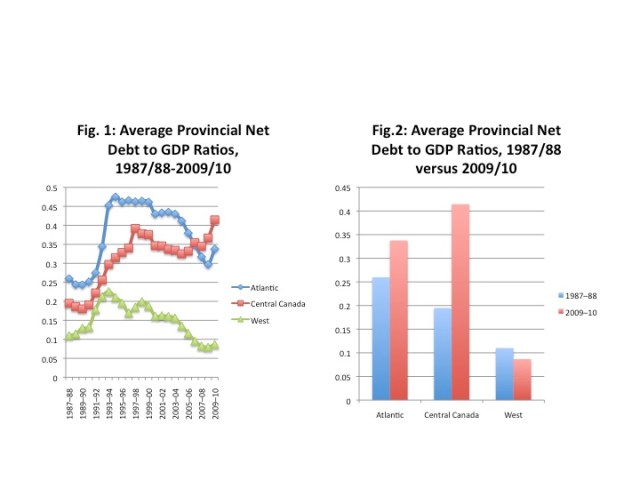
I combined the net debt estimates from the fiscal reference tables with provincial GDP estimates from Statistics Canada and worked out estimates of net public debt to GDP ratios for the provinces and then took the averages for the Atlantic provinces, central Canada and the west.
The results are interesting. First, as Figure 1 shows, average provincial the net debt to GDP ratio has been trending down in recent years in both western Canada and the Atlantic provinces. The average for Ontario and Quebec however has not followed this pattern and indeed has risen further over the last few years to surpass the Atlantic region. The west’s numbers of course are improved by Alberta with its resource saving funds, which have created negative net public debt. However, with the exception of Manitoba at a net debt to GDP ratio of 23 percent, the other two western provinces are also below 15 percent.
Second, whereas in the late 1980s, there was a definite east-west gradient in net debt to GDP ratios with the ratio declining as you moved west, it has now become more “hump-shaped.” As Figure 2 illustrates, it is highest in central Canada and lower in both the east and the west. There was an article in Maclean’s this week ominously titled “Why Ontario is poised to become Canada’s Greece” but it might have been scarier if it had included Quebec. According to the Conference Board: “According to figures released by the Organisation for Economic Co-operation and Development, Quebec is in the fifth-worst position in terms of fiscal debt burden in the western industrialized world. Only Italy, Japan, Belgium, and Greece have higher debt-to-GDP ratios." The Conference Board in its 2010 report put the net-debt to GDP ratio for Quebec at 43 percent. Quebec’s net debt to GDP ratio in 2009-10 now works out to 49 percent compared to Ontario’s 33 percent. While I don't think either province can seriously be compared to Greece, they nevertheless are in relative terms becoming the most fiscally disabled provinces in the federation. Is this a major problem? I suppose not until interest rates go up and the debt service costs start to generate a negative fiscal dividend.


 Worthwhile Canadian Initiative
Unlike individual countries, Quebec as a substantial recipient of transfers is able to operate with a fiscal capacity beyond what it’s GDP would indicate. So as long as fiscal federalism is secure, they can probably go out a bit further on a limb. Same for the Maritimes. A big if there though.
I think Ontario is implementing some reforms that ought to help with competitiveness going forward, and hopefully the dividends this pays in terms of economic growth will help it close its fiscal deficit. I am moderately worried about Ontario. Realistically though, raising the HST to 15 or 16% would close the structural deficit in Ontario, and economic growth will reduce the debt burden in absolute terms. We just need some political courage to do it before things get out of hand and bond yields rise too much.
Quebec may have a high debt load, but in the long term I’m optimistic about the province. When peak oil starts to really bite, Quebec is one of the few places on this planet where you can run a modern technological civilization entirely with renewable energy.
If Quebec is ever brought back to fiscal earth, I wonder if there will be protests or riots over heartless “austerity”.
Quebec is not alone in this. Manitoba and New Brunswick are just as bad. The only thing that will ever rescue those provinces is not demographic change, more human capital, or innovation; it is someone discovering a giant deposit of Unobtainium in the ground that will create a labor-intensive industry and jack up government royalties. That’s the only reason Saskatchewan and Nfld have emerged from the shadows of dependency, sadly. Manitoba has some faint hope in the northeast corner of Bakken, but otherwise don’t look to those provinces to improve now or in the long run.
Quebec and Ontario are Eastern Canada, please put a pinch of effort into your charts
Manitoba and Saskatchewan are Central Canada if you haven’t looked at a map lately