Nick Rowe once wrote down some simple advice about how to present an academic paper:
Presenters should concentrate on giving us the big picture: the motivation, key assumptions, the main results, and the intuition behind those results. Don’t try and grind through countless equations in excruciating detail; you won’t have time, and nobody cares (if anyone does care about all the equations, they can do much better by reading the paper).
Speak slowly, clearly, and avoid reading from a prepared text. Yes, you risk making the occasional mistake, but the audience will be much more engaged if you speak naturally, and look at them as you speak.
If you must use slides (no, it is not mandatory), use a maximum of about 5 pages, each with a maximum of about 5 lines. [In powerpoint 1 slide=2 minutes, so a 20 minute presentation should have no more than 10 slides – FW].
It always takes longer to present anything than you think it will. Aim at about 10 minutes, and you will probably find that you finish after 18 minutes. And there is no law against speaking for less than your allotted time; so if you do run out of things to say, just sit down, and allow more time for audience discussion of your paper.
It's great advice, but how does an undergraduate student presenting an empirical paper put it into practice?
Let's begin with the core elements of a presentation: motivation, key assumptions, main results, and intuition.
Motivation means "What you’re doing and why." Simple and concrete is better than vague and grandiose.
An acceptable motivation could be something as simple as: "I'm estimating the impact of religious affiliation on personal income in Canada because it interests me and no one else has looked at this lately." This is good because it is specific – there is a simple and clear statement of the research question – and because it is honest.
The key assumptions depend upon what type of research you are doing, but in undergraduate-level empirical work, four key assumptions are: the choice of data set, the choice of dependent variable (how defined, measured), the key explanatory variables (how defined, measured), and the choice of regression technique.
The Holy Grail of empirical research is causality. For example, does belonging to a particular religious group cause income to change, or is the observed relationship between religious affiliation and income due to other factors, such as ethnicity, age, language or even personality? In a serious econometric analysis, the "key assumptions" are about causality: how do you know changes in the explanatory variable are causing changes in the dependent variable? At an undergraduate level, it may be enough to say "Here are some other variables I'm going to look at in order to avoid specification errors."
The next part of the presentation is the key results. In most applied economics problems, there are only a few variables that you really care about. For example, Weber's Protestant ethic thesis suggests that Protestant values promote personal responsibility and hard work, which in turn leads to higher incomes. In this case, the key results are those that show the impact of religion on income.
Every presenter faces a basic trade-off between the number of results presented and the ability of the audience to read those results. Decide what is important, and what can be relegated to a "controls included but not reported" footnote. Scrutinize every aspect of your table, looking for irrelevant information. 32 takes up far less space than 31.984, is far easier to read, and the 0.016 difference between 32 and 31.984 is immaterial. Highlight what bureaucrats call the "take-aways" – the things you want the audience to remember – in coloured font, or in some other way.
Here are three slides (click on them to blow them up and make them legible) showing bad, medium and acceptable presentations of regression results. They could be improved further by dropping the rows containing p-values, using bold font to indicate statistically significant results, and increasing the font size further.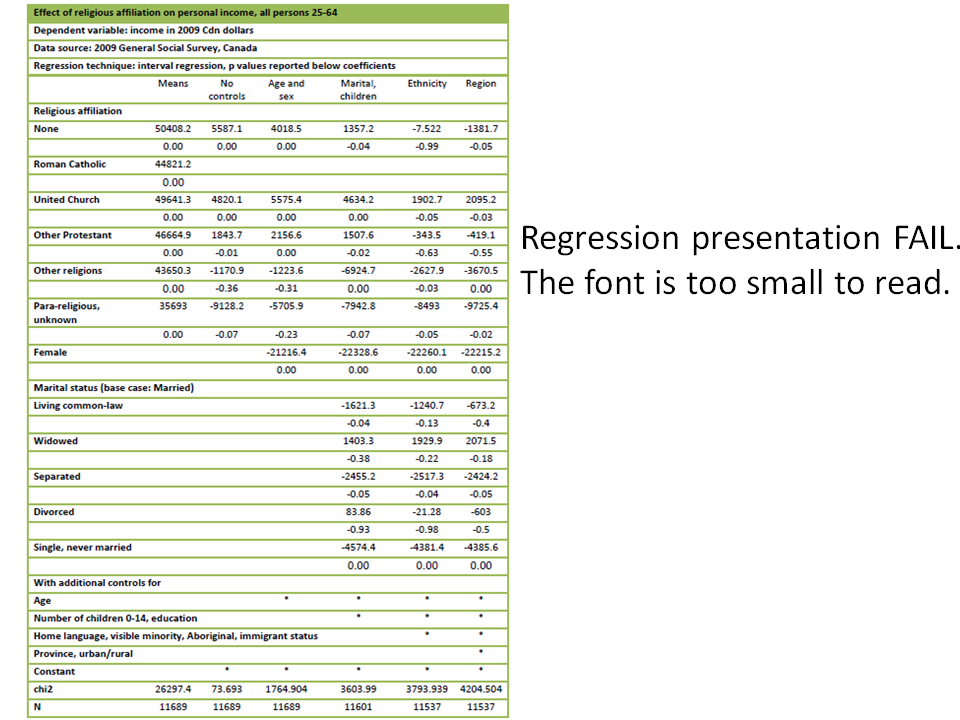

 The font size for the last slide is 14. With anything less than 14 you're generally pushing the bounds of legibility, though some suggest using this rule: "Smallest font-size used is the age of the oldest audience member divided by two."
(Formatting tip: I use estout or outreg2 to export results from Stata to Excel. Once my work is presentation-ready, I cut-and-paste the Excel tables into Word for final formatting. To make the pretty slides, I save my Word document as a .pdf file, and then use the snapshot tool to copy an image and put it in a powerpoint presentation. Cut-and-pasting tables directly from Excel or Word into Powerpoint often necessitates a lot of tedious reformatting.)
The hardest part of an empirical presentation can be figuring out the intuition behind the results. "I did a regression and this is what I got" doesn't really help. For microeconomic stories, I generally try to imagine a typical person, and think about what the results mean for them. For example, the results presented in the slides above say that a typical member of the United Church has a higher income than a typical member of the Roman Catholic church, but much of the income difference can be explained by demographic characteristics. Once controls for immigrant status, home language, visible minority and aboriginal status are added, the income premium enjoyed by members of the United Church falls from $4634.2 to $1902.7 – and we cannot ignore the possibility that there are other unmeasured demographic differences which also explain some of the remaining income differential.
Motivation, assumptions, key results and intuition are the four key elements of a presentation. With a 20 minute, 10 slide presentation, that gives you one slide for the intro, 2 to 4 for the assumptions, 2 to 4 for the key results and intuition, and one for the conclusion/wrap-up.
When it comes to how to present, I can't improve on Nick Rowe's recommendations: Speak slowly, clearly, and avoid reading from a prepared text.It always takes longer to present anything than you think it will. Aim at about 10 minutes, and you will probably find that you finish after 18 minutes. Stand up, speak up, and shut up.
For further advice on how to present a paper, I highly recommend Don McMillan's Death by Powerpoint.


 Worthwhile Canadian Initiative
Aaaaah! Such nostalgia. “My” first ever post on WCI! 5 years ago! (Actually, it was Stephen’s post, of course).
Yup, 28 November is your and Stephen’s fifth anniversary…
A suggestion for you to save a step (writing to pdf and copying from there) on your presentations by, in effect, pasting a screenshot straight from Excel/Word: Copy (from Excel/Word) > Paste Special (in .ppt) > Picture (jpg or other – some picture file types work better than others, so play around and find one that you like).
Chris – excellent idea. On my mac I use command-shift-4 (to copy part of the screen and save it as a file to the desktop) and command-shift-3 (to capture the whole screen). This site has some handy tips on how to take screen shots: http://guides.macrumors.com/Taking_Screenshots_in_Mac_OS_X.
I might add: Don’t waste time explaining what you will go over. “first I’ll discuss the motivation for the paper, then I’ll look at…” In a paper, this is useful, because the reader can skip ahead if she wants, but in a presentation it’s pointless since the audience is going to sit through the whole thing anyway.
Ignacious, I agree, especially for a 20 minute presentation.
I have to say, though, I really like the feature in Beamer that shows the total number of slides, so you know you’re on slide 30 of 45, say. It makes talks go much more quickly. I generally put slide numbers on my lecture notes because students like it, but haven’t figured out a way to show the total number of slides. So I’ve worked out how to insert slide #2, but not slide #2 of 10.
I might add: Don’t waste time explaining what you will go over. “first I’ll discuss the motivation for the paper, then I’ll look at…”
Yes! Yes! A thousand times yes!
Frances, having the total number of slides displayed when teaching is not a good idea. Whenever I’ve done this, I notice that on exactly the 3rd last slide, students start getting extremely fidgety, unzipping their bags, etc.
So add three blank slides at the end!
Excellent points. I think I’ll steal some them.
I give presentations myself, and I’ve amassed many pointers. Here’s a selection.
o Tell a story. Everyone likes a good story.
o Make the presentation idiotically simple to follow. People will not understand as much as you think they will.
o All listeners should learn something, no matter what their level of expertise.
o State the conclusions repeatedly and clearly.
o The most respected presenters are not those who bewilder their audience, but who make complicated issues clear.
o Speak loudly and slowly, as if the PA system doesn’t work too well.
o Show some life. Don’t bore the audience.
o Don’t have onions, watermelon, fizzy drinks, caffeine, or alcohol beforehand.
o Use a lazer pointer with restraint. You’re not a Jedi warrior.
o Don’t imagine the audience naked. That adding nausea to nervousness.
o Value of a presentation = Content X Clarity.
o Why do many brilliant, cutting-edge researchers become hidebound incompetents when it comes to presenting their results in a clear, imaginative, and interesting way?
When I prepare presentations for anything, I start off with the information I think I need to present…and get rid of half of it.
It generally turns out okay.
Off topic. Frances: “Once controls for immigrant status, home language, visible minority and aboriginal status are added, the income premium enjoyed by members of the United Church falls from $4634.2 to $1902.7 – and we cannot ignore the possibility that there are other unmeasured demographic differences which also explain some of the remaining income differential.”
I wonder. Suppose, just suppose, that every time you added a new control, the remaining premium fell by (say) half. In that case, I would be tempted to extrapolate out and say that there is no real difference, and any remaining difference is because we haven’t got all the possible controls in the data set. If, instead, adding each new control got rid of a smaller and smaller percentage of the remaining difference, or even sometimes made the remaining difference bigger, I would be tempted to extrapolate out and say that there is some real remaining difference due to religion.
But I can’t think of any really logical reason justifying my extrapolating out like that. And it might all depend on the arbitrary order in which I added new controls.
Is this a question econometricians think about? Have they gotten any further than me in answering it?
(I don’t really need to know, I’m just curious.)
Nick: “If, instead, adding each new control got rid of a smaller and smaller percentage of the remaining difference, or even sometimes made the remaining difference bigger, I would be tempted to extrapolate out and say that there is some real remaining difference due to religion.”
As you say, the amount of the premium that disappears when more controls are included depends upon the order in which one adds controls – and people are strategic about that, adding controls in the order that makes for a good story.
Micro data is just so different from macro data. There are literally hundreds of different variables in the 2009 GSS. If I kept on going and added in say “have you ever experienced discrimination because of your ethnicity/religion/etc” I could reduce the income premium further. I could also change the size of the income premium substantially by defining my sample differently – e.g. by looking only at people who are employed full-time, and by looking at men and women separately. Or by looking at log income rather than income.
Econometric theory is framed relative to an ideal universe where all explanatory variables are exogenous and orthogonal to each other, and the economist knows which variables are sensible to include, and which variables are not sensible to include. The real world isn’t like that. E.g. usually it’s a good idea to include dummy variables to control for differences between the provinces, since there are all sorts of differences in the economy/history/geography/demography of the various provinces which mean that economic outcomes differ across provinces. But if you were trying to estimate the impact of language on earnings, including provincial dummy variables might be a problem, because the “Quebec” dummy would soak up the “francophone” effect. On the other hand, perhaps the truth is that francophones earn what they do because they mostly live in Quebec, rather than because they’re francophone.
I’ve never seen your question answered.
But as a practical matter, the reasoning you’ve described is pretty much what I told my students to use. E.g. however the regression was specified, members of para-religious organizations, and people with unknown religion, had a big income penalty. I’m pretty sure that’s real. But members of “other Protestant” had an income premium that jumped around. Put that together with the fact that “other Protestant” is a heterogeneous group, including everyone from high Anglicans to evangelical Christians, and you start figuring – perhaps I don’t really know what’s going on for that group. And given that a Trinity College educated high Anglican is likely to earn more than a member of [insert Protestant group with low average education levels here], that kind of makes sense.
Frances: thanks. I expect my question doesn’t really have an answer. But it’s good to hear applied microeconometricians think about the question.