Stephen Gordon’s posts on the recent employment performance in Quebec gave me cause to get the numbers on employment growth over the long term on a provincial basis. I obtained the seasonally adjusted Statistics Canada employment numbers and used them to construct average annual growth rates in employment by province for three periods: 2001-2011, 1991-2000 and 1981-1990 (Figs1-3). Over the last decade, the top three provincial performers in terms of average annual employment growth rates have been Alberta, BC and Quebec – with Ontario in fourth place.
The 1991 to 2000 period saw Alberta and BC first and second again, with PEI in third place. Ontario was again in fourth place while Quebec this time was in sixth place. Finally, the 1980s saw Ontario in first place, while British Columbia was in second place again, and Nova Scotia third. Alberta was in fifth place and Quebec in seventh.
(This post was written by Livio Di Matteo.)
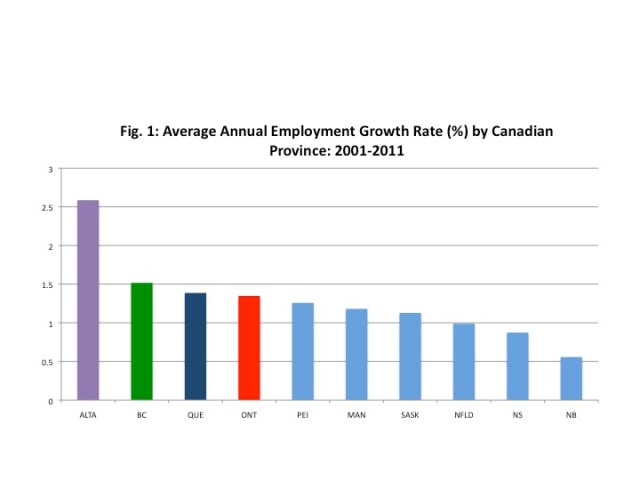


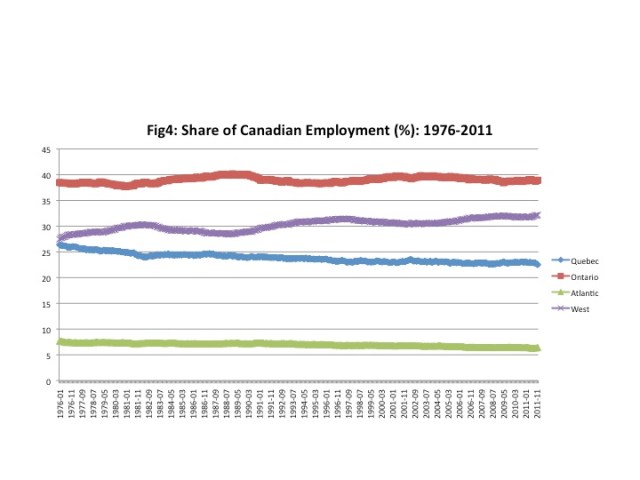
Quebec over the course of three decades appears to have greatly improved its employment growth rate performance relative to the other provinces but overall did not grow its employment as fast as the West which is why its national employment share has declined over time (See Fig 4). The Atlantic provinces have also seen their share of national employment decline. Ontario has also dropped in relative performance over the last thirty years but has managed to grow fast enough in its employment numbers to approximately maintain its employment share. The West has seen its employment share rise. British Columbia, in particular, has been able to maintain a strong performance always managing to finish in second place – after Ontario in the 1980s and Alberta since the 1990s. I was a bit surprised to see this as I had been under the impression that BC was not doing as well in particular because of weak forest sector and resource performance. It would appear that there have been compensations for this. As for the rest of the west, Manitoba and Saskatchewan have been the weaker performers when it comes to employment growth. If you just consider the period since 2001, the West has been particularly strong as its employment share rises during this period while that of Ontario, Quebec and the Atlantic provinces declines. Go west is definitely the right adage for job seekers.


 Worthwhile Canadian Initiative
Essentially this means that the exploitation of the Oil Sands, a resource that has only reached its economic potential recently is having a measurable impact on Alberta’s relative performance?
This goes along with the fact that before the Leduc Well in the 1940’s Alberta was the poorest province in Canada and was perennially a have-not. Oil changed everything.
With respect to BC, I don’t have any particular backing for this, but I think the big contributors to employment growth over the past 25+ years have been population growth, and to a lesser extent structural change. Large influxes of immigrants from Asia to BC have pushed up demand for all sorts of service and distribution jobs in the lower mainland area. Over time, it seems that there has been a shift in the provincial economy from resource extraction and exportation to services. At the very least, the forestry and mining industries are not as significant employers as they were in past. Some of the services , such as tourism and higher education, are major exports of the province.
Sorry. Late to reading this….I was actually busy comparing job growth in cities across the country. Edmonton, Calgary, Vancouver, Ottawa–in that order–were the cities with the largest percentage job growth between 2001-2011 according to the Labour Force Survey.
For BC, add the economic driver of facilitating trade: imports and exports via the Ports in Vancouver and now Rupert (and some other smaller ones on the coast), and people. The Vancouver International Airport is intriguingly enough a fairly significant economic driver for the region. You could put this under “services” but it is a large, and under-appreciated generator of income for the region (harder to track then, say, making cars or exporting lumber).