Financial advisors seem to be everywhere this time of year, pontificating about the merits of Registered Retirement Savings Accounts (RRSPs) and Tax Free Savings Accounts (TFSAs).
I'm not a financial advisor, but I know a bit about how the tax system works, and can do some basic arithmetic.
The most important difference between RRSPs and TFSAs is that with RRSPs, money is taxed when it comes out, but with TFSAs, money is taxed before it goes in.
RRSPs and TFSAs provide identical returns when a person's tax rate doesn't change over time. The table below calculates the returns to investing in an RRSP and a TFSA for someone who always pays a 40 percent marginal tax rate, and has $10,000 in before tax income to invest.
If this hypothetical individual puts the full $10,000 in an RRSP, she pays no taxes (for now), and can invest the entire $10,000. If she puts the money into a TFSA, she has to pay income taxes on her $10,000 before investing it. Thus has only $6,000 to invest – that's the downside of TFSAs.
Over time the money compounds. Then, eventually, there comes a day when the funds are withdrawn. This is where RRSP owners have a nasty shock: all withdrawals from an RRSP are included in income, while TFSA withdrawals are tax free.
Some basic arithmetic shows that, if a person faces the same tax rate throughout her life, it doesn't matter which she chooses, the RRSP or the TFSA. At the end of the day, she will have exactly the same amount in her pocket.
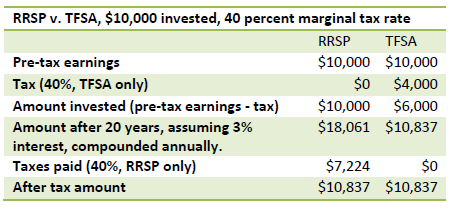 The amount after 20 years is calculated as amount invested multiplied by 20 years of interest payments, for example, 10,000*(1.03)20.
For people who expect their marginal tax rates to fall in the future, however, an RRSP is a better investment. Consider, for example, a person who faces a 40 percent tax rate when the funds are invested, and a 25 percent marginal tax rate when the funds are withdrawn. For him, an RRSP generates a higher after-tax return, as shown in the table below:
 Income in an RRSP is taxed when it comes out, so if a person expects to face a low tax rate during that withdrawal period, RRSPs are a good investment option.
Conversely, if a person expects to face a high tax rate in the future, TFSAs are a better choice. The next table compares the returns to RRSPs and TFSAs for a person who faces a 25 percent marginal tax rate now, and a 40 percent marginal tax rate in 20 years time.

For a person who is currently in a low tax bracket, TFSAs are generally a good choice.
There are a few other considerations to bear in mind. Funds invested in an RRSP can be used to finance a downpayment for a home. On the other hand, funds invested in a TFSA can be withdrawn in the event of a financial emergency, and then recontributed. However once money is withdrawn from an RRSP, the contribution room is lost for ever. Therefore TFSAs are more attractive for rainy day, shorter-term savings.
Bearing in mind the basic arithmetic of RRSPs and TFSAs, how does the commonly given financial advice stack up?
#1. "It's a complicated, difficult decision." Not really. It all comes down to marginal tax rates now and in the future. So, for example, for a childless single person or household earning under $40,000 a year, a TFSA will almost always be a better investment, because a person in that income range might well be eligible for Guaranteed Income Supplement upon retirement, and GIS packs one heck of a marginal tax rate. High income earners, on the other hand, should usually max out their RRSPs before even thinkng about TFSAs.
There are a few caveats to this advice. RRSPs are worth considering for would-be homeowners. Child benefits (CCTB) can add significantly to a person's marginal tax rate, so the calculation is slightly more complicated for people with children – who also might want to consider RESPs as an option. Finally, even high income earners might want to take advantage of TFSAs for short-term saving goals. But TFSA for low income earners, RRSPs for high income earners is a good general rule.
#2 "Invest in an RRSP, and then put your tax refund into a TFSA." Perhaps this works psychologically, making it easier to save. But I don't think it's particularly good advice. Depending upon a person's circumstances, either a TFSA offers the greatest tax savings, or an RRSP does. It makes the most sense to max out the plan that's best for you, rather than contributing some money to both types of plans (except, as noted above, using TFSAs for short-term savings).
#3 "An RRSP is always a good investment." No. Just, no.
Here are some examples of situations where investing in an RRSP is a bad move.
- A 55 year old single woman has no savings, and income of $25,000 a year. Given these facts, the chances of her being eligible for Guaranteed Income Supplement upon retirement are reasonably good. Any money deposited into an RRSP will generate tax savings at a rate of about 25 percent, depending upon the actual provincial tax rate, but will reduce Guaranteed Income Supplement by $0.50 for each dollar withdrawn – plus she might pay income tax on the withdrawals also, for a total effective marginal tax rate of about 75 percent.
- A 20 year old student earns $10,000 in scholarship income, or receives a $10,000 bequest. Since these forms of income aren't taxable, an RRSP contribution will generate no immediate tax savings. Now the student does not have to claim the deduction for his RRSP contribution immediately, he could wait, say, 5 years until he is in a higher income bracket, and claim the deduction then. Given the average person's ability to keep track of deductions and credits year after year, this just does not stike me as a good plan.
A TFSA allows the money to grow tax-free right away. If the student wants to move the money over to an RRSP in the future, that is always an option – she will get back his TFSA contribution room. But once the money is in an RRSP, it usually can't be withdrawn without triggering tax liabilities.
It's a simple choice: taxes now, or taxes later. Pick the one that's right for you.


 Worthwhile Canadian Initiative
Good post. Thanks. My 2cents:
Somewhat OT, but for most people with a mortgage, I suppose paying down our mortgage as fast as possible is also a good choice.
RRSP’s can be also be used to finance post secondary education for you or your spouse (I think the program acronym is LLP). We did that for my wife’s master’s degree and it was well worth it.
Agree that TFSA is great for the rainy day fund. It’s a major improvement in quality of life to a have the equivalent of at least a few months expenses tucked away.
Patrick: “I suppose paying down our mortgage as fast as possible is also a good choice.”
You’re right, it’s often a good choice. I was thinking of leaving that to another post. Basically when comparing a TFSA and a mortgage, it’s simply a matter of looking at the interest rate, and adjusting for your own personal risk tolerance.
“RRSP’s can be also be used to finance post secondary education for you or your spouse” – true.
I think suggesting it’s not complicated is disingenuous. Your scenarios are quite simplified. Consider the first one, the straightforward “40% in, 40% out.”
First, we have to construct an easy math universe that has a 40% rate. Let’s say 40% is the top, and it kicks in at $100k. then 20% for $50-$99,999, and 10% for $0-$49,999. You’re making $110k and have $10k you’re interested in saving.
The TFSA proceeds exactly as seen in your table. The RRSP doesn’t. RRSP withdrawals should be considered at their average rate, not the marginal rate.
At the withdrawal end, in order to get to a 40% rate, you need to pass through several lower rates first. We’re still going to shoot for $110,000 in income, since we still want to hit the 40% marginal rate. Since you’re a high income individual, the only income outside your RRSP/RRIF is from CPP, $11,840. Again to keep the math easy, we’re going assume that the CPP eats up all the basic tax credits, so both our TFSAer and RRSPer get them. Turns out that to top up to $110,000, our RRSPer pays $17,815.70 in tax and has $6,290 and 8,788 clawed back for OAS and GIS, for an effective tax rate of only 33.51%.
So that $10k we started with? Now it’s worth $12,008.
Of course, make the tax rates and bracket cutoffs more in line with the real world, and the result changes. Add a small employer pension from that one job you had for 5 years, and it changes some more. I also suspect that TFSA rules will be altered in the future, particularly I’d be shocked if I reach retirement (some 36 years from now) without investment income inside a TFSA being counted towards means-tested benefits like GIS. It would be pretty absurd if I can collect GIS while having a half million or more stashed in a TFSA.
Here’s a dumb question.
My wife and I are going from being grad students this year to both being employed next year. We’re in our early thirties. No debt, no kids. But no assets, no savings, and no retirement funds. We’ll have household income in the range of $175k and we’ll both have decent pensions.
Neither of us have the slightest clue when it comes to managing our money. We would love to get a financial planner who thinks like an economist — things like this post on savings, and Nick’s posts on housing, for instance. But of course, the financial planning industry is filled with commissioned salespeople and charlatans, and the standard designations are unhelpful in finding the right advisor.
Any advice on finding the right advisor/planner, WCI readers?
Interesting post. I have heard/watched a few pundits in the business give the nod to the TFSA before the RSP. If possible, of course, try to maximize both.
Neil – “I think suggesting it’s not complicated is disingenuous”
It is true that working out current marginal tax rates can be quite complicated. E.g. in certain income ranges for people with three or more children, reductions of national child benefit supplement can add 33.3% to current marginal tax rates.
It’s also probable that Canada’s tax treatment of the over 65s will change in the future. There’s been some sudden RRSP rule changes recently e.g. that have caught some people off-guard. Or, to take another example, a couple who maximized the lower-income spouse’s RRSP in order to minimize their tax liabilities in retirement turns out to have been wasting their time, as over 65s can now income split.
But the basic principle: RRSPs are best when tax rates are expected to go down, TFSAs are best when tax rates are expected to go up, is sound.
confused: sorry, can’t help you there.
westslope: “If possible, of course, try to maximize both.” – Not true. If a person’s current tax rate is low enough and future tax rate is high enough, plus the returns on investment are low, unsheltered investing may be better than an RRSP.
I like to interpret RRSPs in the sense that the government becomes a co-investor with you, in a tax deferred fund.
The government’s co-investment is the amount of your tax liability that has been deferred.
When the fund is cashed out, the government’s co-investment will have earned a return that, in effect, pays the tax on your own investment return, while repaying the principal amount of the original tax that was deferred.
So your own investment earns the equivalent of a tax free return because the government co-invested with you. That’s why the RRSP is equivalent to a TFSA, when entry and exit marginal tax rates are the same.
Example:
Suppose you have one-time contribution of $ 10,000.
Assume marginal tax rate of 40 per cent.
Your refund of $ 4,000 effectively means that the government has co-invested that tax amount of $ 4,000 in the RRSP, along with your own $ 6,000.
Assume a bullet investment for 10 years, where your money doubles to $ 20,000.
Then you cash in.
Assume the marginal tax rate is unchanged.
You’ll pay $ 8,000 tax.
The $ 12,000 return means you doubled your original money of $ 6,000.
That’s an after tax doubling of money, equivalent to the same return on an original after-tax principal contribution of $ 6,000 to a TFSA.
Interestingly, the government has also doubled its original money (in absolute terms), which in effect was the investment of your original deferred tax amount, and which itself earned the same tax free rate of return in the hands of the government as did your share.
What some people don’t realize as well is that when you get your refund, that’s actually the repayment of a loan you’ve effectively made to the government. The government should have been in the plan with you from day one, as a co-investor, with you making a $ 6,000 contribution and the government co-investing with $ 4,000.
JKH – that insight is especially important for people who are in a position to max out both their TFSAs and RRSPs, and have to decide how to allocate funds between the two types of accounts. Since the government is a co-investor in the RRSP, but you’re the sole owner of your TFSA, I think (but need to check the math) that it’s usually a good idea to put any investments that might get a very high return in the TFSA.
“What some people don’t realize as well is that when you get your refund, that’s actually the repayment of a loan you’ve effectively made to the government. ”
If you make regular, automatic contributions to your RRSP, you can fill out a T1213 and you don’t have to lend Jimmy your money for free. But be careful that your employer doesn’t screw-up the adjustments though. I work for a large firm, and the incompetent morons in payroll messed-up, reduced my payroll deductions too much, I didn’t catch it (I check my online paystub now!), and found myself owing CRA a ton (well, for me) of money at the end of the year. Nothing like a little surprise liquidity constraint to ruin your day.
Frances,
Technically, I think it shouldn’t make a different whether you put a high return investment into a TFSA or a RRSP, as long as you’re thinking in pre-tax dollars. I.e., with an RRSP, if I have $10,000 of pre-tax dollars to invest, I can invest it all, whereas with a TFSA, I can only invest, say, $6,000 (assuming a 40% tax rate). It’s true, the government shares in the upside on the RRSP, but that’s because I’m investing $4,000 of “its” money that I can’t invest in a TFSA.
That being said, I know of at least one strategy that people used where your instinct worked. At one time the CRA took the position that underwater stock options (typically employee stock options) had no value (I’m not a finance whiz, but that’s almost certainly wrong. The CRA can be such simple folk at times). So if you contribute a few thousand underwater stock options to your RRSP you wouldn’t get an upfront deduction, but the government would collect, say, 40% of the upside. Needless to say, clever investors figured out that if you follow the same logic with TFSAs you can (a) dump a ton of underwater stock options into the TFSA, notwithstanding the relatively low $5000 contribution limit (in 2009), and (b) you get to keep all of the upside. People who pursued this strategy in, say, the winter of 2009 (when people had lots of underwater stock options) make a fair bit of (tax-free) money when the market rebounded later that year (which is why there are some people running around with six figure TFSAs). Largely as a result, I understand that the CRA is rethinking its position on valuing stock options.
There’s another complexity for people to think about. If they’re going to be investing in US dividend paying securities, RRSPs are exempt from US withholding tax under the Canada/US tax treaty, whereas TFSAs are not (although who knows, that may be changed when Canada and the US revisit the tax treaty in a few years).
Doh, read your post more carefully, yes, if you’re maxing out both accounts, put the high return in the TFSA.
Neil,
Why are we looking at average tax rates on RRSP withdrawals? Given your non-RRSP income when you retire, any additional money coming out of your RRSP will incur tax at your top marginal rate. In fact, in the example you give, the TFSA would beat an RRSP hand’s down. Not only would a $10,000 withdrawal from your RRSP be taxed at a marginal rate of 40% (which is roughly what you pay in Ontario on income over 80-odd thousand dollars), but it would also trigger OAS clawbacks on the amount of the withdrawal. The effective marginal tax rate on RRSPs incomes in that case wouldn’t be 33%, it would be closer to 55% (i.e., the 40% marginal tax rate on the RRSP withdrawal, and a 15% OAS clawback.
Let me rephrase that “given your non-RRSP income when you retire, any additional money coming ou of your RRSP will incur tax at your marginal rate”. In your example, if you have $100K in non-RRSP income, taking out your original $10k RRSP investment will be taxed at the 40% rate (plus the 15% OAS clawback). In that case, you would have been further ahead to invest your $6k in a TFSA.
but it would also trigger OAS clawbacks on the amount of the withdrawal.
Bob nails an important point. All private pension schemes are money losing propositions. By avoiding them all you can have an income of $0 upon retirement thus making you eligible for the maximum amount of retirement income from the government despite having considerable assets.
Robert: “All private pension schemes are money losing propositions. By avoiding them all you can have an income of $0 upon retirement thus making you eligible for the maximum amount of retirement income”
Perhaps I’m missing some sarcasm or irony here, if so, my apologies.
Bear in mind that OAS+CPP+GIS is, at maximum, about $20,000 per person. That isn’t going to finance a lot of holidays in Australia. I’m certainly not going to avoid private pensions in order to get $6,000 in OAS annually.
TFSAs and RRSPs essentially convert our income tax system into a consumption or expenditure tax. People are taxed on their labour income, but investment income is tax free. Lots of people figure that this is a good idea, because it encourages savings and investment, contributing to economic/productivity growth, etc etc.
Hmm … all told, if you’re 65 and have no savings, what is your government pension when you add up OAS, GIS, and CPP?
Oops. I should have noted that you don’t just blow the money you would have invested in a pension on junk, but need to invest it in a non or low taxed appreciating asset. Simply put, you’re much better off putting your $10k per year into a second house instead of an RRSP.
Google to the rescue! Apparently it is about ~24K is you really have no savings. So lets see…
The BoC promises 2% inflation, and they adjust these things for inflation, and say you retire at 65, and you’re a little lucky and live to be 85. So that’s a geometric series… (Google to the rescue again) the sum (NPV) is 24000((1-(1.02)^25)/(1-(1.02)) = $768727.
Oh my.
Robert “Simply put, you’re much better off putting your $10k per year into a second house instead of an RRSP.”
It depends but, yes, in those two situations I described where an RRSP is a bad investment, a cottage or parcel of land might well be a very good investment. Some friends of mine have just built a beautiful retirement home on the little parcel of waterfront-view land they bought just as they were finishing grad school. Fantastic investment.
A cottage offers income opportunities through renting it out, and also a relatively low cost holiday destination.
The benefits of investing in real estate depends to a great extent on one’s ability to contribute sweat equity – buying a home, fixing it up, and then selling it is a tried-and-tested way for people without big bucks of ready cash to generate wealth.
I’m a bit of the Garth Turner school of thought on real estate – I’m not convinced that going forward it’s going to offer the same kind of returns that it has now. But remember that I have no training as a financial analyst at all, and my opinions on the future of the real estate market are worth nothing.
confused: My standard recommendation is to start by reading Andrew Tobias’s The Only Investment Guide You’ll Ever Need. I read it back in high school, and it’s been invaluable. For Canadian content, Gordon Pape’s books are good.
My view of RRSPs and TFSAs is that as a general rule, TFSAs are better. They share the most important advantage of RRSPs, which is that your money compounds tax-free. They’re easier to understand, which is a big plus when it comes to investing. And you don’t need to predict what your future marginal tax rate is going to be.
In specific circumstances (you know that your future marginal tax rate is going to be lower than your current marginal tax rate, and you know that you’re not going to need the money between now and retirement), RRSPs may be better. But in general, I’d invest in TFSAs first.
Russill,
I’m agnostic between the two, but I’m not sure that TFSA’s are inherently better than an RRSP. They’re not really easier to understand, in fact a lot of people have been burned as a result of making over contributions (though chalk that up to the incompetence of Finance and TFSA providers/advisors). Moreover, because it’s harder for people to withdraw money from RRSPs (and generally triggers a tax hit), they’re probably a better vehicle for long-term savings (though balance that against the liduidity of a TFSA). And you sort of have to predict what your future tax rate will be with a TFSA. If it could be lower than your current rate, RRSPs may be a better vehicle (in that respect the uncertainty for TFSA and RRSP are the same).
Confused: Try Chilton’s books or Gail vaz Oxlade’s books/blog (she just entertaining in her own right). I agree with you about financial planners/adviors – think about it, if they had any special insight into making investments, they’d be running a hedge fund making millions, not helping little old you for a 1% “service fee” from fund companies. I think the Chiltons, Oxlades, Papes of the world suggest that, if you’re going to use an advisor, get a fee-based advisor you know that they’re working for you.
Russil “as a general rule, TFSAs are better”
Another argument in favour of TFSAs is this:
Suppose you really aren’t sure which one is best for you, and the best option isn’t obvious from the simple guidelines given above (e.g. your household income is between $40,000 and $80,000 and you’ve got a couple of kids). Then put the money into a TFSA. You can always move the money over from a TFSA into an RRSP next year – tax rates aren’t going down any time soon.
But once the funds are in a RRSP, it’s costly to transfer them into a TFSA – it triggers tax liabilities, and the contribution room is lost forever. So, when in doubt, TFSAs.
A few points have not been discussed.
With a TFSA you are allowed to short sales. This is important to me.
Most people underestimate the probability that one spouse die. In that case, all RRSPs are grouped together with a marginal tax rate increase and a possible OAS clawback.
@Bob: “Why are we looking at average tax rates on RRSP withdrawals?”
First, you should look at the average rate on the RRSP income only, which is what I did. I also factored in the OAS/GIS clawback. Obviously if you have $80k in non-RRSP income (well, $100k in my example), then yes, your whole withdrawal will be taxed at your top marginal rate. But what is that income, where does it come from?
My point was that the decision between RRSP and TFSA is indeed complex and situation dependent. If your private savings are your only retirement income source, you get a different result from someone with pension income or a part time job.
But my example was based on a savings program where you’d ONLY have CPP, and either TFSA or RRSP income.
“it would be closer to 55% (i.e., the 40% marginal tax rate on the RRSP withdrawal, and a 15% OAS clawback.”
If you have enough non-RRSP income for the entire withdrawal to be at the top marginal rate, then your OAS has already been fully clawed back. You can’t have it both ways.
Patrick beat me to the T1213 point I was going to make.
There are online calculators where you can enter your tax situation and it will tell you if TFAS’s or RRSP’s are better. Taxtips.ca is a good one. They also have a great online calculator so you can estimate your total tax liabilities. I find this of great value when looking at a job; I convert the pre-tax headline pay into after-tax pay so I can do a budget and therefore estimate how much apartment I can afford.
confused:
I repeated what Bob Smith said. Most financial advisors have little or no actual experience in investing. They collect fees. You cannot reasonably expect a “financial advisor” (read salesman) in Anywhere, Canada to have market-beating advice and a track record to prove it.
I have sat in product sales meetings. Eyes glaze over when talking about the how the product works, everyone perks right up when fees and trailers are discussed.
The calculators at taxtips.ca are good start on assessing your situation. They work on both you and your spouse’s income and allow for spousal RRSP’s and other commons transfers. Best place to start.
If you are considering an RRSP investment, use the Saskatchewan Pension Plan as a benchmark. It is available to any Canadian citizen, counts as an RRSP contribution and runs only two funds, a balanced fund for long-term investments and a pure money fund for short-term transitions. Investments are locked in like a pension, you can’t withdraw it. The MER is 1% which is the best-in-class in Canada. There are no salesmen either. Cross-selling is a mainstay of the financial industry so you can spare yourself the annoyance.
Do consider your insurance situation too, disability especially. This is the most complicated form of insurance contract in the Canadian market so I strongly recommend that you take an evening to become educated.
I will bet my hat that you will receive one of two forms of DI through an academic group employer: Grouped Accident & Sickness (a string of individual policies) or a Wage-Loss Replacement Plan (one master policy). GA&S plans are paid for with after-tax dollars and the benefits are tax-free; Wage Loss Replacement Plans are tax-deducible and have taxable benefits.
The standard for Canadian DI policies is 2 years Regular Occupation and then Any Occupation to 65. Regular Occ disability means you are disabled from your last occupation, Any Occ mean any occupation you are suited for by reason of education, training or experience. This puts the insurance company in the driver’s seat, get away from this if you can. You can get an individual policy to upgrade to Regular Occ. to 65 to wrap around your group plan. It’s easy and standard. Also look at Partial/Residual disability, which is less than 100% disability. If you are disabled, you will thank your lucky stars if you have these features, they address the main problems people have with DI policies and bring them up to what they mentally expect.
DI is the least understood and most complicated financial product in the Canadian retail market.
westslope: “If possible, of course, try to maximize both.” – Not true. If a person’s current tax rate is low enough and future tax rate is high enough, plus the returns on investment are low, unsheltered investing may be better than an RRSP. -fw
Fine–if all those conditions are met. Investor competence is an implicit assumption often made in these discussions that does not by any means reflect reality.
I suppose if you are advising dope dealers, tobacco smugglers, gun runners, prostitutes and others who live off mostly untaxed income, the TFSA and unsheltered accounts would be the way to go too. Don’t laugh. Take our economist-trained prime minister Stephen Harper. Mr. Harper LOVES black markets. Fearful Canadians–his constituency–LOVE black markets.
In fact, I heard a rumour that top Hells Angels capos are funnelling all kinds of contributions to the Conservative Party. It is always nice to know that the prime minister is rooting for your bottom line when income is sourced from marijuana, cocaine, guns and girls. MCGG for those looking for an acronym.
westslope: ?
Determinant’s stuck in spam again (I can’t rescue you, since it’s not my post).
“But my example was based on a savings program where you’d ONLY have CPP, and either TFSA or RRSP income.”
Even in that example, you should only look at the marginal tax rate, because you’re making a marginal decision to invest in TFSAs and RRSPs. You can invest an extra $10k in RRSPs, and have an income (in your example) of $110k when you retire, or invest $6k in TFSAs, and have a taxable income of $100k when you retire and $6k in tax-free money. What matters in that example isn’t the average tax rate, it’s the marginal tax rate. The only time the average tax rate matters is if your choice is to either save everything in a TFSA or everything in a RRSP and you’ll have no other income.
Weslope – if you’re advising drug dealers, gun runners, and they aren’t reporting their income, TFSAs are the ONLY way to go, because they won’t have any RRSP room (also, advise them to pay their taxes before they caught – a particularly nasty outcome for drug dealers is that they get arrested and the government seizes their money as proceeds of crime, then the CRA comes along and points out that they owe some money on all those proceeds)
Neil – “If you have enough non-RRSP income for the entire withdrawal to be at the top marginal rate, then your OAS has already been fully clawed back. You can’t have it both ways.”
The OAS doesn’t get fully clawed back until just under $110k. So in your example, you still have to worry about OAS clawback.
“So, when in doubt, TFSAs.”
You can also use TFSAs as collateral for a loan, which you can’t do with RRSPs, so another point in their favour.
Determinant: “If you are considering an RRSP investment, use the Saskatchewan Pension Plan as a benchmark.”
You know, I’ve though about investing with the SPP. I’m wedded to index funds with low MERs (ETFs and the TD e-series funds), but the SPP has a good product, so each year I wonder about tossing a portion of my savings in with them. Maybe this year.
Frances,
“Since the government is a co-investor in the RRSP, but you’re the sole owner of your TFSA, I think (but need to check the math) that it’s usually a good idea to put any investments that might get a very high return in the TFSA.”
I’m not seeing that.
In my example, you invest $ 6,000 of after-tax money in either case, and the after-tax returns are equal, regardless of the size of the assumed pre-tax return.
JKH: Yep. If T1=T2, then TSFA=(1-T1)X(1+r)^t = X(1+r)^t=RRSP
Bob:
If you feel you have the ability to successfully invest in ETF’s, go for it.
I like the SPP because there is no management decision involved, they won’t switch your funds and they don’t have a herd of mutual funds to do that. What you see is what you get, it’s very rare to get that level of transparency in an investment.
It’s a good way to evaluate if your own efforts can increase your investment returns.
I hope that if a few things work out I will use the SPP as the top-up for my retirement planning. I am competing for a position with a very nice pension.
BTW, why does the spam filter hate me so much?
Determinant – try doing several shorter comments instead of one long one, shorter comments seem to be more likely to get through the filter.
JKH, Nick, frame the problem this way instead.
You have $10,000 in RRSP room and $10,000 in TFSA room. You have enough funds to max out both.
You want to invest $10,0000 in opportunity A, which you anticipate will give you a 3% rate of return. You want to invest $10,000 in opportunity B, which you anticipate will give you a 6% rate of return. (Let’s just assume that is some limit to the amount that can be placed in opportunity B without triggering a CRA investigation).
If we assume away all issues related to risk, it’s clearly better to put the opportunity B funds in the TFSA and the opportunity A funds in the RRSP.
Frances,
Yes and no.
If a higher rate of return means a higher income tax rate…yes.
If a higher rate of return do not means a higher income tax rate…no.
Am I missing something?
Normand – in both of these examples, $10,000 is put into an RRSP – this is an investor who’s maxing out both (so presumably someone who’s reasonably high income). In this case, it’s better to have the low return asset in the RRSP, because those returns are going to be taxed, and the high return asset in the TFSA, because those returns are not going to be taxed.
There’s an annual tax conference I go to most years that’s a combination of economists and accountants – as soon as TFSAs were announced the accountants were working out how to create investment vehicles that could be used to generate very high returns within a TFSA. And as an economist I’d thought they were all about providing investment opportunities for low income Canadians…
Frances: OK. Got it.
Frances,
“You have $10,000 in RRSP room and $10,000 in TFSA room. You have enough funds to max out both. You want to invest $10,000 in opportunity A, which you anticipate will give you a 3% rate of return. You want to invest $10,000 in opportunity B, which you anticipate will give you a 6% rate of return. (Let’s just assume that is some limit to the amount that can be placed in opportunity B without triggering a CRA investigation). If we assume away all issues related to risk, it’s clearly better to put the opportunity B funds in the TFSA and the opportunity A funds in the RRSP.”
You’re putting $ 10,000 of after-tax money into the TFSA, but only $ 6,000 of after-tax money into the RRSP. So the reason for putting the higher yielding return funds into the TFSA is not because it’s a better tax shelter, but because you’re putting in more after-tax money. Maybe that was your premise – but it works because its apples and oranges in terms of a $ 4,000 difference in after-tax room contribution room.
JKH – like a lot of these investment things, it’s pretty obvious once you think about it, isn’t it? But until I read your last comment, it hadn’t occurred to me that $1 of TFSA room is worth that much more than $1 of RRSP room, I’d just mentally being equating the two…
Bob Smith: I’m not advizing anybody but from what I understood successful black marketeers are very careful paying all bills (e.g., hydro) and tax bills.
That is how, for example, ex-marijuana seed exporter Marc Emery stayed out of trouble with Canadian authorities. The fact that he paid Canadian taxes was insufficient to dissuade American drug warriors.
All this solid advice on how to best save black market income also applies to untaxed income from so-called legal activities, too.
You have assumed that someone will make the same kind of investments in an RRSP as in a TFSA.
But what if they don’t? What if someone has both an RRSP and TFSA, and wants to make both higher risk (e.g., equities) and lower risk (e.g, mid-term government bonds) investments. How should they do it?
It seems to me that the investment with the highest expected return should be in the TFSA, since you will not pay tax on those extra profits.
But this raises a question: Should TFSA investments generally be more aggressive than RRSP investments, even if you only have one of these vehicles?
In the case when you can maximize both RRSP & TSFA, yes, it is likely that the optimal portfolio in each is different.
First, most people in a position to maximize contributions are already paying the highest marginal rate. Their future rate of taxation to be concerned with is the average, not the marginal; this will be higher only if the tax regime in general rises substantially. So they should discount the risk that their personal tax rate will be higher in future then it is today. In that case, both shelters will be effective if they generate positive return, but …
The TSFA has considerable liquidity value over the RRSP, because you can withdraw from and restore it as needed and because it can serve as collateral. Therefore it should be invested in something you are willing to liquidate, but that still has enough return to be worth sheltering. In “normal” interest rate regimes, a diversified bond position would be ideal. Admittedly, this usage conflicts with the desire to generate tax-sheltered returns from short positions. But that is a minority of investors.
The RRSP has considerable insurance value, because it pays off the most in states of the world where you most need the money. In other words, it has option value. Like all options, the longer the potential exercise date, the more valuable. You should invest accordingly.
rabbit – I need to do the math on the risk thing but here’s the intuition: the government owns part of your RRSP, that means the government takes 25 or 40% of any gains/losses. That basically reduces both the upside and downside risk of an RRSP investment, making it overall less risky. So take an investment that has a 50% chance of generating a 20% return, and a 50% chance of generating nothing. Put that into an RRSP, and it becomes a 50% chance of generating a (1-t)*20% return, and a 50% chance of generating nothing. The variance of your portfolio has just been reduced.
Frances, I believe there’s a paper out there that does that math with respect to the taxation of capital gains/losses (different context, similar analysis). For the life of me I can’t remember the paper (you may be familiar with it, but if not Michael Smart would know it – I read it for his class).
RRSPs have a significant disadvantage with respect to capital gains: RRSP withdrawals are always taxed as ordinary income.
For simplicity, suppose you have a 50% marginal tax rate. If you realize a $10,000 capital gain outside your RRSP, you pay $2,500 in tax (only one half of capital gains are taxable). If you realize a $10,000 capital gain inside your RRSP, you pay $5,000 in tax when you withdraw it!
Russil, that’s true, but keep in mind, you gotta invest after-tax funds if you invest outside your RRSP. So, at a marginal tax rate of 50%, you can either make a $10k after-tax investment outside an RRSP or a $20k pre-tax investment inside an RRSP (i.e., to invest $10k after-tax, you need $20k pre-tax). True, if that investment goes up 100% outside the RRSP, you’ll have an after-tax gain of $7.5k (75% of $10k). On the other hand, if that investment goes up 100% inside the RRSP, you’ll have an after-tax gain of $10k (50% of $20k). The after-tax rate of return in an RRSP may be lower (or the tax rate may be higher), but the RRSP is a still a better investment.
Essentially an RRSP is a leveraged investment. You’re investing the government’s money (i.e., the $10k in taxes that you otherwise would have paid to have $10k in after-tax money), but you get to keep 50% of their share of the profit. Good deal – you won’t find many other silent partners willing to give you that kind of sweet deal. Too many financial planners focus on the tax rates without thinking about the economics of the investment.
Bob Smith – there’s a literature out there on the impact of different types of depreciation rules and corporate taxation on risk taking which is very similar.
Russil – you raise a good point. There are similar issues with holding dividend-paying stocks inside an RRSP, i.e. it’s not possible to take advantage of dividend tax credits.
Frances:
I see your point. With RRSPs you are investing the government’s money as well as your own.
If one is investing in quality equities for the very long term, however, it is reasonable to assume that you will not lose money, and in fact make money at a faster rate than bonds. Not guaranteed but a darn good guess. If we take superior returns as a given then the numbers seem to suggest that the bonds should be in the RRSPs.
But this argument neglects risk, and if you neglect risk you would invest in equities in both portfolios. I need to think on this.