It's been five or six weeks since I noted that there was something strange about the Quebec LFS employment numbers. A one per cent drop in employment in the space of two months looked like the ohmygodweareallgonnadie months of early 2009, but there didn't seem to be any supporting story for why it was happening in Quebec, and why it wasn't happening elsewhere.
Since then, more data have come in, and it seems pretty clear that there's a glitch in the Quebec LFS numbers. There are several graphs below the fold.
First, here are the employment numbers up to December 2011. I was waiting for today's SEPH release for comparison purposes.
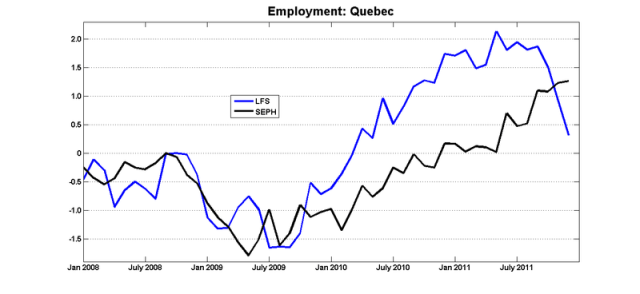
The two series tell very different stories. The LFS shows strong growth during the recovery, followed by a crash in the last two months of 2011. The SEPH shows more modest growth, and while growth may have slowed a bit near the end of 2011, there's nothing like the drop in the LFS numbers.
Which story is right? Another source of information about what's going on in the labour market is the number of new EI claims. These data are not seasonally adjusted, so they're grouped by month:
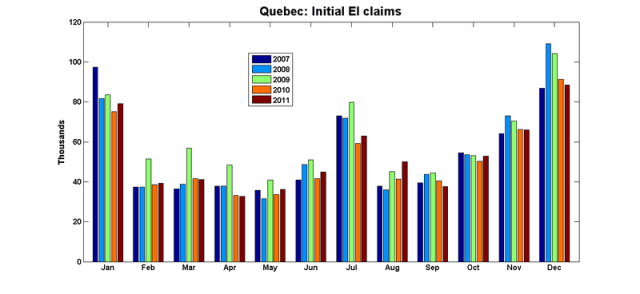
I don't see a surge of new claims in the last few months of 2011.
Here are the retail trade numbers:
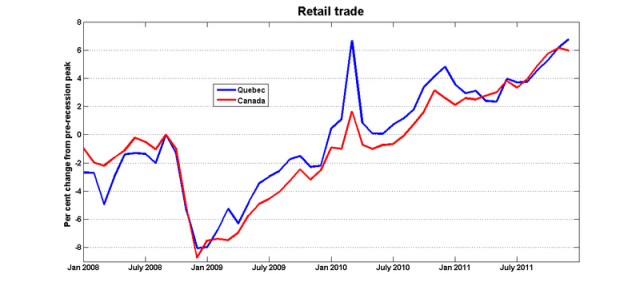
Once again, no visible slowdown there.
Housing starts:
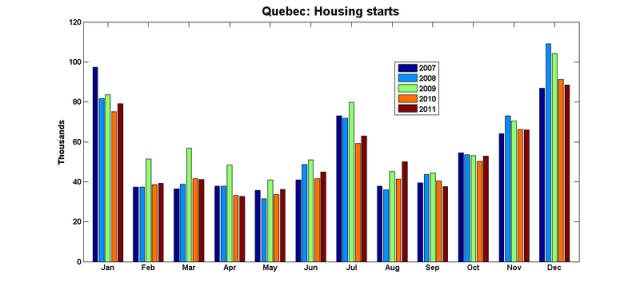
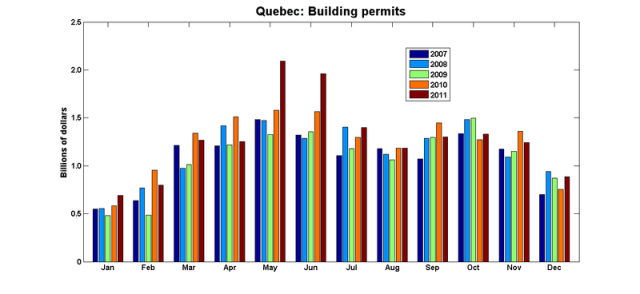
Housing starts are down from what they were over the past two years. but then again, the last two years were pretty strong – Quebec escaped most of the worst effects of the recession. It's hard to reconcile starts falling to 2007 levels with a sharp drop in total employment.
Especially since building permits as a whole are holding up:
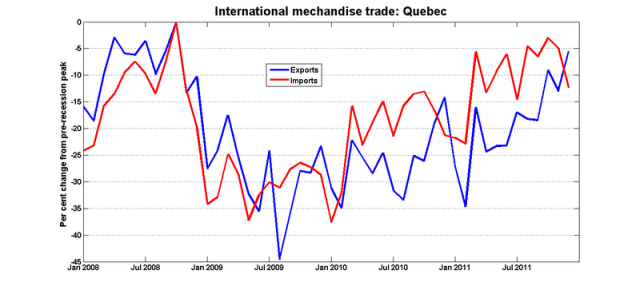
Merchandise trade:
And finally, here is new motor vehicle sales:
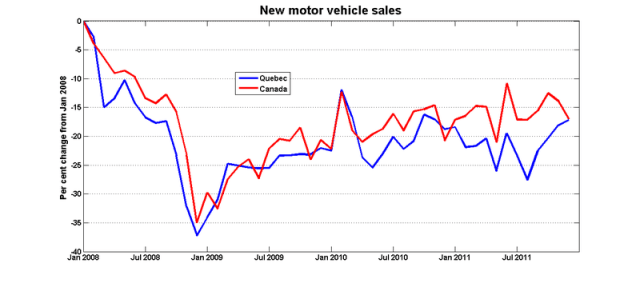
The only series that shows a sharp fall in the latter part of 2011 is the LFS; nothing else seems to confirm the LFS story.
As far as I can tell, the Quebec LFS numbers for November and December are a statistical aberration, not a signal of a recession.


 Worthwhile Canadian Initiative
Well done! I wonder if this post will be picked up by the media? Or is it a “non-story”?
Presumably, since Quebec employment is a bit over 20% of the national figures, IIRC, this might even have caused a small glitch at the national level.
To borrow a phrase from politics, rogue polls happen.
Nick:”I wonder if this post will be picked up by the media? Or is it a “non-story”?”
NO! They won’t. In the canadian narrative, QC must be poor and unemployed because they are lazy and stupid.
Look at the title of 23/02 Alain Dubuc column in La Presse.
Title: La paresse des Québécois. (Québécois’ laziness)
Fun thing is , he has to admit that participation rate for the core employment age is the same as ON. The difference is among the 55-64, where adjustment in indusrial structure is still going on.
Don’t bother writing him for a correction or discussion. He won’t answer.
Nor would anyone at The Gazette ( except maybe Jay Brian) or the G&M or Maclean’s.
http://www.cyberpresse.ca/chroniqueurs/alain-dubuc/201202/21/01-4498373-la-paresse-des-quebecois.php?utm_categorieinterne=trafficdrivers&utm_contenuinterne=cyberpresse_B13b_alain-dubuc_3261_section_POS1
Sorry for the long url above. I am even worse than you at html tagging.
Stephen, the thing that’s weird about this is that the LFS is a little bit longitudinal. From the documentation:
“The LFS uses a rotating panel sample design so that selected dwellings remain in the LFS sample for six consecutive months. Each month about 1/6th of the LFS sampled dwellings are in their first month of the survey, 1/6th are in their second month of the survey, and so on. One feature of the LFS sample design is that each of the six rotation groups can be used as a representative sample by itself.”
If the dip down is caused by some kind of weird sampling variation, it should persist for a few months.
The other thing to know about the LFS is that it is a mandatory survey – people are required to respond. So non-response shouldn’t cause that kind of variation either.
Yes, I was going to make that point, but forgot to. Another possibility is that the panels for the last year or so were wonky, and this drop is a sudden reversion to reality.
Aha! I was wondering how you could get a sampling error that looked to be serially correlated.
Jacques: maybe. But there’s also just the “well, the big exciting story we thought we had turned out not to be a big exciting story at all, ho hum” effect. It’s not that it doesn’t fit the “lazy quebec” narrative. It doesn’t fit any narrative at all.
Stephen, what is the unit of measurement for the Y axis in the top chart?
Gah – forgot to label it. It’s log per cent deviation from employment at the peak in October 2008.