One of the (many!) important questions raised by the robocall scandal is whether or not the deceptive calls did in fact achieve their presumed goal of inducing supporters of opposition parties to stay home and not vote.
If you look at riding-level data, there's not much to see. But Simon Fraser University's Anke Kessler has dug deeper into Elections Canada's poll-level databaseand uses information that is available at the poll level. Outcomes at polling stations differ in turnout and in vote shares for particular candidates; this makes each riding look like a smaller copy of a country-wide election. In a first step, she finds that polling stations with predominantly non-Conservative voters generally experienced a decline in voter turnout from 2008 to 2011. In a second step, she asks how the extent of this decline varies with reported robocalls. She finds that it was larger in the former, meaning that in ridings where robocalling was reported, polling stations that voted predomininantly non-Conservative in the 2008 election saw a greater-then-average decline in voter turnout. The paper "Does misinformation demobilize the electorate? Measuring the impact of alleged 'robocalls' in the 2011 Canadian election" is available here.
Here is the abstract:
The paper presents evidence on the effect of voter demobilization in the context of the Canadian 2011 federal election. Voters in 27 ridings (as of February 26, 2012) allegedly received automated phone calls (‘robocalls’) that either contained misleading information about the location of their polling station, or were harassing in nature, claiming to originate from a particular candidate in the contest for local Member of Parliament. I use within-riding variation in turnout and vote–share for each party to study how turnout changed from the 2008 to the 2011 election as a function of the predominant party affiliation of voters at a particular polling station. I show that those polling stations with predominantly nonconservative voters experienced a decline in voter turnout from 2008 to 2011, and that this effect was larger in ridings that were allegedly targeted by the fraudulent phone calls. The results thus indicate a statistically significant effect of the alleged demobilization efforts: in those ridings where allegations of robocalls emerged, turnout was an estimated 3 percentage points lower on average. This reduction in turnout translates into roughly 2,500 eligible (registered) voters that did not go to the polls. The 95%-confidence interval gives a lower bound estimate of 1,000 fewer votes cast in robocall ridings, which is still a sizable effect.
And here is the passage in the introduction where she describes how she was able to extract her results:
The problem with identifying any possible causal effect of the robocalls is that a crucial variable that likely affects both turnout and the selection of ridings that were targeted is the expected margin of victory, which is unobserved. Instead of proxying for the perceived margin of victory by the actual margin (or the margin in the previous election), I employ a different approach that allows for arbitrary unobservables at the level of the riding and instead uses within riding variation for identification. Specifically, the starting point of my identification strategy is that there is considerable variation of outcomes (turnout, vote shares) on the level of the polling station within a riding. On average, an electoral district has roughly 250 polling stations, some predominantly supported the Conservatives in the past election, while others predominantly supported the main opposition parties (Liberals, NDP, Bloc) in 2008. In the 2011 election, turnout at the latter polling stations fell, while turnout at stations with more Conservative leaning voters increased, relative to the district average. This effect can likely be attributed to the failure of the main opposition parties to mobilize their supporters as effectively as the governing Conservatives. Now assume that the instigator behind the robocalls targeted opposition voters evenly within the riding. Because some polling stations have more eligible voters favoring the opposition than others, we would expect those polling stations to have a differentially lower turnout compared to similar polling stations in ridings that were unaffected, assuming the misinformation worked and supporters of the main opposition parties were in fact demobilized. In other words, comparing ridings with robocall complaints to ridings without, the decline in turnout at those polls with more Liberal NDP or Bloc support should be more pronounced in the former. The result suggest that this is indeed the case: those electoral districts that were allegedly targeted by robocalls experienced a (relative) drop in voter turnout. On average, voter turnout was 3 percentage points lower in those ridings from which complaints had been received as opposed to ridings from which no such complaints had been received. Using the average such riding as a benchmark, this translates into roughly 2,500 fewer voters at the polls.
Here is her graph showing the model's predicted turnout rates:

And a bar graph summarising the effect of the robocalls on turnout rates
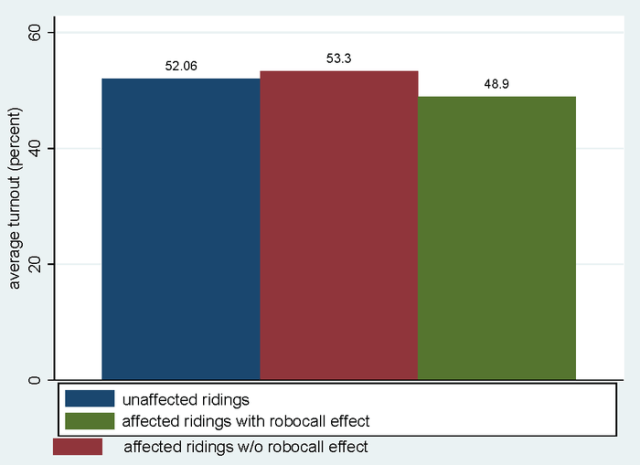
Section 4 of the paper is devoted to robustness checks.
And there are important caveats to be kept in mind when in interpreting these results:
It is important to note that my findings in no way can ‘prove’ whether misconduct or an illegal act has occurred. First, since I can only rely on self-reported incidences of misleading or harassing calls, which are made available through the Canadian media as my data source, there might be a considerable amount of noise present in the data as the actual occurrence of misconduct is obviously not observed. That is, I can only estimate the effect of (the average level of) robocalling in a riding, conditional on the calls being reported, relative to the effect of (the average level of) robocalling in districts where the calls, if any, have not been reported and consequently do not appear on the robocall list. Second, the findings only apply to the artificial construct of an “average” riding, i.e., the interpretation of the results necessitates an electoral district with average characteristics (voter turnout, margin of victory, etc.) which does not actually exist. For this reason, I wish to emphasize that the analysis and the corresponding results are not suited to bring the outcome in a particular riding into question.
This is an important insight into the robocall scandal, and people who are following this file would do well to read Professor Kessler's paper.


 Worthwhile Canadian Initiative
Not one voter has stepped forward so far to say they didn’t get to vote because of a robo call. If this analysis were true surely there would be at least 1. The most likely reason for a huge drop in Liberal voters was a collapse in voter support for the Liberal party. Call it the Iggy affect.
Hi James,
Anke finds a differential drop in non-CPC vote turnout in ridings allegedly receiving robocalls. If this were just a ‘Liberals stay home’ thing, it would affect all ridings equally, not just those that received calls.
re:”not one voter”
What about the voters that ripped up their cards, upon discovering they couldn’t vote at the polling station they’d been redirected to in guelph?
James,
It may be (and almost certainly is) true that liberal turnout would have dropped anyhow, but the tricky question is why does it seem to have dropped more in riding in which “robocalls” were reported than in ridings without robocalls.
That said, my observation is that Kessler’s definition of a “robocall” may be overly broad. Some (most?) of the 31,000 reported “robocalls” while, annoying, were almost certainly otherwise legal and legitimate campaign calls (some, almost certainly, made by opposition parties themselves – I have a heck of a time believing that the Tories were trying to suppress the vote in ridings like the Beaches in Toronto, where no Tory has been close to getting elected in decades), a point that in fairness, she recognizes. Still, given the inherent limitations on data, it’s an interesting paper.
Weren’t we supposed to learn the idenity of Pierre Poutine today?
Anke Kessler was one of my professors in university. I’m glad to hear about interesting research that she’s doing.
Many who recieved robocalls likely would not reveal that they didn’t vote, and nor should they have to in order to demonstrate that an illegal activity took place.
No one wants to admit that they did not meet their civic obligations…. when you admit that you didn’t vote your friends and family stop taking you seriously when you complain about the government, meaning that all that remains for you to complain about is the weather – Boring.
Also how could we confirm or deny that any of those who reported that they received robocalls did or did not in fact vote? I think that kind of voting information would be confidential, and any public statement on voting activity would be cheap talk.
Nice post!
Nobody has ever alleged that every voter, or even every non-Conservative voter was targeted by misdirection, yet this us assumed in the study above.
Indeed, even if every one of the 31,000 complaints were true, this is only a tiny fraction of the millions of votes properly cast.
The only valid conclusion based on the facts at hand is actually the opposite of what is claimed: that there were multiple effects depressing the non-Conservative vote (presumably predominantly the policies of the Liberals and NDP).
In the last election, I went door to door with Bob Rae in Ken Dryden’s riding, not because of how I planned to vote but because I thought Ken Dryden was worthy of reelection. The Conservative candidate, Mark Adler, beat Dryden. One of the tactics Adler’s team used was to inform voters who could not name their MP that Adler was the incumbent MP. This was a lie, but unsuspecting voters then allowed Conservative signs to be placed on their lawns. When Bob provided people with correct information, some agreed to replace their Conservative signs with Liberal signs. There is photographic evidence of what I describe. Robocalling to discourage people from voting was not the only dishonest tactic used by Conservatives in the last election.
That being said, I have my doubts about the “robo-calling” scheme being some sort of coordinated Tory dirty-trick campaign, if only because occurences are reported in ridings that are so random and seemingly illogical. Why would any polical party engage in vote-supression, for example, in a riding like Wllington-Halton Hills, where Gordon Chong (no favourite of Tory insiders) routinely gets 60% of the vote (the same story goes for ridings like Perth Wellington, or Niagara falls, which are some of the safest of the safe Tory ridings outside of Alberta)?
On the other hand, we see reports in ridings like Bas-Richelieu-Nicolet-Becancour (where the Tories finished a very distant third to the NDP and have never been within 30% of the Bloc) or Davenport (where the Tories are lucky not to get lynched on the best of days). It’s one thing to think that political operatives might break the law to win (unfortunate, but sadly believable), but who risks a hefty jail sentence to cheat in a riding where you know you’re going to finish third? It’s stranger still when you think of really close ridings, with really nasty battles, like in Ajax, Saskatoon-Rosetown-Biggar, or Brampton-Sprindale (which wasn’t close in the result, but was expected to be close, and was a riding that the Tories desperately wanted to take from Ruby Dhalla).
I don’t have a good explanation for what did happen, or at least what’s being reported to have happened, but the pattern of ridings don’t jive with their being a coordinated campaign.
In point of fact, the CBC reported at least one voter as saying he didn’t vote because of a robocall. This was an elderly gentleman who was directed to a polling station 3 km from his home. He walked there, and, of course, could not vote. By the time he got home he was too tired to go out again, even when offered a ride to the correct polling station.
“Nobody has ever alleged that every voter, or even every non-Conservative voter was targeted by misdirection, yet this us assumed in the study above.”
No, it isn’t. You should read the paper. All it purports to report is the difference in opposition turnout in RIDINGS (not voters) allegedly targetted by robo-calling, and RIDINGS (not voters) not targetted by robo-calling. It doesn’t assume that all or most voters, or non-Conservative voters, were targeted by alleged robo-callers, it simply reports the apparent different in turnout in ridings in which ANY robo-calling was reported.
Btrister,
I have no doubt that local campaigns, of all political stripes, engage in all sorts of nasty dirty tricks to get elected. What’s remarkable is that some people think this is a new development. Try putting up Tory signs in Toronto during the Mike Harris years to get a sense of what some people will do.
I’d be curious if the professor took into effect that many of the polls changed between the 08 and the 11 election. Could be comparing apples and oranges. I volunteered in a riding with quite a bit of population growth and the poll boundaries were completely different. For example poll 1 was in a totally different area in the 2011 election than in the 2008 election.
Stupid things happen. I was a DRO for the Federal election. A scrutineer came into my poll wanting to be accredited. I accredited him. He gave me a paper saying to write the poll results on it, phone the results in to his candidate’s HQ on the other side of the county, and BTW I could come for the party afterwards (it wasn’t a victory party that night).
I told him to go fly a kite. His request was against Elections Canada’s rules about poll results. Poll officials only communicate with the Riding Office where the accredited media representatives are. There are staff for that.
The guy was just lazy because his party didn’t have enough scrutineers to cover all the polls.
Bob Smith, it seems to me that they might target specific ridings where the race was close, but then target a variety of other ridings in order to make it harder to detect a pattern; They would be trying to accomplish two things: a) win some ridings by preventing opponents from voting; b) not get caught doing it.
Does this make sense to the statisticians here, the ides of covering it up by adding noise to the whole picture?
The number does seem high. Think about it. If the theory is that voters were turned off by robocallers, then at least 2500 voters in an “average” affected riding have to have received at least one robocall giving them misleading information or harrassing them (for the purpose of the post I’m going to use the term “robocalls” to denote misleading or harrsing calls, but its worth keeping in mind that there’s nothing inherently illigitimate about robocallers). But since a number of the people who’ve reported receiving such calls reported not being mislead by them, it’s probably reasonable to conclude that only a portion would be mislead or discouraged from voting.
So let’s play some numbers games here. Let’s assume 50% of targeted voters would be mislead (which seems awfully high, but maybe I’m underestimating the gullibility of would-be Liberal voters – they do vote Liberal, after all), we’d need 5,000 robocalls in an “average” riding to get 2500 discouraged voters. On the other hand, if 10% of targetted voters would be mislead, than to get 2500 discouragd voters, you’d need 25,000 robo-calls. Moreover, we’re assuming that robo-calls were only made to voters, but presumably some of the people who would have received robo-calls weren’t going to vote anyway. Given an overall turn out of 60%, you’d need to call, under each of those scenarios 8,333, and 41,667 voters, respectively, to get 2500 discouraged voters in a riding.
Spread over 50 ridings, there would have been between 416,650 and 2,083,333 recipients of robocalls. Moreover, if we accept reports that robocalls may have been made in 70 ridings that number bumps up to 583,310 and 2,916,690 recipients of robocalls.
Now, if the “robocall” campaign had been as widespread as that back-of-the-envelope calculation suggests, even at the low end of the spectrum, I think there’d be a heck of a lot more evidence than there currently is. I mean, you call half a million people, and all we end up with is a handful of voicemails? Ok, fair enough, I don’t recall voicemails that people left me a year ago. But then again, on Kessler’s account 125,000 and 175,000 would-be voters took the message seriously enough not to vote, you’d think their recollection might be a bit crisper on the point – not 31,000 mostly, at least from media accounts, fairly hazy recollections.
Moreover, it’s worth looking at that estimate from a different perspective. I gather that Forum Research (the poll is reported by Eric Grenier, here http://www.huffingtonpost.ca/2012/03/09/robocalls-scandal-poll-forum-research-canada_n_1333207.html?ref=canada) asked Canadians about whether they received robocalls dealing with voting locations. 9% said that they had, of which 78% reported that the information was accurate, while 22% (roughly 2% of the sample as a whole) reported the information as being inaccurate (interestingly, there apparently was’t much of a difference between Tory and opposition supporters, which might suggest incompetence, rather than dirty tricks was at play). Setting aside the fact that the 2% result is statistically meaningless, it implies that 400,000-odd Canadians received misleading phone calls (i.e., 2% of the 20-odd million eligible voters). The forum number is potentially consistent with Kessler’s results, but only if we make fairly significant assumptions about the gullibility of voters (or, more charitably, the effectiveness of robocalling), and assume that all respondents to the poll lived in the 50 reported ridings, and recall the robo-calls accurately (although that cuts both ways).
All of which is to say, I’d take Kesslers’ result with a hefty grain of salt.
@ Holly Stick: depending on the sophistication of the investigators and the availability of data, it could be worth a try. Given that the first shots would be fired in the political arena and MSM, hotbeds of low-information, it would be valuable to cast doubts in the public mind.
Doesn’t seem to have worked though. Canadians don’t like that much to vote but seems to care about clean elections.
Where’s Poutine?
It would be super cool if we could all just read Canada Elections Act… K thx bai.
There is also the possiblity that misleading robocalls were used in 2008 in Saanich Gulf-Island and apparently did not cause any repercussions to whoever used them.
And even having faced repercussions for the in-and-out scheme in 2006, it seems possible the Conservatives tried that again in 2011.
Yeah, if they give Canadians the elbow to the face often enough, we eventually notice.
Holly: “Bob Smith, it seems to me that they might target specific ridings where the race was close, but then target a variety of other ridings in order to make it harder to detect a pattern; They would be trying to accomplish two things: a) win some ridings by preventing opponents from voting; b) not get caught doing it”
Maybe, except the likelihood of getting caught increases with the number of calls you make (both because you’re talking to more people, and because you’re creating a paper trail). The best way to achieve the two goals you set out would be the place very few calls in very close ridings (or at least ridings that are expected to be close) – i.e., the Ajax, Saskatoon-Rosetown-Biggars of the world. Moreover, you wouldn’t want to be making calls in a riding like Davenport, where you’re likely get some militant NDP activist who thinks innocent calls from Tory callers are a form of criminal harrassment (as I can attest from personal experience, to say nothing of robocalls).
Holly: “And even having faced repercussions for the in-and-out scheme in 2006, it seems possible the Conservatives tried that again in 2011.”
You see, in my mind the comparison with the in-and-out scheme is why this doesn’t sound like a coordinated campaign by the Tories. The in-and-out scheme was an agressive scheme, alright, and may have crossed the line, but there was probably a reasonable interpretation of the Elections Act such that it was consistent with the letter of the Act, if not its spirit. Almost certainly they got a legal opinion from a respectable law firm to that effect (not that I know that one way or another) – my first though on reading the description of the scheme in the various court decisions was that it read like a tax planning memo. I suspect the reason that Elections Canada accepted a guilty plea (to a regulatory offense) from the party in that case, while dropping the charges against party organizers, was that they were probably told by the Department of Justice that the Tories had a reasonable due-diligence defense such that a conviction wasn’t a sure thing. A bird in the hand, as they say.
On the other hand, intentionally misleading voters as to where their pollings stations are isn’t something that’s “close to the line”, it’s over the line and then some. That isn’t something for which there’s a due diligence defense or where there’s a “filing position” that you were complying with the law. It’s clearly offside. In that it sounds completely unlike the in-and-out scheme. Is it reasonable to think that the a party that got burned taking a “close-to-the-line” position in the in-and-out case, despite probably having secured legal opinions that their position was defensible, would turn around and pursue a strategy that was nowhere close to being defensible? Maybe, but that sounds pretty unrealistic.
It’s been 10 months since the election and they haven’t been caught for sure yet. And possibly the urgent need to win a majority would be worth the risk to them. Now that Canadians are aware of this widespread activity, anyone would be a fool to try it again.
Holly, you’re projecting your thoughts about what the tories were thinking onto them. Did the tories have an “urgent need to win a majority”? They wanted one, sure, just as the opposition parties wanted to keep them from winning one. But do we get from there to cheating to win one? Hard to believe – particularly since late polling before the election showed the Tories moving into majority territory.
Moreover while the Tory campaign ran hard on the message that unless they won a majority, the opposition parties would take over, query whether they actually believed that (certainly no serious pundit thought it likely after Iggy finally took a position against it), or was it part of a concerted strategy of fear-mongering (and a successful one at that) to draw centrist Ontario voters away from the Liberals.
As for the fact that the Tories “haven’t been caught for sure yet” (note, so far they haven’t been caught at all, unless there’s some late-breaking news that I’m missing), that’s not particularly compelling evidence that they’re guilty.
Let us not forget the CPC also hires internet teams to “correct” our ideas with their doubt and purposeful misinformation! Try reading from known sources instead of those who naysay on WWW forums and comment sections. Here’s Stephen Lautens’ explanation of the central party controlling the voter suppression(robocall) scandal: http://lautens.blogspot.com/2012/03/robobcall-smoking-gun.html?spref=tw
Look at what they are doing about the tarsands. They have started an all-out war on our environment and on anyone who opposes their plans to gut our environment and sell our resources off. So yes, they did have an urgent need to get a majority.
My grandmother lived in the beaches… She did get robocalls… luckily her building was her polling station. The harassing calls however. Which I had heard at least one of, claiming to be on behalf of the liberals, was ridiculous. Not fake. Not made up. Im sure there are plenty of seniors in her building that got the calls too. Theyre not going to go and post on facebook though.
I find it, kinda disturbing, that some people want to claim this isnt real. I find it more disturbing that this government seems to have less and less social morality.
Is impersonating a federal government official from Elections Canada, during an election, a crime?
Holly, I rest my case.
AmyM: While its easy to dismiss me as some sort of tory stooge (fyi I’m not) that not a particularly thoughtful observation. But you’re right that people should look to reliable sources. For example, an impartial observer might give some weight to the report in today’s Globe that, according to elections Canada, the majority of the 31,000 complaints of robocallers were just form letters prepared by a left-wing activist group (leadnow.ca) and don’t make any substantive allegations. I guess you’re right, people shouldn’t believe everything they read on the internet.
FYI the story is front page on the globe website, if you’re interested.
Dick, let me get this straight, you’re seriously suggesting that the Tories were engaged in vote supression in a riding where they routinely finish a distant third by a margin of 30% or more? Maybe, but I can think of a lot more plausible scenarios.
“Holly, I rest my case.” Meaningless. Your arguments were not convincing to me.
When did Stephen Harper meet with Karl Rove again? It would be nice to see a transcript of those discussions. Who else did he meet with here: Tom Flanagan? Given that guys conduct the University of Calgary should be doing something about him!
I received the robocall 2008/Saanich Gulf Islands
It definitely created confusion
Is confusing voters part of voter suppression?
Ten things you don’t know about Steve Harper, the leader of Canada’s “Corporate Party”
1. Harper’s an Evangelist (i.e. a Holy Roller, but he doesn’t believe in it, it’s just for show, it’s actually just a front for “corporate interests”)
1. Harper’s church rejected divorcee Laureen, so after living common-law together, they married in a civil ceremony on December 11, 1993. So much for his religious shtick.
2. He’s getting divorced (check out his website, all pics of Harper and Laureen together have been removed; note I don’t care they broke up, I care how he lies about it for years and uses fake happy family to campaign for him
2. His “personal assistant” Ray♥Novak used to live in Harper’s backyard above the garage… FOR YEARS… what wife would put up with THAT?
3. Member of the fundamentalist Christian Alliance Church (they don’t like gay people)
4. Member of the Northern Foundation (I think they don’t like black people)
5. Member of the Calgary School of Political Science (they don’t like science)
6. Leader of the Reforma/Alliance Party (they don’t like women)
7. Former Head of the National Citizens Coalition (they want to kill our national health care)
8. Supporter of The Canadian Taxpayers Federation (AstroTurfers who want to kill Canada’s social safety net while running a pyramid scheme cheating taxpayers out of revenue from wealthy corporate donors)
8. He’s not a real Red Tory Conservative; he’s a Reforma Alliance CRAP Party thing
9. His grandfather (Harper’s family is from Moncton, New Brunswick) either offed himself after becoming mentally ill or ran off with a woman, the truth is never talked about for some reason
10. The asthmatic Harper wears a $3,000 weave (he’s obsessed with his own image and has a special salt & pepper one for elections, brown other times)
11. Steve hates to travel and didn’t get a passport until he could travel at the public’s expense
12. Steve hates being a politician, is uncomfortable in groups, really dislikes glad-handing
10. Steve stole three Canadian elections in a row. True story; Google it.
13. Steve Harper was president of his high school’s Young Liberals Club at Richview in Toronto; he also appeared on Reach for the Top t.v. program. Harper is not dumb, he just works for the interests of rich corporations / big business instead of for you
14. Spends every second of every waking moment plotting his scorched earth policy against Canada’s Natural Governing Party, The Liberals
Shouldn’t Steve Harper be working on other things? Like help for struggling families.
C.R.U.S.H.
– Canadians Rallying to Unseat Steve Harper
Multi-Partisan Discussion Group of 8,000+ People
http://www.facebook.com/groups/292671928599/
http://www.unseatHarper.ca
Nadine,
Your list of “ten” things people “don’t know” about Stephen Harper might be more persuasive if it wasn’t a list of 18 things seemingly written by someone who’s functionally innumerate. With opponents like that no wonder the Tories won the last election. Either that or you’re a brilliant parody of some of the more foaming anti-Tory types.
Stephen: Mark Thoma just linked to this post at Economist’s View
Our electoral problems are now officially an important news…
http://economistsview.typepad.com/economistsview/
Something to consider when discussing possible CPC motives: They obviously wanted to win ridings, and the speculation so far has centred on this. However, they also have a serious hate-on for the Liberals, and have a stated goal of destroying that party. So, there’s a motive for suppressing Liberal votes in ridings conservatives were unlikely to win, or likely to win by large margins. There’s also the reduction in subsidy that goes along with a low vote count — just because they planned to phase out the per-vote subsidy if they won, doesn’t mean they wouldn’t try to reduce the subsidy in the meantime (or, if they didn’t get they majority). The Conservatives play a deep strategic game. They’re not always focused solely on obvious goals, but often have secondary goals as well.
It is important to focus on the CONTENT of the voter-deterring recorded messages, not the technology of “robocalling” itself, which has legitimate uses.
See http://tcnorris.blogspot.com/2012/03/robocalls-and-stuffed-ballot-boxes.html
“There’s also the reduction in subsidy that goes along with a low vote count”
I’ve heard that theory, but it still doesn’t make sense. Think about it, the Liberals lose their $2 per vote whether they lose a vote in the Beaches or lose a vote in Ajax, but a reduced vote in Ajax helps the Tories win a seat, while a reduced vote in Beaches helps the NDP win a seat. If you’re a sneaky conservative, which riding would you target?
Indeed, if that was the thinking, wouldn’t they be further ahead to be running fake calls in ridings where the Liberals win with hefty majorities, since those are the ridings where there are large numbers of Liberal voters who could be pursuaded that their one vote doesn’t make a difference (and if you were doing that, you might use a strategy that I’ve heard of in the US, whereby Republicans (presumably) call up Democrat voters and say something along the lines “Hey, Obama’s going to win, hope you can make it to the party tonight” to sugges that their vote isn’t needed – arguably in a safe Liberal riding, such a statement would be true). Certainly, you wouldn’t be running robocalls in strong Tory ridings, where the only Liberal supporters are likely to be fairly committed, or in ridings with close races between the NDP and the Liberals.
On top of that, the amount of money at issue is so small as to be irrelevant. Take Kessler’s numbers at their highest, 2,500 discouraged voters in 50 ridings – 125,000 discouraged voters. Do the Tories hate the Liberals so much they’d risk jail time to deny them $250K in 2011? The Liberals have had a rough go of things recently in terms of fundraising (although they’ve improved) but even for them $250k is a rounding error. At the lower end of her range, it would have cost the Liberals $100K in 2011 (and less in subsequent years), in the greater scheme of things, that’s nothing. A political party would rather have an extra seat (with the profile and publicly funded machinery that comes with the office) than cost its opponents a few hundred grand.
In addition, that theory assumes that all the discouraged voters would have been Liberal voters. But is the Tory machine so efficient that they can distinguish between Liberal, Green and NDP voters (keep in mind that common response from such voters when you introduce yourself as the Tory Candidate is: “fuck off”)? Probably not. Even if you assume that they can perfectly identify their own voters (which is a strong assumption) and maybe 65% of the people they call are Liberal voters, I mean, we’re getting into some pretty small numbers here for political parties that blow through $20 million a piece each election. For what it’s worth, the one poll I’ve seen suggests that voters from all three political parties received calls with false voting addresses in roughly equal numbers. Although I don’t give that poll much weight (both because the results aren’t statistically significant and because we’re talking about recollection 10 months after the fact), if true, it isn’t consistent with the theory that the Tories (if they were the ones making false calls) were trying to drive down the Liberal vote.
And of course, large-scale robo-calling costs money, particularly if, as I suggested earlier, you had to call between 400k and 2M voters to discourage the 125000 voters Kessler suggests. Are there more efficient (and legal, if somewhat disreputable) ways of depressing your opponent’s vote? Probably.
The polling division boundaries were NOT the same in many ridings between 2008 and 2011. An analysis that compares the same numbered polling divisions across elections is flawed methodologically from the start.
Read footnote 9.
I think there is a case to answer on a riding-by-riding basis for (probably) illegal robocalls.
As a constituent in a safe Conservative riding, I had many robocalls from them telling me to go to local
town hallmeetings (for some reason I seem to be on the Partys list as a Conservative voter). Probably about 10 of them. Very annoying.campaigns were given the idea and instructions for using the robocall mechanism by the main party organization, and some local constituency parties went into dirty tricks mode. The rest were just sending out innocuous or stupid and irritating messages.The most probable scenario, imo, is that the various candidates
While the central organization may get away with this, it`s a bit like giving a baby a razor blade…
I agree, that sounds like a plausible scenario (certainly that seems to have been the case in Guelph). As is the possibility that misleading robocalls were the result of error rather than malice (the fact that polling indicates that a good number of Canadians received non misleading calls about polling locations is suggestive in this regard – it would be helpful if we knew just how many substantiated complaints about misleading calls elections canada has received. When it was 31,000 mistake seemed unlikely, now that we’re being told its a significantly smaller number, it’s back on the table).
I’m not sure about the comparison with giving a razor to a baby. Local campaigns are generally lead by otherwise functional adults (although they may act like babies). Seems reasonable to me to expect them to obey the law. In any event, no political party has the resources to closely supervise what people do in 308 ridings (which is always a source of frustration for all parties because every election there’s some loon local candidate who goes off message and starts blathering about abortion or Israel or pick your hot button sensitive issue).
What a con will do to make a buck, including trolling the web to seed untruth.
The truth is there. The cons sent not only robocalls but had people in calling centres call the elderly mostly and mislead them on where to vote.
The ridings they chose were strategically based to boost the CRAP fortunes in vote rich Ontario. In any election there are onlya handful of actual ridings in play. All the others have their core paty supporters. All you have to do is target swing ridings to get the majority. This time unfortunately instead of a fair election we had CRAP members stuffing ballots, impersonating elections Canada and out right lying to elderly people to get votes. Makes me ashamed to be a Canadian.
You CRAP trolls on here want to do something then apologize for robbing everyone else’s gandparents democratic right to vote.
And you people play Christian…DISGUSTING!!!!
Ask, is it too much to ask you to actually read my posts?
The whole point is that a fair number of the “robocall” riding are not strategically sensitive ridings (at least for the Tories). Some of them are the safest of the Tory seats in Ontario, while others are ridings where the Tories routinely finish a very distant third. Moreover, we’re not hearing reports of robocalls from some very competitive ridings, where it might make sense to cheat. But don’t take my word for it, look at the list of ridings in Kesslers paper, and look at the voting results in recent elections for those ridings.
I realize that expecting critical thinking from someone who describes reasoned posts as trolling (and uses the childish terms Cons and CRAP to describe the Tories) is asking a lot.
So far 82 ridings have reports of hoax phone calls. http://sixthestate.net/?p=3646
Anybody who claims a few local campaigns might have decided to go rogue is simply ignoring the evidence. It had to be a coordinated campaign. See: http://lautens.blogspot.com/2012/03/robobcall-smoking-gun.html?spref=tw
So far elections Canada only has 700 complaints of “specific circumstances where they believe similar wrongdoing took place” (note the vague language). (http://www.theglobeandmail.com/news/politics/ottawa-notebook/elections-canada-probe-focuses-on-700-similar-robo-call-complaints/article2370681/)
It’s a massive campaign that only affected 700 people? Ok, maybe more complains will emerge, but on the other hand, this has been front page news for a few weeks. And that’s assuming all those complaints are ultimately substantiated, as opposed to the “I got a call from a guy who purported to be a Liberal, who told me to vote Liberal, but who was a jerk about it, so must have been a Conservative”-variety complaints.
And look at some of the reports from the “sixthestate” blog you posted:
Burnaby New-Westerminster – Vague. No details yet.
…
Davenport – Reported by NDP. No details yet.
…
Egmont – Reported by Liberals. Postmedia: live callers pretended to represent Liberal candidate (but mispronounced his name). [Really, someone mispronounced the Liberal candidates name and that makes them a Tory? Do Liberals not mispronounce names from time to time?]
…
Oakville – Postmedia: callers with “fake accents” pretended to represent Liberal candidate. [“fake accents”?]
…
Windsor West – Reported by Liberals. Windsor Star: “similar” phone calls to other ridings. Details vague.
And that’s just a sample. What’s compelling about that evidence is the absence of any actual evidence.
Moreover, I come back to my earlier point, no one who thinks this was a massive Tory campaign has been able to give a particularly compelling explanation for the pattern of calls. In fact, some of those people aren’t even thinking about the pattern of calls. Take the lautens post you linked to: “We know the robocalls were made to multiple swing ridings, so there was a coordinated effort.” That would be compelling logic if it were true, but let’s look at the actual pattern.
Some swing ridings reported robocalls, others haven’t. If we saw lots or robocalls in very close ridings, hmm, I’d be suspicious, but we don’t really see that pattern. Of the 22 seats won by less than 1000 votes in 2008, 10 have reported robocalls. That’s a pattern?
Of the 82 seats that reported robocalls, 42 of them were won by the Tories in 2008 (which is sort of what you would expect if robocalls were reported randomly). A whole lot of those seats were safe Tory seats. By my count, in 12 of those ridings the Tories won the 2008 election by 10,000 or more votes, and 18 by more than 8,000 votes – do you think they spent a lot of time and effort (legal or otherwise) trying to win rock solid safe seats? Only 6 were seats where the margin of victory was close (i.e., less than 1000 votes) in 2008. That doesn’t suggest a pattern, that suggest randomness.
A bunch of the ridings on the list are ridings where the Tories weren’t (and never have been) in the race (Davenport, Winnipeg Center, Windsor West, Windsor-Tecumseh, Vancouver Kingsway, Vancouver East (Vancouver East, for god’s sake, the Tories finished 44% behind Libby Davies!), Thunder Bay-Superior North, Sudbury, Parkdale-High Park, Ottawa Centre, Beaches East York, Bas-Richelieu-Nicolet-Becancour). For Robocalls to help the Tories win in those ridings, they’d have to call the whole freaking riding – I think we’d have more than 700 complaints if they tried that. Of the opposition held ridings reporting robocalls, only 4 were “close” (less than 1000 votes in 2008)
Whatever was happening, it certainly wasn’t a COORDINATED campaign?
Holly,
Just to follow-up on my last post, according to the SFU election data site(http://www.sfu.ca/~aheard/elections/marginal-seats.html) in 2008, there were 42 “close” ridings(defined as ridings where the margin of victory was less than 5%). Of those, the Tories finished either first or second in 33 of them (including Andre Arthur as a Tory, because the Tories didn’t run a candidate against him and he generally voted with them).
Now, if Lauten’s right, that there was a pattern of robocalls targeted at “swing ridings”, these 33 ridings are the ones we’d expect to see targetted (not ridings where the Tories, Liberals or NDP, win by hefty margins). But only 17 of them reported “robocalls” (i.e., are included in the Sixth Estate list, though I note that that list includes ridings where specific allegations aren’t made), roughly 50%. Moreover, some of the “close” ridings that have reported robocalls were ones where the margin of victory was, in terms of votes, relatively large (1500-2800). But those are ridings where a robocall strategy doesn’t make a lot of sense since, all else being equal, its going to be harder to pursuade 1500-2800 Liberal voters to stay home than it is 100 or 200 (and, as noted, it means you’ll have to call a lot of people for it to work), while many of the ridings where the Tories won or lost with tiny margins of victory, in terms of votes, in 2008 haven’t reported robocalls.
And it’s even stranger than that. Some of the close opposition held ridings that haven’t reported robocalls were ridings that the Tories dearly wanted to win – you just know Tory HQ wanted to knock off Linda Duncan out in Edmonton, Ruby Dhalla in Brampton(although she did a good job of doing that on her own), Dawn Black in New Westminster, Paul Szabo in Missauga or Wayne Easter in PEI, but they haven’t reported robocalls.
Why would the Tories use a robocall strategy in a riding like, say, North Vancouver, where they knocked off the incumbent by 2800 votes in 2008 (and which, given the demographics of that riding, is likely to be sympathetic to the Tories), but not in ridings like Welland or Missisauga-Erindale, which they lost/won, by 300, and 397 votes, respectively, or a riding like Edmonton Strathcona that they lost by less than 500 votes, and that they’d dearly like to win back? I can’t figure out what kind of strategy there is there, if any, but maybe the people who are convinced that there’s a pattern there can explain it to me.
Now, here’s a plausible explanation for the oddball pattern of robocall calling: http://fullcomment.nationalpost.com/2012/03/16/john-ivison-pierre-poutine-called-voters-in-ridings-across-ontario-not-just-guelph/
Basically, the story goes that Pierre Poutine used the Tory election list to call opposition supporters in Guelph. But because the Tories don’t really care much about opposition supporters, that list had all sorts of incorrect information, so that Pierre Poutine called handfuls of people in all sorts of oddball ridings accross Ontario. To the extent people reported calls from ouside Ontario, those were live calls, likely dealing with actual changes in voting locations (although mistakes may have been made there).
Sure, judging from Ivisons’s sources, this is the Tory gloss on the story, but if true it goes a long way to explaining two confusing aspects of this tory (i) the somewhat haphazard calling pattern we’ve seen and (ii) why the number of substantive complaints are so small.
@ Bob Smith:
“To the extent people reported calls from ouside Ontario, those were live calls, likely dealing with actual changes in voting locations (although mistakes may have been made there).”
Are you thinking that these were legitimate live calls? Elections Canada has said under no circumstances do they ever telephone anyone to tell them about a change to the voting location. Live calls of this nature would also be illegal.
I think it might be fruitless to be searching for a pattern when the underlying data you are working with is highly suspect. For example, it is not necessarily true that ridings that have no reported robocalls did not have actual robocalls.