Along with the Canada geese returning home and the melting snow revealing buds of green growth, another sign of spring in Ontario is the unveiling of the sunshine list – those individuals in the Ontario public sector and broader public sector earning $100,000 or more. Included as always on the 2012 list are university salaries (for 2011) and given the occupy movement and the preoccupation with the top one percent a glance at university CEO salaries can be entertaining.
Figure 1 ranks presidential total compensation (salary plus taxable benefits) for Ontario’s twenty major autonomous provincial universities (affiliates like Huron at Western or Huntington have been left out). The average total compensation in 2011 was 381,390 dollars ranging from a low of 160,664 for University of Ontario Institute of Technology to a high of 591,490 for Western Ontario.

Being a university president is a pretty complex job. It is part diplomat, part fundraiser, part cheerleader, part civil service administrator, part strategic visionary, part financial planner and part fire fighter given the tendency for assorted crises to flare up. The main tasks are really forging community relationships (both internal and external to the university), fundraising for the university as its front man, and general strategic vision and direction. Day to day management of academic and financial affairs as well as dealing with the staff and faculty is usually the preserve of a vice-president particularly at the larger places. The buck does eventually stop at the president as she or he is ultimately accountable to the board.
There are undoubtedly many factors that go into determining compensation for such a role including level of prior administrative experience, educational and academic achievement as well as the complexity of the institution being managed. These are difficult to quantify in a quick analysis such as this but as a proxy for scale of the job, why not look at total enrollment and the general type of university (which according to Maclean’s magazine is medical doctoral, comprehensive and primarily undergraduate).
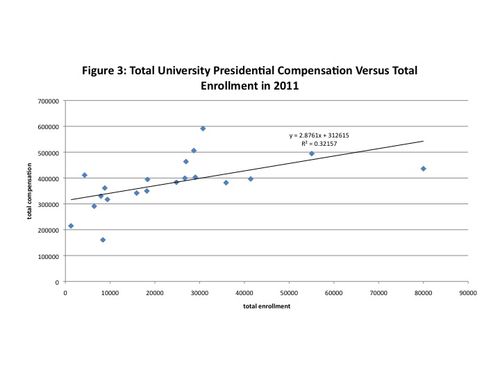
Figure 2 ranks these universities by total enrollment (full and part-time undergraduates and graduates as reported by AUCC) and ranges from a low of 1,250 students for Algoma to a high of 80,000 for University of Toronto. A quick plot of total compensation versus total enrollment (Figure 3) finds a positive linear relationship but only about one third of the variation in salaries is explained by scale of the institution as measured by total enrollment.
Figure 4 plots average total compensation by university type and the highest average salary is for those presidents at comprehensive universities, followed by those at medical-doctoral institutions and finally those at primarily undergraduate institutions. Is a comprehensive institution harder to run than a medical-doctoral? Or could it be that medical-doctoral schools have medical schools that run themselves with even higher paid CEOs-thus reducing the role of a university president.


A quick linear regression (See Figure 5) of total compensation (total) on total enrollment and whether as medical doctoral or comprehensive institution with primarily undergraduate institutions as the omitted category explains just over half of the variation in total compensation. While all the variables were positive determinants of total compensation, only being a comprehensive institution was statistically significant.

What determines a university president’s salary? Size and complexity of an institution – the scale of the job – may explain about half of the compensation package. The other half – the residual – can be a function of individual characteristics and experience, personal traits, and perhaps the hiring committee's view of institution specific requirements for the position at a point in time. In the end, I would venture that much of the total compensation is driven by the unique social culture and expectations of university presidents and what they are able to negotiate with their respective boards given the perceived needs and requirements of boards at the time of hiring.
March 25th UPDATE
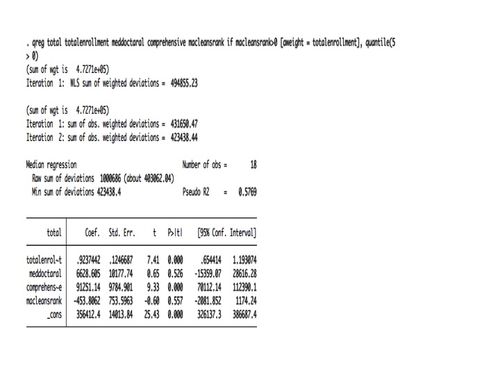
Well, I obtained the MacClean's rankings for each university within their category with the exception of OCAD and Algoma (therefore n=18) and also ran a quantile regression (0.5 quantile). I also weighted the observations by total enrollment (aweight). The results are below. They suggest total enrollment and being comprehensive are significant positive compensation drivers. A low Maclean's ranking (larger numbers are lower ranks) is associated with lower total compensation but it is not significant. About 60 percent of total compensation is explained by this regression with 40 percent still in the residual.


 Worthwhile Canadian Initiative
Consider a comparison (if it were possible) of the relative status of the institution and that of an incoming president.
Gotta pay more if you want a big shot in the job.
Livio – it would be nice to see a “robust” regression (LAD, say).
Thanks David. I’ve put a couple of more robust results in the e-mail to you.
dw has a very good point, that half of income driven by institutional size /revenue of it, is absolutely enough. Please try to find proxies for the personal standing of the competitors, and the reputation of the institutions.
Genauer: Finding a proxy for the personal standing of the competing presidents is a tough one. Re the reputation of universities, what do you think of the MacClean’s rank of each institution within its respective category?
Livio,
I just looked it up this “MacCleans”. Looks like something usable, at first glance, from the outside, formally. But I am certainly not in a position to make any judgement about Canadian places.
And I vaguely remember something similar, where they ranked my Alma Mater, TU Munich, 4th (out of 20, or so) in a category, in which it did not even have faculty. So, I don’t do endorsements of stuff (like MacCleans) I barely know.
Personal standing, …, in Germany often professors of (technical) universities still have a significant science reputation (papers, citations, h-index, 3rd party grants, collaborations, yearly reports, fellow here and there, whatever that is worth, or whether a good scientist is a good administrator) tax cheating convictions are at least not counted positive …. , even in Bavaria : – )
In economics, there is the Handelsblatt ranking.
Thanks Genauer. The Maclean’s ranking do look usable. I will also look up the Handelsblatt ranking – it sounds interesting.
livio,
for the latter:
http://www.handelsblatt.com/themen/VWL-Ranking
beyond that, the german economic science god is with the “Verein für Socialpolitik”
UOIT’s president started July 2011, so only second half of 2011 is captured in the 2011 salary disclosure.
http://www.uoit.ca/EN/main2/about/news_events/news_archives/news_releases/2011/10110211_1.html
Thanks John. I was wondering about that. That would place UOIT at about 320,000 which would put it ahead of Laurentian and just below Trent making Algoma the lowest paid university president.
Of course none of this actually answers your question.
with canada being 34 mio people,
this macclean index being for all of canada,
I assume that univ education in canada is free ? is it?
and access equal for all provinces ?
wouldnt it make sense, to run the correlation across all of canada?
2 more things, from a german perspective:
a) what is the respective personal alternative of the president (who is most the times a prof of the same institution?, and only does the “prez” for 5 or 10 years ?). Is he /she a poor sociology sucker, for whom the official income reflects on his real total income, or is he an engineering / medical guy, running a private business on the side, which might take some beating with his absense ? I remember sitting in a commission, when certain prof. colleagues bitched a little bit about another one, just sending lump sum payments of a straight million on 30th of Dec, to somehow formally fulfil some deadlines, supposed for detailed payments on university services used in that way, a quarter century ago.
b) House prices / rent are a factor of 3 higher in Munich, compared the larger capital Berlin and other relative poverty areas. This has to be reflected in the salaries. I don’t know about such differences in Canada.
Hello Genauer:
Re your points and questions. 1) The Maclean’s index is imperfect as it is for all of Canada but some universities may choose not to participate. 2) University education in Canada is not free and tuition rates vary across the provinces. 3) I cannot run the regression for all Canadian universities as not all provinces have sunshine laws that publish the salaries. I was just using the Ontario universities because those results were just released. 4) University presidents used to be largely internal candidates who had worked their way through the ranks at respective universities but over the last decade it has become much more common to recruit external candidates. Thus there is now a national and sometimes international market for university presidents which can fuel salaries. Indeed, changeovers of senior university administrations with an external president who later on brings in a lot of their own external people into senior administrative positions has made new university administrations sometimes resemble either a foreign occupation or a feudal changeover of fiefs. 5) If house prices are a factor, you would expect the president of OCAD, York, U of T and Ryerson to be paid the most as they are all in Toronto which is probably the most expensive housing market in Ontario. Those universities are certainly in the top half of the total compensation rankings.
Any thoughts Jim on what is driving presidential compensation?
Livio – interesting post. I have some reservations about the MacLean’s ranking idea – if presidents are effective, and if compensation is correlated with effectiveness, the MacLean’s rankings are potentially endogenous to presidential salaries.
Also look for golden handshakes – those distort the president salary #s some years.
I saw the updated regression, and with the other stuff to be looked at,
I would say this is as good as it should be.
With these rankings, I would second Frances, to not give too much about them.
Most of this is popularity, brand recognition, and sheer size.
This is easier said, if you come out on top, which I did both personally and with my own university, and I recently experienced how far off my quality judgements are from
25 year olds.
Remaining question: why is Institute of Technology so low? In my world Technical Universities are on the top.
If you look at the past 25 years or so I suspect you’d find both a dramatic rise in the relative pay of presidents and a comparable change in the demands of the job. On the one hand administration has been transformed into a much more bureaucratic, professional (and I don’t necessarily mean that as a compliment), and of course larger thing. Which I think demands a different type of person and background. On the other hand the job of a president, which is increasingly to ensure the institution is funded, has changed just as much. The level of government funding has fallen precipitously, the need to push research and private funding has become paramount. Scholarly functions have been put aside, they’re now real CEO’s.
My president when I moved here was a Classics professor, the epitome of a gentleman and a scholar. No way they’d hire him now.
I think pay has gone up perhaps partly due to supply and demand issues – there are only so many people capable and interested in this kind of work. But I think its also partly that there is a perception that a larger administration demands higher executive compensation. When you have no VP’s you just have to pay them more than the Deans.
Are they actually worth it is maybe yet another question.
Jim: I have heard (from a knowledgeable source) that a few decades ago the position of VP Finance and Admin was commonly filled by a professor, but that this is very rare at Canadian universities nowadays.
Remaining question: why is Institute of Technology so low? In my world Technical Universities are on the top.
Because OUIT was only founded ten years ago and barely has a reputation. Canada doesn’t do “Grande Ecoles” in the French or broader European concept. Engineering programs here are integrated into general universities, the old Engineering faculties are at places like the University of Toronto, Queen’s University, McMaster University, University of Western Ontario, Carleton, etc. Until 1945 and the founding of Carleton, all universities in Ontario were founded, funded and controlled by churches. McMaster was Baptist, UWO was Anglican, UofT was a combination of the United Church and Anglicans, Queen’s was under the jurisdiction of the United Church.
The state didn’t bother much with secondary education until 1945 and never created technical universities in the European sense.
Ryerson University, a Polytechnical school, is something like a community college (trade-oriented) that gained degree granting powers in the 1980’s. Ryerson and OUIT are seen as less “academic” than the older universities. It’s like Oxford/Cambridge vs. the Red Brick Universities in England.
The church controlling the engineers, eeeewh.
“Less academic”, erm, … “we, and only we, are real hard science, proven in the real, engineering world” would be the answer from here.
http://en.wikipedia.org/wiki/Technical_University_Munich
15 Nobel prize winners, running its own nuclear reactor,
some buildings donated by BMW, Siemens, and the likes, their CEOs and owners (Klatten) sitting on the TU board, GE runs their own Campus within the TU. half a billion of external funding, with 30k students
the renaming from TH “technical high school” was just done 1970, our hardest German competition, RWTH Aachen (only 5 nobels, boooh : -) is still holding out, I think it is actually brand positive. The sister university
http://en.wikipedia.org/wiki/University_of_Munich has 34 Nobels,
and is with 45k students already very large.
Competition is global, and Nobels are not a goal in itself, very clearly spelled out.
For institutions like that, ranking and reputation are clear.
TU President Herrmann http://de.wikipedia.org/wiki/Wolfgang_A._Herrmann
720 publications, breeded 150 PhDs, 10 professors, sitting on the board of 2 large cap German companies. This guy is obviously worth top dollars, the amount of it, none of us will ever see.
Tuition is 542 Euros per semester. For most studies there are no entrance limitations. Cost effective weeding out (50%) happens through written exams in the first few semesters. That gives also folks from lower quality, non-bavarian states / schools the chance to catch up, 7am and night courses, a very fair thing from my perspective. Munich is expensive, but poor students can live in cheap dorms, like me, I loved it, and earn money in the industry around.
The marching orders are clear:
global excellence, like Stanford and MIT, AND
large volume of hardened engineers needed in industry, cost efficiently, AND
fair access.
Nobody can say, he didn’t have his chance.
I forgot,
h-index should be fairly easy to look up and correlate for the prezies.
Herrmann has h-Index 87 (Stand 1. September 2011; Essential Science Indicators, ISI).
(My prof had 56, and mine is a mere 14, but I had only 5 years for that).
And I think it says something about relevant qualities here.
“The church controlling the engineers, eeeewh.
“Less academic”, erm, … “we, and only we, are real hard science, proven in the real, engineering world” would be the answer from here.”
I have an engineering degree from one of those institutions, so you’re way off base. The churches removed themselves from direct control of universities from 1945 – 1965. The United Church spun off Queen’s, the Baptists spun off McMaster, etc. The rule was a university could not receive government funding if it was religiously controlled.
The only remaining institutions under religious control on campuses are faculties of theology. The University of Toronto, Queen’s and McGill all have large theology faculties in which multiple churches participate. Toronto School of Theology serves 3 Roman Catholic orders, the United Church, 2 Anglican schools, and the Presbyterians. They all have joint classes.
Anti-clericalism of the kind found in Europe is rare to unknown in Canada, Quebec has a trace of it due to the Quiet Revolution in the 1960’s an a reaction to the very, very conservative Roman Catholic hierarchy in Quebec. But the Protestant churches in the rest of the country are downright mellow.
In Ontario the public school system was set up be a Methodist/United Church minister. Religion and education have been happy friends here forever.
Determinant,
I did read your “until 1945”, no worry. And the German state still collects tax for the Christian churches, no foam before the mouth here either. And a looooong story : – )
I just wanted to express, that the THs/ TUs here certainy did/do not see themselves in any way inferior to the Universities.
The rest was primarily shown for Livio, to give him some ideas about reputation scores for Univ and the Prez personally, especially the hirsch-index.
And some more bitching:
If we count the nobels after 1945, TU Munich is second to none in Germany, and beaten by all of Canada only with peace and literature counted in, where we don’t compete ….. yet : – ) But watch out in Economics, the present Dean was one of my students, sort of.
I think this analysis falters in using the Maclean’s categories – they are, after all, essentially arbitrary and not even consistently applied (e.g. Memorial has a medical school yet is categorized as “comprehensive”). Additionally, I don’t think any particular variables explain why Waterloo or Western sit at the top. Certainly Waterloo paid former president (now Governor-General) David Johnston more than any other school in the country for reasons I don’t fully understand, but having been a student there I’d say there is a culture of kleptocracy at least at the student level (Federation of Students executives sought doubling of their salaries to almost $50,000 based on spurious arguments about local income levels).
While Faculties of Medicine do in some sense “run themselves”, they tend to be more administratively complex, with separate divisions for research/basic sciences, undergraduate medical training, and postgraduate residency training, along with administration of clinical departments.
If you’re interested, Sue Horton and I had a paper analyzing cross-university patterns of compensation amongst university administrators in Ontario. It’s a few years old now:
Essaji, A. and S. Horton. Silent Escalation: Salaries of Senior University Administrators in Ontario, 1996-2005. Higher Education, 59(3): 303-22, March, 2010.