The 'starve the beast' strategy works like this:
- Cut taxes.
- Observe that cutting taxes has produced a government deficit.
- Cut spending to reduce the deficit.
This idea is apparently American in origin, but the US never has quite managed to get the hang of it; they keep getting bogged down at Step 2. The federal Conservatives implemented Step 1 when they cut the GST*, Step 2 was reached in the 2011 budget and they started Step 3 in the most recent budget.
The opposition parties deplore this agenda, and from the proposals that have been put forward in various elections and leadership campaigns, their strategy for restoring sustenance to the beast is to increase corporate taxes and increase taxes at the top of the income distribution.
This won't be nearly enough to close the hole left by the cuts to the GST, let alone finance new spending. Increasing corporate taxes will generate very little revenue even in the short run, and a good long-run estimate for the effect of corporate income taxes on revenues is zero. And there's little hope of generating much in the way of significant revenues from taxes on those earning more than $500,000 or even more than $250,000.
If the goal is to feed the beast, then tax increases on high earners is the fiscal equivalent of Chocolate Frosted Sugar Bombs:
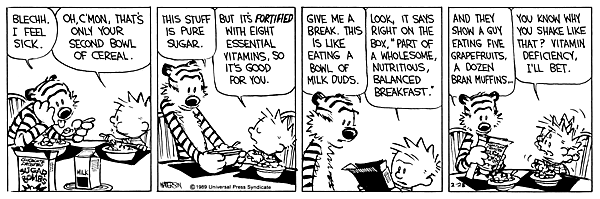
A serious increase in revenues would require increasing taxes on the great mass of people, not just the tiny fringe at the top. But the only way a general increase in taxes would be politically viable is if it were viewed as being 'fair' – and that means one in which the rich are seen to pay more.
The problem occurs when the revenue generation program consists exclusively – or almost exclusively – of taxes on high earners. There are lots of people who think that top earners are an inexhaustible source of revenues, and that a social democracy can be built on the taxes produced by a fraction of a per cent of the population. These people should be disabused of that notion.
Those who want to keep the beast from starving are going to have to put something more substantial on the table than the sugar-fueled rush of taxing the rich.
*Yes, I know about the corporate tax cuts. The effect on the budget balance is tiny in comparison.


 Worthwhile Canadian Initiative
Steve:
Very timely post given that Ontario has just decided to impose a surtax on individuals earring more than 500,000 dollars.
Fairness has been an issue and there are no program increases tied to or justified by this tax increase, so for once the “deficit reduction” claim has an air of reality.
Great post, but why put scare quotes around “fair”?
Not a scare quote. It’s a subjective value judgment.
Hello, Stephen Gordon. It is time for some numbers. Observe the large fraction of income made by Americans earning more than $200,000:
http://online.wsj.com/article/SB10001424052748704621304576267113524583554.html
Now argue to me that people making 5 times the median income are not “rich”. Go ahead. It has been a long time since I got to really lambast anything, and I am suffering from acute caffeine withdrawal! >:-E <–troll face
Here is one reason the starve-the-beast strategy might not work:
Bradford DeLong writes: “Buchanan and Wagner (1977) argue that deficits are dangerous because voters are highly myopic: when spending is raised and taxes are raised to finance the extra government spending, voters feel both the pain of reduced after-tax incomes and the benefits of spending programs and can judge whether the one is worth the other; but when spending is raised and financed by borrowing, voters feel the benefits from spending but do not sense the true resource cost of added indebtedness.”
James Buchanan and Richard Wagner, “Democracy in deficit: The political legacy of Lord Keynes”
Bradford DeLong, “Fiscal Policy in the Shadow of the Great Depression”
The top 10% of earners made 45% of U.S. national income in 2008. Do you call that the “great mass of people”?
HOMEWORK. FACTS. NUMBERS. Thank you.
“Fair” enough. But even if you assume that is true, I think you’ll have a hard time convincing social democrats to take economics more seriously if you’re so dismissive of their moral concerns.
Noah Smith,
Does Canada really bore you so much? Or is there a lack of debate about US finances?
Noah, I suppose it
s too much to ask to be familiar with the context in which this debate is being played out in Canada. But its not too much to ask to assume that the debate in Canada is based on a different set of facts than is the one in the US.You keep saying that taxing the wealthy or corporations won’t work because they change their behaviour to reduce the taxes they pay.
Yes, but so does everyone else. Raise the GST, and people will spend less money. Introduce a carbon tax, and people will use less energy. Raise the income tax, and the incentive to work and save takes a hit. Raise the payroll tax, and employers have a disincentive to hire. Raise tariffs, and see trade go down. Et cetera.
There is no tax, anywhere, that does not have side effects. You can never raise revenue by 10% simply by raising the headline rate by 10%.
Your spreadsheet shows that Ontario’s new $500K+ tax will still raise revenue as long as the income elasticity is 0.6 or less, and it admits the best estimate is 0.25. Revenue may be less than expected, but we are still on the left side of the Laffer curve.
Why should the rich get a pass because of their side effects, but the middle class toils away under static analysis?
The behavioural responses to changing the GST are much smaller, so changing the rate changes the revenues collected.
Yes, increasing tax rates at the high end will increase revenues, but the amounts involved are tiny.
I’m not saying the rich should get a pass. I’m saying we should be under no illusions about how much money you can expect to get from taxing people in the top one half of one per cent of the population.
Corporate taxes would work much better if it weren’t for free capital flows. What we need is a return to Bretton Woods.
Even under Bretton Woods and with 1950s-era communications and financial markets, stopping the flow of capital between Canada and the US was impractical; that’s why Canada was the only country to float its exchange rate.
It’s even less practical now.
For some reason, this springs to mind this morning.
Tyronen: “Your spreadsheet shows that Ontario’s new $500K+ tax will still raise revenue as long as the income elasticity is 0.6 or less, and it admits the best estimate is 0.25. Revenue may be less than expected, but we are still on the left side of the Laffer curve.”
A couple of clarifying points are in order. First, Milligan’s analysis doesn’t “admit” that an income elasticity of 0.25% is the “best” estimate of the income elasticities of the rich, it merely state that that’s an income elasticity accepted by Krugman in his proposed “soak the rich” strategy (making it hard for other proponents of that strategy to quibble with that particular estimate). Estimates of the income elasticities of the rich are all over the map, but I’ suggest that the elasticity relied upon by Krugman is probably closer to the bottom of the range, and my recollection is that there are credible estimates in the 0.5-0.7% range.
Second, even at Krugman’s income elasticity, it’s worth noting that the proposed tax increase will bring in less than half the revenue that it’s proponents claim it will i.e. $254 million rather than $570 million (As an aside, it’s a sad commentary on NDP policy making that, based on Kevin’s analysis, even ignoring behavioural response, that estimate badly, badly, overstates the likely revenue generated by a good $168 million- seriously, would it kill the NDP to retain a couple of clever grad students to do this analysis for them?). This is an important consideration when you keep in mind that this proposal was originally linked to a series of spending/tax cut proposals (child care, welfare, and a GST cut for home heating) that would have cost $500-odd million. In effect, the original NDP proposal was to soak the rich and aggrevate the deficit to the tune of $250 million a year.
Finally, saying we’re on the left side of the laffer curve is a pretty weak defense of a proposed tax increase because it only takes into account the extra government revenue and not the social cost of the behavioural response to higher taxes. The reason that the proposed tax increase will bring in less money than expected (assuming no behavioural response) is because people are either foregoing otherwise productive activities (working less, investing less) that they would otherwise engage in or because they’re incurring added costs (setting up family trusts in Alberta, rather than Ontario, taking compensation in the form of stock options, or deferred compensation arrangements, rather than cash) to avoid tax that they otherwise wouldn’t incur. Those are real social costs, that have to be taken into account. The top of the Laffer curve may be the revenue maximizing point, that doesn’t mean it is (and if collecting that last dollar in revenue is costly, it probably isn’t) the social welfare maximizing point.
Tryonen,
And for what it’s worth, I note that, in the spreadsheet, Kevin links to a paper prepared by the federal department of Finance, which both summarizes some of the existing literature on income elasticities, and attempts to estimate those elasticities for Canada for different income groups, Finance estimates the income elasticity of the top 1% (i.e., people making more than $150,000) to be between 0.62% and 0.72%.
While I’d take anything coming out of Finance with a hefty grain of salt, it’s certainly plausible that the proposed tax increase will generate more or less nothing in added revenue. That that’s even a possibility is a concern.
“The problem occurs when the revenue generation program consists exclusively – or almost exclusively – of taxes on high earners.”
Well then, according to your lights, no problem has occurred, since Ontario’s revenue generation program does not in fact consist exclusively – or almost exclusively – or anywhere remotely close to exclusively – of taxes on higher earners. What’s that you say? Changes at the margin to the revenue generation program consist almost exclusively of taxes on high earners? But then, changes at the margin on spending have fallen disproportionately on low earners. If taxing the high tail of the income distribution won’t work, taxing the low tail is doubly guaranteed not to work.
I’m afraid I don’t understand your point.
Bob, you’re last point is a good one, I think. The last thing we need is added incentives for more complex financial shenanigans. If the government raises my income tax rates, I have no option other than to pay-up. Rich people, on the other hand have all sorts of options to evade taxes (e.g. buy Congress). I keep trying to convince my fellow lefties that efficient regressive taxes (e.g. consumption taxes) + progressive transfers is every bit as good as progressive taxation, but it seems that their desire to stick it to the evil rich exceeds their desire to help the deserving poor (never mind the long suffering middle class).
Sigh.
Patrick,
On that point, I liked Kevin’s comments in this morning’s globe: “The assumption you have to make to get to revenue levels of like $500-million is that people who have the best tax advice available are not going to take it”.
Frankly, I’m with you, despite my righ-wing tendencies, I think a modern welfare state is sustainable if coupled with a pragmatic tax policy driven by reason rather than ideology. The Ontario NDP’s fixation with cutting the HST on home heating (apart from being an odd policy for a party that claims to be driven by environmental concerns) and the BC NDP’s opposition to the HST is a testament to the Canadian left’s suicidal willingness to torpedo the best (if not only) tax instrument to fund the spending side of their program without wrecking the Canadian economy. Until they become far more fiscally sophisticated (like their ideological counterparts in Europe), they’re doomed to failure.
At the end of the day, people need to realize that what they want the government to provide and what the government is actually capable of providing are two separate things. The government is not an efficient supplier of the kinds of things we have demanded of the government. Different tax regimes have been incapable of rectifying this problem. Levying a 100% tax rate on “all them rich b@stards” won’t make the government a more efficient supplier.
Tax rates keep going up, government spending keeps going up, and we all keep complaining that the government should do more. What will it take for people to second-guess this notion? How many centuries does it take before a stupid idea is universally accepted as a stupid idea? Governments can’t give us certain things, so we should stop asking them to do it and hanging it all on one or two demographics.
Wait, isn’t Canada a U.S. state???
What am I missing here???
How about some numbers. Does anyone have recent data on Canadian income shares? Preferably with the top 10%, 1% and 0.1% broken out. It has been my experience that we don’t get a good picture with quintiles alone since there is so much skew at the top. While we’re looking for data, it would be great if someone had an estimation of tax burden per group (including all levels of taxation down to GST and property).
Also, GST federal. $500K+ surtax provincial. Provinces are not like Ottawa, the constraints are different. We can debate on the effects of Ottawa issuing currency, but not on the fact that they do.
Not to defend Noah, but he’s been in Michigan for the last number of years, I suspect he’s pretty Canada knowledgeable. I must admit though, his visit to the blog today was exceedingly strange in style.
Good feedback here. A couple points.
1) Canada is not the US. About 13% of total income in the US is over 500K. In Canada it is only around 5 to 6%. So, taxing high earners in the US would yield more than twice the bounty as in Canada because their income distribution is so skewed to begin with.
2) Bob is right that I don’t argue that 0.25 is the ‘right’ elasticity. I argue that it is the minimum bound I would accept for the reasonable range. Anything less than 0.25 is far-fetched.
3) Yes, all taxes (except for lump sum taxes, of course!) are distortionary. But some are more distortionary than others. Taxes on broad consumption are very hard to avoid, compared to taxes on high income earners. We’re not stuck on a binary {distortion,no distortion} choice set here. We know more than that.
4) Bob: Thanks for the feedback on the quote “The assumption you have to make to get to revenue levels of like $500-million is that people who have the best tax advice available are not going to take it”. Must admit I like that one myself (self pat pat on the back . . .)
Despite what has gone on BC I do have to give credit to the Federal Conservatives for pushing GST Harmonization especially with the recent news that PEI is moving to HST. PEI’s PST is particularly noxious in its implementation and I suspect may start the drum roll towards HST in Manitoba.
Hi Tim,
I was genuinely shocked by the PEI announcement. I figured BC’s experience would salt the earth of HST transitions for generations. But maybe David D. Robertson’s overview in the CTJ of how Ontario got it right and BC poli’s acted like dunderheaded lummoxes is a useful guide to other provs. CTJ link.
MikeB
Yes, GST is federal, but the federal government has been more than willing to amend its legislation to increase the provincial portion of the HST for those provinces who request it (most recently, Nova Scotia – the exception to the rule that the NDP are fiscally suicidal). Certaily, Ontario, BC and most recently PEI haven’t had any trouble getting the feds to “increase” the GST in those provices by 7,8 and 9% respectively (i.e., impose HST).
And of course, constitutionally, there’s nothing to prevent a province from imposing its own value-added tax, like Quebec does with the QST (Quebec is further harmonizing the QST with the GST next year – it is already mostly harmonized – but the provincial portion will still be levied under provincial legislation, rather than under the federal legislation as in the HST provinces). When it comes to GST/HST, the provinces aren’t different from Ottawa, for the most part (except Quebec) they’ve chosen to use the GST/HST regime for the sake of administrative convenience and simplicity, not because of any legal constraints on their part.
Simply put, in Canada, there are no legal, and few practical, limitations on the rights of provinces to levy the taxes that account for the bulk of the tax revenue of most civilized jurisdictions.
“PEI’s PST is particularly noxious in its implementation and I suspect may start the drum roll towards HST in Manitoba.”
I’ve heard that. I’ve been baffled that it took PEI this long given the potential for administrative savings and what I suspect is a high degree of non-compliance in the internet era.
Maybe British Columbians are just nuts! 🙂
“Maybe British Columbians are just nuts! :)”
I see some evidence in favour of that proposition.
Don’t blame me. I voted to keep HST in BC. If we can blame anyone, can we please blame Bill Vander Zalm?
The main problem in BC was that the BC Liberals said that they would not pursue harmonisation (stupidly), then flip-flopped. Also, the electorate seems to have grown tired of the BC Liberal. Maybe we need a few years of NDP rule to remind us why we voted them out in the first place.
I think you missed by point Bob. The federal government does not need our tax dollars before it spends because it is the issuer. The provinces are users. The rules and results are different.
Oh god. No, we are NOT having a MMT debate in this thread. Don’t even think about it.
Promise not to go there Stephen. I’ll take back the which comes first part. Hopefully the rest is not controversial. I believe Nick and Krugman have both commented about the differences of being currency issuers wrt Europe.
I am a member of the NDP (there is only one membership, federal party and provincial party go together, you can’t have one and not the other) and I think the HST on home heating idea is silly. Just increase the HST credit instead, at least it has a much better chance of going to people who actually need it.
On a federal level (since the Income Tax Act is federal, let us not discuss Quebec’s special peculiarities) I am fully in support of fully enacting the Fiscal Nullity Doctrine into law, it’s a great way to prevent abusive avoidance. Worldwide liability for income tax with Canadian citizenship too. Easy enough to rework the Canada/US Tax treaty as we would both use the same liability concept.
Stephen, the NDP are not fiscally suicidal, their track record when actually in government is the best of all parties in fact. It’s just VAT style taxes play very poorly in Canada and always have. But that’s politics and therefore sales, that is the art of convincing or the lack thereof.
Further, the Ontario NDP is an opposition party. Recent federal experience shows that opposition parties get appetizers when asking for budget changes, not wholesale main course differences. I am surprised that the Ontario Liberals even consented to a tax increase at all. It was a major concession as far as minority budget negotiations go and likely as much as could be expected.
Stephen: You and the other authors offer your time to generate this interesting content for us and even respond to some of our primitive comments. Thanks and sorry for straying.
I reread your post again and I can appreciate what you are saying about considering the source of revenue. I’m not sure if you have an underlying view of the revenue sources you prefer, but if you do – you didn’t push it in this post.
The trouble for a non economist like myself is the wide range of opinion as to what the best course of action is. It seems that even the experts can’t agree on how much revenue will be generated by this recent proposed surtax in Ontario. Perhaps it is not knowable with any amount of certainty.
Step 3 of your list above says cut spending to reduce deficit. It seems to me that many countries are trying this now and the deficits are not going away. Can we really make deficits go away if we cut spending or increase taxes? Are they both a similar drag on the economy? Again, I’m not an expert, but it seems to me they both take money out of the economy. Correct me if I am wrong.
“It seems that even the experts can’t agree on how much revenue will be generated by this recent proposed surtax in Ontario. ”
For the Topp proposal, they came up with $3B. I said more like $1.5B. Even taking their number, that is about a 1% increase in federal revenues. Enough to pay for about 1 or 2 years’ worth of OAS increases. That’s it. Even their own numbers show that the revenue isn’t really substantial.
As for ‘experts’ disagreeing, I think you have a broader set of people in mind that you classify as ‘experts’ than I do, perhaps. I see disagreement between economists and political marketers, but not so much within the set of economists.
MikeB
To second Kevin’s point, I think you have to be careful discussing the degree of disagreement among experts. I think it’s safe to say that there is no respectable economist (or tax expert more broadly) who believes that high income earners don’t change their behaviour in response to changes in tax rates. To that extent there is likely to be no expert disagreement with the proposition that the NDP (and Liberals) revenue estimates are nonsense – suitable only for politicians.
However, while no expert would disagree with the proposition that people change their behaviour in response to changes in tax rates, there is significant disagreement about the magnitude of that behavioural response. At one end, you might have someone like Krugman who thinks its relatively low – though even at the low elasticity Krugman uses, tax revenue is half what the NDP and Liberals think it will be. And as I noted, others have found estimates of elasticity that are significantly higher.
However, while there may be disagreement, we can still draw informed conclusions from those experts. While it may be the case that we can’t know with certainty what the revenue will be, we can rule out the possibility that it’ll bring in $570 million dollars. That’s useful information – if only because it allows us to dismiss anyone making such claims as a charlatan (and so we don’t go planning on spending revenue we won’t get) Also, a priori, we can’t rule out the possibility that it’ll bring in no net revenue (or even negative revenue). Again, that’s useful information, since that’ll be something we should look out for once this proposal is implemented – and it also suggests we should have an open mind about repealing this tax in the event it turns out to be a money loser.
Determinant:
I take issue with comment about worldwide taxation for Canadian citizenship. In fact the NDP has already come out vehemently against the “concept.” There are HUGE tax problems right with US Citizens living in Canada many of which do not know they are US citizens due to something called FATCA and FBAR. In fact I have been posting regularly at another web called the Isaac Brock Society that is devoted to this issue. I am actually going to have some of the regulars over their come over here now that the subject has been brought up. As I linked to below the NDP actually has an official policy determined by caucus of opposing the US policy of trying to tax US Citizens living in Canada with no residential ties to the US on their Canadian source income. I also believe the entire BC NDP federal caucus sent a letter to Flaherty opposing the US’ effort to try to impose tax and reporting requirements on its citizens living in Canada. As someone who generally doesn’t support the NDP there efforts on this issue have caused me to look at them a whole new light.
http://denisesavoie.ca/ndp-position-on-the-us-foreign-account-tax-compliance-act-fatca
http://jeancrowder.ndp.ca/post/jeans-column-on-the-u-s-foreign-account-tax-compliance-act-fatca-for-the-cowichan-valley-citizen-september-2011
All of Canada tax treaties with countries other than the US(about of 80 or so based on the OECD model)prohibit taxation of non resident citizens. Dual US Canadian citizens are the ones being treated unfairly by past Canadian government that refused to standup to the US in past treaty negotiations. Sorry for going on about this but I don’t think there has ever in my life been an issue I am so hot under the collar about it.
The US gives tax credits for taxes paid in Canada under the Canada/US tax treaty.
http://www.uscanadataxexperts.com/dbltax.php
As demonstrated above, even though I am a card-carrying member of the NDP I don’t always agree with party positions.
In most cases dual citizens would owe little to no tax.
The US has imposed income taxes based on citizenship since the 1920’s. This is not new, I cannot see that any representation by Canada would persuade the US Congress to change a fundamental assumption of the US income tax system. But they did give Canadians credit for taxes paid here under the Tax Treaty.
While US tax law is a pain sometimes, dual citizens always had US income tax liability. Recent acts just made that far more clear to many people. Americans living in Canada, unlike most other countries, are by an large low to middle income.
Determinant:
Yes but the filing and preparation costs can be into the thousands for someone with only middle income. The issues is isn’t tax per say(Canadian rates are higher than the US so there is almost never any tax due) is the filing and preparation requirements and the PENALTIES for not doing it correctly. For a US Citizen living in Canada ALL Canadian financial accounts are considered “offshore” even though the person lives in Canada thus the account balances all have to reported on two separate forms once to the IRS and once to the US Treasury(the penalty for a willful error is 50% of the balance each with statute of limitations going back six years). The other issue is the US IRS is trying to compel Canadian financial institutions to report information on dual citizens clients in violation of the Bank Act, PIPEDA, the Canadian Human Rights Act and god knows what else.
The other issue is the US retroactively restored citizenship to many American who came over to Canada in 1970s and “reliquinshed” their US citizenship under the laws of the day when they became Canadian citizens. Elizabeth May I believe is in this group. Additionally not surprising given that many Americans who came to Canada in the 1970s did so for “political” reasons because of the Vietnam War once becoming Canadian they often became life long NDP supporters(which could possibly be skewing the party’s position on the issue).
NDP MP Denise Savoie of BC actually sent a letter to Obama calling on the US to change its laws on this issue.
Click to access letter_to_president_obama.pdf
Prof Milligan: My comment about various opinions was mostly based on a recent exchange between yourself and Erin Weir at PEF. Having read the full list of comments, it looks like there is less disagreement on the static estimates. BTW IMO quite a civil discussion between you two. Perhaps it is as Bob Smith says: it is about the elasticity estimate and behavior. It seems from your CV that you are well qualified from that point of view. In terms of resources, I do try and stay away from the media and political press releases. For my Canadian content, I typically come here or PEF. On the US/Intl side I do try to stick with academic based blogs. I know I should read the academic stuff, but I’m too old to do another degree. It seems to me that taxing income is not necessarily the best or easiest way for us to tax. If you were to build something from the ground up in 2012 – what would it look like?
Bob:
As I mentioned above, I think it is the behavioral component that I was referring to with the broad range. WRT to possible repeal, I’m all for agility in the tax code – not sure our politicians are though;)
@Tim:
Unfortunately the US can compel institutions with US branches. That’s plain power. It sucks, but it has that power.
On the other hand, Canada has done the same thing, we call people who inadvertently lost citizenship through more restrictive provisions of the Citizenship Act “Lost Canadians”.
@Determinant
All I can is watch this channel. I suspect it will be an issue we will be hearing about more. One problem from what understand is the US wants Canadian banks with branches in the US to ask all of their Canadian customers for their place of birth. For those born in the US then have to provide a Certificate of Loss of Nationality from the US State Department for their information not to be reported to the US. The problem is very few people who lost their US citizenship in the past(i.e. 1970s) in favor of becoming Canadian have these(Elizabeth May is in this category from what I have heard her say publically. An NDP MP from Toronto is also effected). Several people have personal talked in this situation who became Canadian Citizens in the 1970s went on to multi decade high level careers in the Ontario and Federal civil service and one in particular held diplomatic rank in Canadian Embassy in Europe and worked in a “policy level” position in the BC Premier’s office under Mike Harcourt. These are not “acts” under international law that are generally thought of as indications of ones intention to remain a US citizen. I have been told secondhand cases of people who went to work for the Bank of Canada or went into the Canadian Forces who again were born in the US but can’t show proof to the IRS of losing US citizenship.
I don’t believe it was the intention of the US to do this but they because they only have an income tax(No GST) they are desperate to crackdown on offshore tax evasion but instead are snaring a lot of people they shouldn’t be.
And don’t forget – US is in a very small club of countries, with only Eritrea and North Korea, who tax citizens wherever they live. The rest of us are taxed by the country in which we reside regardless of where we hold citizenship. The US government has very clusily tried to clamp down on rich US citizens hiding their money abroad by punishing all overseas US (accidental or otherwise) citizens. This is exacerbated by the US insisting that the rest of the world must pay for and execute US tax policy.
I also have serious doubts about whether citizenship based taxation really results in a significantly broader tax base than residency based taxation. The latter set of rules would tax those citizens who are ordinarily resident in the US, while the former would not (effectively) tax those who are ordinarily resident in other high tax jurisdictions (Canada, the EU, etc.).
So the only group who might generate significant revenue would be US citizens who are ordinarily resident in low-tax jurisdictions and I’d suggest to you (a) that those numbers are relatively small and (b) the actual ability to tax those citizens under citizenship based rules is pretty minimal.
On the first point, US citizens working abroad on a “temporary” (understood as being a potentially long time, so long as there is an intention to return to the US) would likely be taxed in a residency based system (it is exceedingly difficult, for example, to cease to be a resident of Canada and it typically triggers an exit tax liability). And let’s face it, moving permanently to the Caymen Islands or Mauritius is a damned difficult way to avoid taxes. Sure, they’re nice, but they’re not Paris, London, New York, Los Angeles. Leaving your family, friends and connections in the US to live out the rest of your life in the tropics is not a particularly attractive option to your typical tax evader – in practice, they try to hide their money abroad while continuing to live in the US.
And on the second point, if someone is willing to permanently leave the US simply to avoid taxes, under a residency based regime, any bets on their willingness to actually comply with US tax law when they’re out of the country under a citizenship based regime?
This is interesting from the Center on Budget and Policy Priorities on the real impacts of rising taxes on high income earners.
Heh. Its subtitle is a restatement of the title of this post. And is $60b – 0.4% of GDP – really ‘significant’?