The 'starve the beast' strategy works like this:
- Cut taxes.
- Observe that cutting taxes has produced a government deficit.
- Cut spending to reduce the deficit.
This idea is apparently American in origin, but the US never has quite managed to get the hang of it; they keep getting bogged down at Step 2. The federal Conservatives implemented Step 1 when they cut the GST*, Step 2 was reached in the 2011 budget and they started Step 3 in the most recent budget.
The opposition parties deplore this agenda, and from the proposals that have been put forward in various elections and leadership campaigns, their strategy for restoring sustenance to the beast is to increase corporate taxes and increase taxes at the top of the income distribution.
This won't be nearly enough to close the hole left by the cuts to the GST, let alone finance new spending. Increasing corporate taxes will generate very little revenue even in the short run, and a good long-run estimate for the effect of corporate income taxes on revenues is zero. And there's little hope of generating much in the way of significant revenues from taxes on those earning more than $500,000 or even more than $250,000.
If the goal is to feed the beast, then tax increases on high earners is the fiscal equivalent of Chocolate Frosted Sugar Bombs:
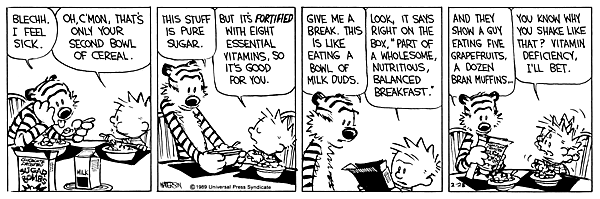
A serious increase in revenues would require increasing taxes on the great mass of people, not just the tiny fringe at the top. But the only way a general increase in taxes would be politically viable is if it were viewed as being 'fair' – and that means one in which the rich are seen to pay more.
The problem occurs when the revenue generation program consists exclusively – or almost exclusively – of taxes on high earners. There are lots of people who think that top earners are an inexhaustible source of revenues, and that a social democracy can be built on the taxes produced by a fraction of a per cent of the population. These people should be disabused of that notion.
Those who want to keep the beast from starving are going to have to put something more substantial on the table than the sugar-fueled rush of taxing the rich.
*Yes, I know about the corporate tax cuts. The effect on the budget balance is tiny in comparison.


 Worthwhile Canadian Initiative
Frances, I can’t help but think that the CBPP seems to fall within the catagory that Kevin described as “political marketers”.
While the underlying research on which they rely (particularly the upcoming Saez, Slemrod and Giertz (SSG) paper) is unimpeachable, the CBPP paper draws a number of conclusions that simply aren’t supported by that research.
For example, in the opening paragraph, the state that “The literature [meaning the SSG paper – though that’s a pretty selective reading of the literature] suggests that if the alternative to raising taxes is larger deficits, then modest tax increases on high-income households would likely be more beneficial for the economy over the long run.” But, the SSG paper doesn’t “suggest” anything of a sort – it doesn’t use the word “deficit” or make any comments about the merits of tax increases. At most, it can be relied on for the proposition that the real costs of tax increases are overstated (although I note it does not, and doesn’t puport to, estimate the real costs associated with implementing” tax avoidance” strategies). Everything beyond that is the CBPP’s spin.
Or consider a second example, the CPBB states that “policymakers CAN limit high income taxpayers’ ability to respond to increases in tax rates by engaging in tax avoidance activity — and also enhance the efficiency of the tax code — by broadening the tax base” (emphasis added]. Maybe, but here’s what the SSG paper actually said: “In that context, broadening the tax base and eliminating avoidance opportunities such as to reduce the elasticity is LIKELY to be more ecient and more equitable than altering tax rates within the old system” (emphasis added). The CBPP has taken what was is a fair, but speculative, comment in the SSG paper, and converted into it into a definitive statement.
I don’t mean to be hard on the CPBB, think tanks of political varieties engage in these sorts of exercises (and some are worse than others). I’m not even convinced that the intention is to mislead, as much as anything else it may just be a sloppy use of language. For example, in the same paragraph the CBPP says “[w]hile [tax avoidance] strategies entail some economic costs, these costs ARE relatively modest” (emphasis added), but in their appendix they cite a Chetty paper for the proposition that “while avoidance has an economic cost of its own, it MAY be more modest than if the entire ETI were explained by “real” changes to work, savings, and other economic behavior” (emphasis added). Again, they’ve taken a fairly unobjectionable, but speculative and uncertain, statement by an economist, and converted it into a definitive conclusion. I suspect someone just wanted to “punch up” their introductory portion (i.e., the part that journalists and policy makers might read), without thinking too hard about the fact that what they’re saying isn’t supported by the evidence they cite later in the paper.
MikeB, if you want to tell the difference between an expert and a political marker, look for definitive conclusions about controversial subjects, that’s usually a dead give-away for the latter.
Frances: Actually those results from the paper seem logical to me. I have always doubted that increasing tax rate for the rich has high real impact (such as adverse impact on labor supply). Such assumption runs contrary to result of behavioral economists. The results overwhelmingly show, that financial incentives can even have adverse impact on the performance of people engaged in creative activity. What (more money) is good at – is motivating people to do manual and repetitive and bore-some work. Financial motivation narrow’s ones focus which means increased concentration on any given specific task. However it does not help at all with inventing new things. That is one of the reason why the wealth of artists is not a very good predictor about the quality of his work, while being in a stimulative environment can be. So one would predict that lowering taxes for low-skilled (and probably poor) people can have positive impact on their willingnes to work, while this effect diminishes with rising level of income. At the top level income is not as important as is the nature of the work (is it challenging, new, interesting), how your job is seen by other people (it’s status) and other non-financial factors.
“And is $60b – 0.4% of GDP – really ‘significant’?”
In the Ontario context of a 2.3% of GDP deficit, it’s definitely part of a balanced breakfast.
Mark,
I think Stephen was referring to the revenue estimate in the CBPP paper. $60B relative to US GDP. 0.4% is nothing to sneeze at, sure, but given that the US is running a deficit that’s roughly 8.5-9% of GDP, a tax increase that brings in an extra 0.4% of GDP really doesn’t start to address their problems. At best it means that the massive spending cuts, or new value-added tax, that the US will need to balance their budget can be 5% lower than it would otherwise need to be.
The Ontario government’s new tax, assuming it’ll bring in $250 million (which may be an optimistic estimate) would be something along the lines of 0.042% of GDP ($250m/$600B) – i.e., a rounding error.
Bob Smith:
Becoming a non tax resident of Canada is not as difficult as one might think however, you do really have to no longer live in Canada(One spouse can’t stay behind while the other works on a temporary contract in the Middle East for example). As such the vast majority of Canadian citizens living outside of Canada are NOT tax resident. Where it gets kind of interesting I suppose is when “young” Canadian citizens become tax non residents working outside the country and then come back to Canada and enter the political and government arena. I am thinking of Michael Ignatieff or Mark Carney(or perhaps even Laureen Harper and several backbench MP’s of all parties). However, I have never heard from anyone that the aforementioned were some how avoiding taxes. Carney and Ignatieff in particular lived and worked in very high tax countries(UK and US)Iggy’s problem is he had been out of Canada for so long.
In countries where Canada has a tax treaty the CRA specifically discourages “dual tax residency” and actually tries to negotiate with the other country(except in the case of US Citizens)what country should the person in question based on their circumstances pay tax to.
“Becoming a non tax resident of Canada is not as difficult as one might think however, you do really have to no longer live in Canada.”
You’re right that, technically, it’s easy to do, sell the house, give up the drivers license and health card (how many “non-resident” Canadians living in the US haven’t done that I wonder?), close the bank account. I was thinking more about practically. It’s hard to move away from your friends, family, social connections etc. It’s one thing if you’re offered a great job in a country like the UK, Japan, the US, etc. where you have all the other ameneties of civilization (but you can’t really avoid tax). That’s a transition you can see. It’s another altogether if you’re moving to some tax haven in the caribean for the sole purpose of avoiding your tax liability. In practice, I don’t think the effective tax base (after taking into account foreign tax credits) between citizenship based taxation and residency based taxation is all that material.
Bob,
I disagree and would say that reducing the U.S. deficit from 9% to 8.5% is a decent start. It is a key, yet small, part of the “complete breakfast”. At least Occupy wouldn’t be a distraction anymore and we can move forward and get to the grapefruit.
It would be cool to see a post of SG’s comprehensive policy prescriptions. Maybe he has in the past and I’ve missed it. As I read it SG would like corp taxes to go down significantly, consumption taxes to go up and transfers to the poor to go up. I don’t think this mix is wise politically or economically.
After the latest round of cuts, cutting corp taxes isn’t a great priority of mine. But I’d be fascinated to hear what’s wrong with the rest of that agenda.
Bob Smith:
In terms of places such as the Carribean “tax havens” there are cases I have heard of people moving down there and then “commuting” back to Toronto by Air Canada while being tax “non resident”(Air Canada pilots who get free “transportation” seem to do this a lot). However, it is pretty primitive lifestyle. For one thing many tax havens aren’t really tax free its just their tax systems uses indirect taxes such as import duties vs. direct taxes such as GST and income. Thus the cost of consumer goods in the Cayman Islands or Bermuda is through the roof never minding transportation charges.
What you are seeing a lot since the financial crisis are the Mark Carney and Michael Ignatieff types who left Canada after college or even before for the bright lights of New York, London, and Silicon Valley coming “back” in pretty significant numbers. I suspect in past years many of these high achievers would have stayed in places like New York, Paris, and London for the rest of their lives.
Overall there is no revenue gain from citizenship based taxation it is stupid system that only the US seems to be attracted to in some notion of fairness just the like the US insists on using state based PST’s instead of a national based GST/HST system.
I think the health card issue especially among Canadians in the US is real and something the provinces need to crack down on. I suspect it is a far less problem among Canadians in other countries with universal health care systems.
Mark,
If a surtax on the wealthy was part of grand compromise to introduce a VAT, cut spending, etc., hey, it’s small price to pay to break the gordion knot (as opposed to the Stephen Gordon knot) of US politics. In isolation, it’s just tossing the Astors overboard to try to save the Titanic.
Stephen: “After the latest round of cuts, cutting corp taxes isn’t a great priority of mine”
Agreed, but it might make sense for the US (or not, theirs being a large open economy).
I’ve been a little sloppy the last few days. Please replace all instances of Stephen in my comments with Prof Gordon.
-Michael
No, that’s fine. Unless you’re actually a Laval student, I don’t really expect the honorific.
This argument not to tax the rich because “it won’t solve the problem” is pure unadulterated garbage.
Taxation should be about burden. Figure out what you need government to do, pay for it fairly, based on rough equivalent burdens on people with different incomes. Someone making 10 million dollars a year can just as easily endure the burden of an 80% tax rate as a person who makes $40,000 can endure a 20% rate.
All you apologists for the rich are morally reprehensible since you benefit as much from the thriving society and economy a good government brings as anyone.
Take a deep breath and re-read the post and the comments.
Do you see anyone arguing against raising taxes on high earners?
“Taxation should be about burden”.
“Taxation should be about burden”
See, I can’t accept that proposition. Taxation should be about raising revenue. Ideally, it should be about raising your revenue with as little burden as possible. An 80% tax rate on Richie Rich may impose a similar “burden” (a curiously ambiguous concept) on him as a 20% tax rate on Joe Q. Lunchbox, but it’ll probably bring in a heck of a lot less revenue than, say, a 50% tax. Since that revenue goes to fund programs than generally benefit the Joes of the world, imposing an 80% tax rate isn’t an obvious winner for anyone.
“All you apologists for the rich…”
Well, I suppose if Frances can be a Republican man, I can be an apologist for the rich I’m not quite sure what the rich have to apologize for (being rich isn’t a sin), or why I’d be apologizing for it, but there you go.
“….based on rough equivalent [tax] burdens on people with different incomes.”
Actually, as an apologist for the rich, I think that basis for taxation would place too great a burden on the poor. I would prefer a tax system that placed a zero (actually negative) burden on the very poorest.