Statistics Canada just released its GDP statistics by industry for the provinces and territories for 2011.
According to Statistics Canada: “In 2011, real gross domestic product (GDP) by industry increased in every province and territory except the Northwest Territories. Alberta, Saskatchewan, Yukon and Nunavut had the fastest growth in the country owing to exploration, mining and related construction activities. Nationally, real GDP rose 2.6% in 2011 after increasing 3.4% in 2010.”
Along with a standard bar chart, the release also included a table with the growth rates from 2005 to 2011. Tables are certainly one way of presenting data for multiple units over a time period but they are generally not very dramatic. Sometimes, a graph can be a more stunning visual approach to quantitative information as I learned not in my undergraduate and graduate econometric and statistics classes but from my own reading. What I consider a classic resource if you are interested is Visualizing Data (1993) by William S. Cleveland, which I found very illuminating in its approach to plotting and graphing of data. Until I read this book, my approach to graphing was simply occasional use of bar charts and scatterplots.
Of course, sometimes its fun to play around with data in terms of plotting it in different ways to see if visualizing it differently can yield any other insights or at least a new perspective. I’ve taken the Statistics Canada real GDP data for 2005 to 2011 and plotted it below using what is termed a radar or star chart. One application of radar charts can be to display improvements in performance over time.
A radar chart consists of a number of spokes along which a variable is measured. A radar chart with real GDP growth rates for the provinces and territories would have 13 spokes along which the growth rate of GDP would be measured. If growth rates increase over time, connecting the points would generate an expanding frontier. If growth is slowing, one might expect to see the frontier shrinking over time. Variability of economic growth can also be visually demonstrated by how close the lines appear together on the plot.
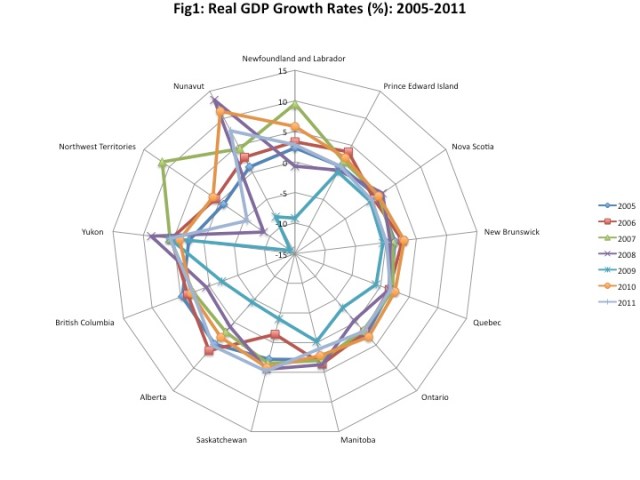
As Figure 1 shows, 2009 was definitely a poor year as it is almost completely surrounded by all the other stars. The frontier lines are more clustered in the east while the western provinces and territories display higher but also more variable growth.
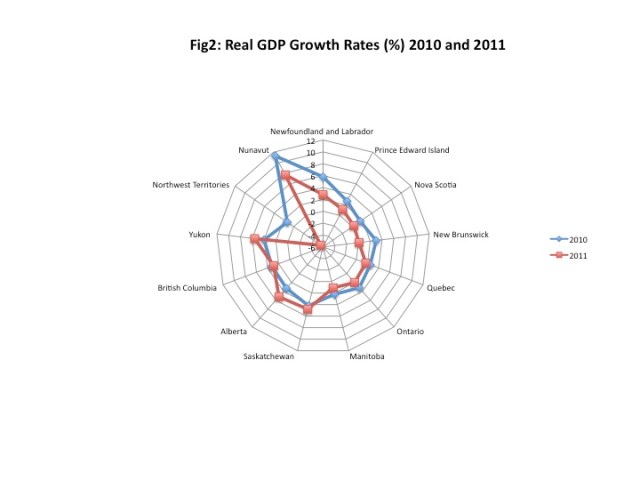
Figure 2 also dramatically illustrates that for most provinces, 2011 was a slower year than 2010 – exceptions being BC, Alberta and Saskatchewan. It would appear that for the 2010 to 2011 period, the star charts show more of an implosion towards red dwarf status than a super nova for Canada’s economy. Sure, you can get all this information other ways but sometimes it fun to vary presentation. Like fine dining, sometimes presentation is everything.
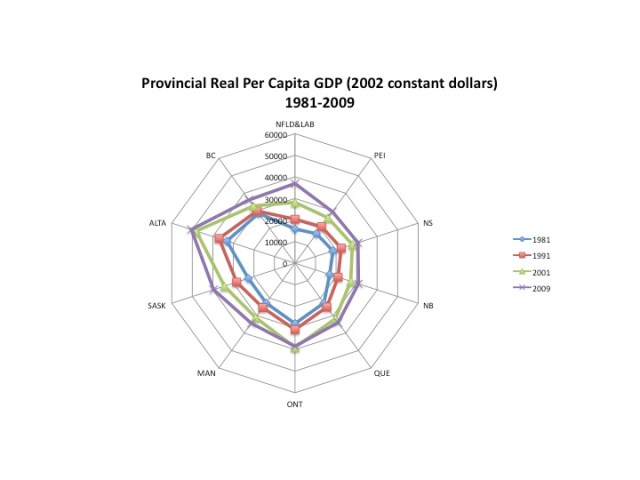
And as a follow-up, a real per capita GDP star chart for the provinces…


 Worthwhile Canadian Initiative
Livio – Neat. What would that graph look like in terms of real per capita GDP, rather than growth rates? The nice thing about doing it in terms of real per capita GDP is, like ripples on a pond, one would expect it to go out over time, and then if it didn’t, you’d notice something was odd…
That is a good suggestion Frances. Will take a look.
Just another note, what is interesting about the real per capita GDP star chart is that it “points west”.
Oh, I like this format very much. Very cool indeed.
There’s something intuitively fetching about the GDP per capita chart – it shows the size (and shape) of Canada’s economic “pie”.
Radar charts should be a standard format in federal Finance reports, Budget documents and Interprovincial comparisons generally.
“Here is what the Maple Pie looks like this year…” 🙂
Gov’t spending as a percentage of GDP by province? Are Alberta’s costs really out of whack if you use this approach?
I admire the valuable information you provide in your articles. I’ll mark your blog and see my friends here often. I’m sure you will learn many new things here than anyone else!