Paul Krugman noted a few days ago that
[A]s far as underlying economic inequalities are concerned, the EZ is no worse than the US.
The difference, mainly, is that we think of ourselves as a nation, and blithely accept fiscal measures that routinely transfer large sums to the poorer states
S.C. at The Economist's Free Exchange subsequently directed us to a 2011 infographic that illustrates the point, and I thought doing a similar exercise for Canada would be instructive.
I'm going to use the Provincial and Territorial Economic Accounts; in particular, Table 7 from this page. This table provides data for federal government revenues and expenditures (including equalisation payments) in each province; the difference between the two is the net transfer. Well, almost the net transfer, because the federal government doesn't always run a balanced budget. A given province's share of the federal deficit is subtracted from the raw transfers from that data table. For the per capita comparisons, it's assumed that the share is proportional to population, and the province's share of GDP is used for the GDP-based numbers.
[Update: Frances caught something important here. The numbers for federal transfers to provinces include the tax points that were transferred to the provinces. For example, the revenue numbers for the Manitoba 2008-9 budget include $3.6b from the federal government, but the data from that table show transfers well above $4b. The difference is presumably due to transferred federal tax points that show up as own-source revenues. I don't *think* this changes the main conclusions you'd want to draw from this exercise.]
The data are available for the period 1981-2009; here is a summary table based on averages during 2003-2008. Positive numbers mean that the province/region is a net recipient, and negative numbers indicate net contributors:
Federal transfers: 2003-2008 Population share GDP share Net transfers:
per capita 2009 dollarsNet transfers:
share of GDPAtlantic provinces 7.2% 6.0% $5,801 14.9% Quebec 23.5% 19.8% $980 2.4% Ontario 38.8% 38.9% -$1,448 -3.1% Manitoba 3.6% 3.1% $4,137 10.2% Saskatchewan 3.1% 3.3% $2,874 5.2% Alberta 10.4% 16.0% -$4,241 -5.9% British Columbia 13.1% 12.4% -$644 -1.5% Core provinces 62.3% 67.2% -$1,765 -3.5% Periphery 37.4% 32.3% $2,358 5.8%
Here I'm defining the 'core' provinces to be Ontario, Alberta and BC – the only provinces where net federal transfers are negative.
Here are some graphs of net transfers between the core and periphery over the last 30 years or so:
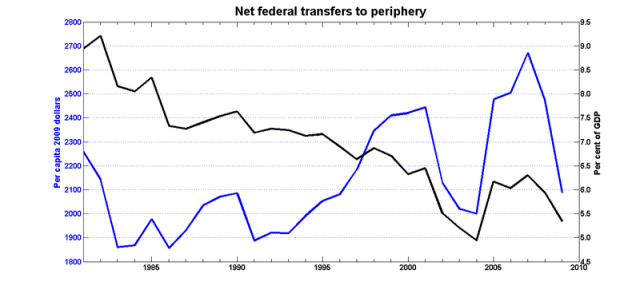
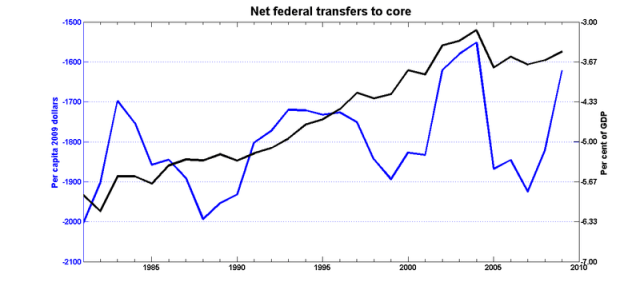
It would appear that these transfers have become less important over time. I'm not sure if this is due to a policy change, or simply because the provinces in the periphery are catching up to the core.
I've prepared similar graphs for Newfoundland, Prince Edward Island, Nova Scotia, New Brunswick, Quebec, Ontario, Manitoba, Saskatchewan, Alberta, British Columbia and for the Atlantic provinces; that would take up too much room to post, so click on the links if you're interested.
But there's one case that is interesting simply because it's so unremarkable: Manitoba. Manitoba's weight in Canada is similar to that of Greece in the eurozone: 3.6% of the population (3.4% of the eurozone population is in Greece) and 3.1% of GDP (Greece's share of eurozone GDP was 2.6% in 2008). Here is how net federal transfers to Manitoba have evolved since 1981:
According to Wikipedia, EU transfers to Greece were 1.3% of GDP in 2009; federal government transfers to Manitoba are routinely – blithely, even – 8 times as large.
The question of whether or not the euro will survive may simply come down to whether or not a framework can be devised in which eurozone core countries like Germany would be willing to regularly send 3%-4% of its GDP to the periphery. From where I'm sitting, I don't think a system to make possible those sorts of intra-eurozone transfers is likely to be created very soon. And if it doesn't happen very soon, it likely won't happen for a very, very long time.


 Worthwhile Canadian Initiative
Stephen: useful graphs, but I disagree a bit with what’s useful about them. I don’t think the mean of those transfers is what matters (for the success of a currency union, though it obviously matters for equality). I think it’s the variance, or, more strictly, the covariance of those transfers with respect to shocks to provincial GDP. So when I see your lines going up and down a lot, I think “that’s good as an automatic stabiliser”.
Maybe I should post the correlation matrix – hmm.
Merkel said basically that there would be no such transfers “solange ich lebe” (as long as I live, e.g., Over My Dead Body). That is right before the summit!
Stephen: I’m maybe a bit muddled here. But it’s more the covariance, I think. Even if there were a perfect minus 1.0 correlation between transfers and provincial GDP differentials, if those transfers weren’t big enough, they wouldn’t do much good. But perhaps the correlations plus the means tells us what we need to know? (Sorry. I can’t get my head straight, and have to go off to Carleton Senate.)
Stephen
– I’d like to see (but am not asking for!) a comparison of this with the effective voting power of the various areas – the Atlantic provinces are also over-represented in terms of political influence, as there are fewer people per riding.
– are transfers of ‘tax points’ in or out?
– although I wouldn’t suggest you do anything about it, it’s worth noting that this graph excludes transfers to the periphery through programs such as Employment Insurance and Old Age Security (the populations of Quebec and the Atlantic provinces are also older, on average, that the populations of the more rapidly growing provinces, and so get more per capita from OAS).
Nick – Yes, I was just realising that since these are pure transfers, you’re going to get a negative correlation by construction. The EU transfers probably have strong (negative) correlations as well. So yes, the story is covariance: correlation times variance.
If you look at provinces like Alberta and Saskatchewan, you can see large swings in the transfers that correspond pretty well with movements in commodity prices.
Canada’s fiscal union has evolved over time since Confederation in 1867. A formal transfer mechanism has been in place since the 1950s though Dominion subsidies existed in 1867 and there were ad hoc transfers prior to the 1950s. The EU is an attempt at a more formal union and harmonization but the history of sovereign nations in the EU has slowed adjustment and the transfer implications of more fisal integration were apparently explored in the 1970s and deemed too expensive but I cannot remember the study. In the Canadian case, the initial members of the union were all British colonies with a relatively common set of institutions – Quebec being the major outlier. Oddly enough given the Euro debt crisis, colonial debt was also a major driver of Confederation as there was a need to stabilize the public credit. Interesting point on Manitoba- they are definitely transfer dependent. Comparing them to Greece is rather inspired-if only Rob Lowe has blurted that out instead in that bar in Winnipeg last week.
Frances – the data do include ‘transfers to persons’, so I think EI and OAS are included. But no, there’s nothing about tax points.
Frances – do you think I should add a column ‘share of House of Commons’ to that table?
Stephen – share of house of commons relative to share of population would be interesting. Table 10 breaks out CPP by province so that could be added in as well. You’re right, Table 7 does seem to have OAS and EI. I’m ashamed to admit that I’ve never really looked at these tables before – I always relied on CANSIM series (now discontinued) that broke down expenditures by, e.g. health, education, etc.
MB has untapped hydro that would be tapped if a MB-interested PM. Same for aerospace. IDK if it is chance or if a MB PM can’t win, but a MB PM would have the new Wheat Research Institute built years ago. The one at the U of M was falling apart years ago. Also has very good demographics. Bad if you lock em up.
Frances,
I wouldn’t think that “tax points” would be relevant, since, at the end of the day, that just allows the provinces to tax their own residents, so shouldn’t result in meaningful inter-provincial transfers.
Bob – that’s one reason why it’s important to know whether they’re in or out.
Frances, but they’re not federal transfers. They’re federal tax cuts and provincial tax increases – they don’t come into either federal revenues or expenditures (except in the negative sense that federal revenues are lower than they might have been). I’m sure federal politicians like to characterize them as federal transfers (though, following that logic, the federal GST cut was a transfer to Nova Scotia, since it increased its HST rate accordingly, but I wouldn’t expect statscan to treat them that way.
OT: Seen in comments on http://www.manifestoforeconomicsense.org:
“Economics is harder than physics… ”
Frank Wilczek
Herman Feshbach Professor of Physics, Nobel Prize 2004
Bob: “Frances, but they’re not federal transfers.”
To the extent that this is true, then if the figures Stephen’s presented include tax points, that’s a proble.
If Stephen’s numbers don’t include tax points, however, then they don’t match other published figures on federal/provincial transfers, and that’s something that’s important to know also.
I’m not sure how the past transfer of tax points would be relevant for the question of how much the federal govt transfers between provinces. I can see how it could show up in the calculation of equalisation payments to provincial governments, but those equalisation payments are part of the reported expenditures (along with transfers to persons and expenditures on goods and services).
Effectively, tax points are really treated as own source revenues by the provinces and therefore not a “transfer.”
Look, guys, the most recent federal budget pegs federal transfers to other levels of government at $53 billion for 2010/11 (see Table 6.6 of the 2012 budget plan). The 2010 federal budget documents has federal/provincial transfers at $46.5 billion for 2008/9, $51 billion for 2009/10 (see Table 4.2.5 at http://www.budget.gc.ca/2010/pdf/budget-planbudgetaire-eng.pdf).
By way of contrast, the table Stephen cites has the transfers from the federal gov’t to the provinces at $63 billion for 2009, plus another billion or so to the municipalities.
Clearly it makes a big difference just exactly how these numbers are calculated – and it is impossible to tell, just by looking at a summary table, exactly how the numbers have been calculate.
Nice work.
Re: Manitoba. One of the commenters in the Economist article that Stephen references has this to say about his home state and its ranking:
“For my state, North Dakota, it’s fairly simple why its a net recipient of Fed dollars.
– Two air force bases
– Three large Indian Reservations
– Very low population density but lots of federal highway.
– Farm subsidies.”
That could easily describe the province immediately to the north. (The North Dakota info is largely pre-Bakken.)
Livio, I wouldn’t even say that “tax points” are “effectively” own source revenue for the province, they ARE own source revenue province.
I’ll say it again: I always love it when people bring data. And I think I learned interesting things from Stephen’s graphs about Canada’s fiscal union.
But in order to conclude that the Eurozone (EZ) would need fiscal transfers on a similar scale, aren’t a few assumptions required? The one that immediately occurs to me is that EZ states have asymmetric shocks that are as important as those faced by Canadian provinces.
I suspect that the big swings we’ve seen in energy prices over the period that Stephen examines constitute asymmetric shocks on a scale larger than anything normally seen in the EZ. (Remember that the biggest European energy exporters – the UK and Norway – stayed out of the Euro.) Then again, banking crises (like those facing Spain, Ireland, Greece, Cyprus, ….) are neither normal nor small.
But that difference could matter for the current policy debate. One proposal making the rounds is for a much stronger fiscal union. Another calls for a EZ banking insurance scheme. If the latter takes care of financing banking crises, do they still need the former?
A few quick thoughts:
Tax points: citizens of the same polity should be taxed along the same rules. So, on gross, QC tax points should be counted borh as taxes and expenditures. On net they cancel out. But we should see them.
The variability of resources dependant provinces clearly show that a good part of the federal transfer system is about correcting balance of payments problems that would be somewhat self-correcting if each province had its own currency.
The amounts clearly show convergence of most provinces. A lot of other indicators, from GDP/capita to productivity to employment ratio,etc, show that convergence since the early ’40’s ( and NL since the ’90’s) was one of the main canadian economic story of the last century. (That the convergence would have happened far faster without a common currency goes without saying so I will say it. It is my opinion and I strongly share it.)
But the problem is political. Almost nobody begrudge Maritimes and Manitoba their cash. Debates are always about how the Greeks are (insert your favorite insult)or QC is (other insult). That the Greeks yearly work longer than the Germans or that equalization payments to QC have been dropping for a long time is essentially irrelevant. Facts are always irrelevant to gut feelings…
Simon: I dunno. As you noted earlier, Maastricht was supposed to make a stronger fiscal union unnecessary as well.
Livio: “Effectively, tax points are really treated as own source revenues by the provinces and therefore not a “transfer.””
Do you know why the fed-prov transfer estimates in the budget documents are more than 10 billion dollars lower than the numbers in Table 7 that Stephen links to above? It can’t be a matter of actual v. projected or calendar year v. fiscal year or exclusion/exclusion of the territories or rounding error – none of those are large enough to explain the difference.
The only possible explanation I can think of is tax points, but I might be wrong, I can’t find any documentation that explains why these numbers are so different.
Frances – it looks like you’ve hit on something. In the Manitoba 2008-9 budget, they list revenues from the federal govt as $3.6b, but the data table I used say that federal transfers to the provincial govt were $4.1b in 2008 and $4.9b in 2009. Hard to explain that difference if the fed transfer numbers weren’t including tax points.
Dang. I’ll add an update.
Stephen – or just call someone at Stats Can. I’d actually be really interested in knowing, and there’s nothing on-line that I can see that describes the data definitions.
Great work by the way – this kind of post is exactly what’s special about WCI (other than Nick).
I learned something today, thank you.
Regardless of whether the provinces consider them a transfer or not, why wouldn’t an outside observer with no stake in the matter consider tax points a transfer? Everyone receiving a transfer believes that they are deserving of it, and view it as compensation for putting up with something else.
The numbers don’t really make sense for “tax points” either. In 2003 the value of the “tax points” was something like $16 billion – that number wouldn’t have gone down since, so the $10 billion difference is still a mystery.
Moreover, I’d think the inclusion of tax-points would run the other way – i.e., it would be included in the budget numbers, but not in the Stats Canada numbers (for obvious reasons, federal politicians want to claim credit for health care spending, notwithstanding that it was raised by provincial income tax). And it’s hard to believe Statscan could make such a fundamental mistake as including “tax points” as federal expenditures (given that there’s no corresponding inclusion on the federal revenue side, quite the contrary, the revenue from “tax” points would come as own source revenue for the provinces).
In any event, Stephen, the inclusion or exclusion of tax points shouldn’t affect the “net” transfer since any revenue from “tax points” spent in a province is also raised in that province.
the 1.3 % GDP number is misleading.
Please take a look for EU transfers to Grece over time:
http://www.money-go-round.eu/Country.aspx?id=EL&year=2010&method=gdp
Greece is the posterboy that massive financial transfers to 3rd world countries are counterproductive. They primarily drive the development of a parasitic ruling class.
How much are these transfers to poorer US States, in total?
Greece got a net of 60 % GDP
@Jacques
Greeks do NOT “work longer”. They just fudge the accounting, as usual.
All full time folks in Europe work between 35 – 42 hours with a massive concentration at 40, well the higher ups allegedly more. And if you sit in your shop, nominally from 10 – 8, with a customer only 1/2 the time, this is not the same as in a factory.
This is a classical case of “sanity check” with the real world.
Just look at the numbers the rest of europe is recording, and greece and do your own calculation, how many hours you get with 6 weeks vacations, a couple of holidays, some part time jobs, and how you would make sense of greek numbers.
Just to follow-up on that point it looks like in 2008-09 the value of the “tax points” transferred to the provinces were ~$14 billion for the CHT (http://www.parl.gc.ca/Content/LOP/researchpublications/prb0852-e.htm), and ~$7-8b for CST(http://www.parl.gc.ca/Content/LOP/ResearchPublications/prb0857-e.pdf). Whatever the gap is, tax points isn’t it (or if it is, there’s any offsetting (and unexplained) ~$10 billion payment from the provine to the feds.
RSJ: “Regardless of whether the provinces consider them a transfer or not, why wouldn’t an outside observer with no stake in the matter consider tax points a transfer? Everyone receiving a transfer believes that they are deserving of it, and view it as compensation for putting up with something else.”
They’re not a transfer because the federal government isn’t giving the province anything. The “tax points” are revenue raised by the provincial governments through provincial income taxes. They never go into the federal governments coffers, so it isn’t clear how they can be “transferred” to the provinces, they’re already the province’s money.
Bob,
Perhaps I don’t understand what tax points are.
Take two provinces. Suppose the only provincial spending is healthcare. Federal spending is only for military bases.
Province A:
The citizens of one province pay $100 in state taxes and $200 in Federal Taxes. The state spends $100 on healthcare for residents, and the Federal government spends $150 to build a military base in that province.
Province B:
The citizens pay $200 in state taxes and $100 in Federal Taxes. The state spends $200 on healthcare for residents, and the Federal government spends $150 to build a military base in that province.
Even though the total tax burden is $300 in both cases, and the Federal Government is spending $150 in both cases, there is a real transfer occurring from the citizens of Province A to those of Province B, because both provinces receive the same level of federal spending, but one province pays less in federal taxes (which are diverted to local taxes for healthcare spending).
If you were to look at federal tax receipts – federal spending in each province (which is what you should look at), then province A is running a deficit with the federal government, while province B is running a surplus. To equalize, the federal government would need to spend less on military bases in province B, in line with the reduced federal tax receipts from that province. Whether those tax receipts are diverted for state spending or not is irrelevant.
Or, equivalently, suppose that province B is poorer than province A, so that income tax receipts are lower. But in order to equitably provide the same level of health care in province B as in province A, the Federal government gives province B more tax points than it gives to province A. As long as the federal government spends the same amount in both provinces, that is a real resource transfer from A to B.
E.g. from http://www.law.ualberta.ca/centres/ccs/keywords/?id=63
“The value of the tax abatement, which made room for increased provincial taxes, varied by province and the cash payment made up the difference to the uniform per capita amount. “
RSJ,
The background to the “tax points” discussion is an agreement between the federal government and the provinces back in 1977 whereby the feds agreed to reduce their personal income tax rate by 13.5 percentage points, and their corporate tax rate by 1%, (i.e., the “tax points”) and the provinces increased their provincial tax rates accordingly to occupy that tax “room”. (http://www.fin.gc.ca/fedprov/tt-eng.asp). Of course, the feds didn’t give the provinces they couldn’t get themselves (the provinces and feds having equal jurisdiction to levy income tax). There is a small cash payment to equalize for the fact that the “tax points” are worth more for richer province than poorer ones.
It’s hard to see how anyone could characterize taxes levied by the provinces exercise their authority to do so as being transfers by the federal government.
The combined cash payment to equalize the tax points was estimated at ~$1.6 billion in 2008-09, and presumably is included in the federal government’s account of transfers to the province – I note Finance lists it as one of their transfers to the provinces for 2012-13 (http://www.fin.gc.ca/fedprov/aseq-eng.asp)
Bob: thanks for that. I didn’t understand what “tax points” were either, and was afraid to ask. They aren’t anything. Only this is something (and not a very big thing): “There is a small cash payment to equalize for the fact that the “tax points” are worth more for richer province than poorer ones.”
On the tax point issue, I can see why those of you from Ontario might want to ignore them, but the fact is that they were historically not “just” a making of tax room and a picking up of tax room. For most of the history of what are now the CST and CHT they were considered part of the federal transfer and the cash portion was calculated taking the evolving value of the tax points into account. With the changeover of the CST to an equal per capita cash transfer and the planned change of the CHT to the same (largely at the insistence of provinces like Ontario), they will no longer be as relevant, but in a sense they still are.
What the transfer of tax points (and the more recent shift of tax room under the GST/HST might be similar) did was make the imbalance between tax sources and spending responsibilities across the provinces even more uneven. Factoring that in to the calculation of cash transfers offset that. Over the more recent period, forgetting all that and moving to equal cash per capita, I see more of a restricting of federal transfers from doing the job of equalization across the fiscal union than a lessening of the need, in terms of where your trend is coming from.
Thanks, Bob.
It’s hard to see how anyone could characterize taxes levied by the provinces exercise their authority to do so as being transfers by the federal government.
I’m not saying that. I’m saying that for each province, calculate how much residents (and businesses) of that province pay in Federal Taxes. Then, subtract out how much they receive in Federal spending. Include all forms of spending — payment of salaries of central government employees, rental payments for federal government offices, benefit payments, etc. The reason for the spending or the tax differentials is irrelevant. All that matters is the differential.
Then divide each differential by the population of the province. You get a number for each province, and unless that number is exactly the same, transfers are occurring from one province to another.
The above is the only way to measure transfer payments, IMO.
The original cost sharing formula for Medicare gave each province a per capita transfer equal to half of the national per capita cost of Medicare-covered services. The switch from cost sharing to Established Programs Financing included a handing over of tax points and a cash top-up to equalize the value of the tax points. Most of the long-running debate about whether Ottawa was still picking up half of the cost of Medicare came down to whether you counted the transferred tax points as federal or provincial money.
It occurs to me that since I corrected for the difference between federal expenditures and revenue at the national level, some/much of the effect of not taking those transferred tax points into account should have been cancelled out.
Canada’s fiscal union has evolved over time since Confederation in 1867. A formal transfer mechanism has been in place since the 1950s though Dominion subsidies existed in 1867 and there were ad hoc transfers prior to the 1950s. The EU is an attempt at a more formal union and harmonization but the history of sovereign nations in the EU has slowed adjustment and the transfer implications of more fisal integration were apparently explored in the 1970s and deemed too expensive but I cannot remember the study. In the Canadian case, the initial members of the union were all British colonies with a relatively common set of institutions – Quebec being the major outlier. Oddly enough given the Euro debt crisis, colonial debt was also a major driver of Confederation as there was a need to stabilize the public credit. Interesting point on Manitoba- they are definitely transfer dependent. Comparing them to Greece is rather inspired-if only Rob Lowe has blurted that out instead in that bar in Winnipeg last week.
Quebec wasn’t really an outlier either. It had been a British colony since 1763 and had a British-style legislature, civil service, and had happily used British criminal law since 1763 without complaint. That is why the authority to make criminal law in Canada rests with the Government of Canada, not with the provinces.
Quebec also uses the common law for administrative law, which has become ever more important over the last 250 years. Things like the Highway Traffic Act and school boards are administrative law, not “property and civil rights.”
The Civil Code pertains to property and civil rights, which means contracts, commerical law, most private law and most family law with some very specific exceptions, most notably Divorce (specifically reserved to Ottawa, the Divorce Act is federal).
Montreal was the commerical heart of Canada until the 1970’s.
Aside from the French language and the Civil Code, Quebec was not and is not far from the mainstream pan-Canadian view of what institutions should look like and do.
A further aside is that Confederation was a divorce for Upper and Lower Canada, at the time fused into the Province of Canada with a single legislature which had become dysfunctional and unworkable. Both Quebec and Ontario did not exist as legal entities before 1867, much as both have tried very hard to forget that fact.
A question:
Are there any similar data for earlier decades?
My expectations are that BC and Alberta were net recipients in the 50ties and 60ties.
In Germany we had some substantial reversals in the http://de.wikipedia.org/wiki/L%C3%A4nderfinanzausgleich
From net payer to net recipient and vice versa.
(Comment, because of federal grants, the real numbers are approximately a factor of 2 higher, The weak states Bremen, Berlin, Saarland suffer a “inner city” situation, and all social insurance stuff, federal wages …, Retirement, health, unemployment, are not included, which leads me to the vague statement, that this is actually pretty comparable to Canada in size)
@mandos
Merkel said “no total liability”. That is very different to your perception. And it was “off the record” : – ) In the moment it looks like that everybody got what he need at this summit.
I don’t understand Jim’s comment. (That’s probably my fault, not Jim’s). But AFAICT, the value of revenues “transferred” under tax points cannot work as an automatic fiscal stabiliser between provinces. Because it will have a positive correlation with provincial GDP correlations, when what’s needed is a negative correlation. To help a monetary union, you want to increase transfers to a province that has a drop in relative GDP.
Nice article, however it is one that presupposes that Canada is already an optimal currency area. Meaning that we assume that all asymmetric shocks are already smoothed out and that we can then fiscal transfers as a proxy for what it takes to stabilize regional AD and make OCA work. Read comments from Mark A. Sadowski in this thread of recent Scott’s post: http://www.themoneyillusion.com/?p=15107#comments Mark has several very good posts that compare Dollarzone and Eurozone with regard to in Optimal Currency Area, and how they are prone to asymmetric shocks.
So what would help here? First, do not assume that asymetric shocks do not happen in Canada and focus on states that felt most impact of the crisis, that is comparing GDP growth during recession with it’s pre-recession trend. This is how you define core and and periphery, not by just by overall absolute GDP growth/GDP level or by fiscal transfers prior to recession – that might be solidarity transfers and not AD shocks smoothing transfers – something akin to Eurofunds in EU. For instance Slovakia is now small Eurozone country with low GDP level that had high GDP growth before and even after recessions and that has no imminent fiscal problems. So is it part of the core or is it periphery? Ireland another similarly small country that looked very similar to Slovakia pre-recession is now considered periphery, while other countries Mark marks as BELLS (Bulgaria, Estonia, Latvia, Lithuania) that had large drops of GDP, bud that did not experience sovereign issues are not even discussed. With overall changes it may very well be so that the meaning of “periphery” changes – for instance if German export outside of Eurozone (mainly to China) collapses, while tourism will realitively flourish we may see redefining the meaning of the word if we follow capital flows that could be leaving Germany and maybe flowing into southern countries.
NIck,
Agreed, tax points can’t work as an automatic stabilizer, anymore than, say, Greece’s ability to tax its residents is an automatic stabilizer within the EU framework. The incremental tax point equalization payment would, but as you noted, that’s so small as to be immaterial.
Jim, you’re right that politicians have traditionally counted the “tax points” as a federal contribution to the CHST (and its successor programs), but that’s a political narrative, not a factual one. The “tax point” component of the CHT/CST aren’t transfer to the provinces, and don’t result in intra-provincial redistribution. There’s a intra-provincial redistribution associated with the Cash CHST payments (now the CHT/CST payments) and the associated equalization amount (which were intended to address your concern about different provinces having different tax capacities – so that “tax points” are worth less to poor provinces than rich ones).
Also, I’d suggest that the cash component of the CST/CHT isn’t the proper instrument for addressing differences in revenue capacity – that’s why we have equalization, and, as part of the CST/CHT, the associated equalization payments. A per-capita cash payment will still have a redistributive element (since the federal revenues that fund it will still come disproportionately from taxpayers in the richer provinces), but query if, at least from a policy design perspective, such payments shouldn’t be linked to the cost of providing health care in the provinces, if the goal is truly to equalize health programs (which might result in higher spending in richer provinces – though that has its own perverse incentives). But that’s a separate issue from Stephen’s broader point about the automatic redistributive elements built into federal spending in Canada, to a degree not found in the EU.
Nick,
“Because it will have a positive correlation with provincial GDP correlations, when what’s needed is a negative correlation.”
Or, at least, something that’s uncorrelated with provincial GDP. Presumably something like the CST/CHT transfers aren’t closely correlated with provincial GDP, but likewise, the university and health spending that those are intended to fund are probably also not closely correlated to provincial GDP (except to the extent that GDP variation imposes budget contraints on provincial government). Although not a traditional “automatic stabilizer”, the use of federal transfers to break the link between spending and provincial revenue capacity may nevertheless promote stability (since it means that, say, New Brunswick, doesn’t have to slash its health care spending every time its economy slows down.
“Montreal was the commerical heart of Canada until the 1970’s”
Indeed, the PQ was the greatest thing ever to happen to Toronto’s commercial and cultural life. We really should put up a statue honouring Rene Levesque.
@Dubois,
tourism, especially international, is a function of income growth and wage differentials.
When german incomes were high (like before 1990) and growing and significantly higher than in Italy and Spain,there was a lot of vacation there. When people feel the pinch, for example with shrinking exports to China, they cut first on variable costs like vacation, find more affordable vacation in Germany.
And since core Europe is tightly integrated, this influences NL, BE, CZ, AU, DK as well.