Paul Krugman noted a few days ago that
[A]s far as underlying economic inequalities are concerned, the EZ is no worse than the US.
The difference, mainly, is that we think of ourselves as a nation, and blithely accept fiscal measures that routinely transfer large sums to the poorer states
S.C. at The Economist's Free Exchange subsequently directed us to a 2011 infographic that illustrates the point, and I thought doing a similar exercise for Canada would be instructive.
I'm going to use the Provincial and Territorial Economic Accounts; in particular, Table 7 from this page. This table provides data for federal government revenues and expenditures (including equalisation payments) in each province; the difference between the two is the net transfer. Well, almost the net transfer, because the federal government doesn't always run a balanced budget. A given province's share of the federal deficit is subtracted from the raw transfers from that data table. For the per capita comparisons, it's assumed that the share is proportional to population, and the province's share of GDP is used for the GDP-based numbers.
[Update: Frances caught something important here. The numbers for federal transfers to provinces include the tax points that were transferred to the provinces. For example, the revenue numbers for the Manitoba 2008-9 budget include $3.6b from the federal government, but the data from that table show transfers well above $4b. The difference is presumably due to transferred federal tax points that show up as own-source revenues. I don't *think* this changes the main conclusions you'd want to draw from this exercise.]
The data are available for the period 1981-2009; here is a summary table based on averages during 2003-2008. Positive numbers mean that the province/region is a net recipient, and negative numbers indicate net contributors:
Federal transfers: 2003-2008 Population share GDP share Net transfers:
per capita 2009 dollarsNet transfers:
share of GDPAtlantic provinces 7.2% 6.0% $5,801 14.9% Quebec 23.5% 19.8% $980 2.4% Ontario 38.8% 38.9% -$1,448 -3.1% Manitoba 3.6% 3.1% $4,137 10.2% Saskatchewan 3.1% 3.3% $2,874 5.2% Alberta 10.4% 16.0% -$4,241 -5.9% British Columbia 13.1% 12.4% -$644 -1.5% Core provinces 62.3% 67.2% -$1,765 -3.5% Periphery 37.4% 32.3% $2,358 5.8%
Here I'm defining the 'core' provinces to be Ontario, Alberta and BC – the only provinces where net federal transfers are negative.
Here are some graphs of net transfers between the core and periphery over the last 30 years or so:
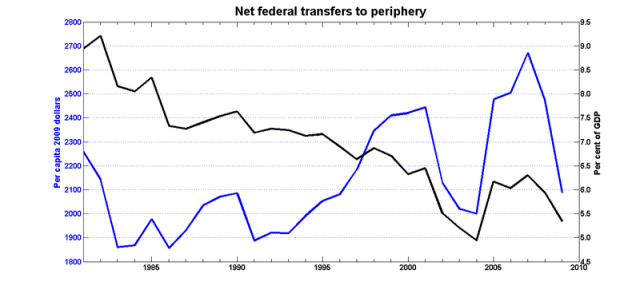
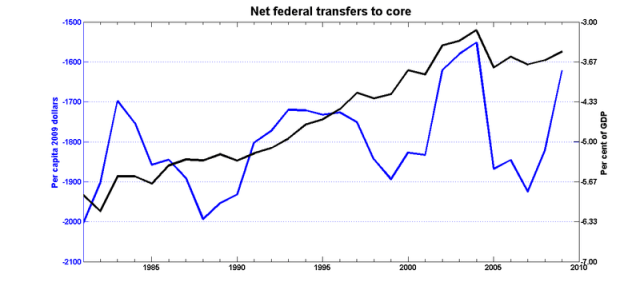
It would appear that these transfers have become less important over time. I'm not sure if this is due to a policy change, or simply because the provinces in the periphery are catching up to the core.
I've prepared similar graphs for Newfoundland, Prince Edward Island, Nova Scotia, New Brunswick, Quebec, Ontario, Manitoba, Saskatchewan, Alberta, British Columbia and for the Atlantic provinces; that would take up too much room to post, so click on the links if you're interested.
But there's one case that is interesting simply because it's so unremarkable: Manitoba. Manitoba's weight in Canada is similar to that of Greece in the eurozone: 3.6% of the population (3.4% of the eurozone population is in Greece) and 3.1% of GDP (Greece's share of eurozone GDP was 2.6% in 2008). Here is how net federal transfers to Manitoba have evolved since 1981:
According to Wikipedia, EU transfers to Greece were 1.3% of GDP in 2009; federal government transfers to Manitoba are routinely – blithely, even – 8 times as large.
The question of whether or not the euro will survive may simply come down to whether or not a framework can be devised in which eurozone core countries like Germany would be willing to regularly send 3%-4% of its GDP to the periphery. From where I'm sitting, I don't think a system to make possible those sorts of intra-eurozone transfers is likely to be created very soon. And if it doesn't happen very soon, it likely won't happen for a very, very long time.


 Worthwhile Canadian Initiative
Bob: “Presumably something like the CST/CHT transfers aren’t closely correlated with provincial GDP”
I don’t want to go into the history of CAP (Canada assistance plan, the matching grant program in place before the Canada Health and Social Transfer), and the whole cap on CAP episode but, yes, there has historically been a correlation between CST/CHT type transfers and provincial GDP.
Frances,
Fair point (I can still recall Bob Rae yapping, with some fairness, about how Ontary was getting screwed), although my recollection is that they’ve moved away from that recently.
I suppose, though, I’m missing the forest for the trees. Even if CST/CHT transfers are not correlated to GDP, the “net” transfer to the province is (since, if provincial GDP falls, the federal revenue from that province falls, increasing the “net” transfer even if expenditures stay fixed).
Bob: “Even if CST/CHT transfers are not correlated to GDP, the “net” transfer to the province is”
Precisely!
Tax points spring from Ottawa’s history of taking over the income tax system completely, starting in WWII. The tax rental agreements, which paid provinces direct transfers from Ottawa in lieu of personal income, corporate income and estate taxes made Ottawa the primary tax authority on income taxes.
While Bob Smith is correct that constitutionally both the provinces and Ottawa have equal power to tax income, the rub comes from the practical detail that there is only one taxpayer. Starting with the tax rental agreements, Ottawa set its tax rates at a level that would occupy all the politically and economically feasible tax room of the average taxpayer. Thus tax points were an abatement of federal taxes in favour of provincial taxes. Ottawa could seek to recover that tax room by providing transfers and raising taxes again, it would amount to a game of chicken with the provinces, one that Ottawa would likely win. The Public Service of Canada has a mountain of patience when it comes to gaining power.
The “tax power” strategy is not unique, Australia went even further. There the Commonwealth set its income taxes at the maximum possible rate and required that federal taxes be paid before state taxes, starting in WWII. The states would get transfers. After a two High Court of Australia rulings, the Commonwealth gained the sole power to levy income taxes and states were reduced to living on transfers. The process of tax centralization went much further in Australia than it did in Canada.
Australia went even further than that, apart from jacking up commonwealth taxes, they imposed a condition on federal transfers that the states not levy income taxes. Now THAT is an aggresive use of the federal spending power.
“Ottawa could seek to recover that tax room by providing transfers and raising taxes again”
Would it want to? Much of the spending that goes on in Canada goes on in areas of provincial jurisdiction (health, education, welfare). Apart from the questionable desirability of splitting the revenue raising/expenditure functions between two levels of government, politically it’s foolish. Raising taxes and transfering them to the provinces is loser scenario for the federal government, its get all the blame for levying taxes, while the premiers get all the glory from spending money (and if there isn’t enough money, they get to blame the feds).
Also, query whether terms and conditions imposed along Australian lines would be permissible in the Canadian framework. After all, the Australian constitution explicitly grants the federal parliament authority to impose the terms and conditions that it sees fit on transfers to the states. Although we recognize the federal spending power, it isn’t an explicit constitutional power, so you wonder if that would survive a constitutional challenge. It would also raise charter issues – how could the federal government justify treating Ontarians differently from Albertans (for example) as a consequence of the legitimate policy choices of their duly elected governments?
Bob Smith “”Montreal was the commerical heart of Canada until the 1970’s”
Indeed, the PQ was the greatest thing ever to happen to Toronto’s commercial and cultural life. We really should put up a statue honouring Rene Levesque.”
Pierre Fortin touched the subject in his 1996 presidentail address but even a CEA president with a Nobel-number of 1 can’t kill a good zombie meme…
http://www.jstor.org/discover/10.2307/136214?uid=3739464&uid=2129&uid=2&uid=70&uid=3737720&uid=4&sid=56283706123
(look at page 766)
So, once more into the breach…
As much as I enjoy the idea of the mighty Brits fleeing in terror at the arrival of the natives, it didn’t work out that way.
Census, old-age pension and family allowances data are quite clear. By the ’50’s, French Quebeckers stopped moving west while western francos going east ( especially for education) didn’t go back. You could live in french on the farm, not really in the west large cities so Montréal here I come.
As for Anglos, ON and the west growth meant more more opportunities and more QC anglos moved west than westerners moved east. By the late 60’s-early ’70’s, older Anglos began moving to retire with their grand-children. It is a simple diffusion model with nobody having political reasons as such to their moving. There is no clear sudden break in any series (no break at all in fact) and the QC-CN convergence continued.
One could argue that franco rise to power came through a power vacuum , not the other way around.
Boston and Philadelphia have essentially the same story even though there are no Pennsylvania or Massachusetts party to blame.
And Chiquita leaving Cincinnati OH for Charlotte NC is clearly ascribed to “ease of access”, that is DELTA Airlines dropping most international flights from CVG
http://www.foodandbeveragepeople.com/cm/news/chiquita_moving_headquarters_to_charlotte
and traffic being cut by 2/3 in the last ten years, a period in which Montréal YUL grew by 50%.
The Montreal anglo “elite” (The Gazette editorial board) is still smarting from the loss of their center-of-the-world pampered existence. Ah feel the pain but it doesn’t make theit faulty analysis truer. Mama, don’t let your son grow up to be a Gazette-Globeand Mail-Macleans reader.
I’d like to add CoC but Nick has the copyright…
Back to tax points, a truly fascinating topic.
Enjoy the long Canada Day week-end (or as we say here La Confédération)…
It’s not a zombie meme, Jacques, and as a descendant of those “Brits” I find your use of that term offensive. My family lived in Quebec since the 1820’s.
The Royal Bank of Canada, Sun Life, even the Bank of Montreal, all removed their operational headquarters to Toronto during the first two PQ terms, all moved because of “political risk”. The list goes on.
Law 101 was explicitly aimed at the heart of the Quebec Anglo community and it hurt. Montreal & Ottawa Conference, the United Church conference which covers Quebec historically relied on “Settlement”, the transfer of newly ordained ministers from Ontario to Quebec churches. Such ministers would send their children to the English school with their friends, but Law 101 forbade that. I narrowly missed being born in Quebec because my father had Law 101 rights due to attending a Quebec English school in the 1950’s. The family ultimately ended up in New Brunswick. The Settlement Committee strongly considered sending my parents to Quebec.
Law 101 was gratuitous that way. The United Church was very grateful for the Canada clause in the Charter of Rights and Freedoms which overturned that provision of Law 101.
Second, to follow on from Bob Smith, Australia had two High Court cases in the 1950’s in which the High Court ruled that Income Taxes were excise taxes and therefore under the Australian Constitution an exclusively federal domain. Yes, it was a legal fast one, but it stood. Legally Australian states can’t impose an income tax themselves.
Third, the spending power comes under the dreaded heading of the Reserve Powers. The federal government does have conditional transfers, the Canada Health Act deducts extra billing dollar-for-dollar from federal transfers, which is what caused extra billing to disappear. Conditional transfers appear to be legal.
Fourth, in the spirit of Canada Day, my one and only desired constitutional amendment is to overhaul and revive Section 94. This section has never been used, but it was supposed to allow the Federal Parliament to pass uniform laws for “property and civil rights” in the Common-Law provinces (not Quebec, this procedure does not apply to Quebec and therefore Quebec can’t use it even if it wanted to). In 1867 that meant wills, civil procedure and property. Such uniform federal laws could only be applied with the consent of the provincial legislature.
Australia has a more modern form of this idea, that is how the national Australian Securities Commission came into being, the states acceded to a uniform Commonwealth law.
My version would allow Quebec to opt in. Even Jacques should not object, no law would apply to Quebec under this section unless the National Assembly assents. I would clarify that my idea is that only Ottawa could propose and amend laws under this section, provincial legislatures would have to vote up-or-down. Further, I propose that laws under this section would by default apply for five years, after which they would have to be renewed; in other words the “opt-out” date on which a province could withdraw its assent would be at the five year term, just like Ottawa does with the Bank Act review every ten years.
In Canada such a procedure would be extremely useful to allow for federal laws to directly address property and civil rights. Under such a provision, Ottawa could legislate and run a national securities regulator, we could have a uniform pension law system, the sky’s the limit. But Ottawa could not abrogate the Civil Code or any other Quebec law so the National Assembly shouldn’t worry.
Actually, I got this idea from a Quebec lawyer who posted an article on it.
Determinant: The ” Brits” was an attempt a quip. It was inspired by a meeting with a high-level mining executive when I was a political attaché. Sorry if it misfired. My apology.
Bank headquarters were already empty shells by the late 60’s. Some top executives still maintained their homes in Montréal out of habit ( or for their wives bridge games) but many of them commuted to Toronto. At least, those I interviewd in my incarnation as financial journalist.
The point is that there is no observable break in real variables.
Some good people were wounded by petty dispositions of the original Bill 101. Not that I espouse retaliations but none of these dispositions were remotely comparable to Regulation 17. Most Anglo-Québeckers were and behaved as decent, honorable people. Enough didn’t to the point of making life sometimes very unpleasant. Here, it wasn’t until the mid-70’s that workers could have a work contract they could actually read.It was Keith Spicer, after all, who used the term “Westmount Rhodesians.”
Under that law, my college went from French to bilingual. And the hospital here give full service in English to 5% of the population.
The Supreme Court overturned provisions that are not only legal but considered common-sense in Switzerland, Finland and Belgium. Diff’rent stokes for diff’rent folks maybe , but these clauses were hardly violations of human rights as commonly understood in some major western democracies.
Your 4th point is a very interesting one with which I and probably a lot of Québécois would agree to. The consequences would be to create a binational confederation instead of a ten-provinces deal. The two-canoes-in-the-river peace wampum…But your view and mine is about how decent peoples can organize themselves into a workable polity for the common good and mutual prosperity. It’s not the view of some in the media-political elite of this country. They have more power than you and me. Our loss.
Enjoy the Souther Ontario sunshine. Here the weather will be awful…
It sounds like a binational confederation, but my proposal doesn’t do that. PEI could object to a Section 94 law (it can today) as much as Quebec presumably could. Whether Ottawa would want to propose laws that only apply to certain provinces is a political and policy question under my proposal, which is as it should be. No more petty squabbling in front of the Supreme Court.
What my Section 94 would allow is a direct and easy way to implement complicated legislation that cannot be easily categorized under the existing divisions of Sections 91 and 92. Think back to 1866 and the old Province of Canada. The Legislative Assembly of Canada could pass any law it wanted and didn’t have to worry about the division of powers. This proposal would allow that to happen again. No more Division of Powers appeals to the Supreme Court. Ever.
A good example is securities regulation. A Section 94 law would allow the complete merger of securities law (property and civil rights, provincial) with the criminal law (federal) in a single Securities Act. That merger is what gives the SEC its teeth in the US. That lack of teeth greatly hampers Canadian securities regulation. Canada has a poor reputation for fraud prosecution and consumer protection for certain investments (think seedy and pushy investment advisors). Not with my proposal. Watch out scum, here come’s the super-charged Canada Securities Act, complete with 10-year prison terms and investigators who are both securities regulators and peace officers. No more junk advisors defrauding Grandma.
Or Engineering. Unlike the lawyers (who are exceedingly provincial), engineers have wanted a single national regulator (even in Quebec, SNC-Lavalin would love it) for eons. But it falls down on division of powers and provincial jealousy. So we could have a single Engineering Act (Quebec could tag on its language requirements, easy to write in) and the lawyers could do what they want.
Insurance could and probably would consolidate into a single 9-province regulator for the common-law provinces with a separate regulator for Quebec. Insurance is based on contract law and the Civil Code makes enough difference that you really have to have a Quebec-specific regulator and regulations, you can’t get away from it.
Regulation 17 was gutted in 1923 and French schools were fully recognized in Ontario by 1968. Sure it was nasty, but it was long ago resolved.
Switzerland isn’t the support you think it is. Don’t think language, think religion. Geneva was the birthplace of Calvinism but by 1905 some annexations in the 18th century and changing demographics led to a significant Catholic minority in the city of Geneva and a Catholic majority in the rural canton. As a result the Church of Geneva (Calvinist, very Protestant) was disestablished and the canton of Geneva went for multi-religion recognition.
Dunno what you’re chiding the Supreme Court about, aside from the Commercial Signs debate (yawn on that one). The other major line of cases was the attempt to limit the use of English in the National Assembly and to make the French versions the only official ones. That attempt was patently illegal under Section 133 of the British North America Act which mandates that Quebec laws must be published in English and French and both versions are equally authentic; further that both languages may be used in the courts and in the National Assembly (without limit). Nobody should have been surprised on that ruling, least of all the PQ.
The Federal Government and Manitoba are held to the same standard and the Supreme Court’s line is the same: Section 133 mandates complete legislative bilingualism in those three jurisdictions.
Toronto had a bigger market and it was up-and-coming by the 1930’s, Montreal kept its place as long as it did by momentum more than anything else, but Law 101 was a slap in the face and tore the dress off the old lady.
I should be clear. I am not proposing to gut, alter or change Sections 91 and 91, the existing Federal and Provincial Powers lists, in any way. What I am proposing is a workable framework to enact laws that need to be national for policy reasons (like securities regulation) but which need to combine powers found in both Sections 91 and 92 in order to be effective and make constitutional sense.
In my proposal, the Criminal Law and Patents are still federal and education and natural resources are still provincial.
For instance Securities regulation could combine the federal Criminal Law power (20-year sentences for Ponzi Schemes, 5 years for violating insider trading rules and other delights) with the provincial Law Enforcement and Property & Civil Rights powers. All administered by a single securities regulator, paid for by Ottawa, with investigators who are forensic experts and who are backed up by the RCMP, seamlessly. Quebec could even agree to have the RCMP Securities Enforcement Squad do its thing in Quebec, crackerjack forensic accounting experts are blindingly expensive. It’s just plain cheaper to share. The SQ can carry on policing rural Quebec villages and investigating bikers as it usually does.
And on the subject of asymmetric federalism, Ontario has never contracted the RCMP, we have the OPP, just as Quebec has the Surete du Quebec.
Canada is a country that in theory should be a disaster but in practice works rather well. Why not turn Section 94 into the legal ultimate sausage-making machine and become simply outstanding?
Determinant,
There’s no doubt that the feds can make conditional transfers, but there’s a world of difference between the (very modest, and rarely applied) conditions associated with the cht and a condition saying the provinces can’t levy income tax. Apart from being politically suicidal (Quebec would go nuts), it strikes me as being a condition that effectively guts the provincial taxing power – given the push back the feds have received from the scc on their last attempt to intrude on provincial powers (the securities reference), i don’t see that being well received.
I’m not an Australiqn constitutional lawyer, but I don’t think you’re right about their state taxing powers. The Australian states did, after all, impose income taxes pre-1942. I know there are Australian cases which held that sales taxes were excise taxes, therefore part of the exclusive commonwealth jurisdiction, but I’m not familiar with a similar case dealimg with income tax
As for section 94, the basic problem (apart from the fact that it needs to be amended to cover NFLD and the western provinces) is that if the common-law jurisdictions could agree on a common, say, securities scheme, we likely wouldn’t need federal legislation – the provinces could do it themselves (ie., a passport system). Section 94 fell into disuse because, in effect, its little more than a power for the federal government to draft legislation that the provinces can enact if they so choose. The likelihood of them doing that on any matter of substance is precisely zero.
That said I can think of at least one good example of the sort of asymetric federalism you’re thinking about, namely the GST/HST/QST system. As of Jan 1, 2013, we’ll have a more or less harmonized national tax regime, with different tax rates in different provinces, collected under a combination of federal and provincial (Quebec) legislation.
In some ways the HST is much more of throwback to old style “tax rental” agreements in as such as it is solely imposed under Federal law despite having different rates for different provinces(For example a retailer doing business in New Brunswick, Ontario, and Newfoundland doesn’t have to keep track of the number of sales in each province only that all items should be charged 13%). While few Canadian tax scholars go as far as to say that most observers I have seen from outside of Canada tend to call the HST System a form of tax rental.
The next area of tax harmonization might be shifting the corporate income tax base back to Ottawa especially if some provinces(such as Ontario) are unsuccessful over the next few years in bringing there rates down to 10%. Corporate tax harmonization was given a big boost when McGuinty shifted Ontario CIT collection back to the feds in 2007 undoing a policy of Ontario governments that went back to the 1940s. The next interesting move is whether Alberta under Allison Redford would also give their CIT collection back to Ottawa which could bring about a move to completely eliminate provincial CIT legislation and “go back” to tax rentals agreements on the corporate side. There are quite few people out there who have thought for many years that provincial governments shouldn’t be in the CIT business to begin with due to the highly mobile nature of corporate capital its just until McGuinty gave back CIT collection no one thought the politics would ever allow this. What I find most interesting about Dalton McGuinty is he is attempting to undo many of the policies of Oliver Mowat the only other Liberal Premier of Ontario who has served longer than he has. There is also an argument that since the days of Bill Davis Ontario has been moving towards a much more centralized view of confederation but in the meantime personal spite between David Peterson, Bob Rae, Mike Harris, and Ernie Eves and the prime ministers of the day held up many overdue reforms.
Determinant:
Thinking about this over lunch if I was running a national political party today and was looking for a new and innovative proposal to ease the strains of Federalism one idea that came to mind would be to seperate the Ottawa Gatineau region from both Quebec and Ontario into a new seperate national capital territory/province similar to the District of Columbia or Australian Capital Territory. This new CCT(Canadian Capital Territory) would be fully bilingual at all levels of government and would extend 30 miles in all direction of Parliament Hill and would include Macdonald Cartier Airport and other major Ottawa area infrastructure. Ontario would lose the “prestige” of hosting the nation’s capital but you would have a capital city that “belonged” to all Canadians so to speak. Residents of CCT would still unlike residents of DC be represented in Parliament but the CCT(Canadian Capital Territory) would not necessarily have all the powers of a province. In this scenario for example the existing Federal Government Controlled National Capital Commission would be merged into the new CCT government.
One of the nice characteristics of economics as a field is an awareness of data-mining…
– So we find some data which shows there are transfers within a federal system…
– Then we observe that one “federal system”–the EU has lower fiscal transfers and is having a ‘crisis’.
– Hmm, talk about a glaring leap from A to B
I enter the following cause for skepticism about this claim: there has been a common currency sustained in these federal systems long before the government’s share of GDP exceeded more than a few percent.
There’s also a theory that says that fiscal transfers are an important feature of a successful monetary union.
The fact that a common currency was sustained doesn’t mean that it was always optimal. Maybe people suffered needlessly in order to maintain it.
As for section 94, the basic problem (apart from the fact that it needs to be amended to cover NFLD and the western provinces) is that if the common-law jurisdictions could agree on a common, say, securities scheme, we likely wouldn’t need federal legislation – the provinces could do it themselves (ie., a passport system). Section 94 fell into disuse because, in effect, its little more than a power for the federal government to draft legislation that the provinces can enact if they so choose. The likelihood of them doing that on any matter of substance is precisely zero.
First, about Australia, while the States did levy income taxes prior to 1939, a pushy Commonwealth and a pliant High Court stripped them of that right in the First and Second Revenue Cases. I said it was a legal fast-one. Note that I have never argued for this system in Canada, except in my wildest dreams.
Second, there is a legal consensus that Section 94 applies to all the common-law provinces. But I would amend it to put Quebec in, because securities law involves property and civil rights.
My proposal is more subtle than you’re thinking, and you’re missing my point for years of Canadian jurisprudence. I’m turning that jurisprudence on its head.
Right now, we say that Property and Civil Rights is a provincial matter. But what happens when we want to address a Property & Civil Rights matter nationally? Industry does not want 10 passports because it’s nonsense. Nova Scotia does not have jurisdiction in Ontario, and vice-verse. Further there is no mechanism to enforce uniformity in a passport system.
The Federal Government does have jurisdiction throughout Canada and therefore is the only one that can provide realistic, consistent national enforcement to a uniform national act. That is its entire purpose. It is nonsense for Ontario or BC to be national regulators. Besides, business does not want 10 diverse regulators with 10 opinions, they want a single, consistent regulator. That’s one reason we have a single Supreme Court which hears any cases it likes from the provincial Courts of Appeal.
More crucially, Section 94 can combine powers from Section 91 and 92 into a single, coherent act. It is therefore the ultimate in legal consistency, uniformity and parliamentary sovereignty. It would be subject only to the Charter of Rights. So securities regulations could be enforced in the same act with stringent criminal penalties, penalties currently unavailable to provinces. Or place securities law in the jurisdiction of the Federal Court in a Section 94 Act, so that there is a single securities bench throughout Canada, right down to trial level.
We don’t just want the law, we want the singe enforcement too.
The Supreme Court’s Securities Reference was not so much couched on securities as the fear that letting Ottawa into Property & Civil Rights would be the thin edge of the wedge for provincial autonomy. So let Section 94 be a safety valve. We can try a uniform law out for a period of years and then 25 years later have constitutional amendment that everybody agrees with because they have lived with it for so long. Why not road-test constitutional ideas before casting them in stone? Section 94 would be far, far easier to clean up after.
And it means that Ottawa will not eat Property & Civil Rights whole hog, just the bits that the provinces have trouble digesting.
Australia has an exact counterpart to this section in their constitution, that’s how securities came to be regulated federally in Australia. Why can’t we do this. We have traded powers back and forth between the feds and the provinces in Canada, we’re just quiet about it and it’s mainly been administrative law. The Federal Government had exclusive jurisdiction over Fisheries but ceded control over freshwater fisheries to the provinces, who manage them for conservation and local use. Ottawa has confined its interest to large, commerical saltwater fisheries. In Ontario and Quebec the provincial MNR enforce the federal Fisheries Act under agreement with Ottawa.
Criminal Law Enforcement is a provincial jurisdiction but the RCMP has been contracted to do provincial policing for a century in various provinces. Ottawa pays 30% of the costs for small municipalities and 10% for ones over 15,000. Did BC, Alberta and Saskatchewan all of a sudden become impotent and politically powerless when they contracted for the RCMP? It doesn’t appear to have ruined their provincial governments.
Section 94 would not gut provinces, it’s a safety valve for those few matters of property & civil rights that are not local in nature.
Stephen,
Even if that were true, there is another hurdle to face: in the US those transfer payments are largely due to static and are not related to fiscal stabilizers.
(So for instance, New Mexico has three air force bases and two national scientific complexes. Indeed, half of the land in New Mexico is owned by the Federal government… http://pearce.house.gov/sites/pearce.house.gov/files/NMLayout_0.pdf (white areas are private or state owned! It would be interesting to see the effect of corporate income taxes; the big thing most of the dark green states on the economist map are known for is headquartering major corporations. Thus the corporate income tax is predominately booked in those states.)
This is definitely a situation where more data and more analysis could be very revealing… I’m definitely expecting that if you start pulling the claim apart it will disintegrate.
Tim:
Ottawa has a population of a million. I don’t know if you live there or not, and I know the NCC has been controversial, but a national capital territory wouldn’t make a difference, IMO. Hating Ottawa is a traditional Canadian sport. ISTM everybody hates “the Feds” but nobody I know ever raises an issue about Ottawa being in Ontario. Besides, 40% of the Public Service in the National Capital Region is located in Gatineau. Interprovincial commuters are very common. Seems much ado about nothing.
I know Mike Harris was a little hard about not making Ottawa officially bilingual, but neither is Gatineau, though both are in practice.
Jon, the point is indeed the changes in the size of the transfers. If you look at (say) Alberta and Ontario, you see that they move with changes in commodity prices – the most important asymmetric shock – and that those changes are large.
How to sell Section 94 as an amendment while killing two birds with one stone: The RCMP.
The RCMP is the provincial police force in all provinces except Ontario & Quebec. The lines of authority are somewhat hazy, partially because the constitutional lines are hazy. Section 94 could clear that right up. A province that contracts with the RCMP accedes to federal legislation as having effect under Section 92(14). Bingo, nice, neat constitutional mechanism for the federal assumption of provincial powers. For example Ottawa could create an equivalent of the Special Investigations Unit in Ontario (investigates police shootings) and it would have identical authority as a provincial counterpart by virtue of this section.
Determinant, fair point on section 94 applying to the other common-law provinces (if you look at the terms of union for those provinces, it’s reasonable inference that it was intended that section 94 would apply to them).
But your other points are just wrong. Section 94 doesn’t allow the feds to combine federal and provincial powers from section 91 and 92, it’s ambit is expressly limited to allowing the federal government to legislate in the area of property and civil rights – so at most it alows the feds to combine powers from section 91 and subsection 92(13). So they could not, for example, rely on section 94 to legislate in respect of the administration of justice in the provinces.
“Criminal Law Enforcement is a provincial jurisdiction but the RCMP has been contracted to do provincial policing for a century in various provinces. Ottawa pays 30% of the costs for small municipalities and 10% for ones over 15,000. Did BC, Alberta and Saskatchewan all of a sudden become impotent and politically powerless when they contracted for the RCMP? It doesn’t appear to have ruined their provincial governments.”
No, but note the wording the RCMP “has been contracted”. That isn’t an example of the federal government legislating in areas of provincial responsibility, it’s an area where the federal government has offered a service (not, at least in BC, a particularly good service) and certain provinces have chosen to contract with them. When the RCMP arrests people in, say, BC they’re arresting people on behalf of the provincial government, not the feds (that likely doesn’t mean much to the people being arrested, but it’s not an unimportant constitutional point). The problem in BC isn’t that lines of authority are constitutionally hazy, they’re not. The problem is that the only relationship between BC and the RCMP is a contractual one, so BC can’t fire or discipline individual officers and is, understandably, reluctant to “fire” the RCMP and replace them with their own police force (given the cost and possible disruption of making that transition). That’s a contractual problem, not a constitutional one.
“Right now, we say that Property and Civil Rights is a provincial matter. But what happens when we want to address a Property & Civil Rights matter nationally? Industry does not want 10 passports because it’s nonsense. Nova Scotia does not have jurisdiction in Ontario, and vice-verse. Further there is no mechanism to enforce uniformity in a passport system.
The Federal Government does have jurisdiction throughout Canada and therefore is the only one that can provide realistic, consistent national enforcement to a uniform national act. That is its entire purpose. It is nonsense for Ontario or BC to be national regulators. Besides, business does not want 10 diverse regulators with 10 opinions, they want a single, consistent regulator. That’s one reason we have a single Supreme Court which hears any cases it likes from the provincial Courts of Appeal.”
Well, section 94 doesn’t really provide a remedy there does it? First, it’s not national, as it explicitly excludes Quebec. So, at best, it gets you to a 2 regulator regime, rather than a 10 regulator regime. In practice, the AMF in Quebec tends to be the troublesome regulator, so that’s a significant gap. Moreover, in practice, businesses don’t face 10 regulators with 10 different opinions – generally the regulator with the closest connection to the relevant issuer takes primary responsibility for dealing with them, and the other regulators defer to their decisions. True, the OSC may have no jurisdiction in Nova Scotia, but if Nova Scotia agreeds to be bound by decisions of the OSC (and vice-versa), that’s a moot point.
Second, and more importantly, section 94 can only provide a “national” (understood as excluding Quebec) legislative regime if all the provinces agree to be bound by it. But much of the anguish over securities regulation in Canada arises from the the non-uniformity of provincial legislation. It isn’t clear why we would expect provinces who are unwilling to conform their own legislation amongst themselves would otherwise be willing to adopt a uniform national legislation. Without that willingness, section 94 is a dead letter.
As for the suggestion of having securities law administered by the federal courts, wow, where to begin. I don’t see how legislating under section 94 would shift securities legislation into the jurisdiction of the federal courts. Notwithstanding that such legislation may be federal legislation, it would still relate to civil matters in the provinces, so any proceedings relating to such matters would still be governed by the superior courts of the provinces (like, for example, criminal law).
“First, about Australia, while the States did levy income taxes prior to 1939, a pushy Commonwealth and a pliant High Court stripped them of that right in the First and Second Revenue Cases.”
Determinant, that’s just wrong. The high court didn’t strip the states of the “right” to levy income taxes, it affirmed the right of the commonwealth to impose conditions on grants. Very different point. In fact, both cases confirmed that the right to levy income tax in australia was a concurrent right of both the state and commonwealth governments (were that not so, the conditions on federal grants that were the meat of those decisions would have been moot). In practice, it may have gutted that right (by making the levying of income tax at the state level politically suicidal), but the right continued (and continues) to exist.
Tim: “In some ways the HST is much more of throwback to old style “tax rental” agreements in as such as it is solely imposed under Federal law despite having different rates for different provinces(For example a retailer doing business in New Brunswick, Ontario, and Newfoundland doesn’t have to keep track of the number of sales in each province only that all items should be charged 13%).”
Fair enough, as far as the HST goes, but I was thinking more about the integration of the GST/HST regime with the QST. It’ll be interesting to see how closely Quebec can integrate their regime with the federal law. Interestingly, in at least one area, with respect to the imposition of QST on financial institutions, it looks like Quebec just said “screw it” and gave up, because they’re proposing to have amendments to the GST/HST regime applicable to certain financial institutions (SLFIs) (which, at a high level, tries to impose GST/HST on financial institutions based on whether their assets/investors are, depending on the time of institution) to deem Quebec to be an HST province for the purpose of those rules, so that Ottawa collects the provincial portion of the deemed HST (i.e., the QST) for them. That’s a smart compromise on the part of Quebec (the SLFI rules as unintelligible as is, so trying to integrate two different legislative schemes would be unworkable).
There should be a variant of the Godwin Law specifically for Canada. It should read something like this : “As an online discussion about Canadian politics/policies grows longer, the probability of someone finding a way to somehow blame something on Quebec’s Bill 101 approaches 1.”
I think there’s a variant of that dealing with most policy discussions in Canada and the words “American-style”.
First Bob, I proposed to overhaul and rewrite Section 94, not use it as is. I want to make it more like the Referral Power in Australia. Australian states can refer matters to the Commonwealth so that Commonwealth law applies on state matters and is enforced by the Commonwealth. The Referral Power applies to all state matters, and so would my improved Section 94. Further, Quebec needs to be in, nothing would bind it without its consent. Why shut yourself out of the conversation? Given the broad pool that is Property and Civil Rights and the fact that this protects Quebec’s Civil Code, dividing it up by Section 94 is a good strategy because Quebec does not want Ottawa to eviscerate the Civil Code. Fine, that’s a perfectly valid view. Since Australia’s referral power has been used repeatedly since Federation there, I believe it would be just as useful in Canada.
As my improved Section 94 would allow Ottawa to legislate in any provincial matter so long as the province in question agrees to the final Act, a Securities Act could declare the Federal Court as the venue for securities cases in provinces which adopted the federal Securities Act under Section 94. The Federal Court then would be the superior court in the province for securities matters. Whether that is advisable or not is a political matter, to be sorted out by politicians, not constitutional lawyers.
Engineering, Insurance and Securities are three examples in Canada of mostly uniform provincial acts that respective their industries don’t like and where the players have expressed repeated interest in a single, national act with a single national regular providing uniform enforcement.
Nobody in these industries gives much thought to provincial power games. The Supreme Court’s comment in the Securities Reference that allowing Ottawa to regulate professions was constitutionally absurd as these are local matters would have been laughed at by the Engineering profession. That is a legal practitioner’s view, not an engineering view.
Second, the First Uniform Tax Case in Australia held that the Commonwealth could raise income taxes to include state levels, and most importantly the Commonwealth was able require payers to pay their Commonwealth tax obligation before paying State taxes. Further, though incidental, the Commonwealth could operate a grants scheme. In Australia commonwealth laws are superior to state laws and the Commonwealth has a general power to tax.
This interlinked series of steps was constitutional even though it deprived states of the practical ability to impose income tax and rendered their income taxing power a dead letter. Indirect compulsion was legal.
In the Second Uniform Tax Case the High Court held that Section 109 of the Australian Constitution which states that Commonwealth law is superior to state law in concurrent matters, and that as long as a tax is uniform and does not discriminate between states (expressly prohibited), it is legal. The Commonwealth has no duty to allow states to exercise their concurrent powers in meaningful, practical ways. Thus there has been no state income tax in Australia since 1942. So Australian states have the right to impose income taxes. It was a Pyrrhic victory.
Well, if we’re amending the constitution, why just introduce another subsection to section 91 giving the federal government the power to regulate securities, insurance, engineering, what have you. If a national regulator in those fields is good policy, if you have to amend the constition any how, it seems silly to rely on section 94 (even as amended) which relies on provincial consent, when you could just enact specific provisions to deal with those industries, or better yet, clarify the federal power to regulate trade and commerce in 91(2) to provide that it gives the federal government to regulate those sorts of industries more generally. I suppose that amending the constitution may be easier than getting universal provincial consent under section 94 (since you only need 7/50% support), but in practice amending the Canadian constitution is synonomous with impossible.
For what it’s worth, the proper way to address these sorts of issues is to amend the trade and commercerce clause in section 91(2) to better reflect what I suspect was the original intention of the fathers of confederation, namely to give the federal government the jurisdiction to regulate national industries (reflected in the explicit power to regulate banks recognized in 91(15) and (16), navigation and shipping in 91(10), and the exclusion from provincial jursidction of inter-provincial railways in 92(10) and captured in 91(29)). Unfortunately, that section has taken a fair bit of judicial abuse over the years, but looking at the structure of that section, if I were just to read the text of the constitution, I’d read that as granting the feds a broad power to regulate trade and commerce, of which some of the indutries mentioned were specific examples. I don’t think that section will ever be amended either, though, but the SCC has been known to take a 180 on its prior interpretations of the constitution.
That may the end effect, but amending the constitution is a permanent thing, it casts a decision in stone. Section 94, in my view, especially with term limits (they do that in Australia) is a way to “preview” a change, based on a specific Act. So things might be asymmetrical for a time; insurance will always have that feature because the Civil Code is a different paradigm for an industry which turns on contracts more than most. Fisheries enforcement is asymmetrical right now, it says so on Fisheries & Oceans Canada’s own website.
Section 94 would be a way to field-test uniform acts and their effects before making them permanent with constitutional amendments. A constitutional amendment would be the end goal rather than the beginning. Constitutional negotiations frequently fall down on the fear of unintended side effects rather than on the fear of an amendment’s plain meaning. A constitutional amendment is the end goal and a political settlement, Section 94 would be the means.
I agree with you on the Trade & Commerce clause, but the Judicial Committee of the Privy Council are known as the Wicked Stepfathers of Confederation for a reason. “Property & Civil Rights” is a phrase which originated in the Quebec Act, 1774 which restored French Civil Law. For Quebec it is expressly a protection of their Civil Code. Now the Civil Code has borrowed Common Law concepts over the centuries, most lately trusts. The key to constitutional negotiations is to get Quebec onside. Not having them onside is frankly dangerous, fractitious and leads to eternal conflict. Section 94 would allow Quebec in particular to get comfortable with a change and if they aren’t it would allow everything to be repealed easily and reset to the status quo ante.
In my opinion, and in the Quebec lawyer’s opinion which inspired me, Section 94 would be a useful framework for political discussion and recast many constitutional questions as political rather than legal ones. It’s a safety valve.
Right, but as you point out, in its current form, section 94 can’t achieve what you want it to achieve. So a constitutional amendment would be neccesary. Getting Quebec onside matters, but that’s easier said than done, given the baggage associated with the repatriation of the constitution (i.e., Quebec isn’t going to attach its signature to a constitutional amendment, however limited, unless its outstanding constitutional demands are met, which demands are probably unacceptable to the ROC). If we were starting from scratch without the baggage of the repatriation, Meech Lake or Charlottown, sure, amend 94, what’s the harm, the provinces can always opt-out (although, as I noted, there is some uncertainty on that point), but that isn’t the environment we live in.
As for “previewing” a uniform policy, it isn’t clear why you need federal legislation to do that, the provinces can agree to enact uniform legislation within their own areas of jurisdiction with delegated authority to a single regulator (and if they can’t agree to enact uniform legislation amongst themselves, how could they agree to adopt uniform federal legislation?). Sure, there’s no authority to keep them from opting out, but if they can opt-out of section 94 legislation, how is that different?
Who champions national legislation? It should be the federal government. Who will be that delegated regulator? Ontario? BC? That isn’t the kind of federalism I believe in. The provinces putting together a national strategy without the Federal government is not supposed to happen. Happy coincidence is OK, but not as a strategy for operating a federation. National strategies should go through the national government.
Section 94 would give national legislation a definite champion, the federal government, even in Section 92 areas. I should be clear that I am perfectly fine with incremental changes that affect one province at a time, that has happened in Australia too. I don’t believe that all provinces should have to assent to a piece of legislation under Section 94 to make it operative. 6/10 works, even 1/10 works if that what a province chooses. Let the results of their own choices be the convincing factor instead of cajoling. As Richard Gwyn so ably says in his Macdonald biography, never let perfection stand in the way of the possible. Instead of “delegation” agreements or passports, use a clear constitutional mechanism to pass matters up and down between the provinces and Ottawa. If it is a provincial heading that has become national, Ottawa is responsible for it, Ottawa can act on it, the province agrees to let Ottawa act and accedes to the federal measure in the provincial domain. One act, one regulator, once enforcer, one minister responsible. One leader per issue. That’s how it was in 1866 and how it should be again.
Some current legal forms, like delegation agreements and the spending power, are ways developed in lieu of the kind of Section 94 I am thinking of. They are alternative strategies (that I think are sub-optimal) which wouldn’t be necessary anymore.
Quebec agreed to a specific Quebec amendment when Catholic/Protestant schools were replaced 15 years ago with French/English ones. Quebec used the repatriated amending formula to bail out of Section 93, the Separate Schools Guarantee which still applies to Ontario. In that case both the National Assembly and Parliament had to approve the measure as it affected one province, per the 1982 amending formula.
Call me a dreamer, but the internet lets you see how these things work in other places. After the perfect failed in the Constitutional Wars, why not try something different?
Here’s the original article: http://www.irpp.org/po/archive/mar07/adam.pdf
Robert Mianville: “”As an online discussion about Canadian politics/policies grows longer,… “. In February 2011, Krugman posted on housing prices in Australia. Within an hour, by comment 31, yep…
Determinant: Jacques will not retort, as he his now into his annual-pilgrimage-to-an aviation-museum preparation mode…
“National strategies should go through the national government.”
All well and good, but that isn’t the constitutional framework that we live in. Moreover, existing securities practice does give a framework for how a provincially legislated “national strategy” works. Much of securities practice is governed by national or multilateral instruments agreed to by the Canadian Securities Administrators – i.e., a more or less harmonized set of rules that apply accross Canada. If you’re an issuer in, say, BC, you may be dealing with BC securities commission, but you’re governed by the same rules (generally) as an issuer in Ontario dealing with the Ontario securities commission. Moreover, in that example, the BC securities commission makes decisions vis-a-vis the BC issuer, and the Ontario securities commission makes decisions vis-a-vis the Ontario issuer, and each of the BC and Ontario commissions respect (and follows) the decisions of the other. That there is a fairly harmonized body of national securities regulation isn’t a function of happy coincidence, it’s a function of conscious agreement amongst the provinces.
Seen in that light, the notion that “national strategies should go through national government” reflects an ideological bias, it’s not a function of neccesity. Granted, the body of national securities regulation is only “more or less harmonized”, there are a number of areas where the provinces can’t (for whatever reason) agree amongst themselves. Fair enough, that’s a criticism of the existing securities regime, and an argument for giving the federal government a broad power to legislate over securities regulation in its own right (for example, by amending section 91 of the constitution). However, that isn’t an argument in favour of the section 94 style approach you’re advocating for. After all, if the provinces haven’t been able to agreed on a single cannon of securities law amongst themselves, it isn’t clear why they would agree to a single cannon of federal securities law. Similarly, I’m not sure why you think having, say, 6/10 or 1/10 provinces governed by federal securities law would be an improvement over the status quo – unless one accepts that the federal government is inherently more competent than the provinces (which is questionable to say the least). And it’s worth noting that only Ontario supported the proposed federal Securities Act (no doubt in part because it suspected that the new federal securities regulator would be based in Toronto), so at present the 1/10 outcome is the likely one. If the issue with the current securities regime is it’s patchwork nature, why does that become less of a problem when that patchwork includes federal legislation?
As for amending the constitution, yes, section 94 could probably be amended to include Quebec with only the support of Quebec (although a broader amendment to section 94 would probably require approval under the general amending regime), but do you think that makes it easier or harder to amend section 94? The likelihood of Quebec amending the constitution to even theoretically expand federal powers in traditional areas of provincial jurisdiction is nil (at least under the general formula you can in theory, though it would be dangerous in practice, amend the constitution without Quebec’s approval).