Ontario’s government is now engaged in public sector
restraint and reform tackling its doctors and teachers in an effort to wrestle
down its 15 billion dollar deficit.
Soon it will be turning its attention to universities. Indeed, work is already underway on an
ambitious plan to reform the university sector which according to reports on the activities of colleges, universities and
training minister Glen Murray includes having only three year BAs, year round class
offerings, standardized first and second year course offerings that are
transferrable across institutions, more experiential learning, student centered
learning and an online university.
Ontario universities have apparently also been asked to provide by the
end of September a list of the things that make them unique in terms of their
mission and program offerings. It
promises to be a massive overhaul on top of several decades of constant change
in Ontario universities in terms of funding, program changes, faculty turnover,
new technology technology and rising enrollment.
So, what is my point?
Well, my concern is not over whether these reforms have merit or
not. They may or they may
not. My gut feeling is that the
proposed changes if implemented will point the way to a more homogeneous and
factory-like Ontario university environment but I digress. My point has more to do with the degree
of intrusion that Ontario’s government already has in university affairs in
terms of regulations, program approvals, and things like “quality assurance”. I mean, given that the provincial
government almost completely funds the elementary and secondary school system and
the provincial health care system to nearly as high a proportion, they
certainly can justify intervening there in any manner they see serving the public
interest. After all, remember the other “Golden Rule” – he/she who has the
gold, rules.
Yet, Ontario does not have that much gold anymore. Indeed, when it comes to universities,
the Ontario government seems to have some very high expectations of what it
wants them to do especially given that their contribution to post-secondary
finances has declined substantially over the last two decades. In 1989, nearly two-thirds of
university and college revenues in Ontario came from provincial grants and yet universities
then had a great deal more autonomy than they are about to get given the
program changes and standardization the government seems to be suggesting. Today, provincial grants only account
for 37 percent of university and college operating revenues in Ontario while the share of
tuition has grown from 12 percent to 26 percent. The remainder is filled with compulsory fees, federal
grants, research funding and contracts and other revenues.
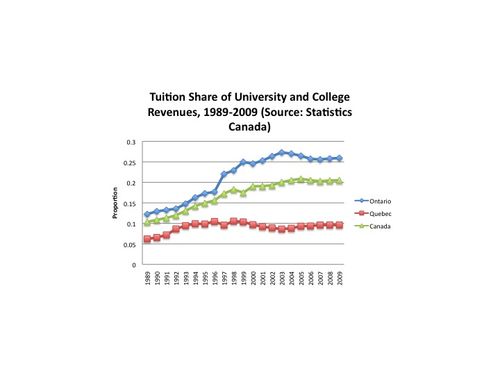
As the accompanying graphs show, compared to Canada as a
whole, Ontario has offloaded a much larger share of its post-secondary operating
revenues onto student tuition and other revenue sources. Almost 50 percent of operating revenues
for universities and colleges in Canada comes from provincial grants (this proportion would
be higher if you omit Ontario) and in Quebec the share is where Ontario was in
1989.
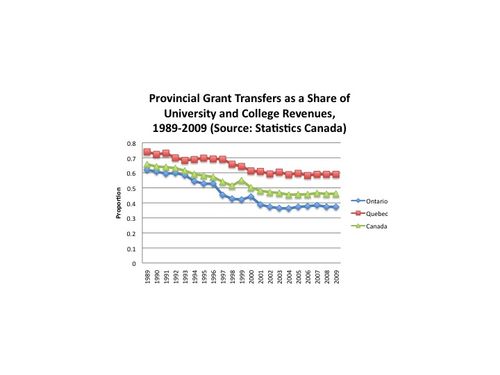 Ontario is about to subject its universities to another round
of changes in their operations and programming and yet it is footing less than half of the bill. It would appear that cash strapped Ontario now views
even its current level of support as too high and is looking for savings though how much cheaper an online university would actually be is an interesting question. In the process, it is increasingly
treating universities not as autonomous institutions but as another government
department – with heavily discounted funding. There seems to be an imbalance between
the bill that Ontario foots for its post-secondary sector and the amount of control it
is exerting over it and in particular university affairs.
What about some input from those providing the rest of the funding – like perhaps students. Yet, unlike neighboring Quebec, there has not been a peep of protest out
of anyone. There seems to be a public sleepiness to Ontario that at least to me
explains why the province’s economy and fiscal situation has become such a
basket case over the last decade. I
suppose it’s the university sector’s turn.


 Worthwhile Canadian Initiative
Just a bit of clarification for someone who has no idea how universities are funded (outside of the thousands of dollars I gave them).
When you say:
“Today, provincial grants only account for 37 percent of university operating revenues in Ontario while the share of tuition has grown from 12 percent to 26 percent. The remainder is filled with compulsory fees, federal grants, research funding and contracts and other revenues.”
Are you saying that tuition only accounts for 26% of of the university’s operating revenues?
According to the numbers I have, by 2009, tuition was accounting for 26 percent of university revenues. The numbers I accessed on CANSIM covered 1989 to 2009. The proportion accounted for by tuition may indeed be higher today.
Also, another point – the compulsory/ancillary fees paid by students to universities have also grown alot but they would not be reported under tuition in this data but under “other revenues”. By the way, the CCPA has a new report on the high cost of university education just out which I believe factors in the ancillary fees – Eduflation and the High Cost of Learning – on their web site (http://www.policyalternatives.ca/newsroom/updates/how-affordable-university-education-your-province).
I don’t know some of these ideas sound pretty good: three year degrees and year-round course offerings.
I checked the UofT budget. For the 2012-2013 fiscal year, 36% of “Total Operating Revenues” (which looks like it includes all sources of revenue other than loans) are “Provincial Operating Grants”. This is in close agreement with your estimate and is the number that matters for the point that you want to make. But 43% (not 26%) come from tuition fees.
The UofT has a large graduate school and lots of students enrolled in professional programs, so the fraction of revenue that comes from tuition may be higher than the provincial average. But given the size of the UofT, the share of revenue coming from tuition at other universities would have to be tiny to get a system-wide average of 26%.
CBBB:
Year round course offerings are a good idea. As for three year degrees, we already have them. What I believe they are proposing is getting rid of four year degrees at the undergrad level so there would only be three year degrees.
Angelo:
Well, I must admit that university finance is becoming a bit of a puzzle. I used a data series from CANSIM -which has been discontinued since 2009 – that provided data from 1989 so I could get some long term evidence. Even with ancillary fees, which can easily add another 1,000 dollars to average tuition – that 26 percent would not get much higher than about one third of total revenue. Interestingly enough, I just decided to go onto the Council of Ontario Universities site and looked at some of their information. Whereas in 2009-10 they report total operating revenue for universities in Ontario at 6.9 billion dollars, the Statistics Canada numbers for Ontario in 2009 report Total Revenue at 14.8 billion. The Statistics Canada numbers also report provincial grants at 5.5 billion whereas COU reports them at 3.2 billion dollars. I’m not certain but I think the Statistics Canada numbers when they report total revenue are merging the capital and operating budgets (when I saw total revenue I assumed operating revenue ) or including some other items whereas the COU numbers are strictly only the operating budget – or as they term it unrestricted expendable funds. Tuition as a share of the total revenues using the Statistics Canada numbers is 26 percent and grants 37 percent in Ontario in 2009. On the other hand, when you use the COU numbers you get 47 percent as the grant share and 40 percent as the tuition share. If you add fees to tuition using the COU numbers, you get 45.4 percent. The COU numbers would have you conclude that the provincial government is actually footing almost half of the bill when it comes to universities. The Statistics Canada numbers I used are available for all the provinces and provide a consistent basis of comparison across the provinces so for the time being I would have to conclude that out of total university revenue for the period 1989 to 2009 – as reported by Statistics Canada – Ontario has seen its share of provincial grant funding of universities decline from two thirds to about 37 percent and the tuition share has risen from 12 percent to 26 percent. Naturally, I’m happy to see what other thoughts on these numbers might be.
Livio: “the proposed changes if implemented will point the way to a more homogeneous and factory-like Ontario university environment”
I wonder if those proposed changes aren’t an example of the “other” golden rule. My impression from undergrad and when I was a TA at UofT a decade ago was that a good chunk, quite possibly even a majority, of university students went to university to get a piece of paper that said they were university graduates. The substance of that degree? Meh, whatever. These are the students who come to your tutorial to ask you what the answers are, rather than for your help in figuring them out. They’re the ones who ask “will this be on the exam?” (as if that matters) or who tell you that they need an “A” to get into law school, not because their work inherently deserves it. They’re the students for whom a university degree is an instrument, not an achievement. Frankly, were it not for the optics, they’d be just as content to buy a degree as to spend 3 or 4 years earning one (some do: http://www.thestar.com/news/gta/article/549772–phony-degree-scam-exposed).
The proposals make a lot of sense if you think there are students who don’t much care about the substance of a post-secondary degree, but are bearing an increasing share of the cost. That it’s being instigated by the government may reflect the possibility that students (and their families) are making their preferences known though political means rather than market forces (understandable given the nature of the university “market” in Ontario). The proposals aren’t my cup of tea, but if you don’t much value the university experience (and for the big commuter schools like UofT, York or Ryerson, that experience isn’t much of a selling point) I can see the appeal of them.
Mystery solved. The Statisitics Canada numbers are for postsecondary sector – it includes colleges along with the universities:
Table 3850007 – University and college revenue and expenditures, for fiscal year ending closest to March 31, annually (Dollars). I will modify the post to reflect this.
Bob:
“The proposals aren’t my cup of tea, but if you don’t much value the university experience (and for the big commuter schools like UofT, York or Ryerson, that experience isn’t much of a selling point) I can see the appeal of them.”
You have indeed hit the nail on the head.
A lot of the dialogue I’ve been following seems to imply that the real benefit to an undergrad degree is non-academic: building social networks, learning coping skills away from home, juggling deadlines and personal life and even meeting a spouse.
Many students now pursue graduate or professional training after their BA where they acquire another skill-set.
I see this 3 year BA as simply accelerating the transition towards the professional phase. How Ontario maintains international student attraction with this change will be interesting.
I imagine the funding ratios are skewed by non-regulated tuition, such as commerce, MBA, engineering, law etc. I also imagine that Ontario’s input in these areas is far more limited. Hell law at UofT used to be $7,000 a year in 1998 now it’s something like $26,000.
As for listening to students, no one can deliver all the unicorns and ponies they ask for…Quebec will find this out 🙂
What I believe they are proposing is getting rid of four year degrees at the undergrad level so there would only be three year degrees.
Yep that’s a great idea. The majority of what’s taught in an undergrad is not particularly relevant or important. I think most BAs could be done in 2 years without much drop in quality – make the courses more difficult if you must but there’s way too many courses that essentially just cover the same material. Degrees like Engineering could probably be done in 3 years there’s a lot of unnecessary material in those programs. How much of any of this material do you think students retain after graduation (or even after finishing the course)? I suggest the amount is well south of 50% so what’s the point of throwing all this content at students?
CBBB:
I do not have a problem with a three year degree per se but the four year degree does offer the opportunity for greater depth and preparation for graduate school – if that is where students are interested in going. Not all students should be doing an Honours BA. As for a two year degree, you probably could cram the necessary courses for a BA into two years but is there actually a demand for it on the part of students? What is wrong with offering two, three and four year degree options and letting the student decide opt rather than fitting them all into a one size fits all mold?
About wait-times. Assuming they are mostly waiting for docs, and not the surgery facilities or whatever, you can rank doctors, and let the inferior doctors accept standard payment for inferior care. The USA insurance MD ratings don’t seem convincing. Ideally want to rate patient outcomes or some sort of video of the procedure reviewed by an expert panel….In Canada doctors kept their sovereignty for a pay cut, so it is up to them. Most obviously to me, you can change the curriculum and have doctors perform the procedure from a smaller knowledge base or from less training. So you could have “para-legal” docs enacting a cut-in-line procedure over the video supervision of a good doc. Over time the rankings will mature.
That’s the obvious solution I see. And without sleep too. Only some docs need be educated or segregate themselves as crappy docs. ANd there are many ways of enacting a cheaper/faster procedure. Gasoline and diesel can be cracked into medical products…
…you don’t want Peter Griffin doing the rankings…
Maybe 2 years was a bit extreme but I see no contradiction between offering only 3 year undergraduates and having undergraduates be prepared for graduate school. It would just require that there is more specialization earlier on. My own degree was in math and I totally feel that you could have a 3 year math degree program that would prepare students for graduate school, maybe this is not the case for every field but I think it is for many.
Another thing is that many students ultimately want to go professional school and are only in a bachelors program because you need a BA to get into virtually every top profession even if what you learned in your undergraduate is largely irrelevant.
I believe in the UK they allow school-leavers to proceed directly to medical or law school without having to get a BA, I don’t see why this isn’t the case everywhere.
CBBB,
Its true that, in practice, you need (at least) a BA to get into professional schools, but that’s not a function of prerequisites so much as competition for space. Take law school, technically you can be admitted with two years of undergrad. I can count on one hand then number of lawyers I know who have done that. The reality is that the candidates with a four-year degree (or a graduate degree) are much stronger candidates for admission (and for jobs).
Also, a uk law degree isn’t directly comparable with a Canadian one. In our system the law degree is the final degree before articling for 10 months and becoming a lawyer (both a barrister and a solicitor) In the uk, once you have your law degree, there’s a year-long post-graduate course, followed by an articling term ranging from 1 to 2 years (depending on your practice) before you can become a lawyer (though typically EITHER as a barrister or solicitor, not both). Ie, there’s a lot less to a UK law degree than its North American equivalent. For that reason uk law degrees are generally not as prestigious as their north american equivalents.
Re: year-round course offerings, is the idea to spread out the existing course offerings? Or to offer additional courses and/or sections in the summer months? If the latter, wouldn’t that increase rather than reduce costs? If you offer more courses/sections, don’t you need to pay more people to teach them?
Worth noting that in many scientific fields, doing research requires faculty and grad students to have extended blocks of time when they aren’t teaching or serving as TAs. And in at least some fields, that research can only happen at certain times of year (e.g., most field ecology happens in the summer, since so many organisms are inactive or leave Canada during the winter). Clearly there are significant logistical issues that would need to be addressed to offer courses year round. Here at Calgary we offer some courses and during the spring and summer terms, but not many, and mostly taught by sessionals rather than regular faculty.
Re: 3 years bachelor’s degrees, I believe that is the British system. If I recall correctly (and I’m sure Nick or someone else can correct me if I’m misremembering), undergraduate programs there are typically much more specialized than are North American programs. Most if not all of a student’s courses are in his or her major field. This has pluses and minuses.
It’s sort of off topic (although arguably further evidence of the low regard students have for post-secondary education) but I got a kick out of this story in the National Post about unemployed “professors” (I suppose PHD graduates) writing papers for students.
(http://news.nationalpost.com/2012/09/12/we-make-your-papers-go-away-website-has-unemployed-profs-writing-students-essays/)
When I TA’d an economic history course at UofT I used to fantasize about selling my old papers to the local paper mills, the theory being that I could make a few extra bucks and perform a public service when I busted my students who bought them. Never did it, of course.
Bob:
I’m intrigued – you TA’d economic history! Did you do a field in economic history?
I didn’t, but only because I dropped out to become a lawyer.
…you’d have lesser right to sue under the “Cutting in line” plan, but if your surgery was done by a chef you’d still want to sue. Doctors could voluntarily opt in, and at first the ratings deviation of bad docs would be narrow. I’d guess randomly videotaping the exams/procedures and having them reviewed by experts later, would be the best way of building up a ranking of bad docs. Patients that consent to this might bias their behaviour. There are various ways to pay for all this and a science of retraining would help. This will be made necessary by synthetic-epedimiology in a few decades. I think it would be worth the cost to give people with migration or $$ issues the option of cutting in line. Cutting in line could be a condition for more transfer payments if it winds up being really cost effective.
Doing a BA in two years? In a way that’s what we do in the Québec Cegep system, given that they have twice the course hours they usually have in university.
Can we meaningfully talk of indifference curves in this kind of context:
I sometimes go north in the woods. As a precaution ,I carry extra gas in three (safe and approved of course) containers: 5, 10 and 15 L. It is safer to transfer fuel to the main tank as soon as possible so: do I empty the 5L first, even though,it is the least dangerous to keep? Or do I wait to empty the more dangerous 15L first though it means I will carry more fuel in my trunk longer?
theoretically, there is a trade-off somewhere but as anyone solved that problem with an indifference curve?
“is looking for savings though how much cheaper an online university would actually be ”
Any university that thinks online education is “cheap” fails to understand online education. Online education is not just slapping readings up to a course website and checking back in 13 weeks. Online education is no different in workload from a campus class, in fact it is often quite higher. That is, if you want to actually do it right.
More thasn 30 years ago, in addition to my college position, I worked in one the first “université à distance” at Télé-Université, ( abranch of the Université du Québec system. Students received material,including such high-tech devise as 33 rpm records.
The counselling load was horrendous. Repeating the same explanation to 30 differentrs students each week instead of a mass class course was unfeasible.
Few people understand that our system of classroom teaching is a method of overcoming the huge cost of teaching (Baumol effect anyone?) through economies of scale, and satisfiy ourselves with a lower but attainable quality. No society is rich enough to have one’s own philosopher walking in Athens Akademos garden.