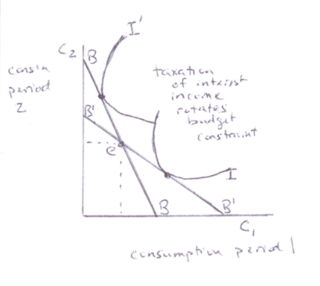
Every year, come exam time, students make mistakes that reveal a fundamental lack of understanding of indifference curves. They write "price" and "quantity" on the axes of their indifference curve diagrams, instead of "apples" and "oranges." They shade in the area below the indifference curve, as if it were a demand curve, and they were showing the consumer surplus or a deadweight loss triangle. They talk about indifference curves "shifting". (An indifference curve is simply a map of a person's preferences, so it makes no more sense to talk about an indifference curve "shifting" than to say that the road has shifted when I travel from Bank Street to Bronson Avenue.) Students draw indifference curves that cross, or tight little circles with upwards-sloping portions.
Why, year after year, do so many students fail to understand indifference curves?
It could be that I notice the students who get the answers wrong more than the students who get the answers right. It could be that my students don't study hard enough, or that I do a poor job of communicating the material. But I'm beginning to think that there is something about the concept of indifference curves that makes them fundamentally difficult to understand.
There's the name, to begin with. All the points on an indifference curve are equally good, from the consumer's point of view. It's a "no difference" curve. Every point on the indifference curve yields the consumer equal satisfaction. They might all make the consumer deliriously happy. They might all make the consumer miserable. The point is, there's no difference in the satisfaction the consumer enjoys at any point on the indifference curve. This is confusing for students, because in everyday speech, indifference means something more like "meh." (Some people use the phrase "isoutility curve" to avoid this confusion, but it hasn't gained general currency).
A more fundamental issue is that creating an indifference curve involves introspection and hypothesis. With demand curves, people's responses to price changes can be observed directly: bus fares go up, people choose to ride bicycles instead. Budget constraints are a simple function of prices and incomes. But indifference curves are a representation of what's inside the consumer's head, not (for the most part) observable reality. What consumption bundle would be equivalent to barbequed lamb, a bottle of wine, and having some good friends over for dinner? I have no idea, and neither does anyone else.
I suspect that, as human animals, we aren't well suited to thinking about indifference. When life presents us with choices, there is survival value to identifying the best option. Given superficially similar alternatives – five lines-ups in the grocery store, say – we search for the one that's best, not for two that are equally good.
One solution to these difficulties is to simply abandon indifference curves entirely as a pedagogical tool. I'm reluctant to do that. Indifference curves are a way of analyzing whether policies make people better off or worse off, and predicting how people will respond to changes in economic incentives. Indifference curves can be used to explain the ideas of substitutes and complements, goods and bads, normal and inferior goods, income and substitution effects. Sure, one can wave one's hands and give verbal explanations, or formulate these concepts mathematically in terms of cross-price elasticities and income elasticities. Yet the first is hard to do well, and I am far from convinced that the typical student emerges from mathematical economics classes with any real understanding of how to apply economics to everyday life.
So indifference curves it is.


 Worthwhile Canadian Initiative
Absolutely priceless. I can even hear the exasperated voice commenting on the graph.
I think indifference curves are hard to understand because people do not actually have indifference curves. It is more of a trick to make certain deductions mathematically simpler.
If you were to give people choices between different bundles of goods, they might have great difficulty deciding which bundle they want, and the answer to which bundle they want will depend on on the day you ask them. Therefore actual indifference might well shift, they might cross, etc.
For example, a general vectorfield is not globally integrable, but is only locally integrable. You can imagine a parking garage with 10 levels, so that given the x coordinate and the y coordinate, there are 10 distinct z-coordinates above it. If you were to draw a level set through a point (x,y) passing through height = 10, it may well intersect with another level set passing through height = 20. And it may well be the case that consumers can switch between sheets, e.g. by travelling along the parking garage. I think there is a lot of reason to believe this because satisfaction is a relative concept.
In other words, the assumptions underlying choice theory are really strong, so strong that the existence of a globally integrable preference function is counterintuitive.
OK, maybe I am wrong. One way to test this would be to see whether level sets for production functions are just as difficult for students to understand as level sets for utility. If I am right, if you were to write “labor” and “capital” on the axis, students would make a different set of mistakes than if you were to write “apples” and “oranges”.
Piercing insight, particularly on the graph. Those look like rather extreme piercings.
I don’t understand how you can think indifference curves are useful to understand reality and admit not being able to figure out a consumption bundle equivalent to the three goods you listed (admitedly one of them is not really purchasable in the conventional sense)?
Isn’t the whole point that consumers are able to calculate the optimal consumption bundle between hundreds (if not thousands or millions) of goods? If they aren’t what practical application do these have? Robinson crusoe?
rsj: “I think indifference curves are hard to understand because people do not actually have indifference curves.”
Well, that’s where behavioural economics is coming from. It’s telling that intermediate micro courses geared to business focus on the firm side – cost curves, production, etc – and spend less time talking about the consumer side. The whole premise of marketing is that preferences can be changed, in direct contradiction of the assumption that consumers’ preferences can be seen as somehow exogenous, given.
meh.
Nathan – “how you can think indifference curves are useful to understand reality ”
When faced with reality, people make choices, people have preferences – it’s just thinking hypothetically “what would I want in this situation” “what’s just as good as barbequed lamb and a bottle of wine” is hard.
I think there’s something fundamentally different between, for instance, a demand curve and an indifference curve. Demand curves are both written and graphed as Q = x(P). Indifference curves are written as Ubar = U(x, y) but graphed as dy/dx = -(dU/dx) / (dU/dy). Students have lots of experience thinking about graphs like demand curves, but very little thinking about graphs like indifference curves. Contour lines on maps are the only example I can think of that most students might be familiar with–but the students who struggle with indifference curves might be the same ones who struggled with contour lines.
Maybe it’d be easier if they were written as y = f(x) and called something else, like satisfaction curves. “Given x, it takes f(x) of good Y to satisfy you.”
What about the Edgeworth Box? Could that help?
Frances,
“The whole premise of marketing is that preferences can be changed, in direct contradiction of the assumption that consumers’ preferences can be seen as somehow exogenous, given.”
This is what I wondered about: how do you see preferences? As I look at preferences, I don’t see my preferences being changed by marketing; I just see marketing as being ‘informed’ whether I’ll be more (or less) able to satisfy my wants with a particular product.
When you therefore draw an indifference curve between, for example bananas and apples, I see these as something sweet & healthy 1 and something sweet and healthy 2, rather than as bananas and apples. And my want or desire for something sweet and healthy is pretty stable.
As someone who teaches this stuff all the time: do you see wants and preferences as different or do you see these two as largely the same?
I’d guess that with the usual assumptions (complete etc.) it is rather hard to distinguish between these two.
Yes, deep down we want to be healthy, important, loved, etc.
It may well be that those fundamental needs are exogenous, but the attempts to satisfy those needs with behavior generally, and consumption behavior specifically, is not exogenous.
“Students draw indifference curves that cross, or tight little circles with upwards-sloping portions.”
There are upward-sloping portions on indifference curves in lots of respectable textbooks; even closed loops, indicating the possibility of satiation. Do you encounter the same problems with isoquants when teaching production theory? If not, that might be a clue to what’s going wrong. Maybe tell them that consumption goods are inputs to the production of utility?
IMHO it’s due to poor mathematic skills. Strong quantitative students will look at it the indifference curve as a function and then interpret accordingly. In this case the indifference curve has a natural ceteris paribus interpretation. On the other hand if the student doesn’t think ‘mathematically’ they will look at the indifference curve as hieroglyphics not discerning the relationship between variables. I speak from experience. My understanding of economics ex-post taking some uni maths course was night and day.
Kevin: “There are upward-sloping portions on indifference curves in lots of respectable textbooks; even closed loops, indicating the possibility of satiation.”
True. But look at the example above. I’I’ has an upwards sloping portion. Given the proximity of I’I’ to the vertical axis at that point, and the fact that the goods in question (present and future consumption in very general terms) are ones for which satiation is not very likely, that looks more like a lack of understanding.
The problem with the tight little circles is that when students draw indifference curves that way, the substitution effects are very small, and so it’s almost impossible to show them on a diagram. It’s only possible to get perceptible substitution effects with indifference curves with less curvature.
Ryan V: “Indifference curves are written as Ubar = U(x, y) but graphed as dy/dx = -(dU/dx) / (dU/dy).”
Spot on! I bring watermelon into class, and slice it up, or sometimes a loaf of bread, to try to explain the idea that an indifference curve is a slice of a three dimensional surface. That tends to help the students with better spatial skills to begin with, but that’s o.k., the rest can enjoy the watermelon. The other issue with the U(x,y) notation is that the textbooks patiently explain that utility is ordinal not cardinal, or don’t mention utility at all. Also, while P and Q have some concrete real-world interpretation, U doesn’t.
On contour maps – yup, I fear that indifference curves are going to become increasingly difficult for students to understand. If you’ve ever hiked a mountain with a contour map as a guide, it’s easy to remember that higher lines=higher elevation. Not so easy if you’ve relied on GPS all your life.
DavidN: “indifference curve as hieroglyphics” I like that way of putting it.
Martin: “As someone who teaches this stuff all the time: do you see wants and preferences as different or do you see these two as largely the same?” Largely the same. But I don’t think about things the same way that my students do.
JoeMac – Edgeworth Boxes are 2x the indifference curves, so 2x the difficulty in understanding. Plus the student has to have the spatial ability to mentally rotate indifference curve mappings (this is why Tetris was invented).
Brilliant!
Indifference curves are inherently difficult to use as a educational tool because, in the view of the utility maximizer, 100% of the curve is irrelevant: it’s outside the budget set!
I often imagine utility maximization as being a gnat in the budget set, walking around to find the highest point.
Inevitably I end up on the budget line and looking for the highest point along that line.
Yes, the highest point is tangent to a contour line-I mean indifference curve-but all of that curve is inaccessible to me. For all that I know, all those isoutility points don’t exist (they do exist, because preferences are complete, but that’s beyond first year).
I think I understand the whole indifference curve tangency thing because I did calculus and function maximization before, not the other way around.
Kelvin: “Indifference curves are inherently difficult to use as a educational tool because, in the view of the utility maximizer, 100% of the curve is irrelevant: it’s outside the budget set!”
I like that way of putting it. The problem is not, as some have argued, that indifference curves don’t exist (though I do see some merits in the behavioural econ critique) as that the bulk of the indifference curve is something the consumer doesn’t ever have to think about.
“An indifference curve is simply a map of a person’s preferences.”
Baloney. No such person exists with such a think ‘built’ into them.
An indifference curve is simply a handy bit of math to capture some aspects of the pure logic of marginal valuation so math economists can easily teach it as a math gradable exam topic — and so they can use it for wide math construction uses.
And how massively economists are misled by this fantasy idea that indifference curves are actual maps of peoes preferences! A scientific sham of the first order.
rsj: “I think indifference curves are hard to understand because people do not actually have indifference curves.”
rsj nails it — and this points directly to how economists are tricked by their math into believing in a bogus conception of economic ‘science’ and the real world.
The math actually makes economists stupid — and makes their economic into a fake and absurd pseudo-science.
In the right hands these mere math constructs don’t have to have that result, but not 1 economist out of 10,000 is came of using the constructs non-pahologically and non-pseudo-scientifically.
Following up on rsj:
Evolution has guaranteed that Buridan’s Ass does not exist in the natural world. http://en.wikipedia.org/wiki/Buridan's_ass
Humans are never truly indifferent – when we are close to being indifferent, we find a way to (arbitrarily) resolve that indifference in some way or the other. That said, as long as we can back-calculate implied indifference from observed actions, indifference curves are a remarkably useful tool.
As an aside, society-wide indifference curves are even more interesting – because they can intersect!
primedprimate: “Humans are never truly indifferent – when we are close to being indifferent, we find a way to (arbitrarily) resolve that indifference in some way or the other. ”
At a price of $5 per bunch of organic broccoli, I buy regular broccoli instead. At a price of $1 per bunch of organic, I buy organic. There is a price range between $5 per bunch and $1 per bunch where I am indifferent.
That price range might be so small – $1.78 per bunch – that I never actually find myself there, or experience it.
But it’s like atoms and molecules – we may not be able to see them, but that doesn’t mean they don’t exist.
I’d argue that it’s more a geometric problem than a conceptual one. It’s the same problem people have with topographical lines on maps, curves approaching asymptotes or even exponential curves on graphs. There are just certain ways graphical relationships that are difficult for humans to imagine/draw. I’d say I always had a pretty strong grasp of indifference curves, and yet I still had to redraw my graphs on a regular basis.
It’s also important to note that indifference curves are simply a cross-section of the infinitely-dimensional map that is a persons preferences. Again, this is very difficult to explain/understand (hence some of the arguments above).
Scott: ” There are just certain ways graphical relationships that are difficult for humans to imagine/draw. ”
What are the characteristics of hard-to-imagine/draw graphical relationships? I’d say one thing about indifference curves that’s fundamentally difficult is that they’re a 2-dimensional representation of a 3-dimensional phenomenon – but must go and do my real job.
There’s no real micro-foundation for indifference curves. Individual preferences are known to have properties that contradict the basic assumptions.
1) Preferences vary according to time and context.
2) They can be intransitive
3) They satiate
4) Choices are based on perceptions of goods, not goods – like choosing between a 95% chance of living and a 5% chance of dying
5) People are averse to excessive choice and tend to make hasty, arbitrary or crudely heuristic decisions when faced with it.
6) People don’t maximize utilities, which are, after all, incommensurate and the required decision making process combinatorially intractable, being analogous to problems that, even when simplified are known to be NP hard.
Kahnemahn covers a lot of this in Thinking Fast and Slow. It makes the textbook examples of utility curves look rather silly. I’d start economics with Kahnemahn, but it would result in a rather different curriculum.
And, of course, there’s always the SMB theorem (neoclassical economics has a rather cavalier attitude about what you can do with aggregates).
The arguments for utility curves are:
1) They are useful in decision making where utilities have objective existence. In this case we’re usually talking about a population, not an individual and the choices involve a question of public policy.
2) They may be an emergent function of considering people in aggregate (for the correct corresponding aggregates) and for choices made more than once. Consider the Delphi method, for example. Why are the results so good when the individual estimates tend to quite bad?
3) You have to teach them because students will be expected to know them in other courses and in the reading the literature of economics.
Peter N – “I’d start economics with Kahnemahn, but it would result in a rather different curriculum.”
Thaler and Sunstein start off Nudge by describing themselves at “paternalistic libertarians.” It’s sort of a “yes, this is obviously a contradiction, so let’s just ignore it and get on with life.”
But I don’t think it is possible to ignore this. Any position that is any way paternalistic must have some underlying notion of the good, what people really want – i.e., some concept of stable, not-entirely-socially-constructed preferences – given what you say above, I suspect you’d probably agree with this.
I teach about the role of government – a question of public policy, as in your second point (1) above. It is a debate about the appropriate form of paternalism, if you will. I have to have some notion of how to evaluate policy. Thaler and Sunstein’s “well, I figure it would be a good idea if people saved more, ate different foods,…” doesn’t cut it with me (though having said that, I enjoyed Nudge very much, and recommend it to people all the time).
@Frances: your response to me was exceedingly weak. The fact that people purchase a consumption bundle doesn’t mean they’ve purchased a consumption bundle that is “optimal” ie on their budget constraint line. I may potentially love this one flavor of ice cream 20 blocks from my house more then any other ice cream I’ve ever had, but if i don’t know that that place, let alone that particular flavor, existed I’d never purchase it even if substituting my current ice cream purchases for it (they have the same price in this example) would bring me more satisfaction. I could even be purchasing a Barbecue sauce that isn’t the one I’d enjoy the most when the one I’d enjoy more is right next to it.
If we are admitting that people have a difficult time choosing what they’d like the most given their available income, the rationale behind indifference curves seems to me to be greatly diminished.
Frances: That is a great way to resolve the Buridan’s Ass problem. Indeed, one could say that the probability of being exactly indifferent has a measure zero.
@Nathan, we make some very strong assumptions in basic consumer theory, one of which is that consumers can compare all bundles. Incorporating new or untried goods into the basic analysis is not simple. I usually tell students, when teaching the basic model (ie, intermediate theory), that we can think of the assumptions we make as restricting the circumstances to which the model applies (although not always in so many words).
I don’t know why indifference curves are hard – I cannot remember finding them difficult to understand, but maybe it was because I took calculus before I saw them. Makes it difficult to teach, though, since I do not understand the lack of understanding!
@Linda: I know this very well. This is why I think the comparison of bundles breakdown as the amount of goods sold rises. think of the classic indifference curve with two goods. each additional good after that one involves adding an axis. Even 10 goods with 10 possible quantities of each good is quite a challenging calculation for consumers. Let alone the amount of actual goods and quantities that exist.
@Linda: It should also be noted that in response to my initial query Frances said “When faced with reality, people make choices, people have preferences”. I read this as saying he thought that some form of Indifference curves were applicable to reality (perhaps I misread him or read uncharitably ). That’s what i was responding to, not that heuristic assumptions are made in teaching that are supposed to be deconstructed as the subject gets more advanced.
In general ( ie putting away my own particular point of view), I think undergraduate students have a lot of trouble because typically the methodology of economics isn’t taught to them first. The first thing students should learn when entering a principles of economics course is what methods do economists employ to understand the world. Indifference curves are difficult to understand because students are constantly comparing what the model describes to their real life experience. To make matters worse, when teaching this subject (in my experience), professors talk as if these models are comparable to reality itself and give examples that imply this is how it works “in the real world”. Since the simplest form (ie the one with the strongest assumptions) is what’s taught first, that makes it very difficult for students because the simplest model is especially out of tune with what those students experience.
i think many more people would understand economics after taking economics classes if methodology was taught to them before anything else.
@Nathan: I think we all know that indifference curves are an abstraction. But I also think that “some form of Indifference curves [are] applicable to reality”, and I don’t agree that adding more goods necessarily makes the concept more difficult. One example I use (works for me; for my students?) is standing in the check-out line at the grocery store – or a dept store – and looking at the contents of others’ shopping carts. Can I compare the contents of those carts to mine? I think so. If I would rather have mine than some of the others, but also see others I like better than mine…it’s not really that big a step to think about the adjustments that would be needed to make me indifferent between another cart and mine.
Mind you, I think I have very thick indifference surfaces!
@linda: but do your students? see my last comment about methodology.
Your example of comparing your basket to other people in line is not the concept of an indifference curve. The typical (ie simplest) indifference curve has an x axis that represents one good and a y axis that represents another. Each axis has a (dollar) quantity of goods. an Indifference curve is about comparing all the possible combinations of these two goods that are within (not on) this person’s budget line. Let’s say there are 100 possible combinations of these two goods that are within (not on) your budget line. when you add another good ie add an axis, the number of possible combinations increases exponentially. when you add seven more goods, this exponential growth increases. an indifference curve compares your chosen consumption bundle to ALL other possible consumption bundles, not just to those who have picked consumption bundles at the same time you have. If indifference curves only compared one’s chosen goods to those one is shopping near, they would be very different and would be much more socially contingent. I’d also probably have much less problems with them.
What if I told you that even economists don’t understand indifference curves. Have you seen the Gheg Economics Challenge questions? No one can answer these questions, but a new framework has been created to make the impossible easy. Watch the two videos in the Alex Gheg channel at youtube and you will understand the true problem and the solution. First, watch The One or the Infinite, then see the consumer theory video.
http://www.youtube.com/user/alexgheg?feature=results_main
1. Suppose good X is the high quality good and good Y is the low quality good. Without using any budget lines explicitly or implicitly, can you show the geometry of quality only with indifference curves? Are flat indifference curves merely rigged preferences that get the large desired substitution effect? Would anyone other than an economist talk about 1/2 of a TV?
2. Suppose good X is the convenient good and good Y is the inconvenient good. Can you show the show the geometry of convenience only with indifference curves?
3. Suppose good X is music on blu ray(quality) and good Y is music on iTunes(convenience). Can you show the geometry of the trade off between quality and convenience with the way they were defined from the first two questions, only with indifference curves?
4. Could you show any of the graphs from the first three questions to the other Economics Professors, and have them all identify the concepts that you defined, without your assistance?
5. Gheg used a CES utility function to explore quality and convenience. He claims that it has dominated the literature for many decades, and is never more suitable since he is comparing such similar goods. If it is inappropriate to use this utility function for his examples then when is it suitable to use a CES utility function?
6. If good X is the high quality music on blu ray and good Y is the convenient music on iTunes then can you describe the trade off between quality and convenience using only the parameters of the CES utility function?
7. If it is acceptable to multiply quality with quantity as in some papers then is it acceptable to have “quantity times quality times convenience?”
8. Do quality and convenience have any meaning in a world without prices? Can a quality ladder model make any useful predictions for the behavior of a child that receives an endowment of goods from his or her parents? Can you give any examples?
9. If imaginary quality ladder models are good theory then is it appropriate to incorporate convenience ladders in the model? Is an imaginary ladder an easy fix for all mysteries in economics?
10 . Where has anyone ever mathematically defined quality or convenience in the scholarly literature without merely putting a variable called Q or C in an equation, without any further explanation?
11. Gheg says that quality and convenience dominate our lives. Do you think they are important? Should the ultimate consumer theory tell us what these things are? Do you believe that the standard consumer theory that is taught right now can ever explain these fundamental concepts?
12. Are you willing to post your solutions to these questions on youtube, so they can be seen by your peers around the world?
Nathan: “an Indifference curve is about comparing all the possible combinations of these two goods that are within (not on) this person’s budget line”? Not in any definition I have read – what is your source for this?
after you asked your question I picked a textbook at random and ended up with the Krugman and Wells Microeconomic textbook
“an indifference curve is a line that shows all the consumption bundles that yield the same amount of total utility for an individual”
I realized here that what I did was make a basic mistake in saying the wrong word. Because I was too quick in responding, I failed to distinguish an indifference curve and an indifference curve map. My apologies for my error that confused the conversation.
When talking about the different combinations I meant to say Indifference curve map
for reference the definition of Indifference curve map provided by Krugman and Wells is this: “The entire utility function of an individual can be represented by an indifference curve map, a collection of indifference curves in which each curve corresponds to a different total utility level”
what I meant to say was this: to draw an indifference curve, a consumer must also be able to say that all the points below the indifference curve would indeed yield them less utility then the points on the indifference curve. a “rational” (in the textbook economic sense) consumer thus would have to calculate all the possible combinations (in the above example, 100 for two goods) and pick out the few optimal combinations. The exponential problem still exists.
I think my training as a physicist first help me view those weird abstractions simply as functions, the same way that going through Kreyszig’s Engineering MAthematics help me saw the cuple systems dynamics in economic cycles.
It remains thatthese curves are “pedagogicla tools rather than real concepts. But what’s the use of a pedagogical toool that doesn’t increase comprehensio? If an obviously master teacher like Frances can’t make it…
In his “Why economics is not yet a science”
Alfred Eichner had very harsh words for these “pedagogical tools”.
Corrections:
“coupled systems ”
By the way, Kreyszig taught at Carleton….
My understanding of the point of the indifference curve picture was mentioned in passing, but I don’t think it’s been quite hammered in yet. Sure, it is about tradeoffs, as mentioned by Frances, but the underlying transcending principle is one of optimality. Here it’s the intertemporal marginal rate of substitution equaling the negative slope of gross interest rate. In the booby picture (what titillated my interest in economics. Sorry, I had to write that… I’m getting old, and with it my appreciation of puns grows as my sense of humour wanes. So sad, yet so predictable and normal.), the interest rate represents the tradeoff: value today versus value tomorrow. What pins down the optimal choice—ie, what the DECISION the consumer makes—is the IMRS.
Also, to further discuss Nathan’s comments although he is speaking in terms of today’s consumption bundle choice. The budget line IS the constraint (time, location, etc., it’s all in there) when it’s taken explicitly, which should never be done. So when you’re arguing about bounded rationality—roughly, that people make poorer yet conditionally optimal choices than they otherwise would have in the absence of full information—it doesn’t apply in the diagram. Here, the consumer knows everything: their utility function’s value evaluated at every single point in the budget set. This happens instantaneously, even if there were N goods, where N is really, really large, as it’s a static model.
The point of either diagram isn’t to say that economics only works if people are fully rational. It’s meant to convey optimality in the face of tradeoffs, and with it decision making. It’s meant to convey that the MARGINAL tradeoff is what determines the decision. The MARGINAL condition determines optimality.
To me, contemporaneous good choice isn’t that interesting or practically relevant, but intertemporal good choice is. It is because the marginal utility of states conveys information about the risk of a particular good, or of a particular asset. If you need something that pays off with certainty tomorrow, choose a bond; if you want a higher, uncertain return, choose a stock. I think this is a little more relevant to people, if this discussion board considers businesspeople people.
I think Frances had implicitly stated that interpreting changes in prices are a lot easier than changes in utils (the ordinal units of utility functions). Perhaps it is easier to begin first teaching them IMRS (ie, buy more or less of the same bundle) rather than MRS (buy a different bundle).
On the pathological fake science of Paul Samuelson using “indifference curves” I highly recommend The Foundation of Paul Samuelson’s Revealed Preference Theory by Stanley Wong.