Raphael Deketele, a student in my fourth year honours seminar, just unearthed a strange finding from the 2006 World Values Survey (WVS).
The WVS interviewed over 1000 Americans, and asked them:
Here is a scale of incomes on which 1 indicates the “lowest income decile” and 10 the “highest income decile” in your country. We would like to know in what group your household is. Please, specify the appropriate number, counting all wages, salaries, pensions and other incomes that come in.
Each income decile, by definition, contains ten percent of the population. In a randomly selected group of people, about ten percent should be in the first decile, ten percent in the second decile, and so on. The distribution of responses to the income decile question should be uniform, that is, flat.
In fact, it looks more like this:
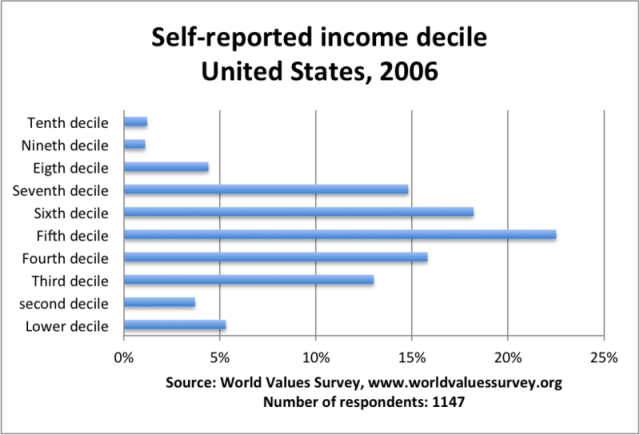
Fewer than ten percent of respondents to the World Values Survey placed themselves in the top 30 percent of the income distribution. Twenty-five percent of respondents placed themselves right in the middle of the distribution, and just under ten percent placed themselves in the bottom twenty percent.
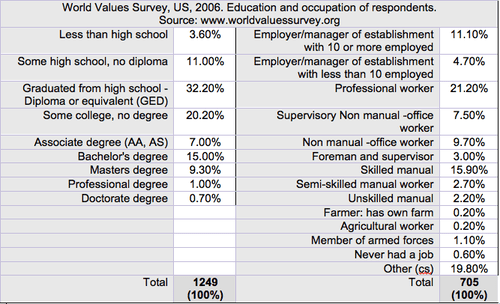
Now it could be that the WVS's sample is not representative of the US population; that the wealthy were under-surveyed and the middle class over-represented. One way of checking the representativeness of the WVS is to look at more objective indicators of socio-economic status, for example, income or education. The World Values Survey doesn't seem to be particularly biased against higher income earners: 25 percent of respondents have a bachelor's degree or higher; significant percentages work in professional or managerial positions.
I suspect people just live in their own little worlds. A typical respondent, when answering this question, probably reasons along these lines: "I'm not as well off as the people across the street with the slightly nicer car and slightly better job, but I'm slightly better off than the people down the road who seem to be struggling a bit financially, so I guess that puts me around the middle of the income distribution."
Such mistaken beliefs could have real impacts of public policy. If few people perceive themselves as being poor, then they will see programs to help the needy as benefiting others, not themselves. If taking action against the deficit requires sacrifice from those who are most able to pay, people who (incorrectly) perceive themselves as only average will refuse to chip in.
Still, the WVS results explain why politicans court the middle class: whether they're rich or whether they're poor, that's how most people perceive themselves.
Update: in the Canadian World Values Survey, the question was phrased slightly differently. People were asked:
Here is a scale of incomes [e.g. up to 12,500, 12,501 to 20,000,…]. We would like to know in what group your household is, counting all wages, pensions and other incomes that come in. Just give the letter of the group your household falls into, before taxes and other deductions.
The distribution of incomes generated by this question is shown below.
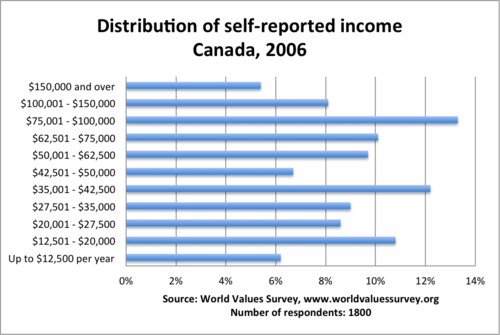
To put these numbers into perspective, according to Cansim numbers in 2006 an household income of $101,000 (2010$) would put a two person household right in the middle of the fourth income quintile. The corresponding figure for a single person household would be $42,200.
Update 2:
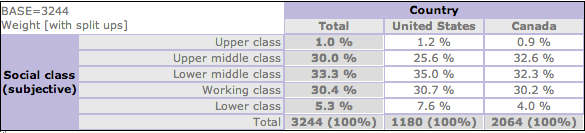
The World Values Survey also asked respondents to identify, subjectively, their social class. I've reproduced the 2006 Canada and US results here, but they're pretty unsurprising.


 Worthwhile Canadian Initiative
Wow. That is an astonishing graph. It explains pretty much everything you need to know about this.
Interesting graph. Puts a bit more context to the typical “because that’s where the votes are” explanation.
I think there’s a minor mistake in your text: did you mean 25% of respondents had a bachelor’s degree or higher (15+9.3+1+0.7 = 26%)?
Jesse, yes, thank you! That seems a little low, but these surveys typically have a fair number of respondents in their 70s or 80s, and education levels in those age groups are typically lower.
Wow!
“I suspect people just live in their own little worlds.”
I wonder if there would be the same results by e.g. ethnic group. People will tend to think that their own ethic group is a higher percentage of the population than it actually is. Or religion. Or politics. “50% the people I know are like me, but only 5% of the people on TV are like me, which just shows how biased they are!”. Like that comment somebody in the US made after Reagan won the election: “But I don’t know anybody who voted for Reagan!”
My hunch is that most Canadians who live in big cities have no idea about small town and rural Canada.
There is a potential problem with innumeracy. People’s responses to questions about percentages tend to be less accurate than their responses about whole numbers. It might be better to frame the question something like this.
There are 80 million households in your country. Where is your household in terms of income? In the bottom 8 million, from 1 to 8 million? In the second 8 million, from 8 to 16 million? . . . .
You might get the same kind of results, but maybe not. 🙂
Actually, that framing may also be confusing. Even better, perhaps, would be something like this.
“There are about 80 million households in your country. To the nearest million, how many households do you think have lower incomes than yours?”
You ask half the people how many households have lower incomes, and half you ask how many households have higher incomes. 🙂
There’s a very important general point trying to get out here. I can’t quite find the right way to say it. Something like; given serial correlation, everybody estimates the population looks more like their own local sample than it actually is. Except “serial correlation’ probably isn’t the exact concept I’m looking for.
Don’t you think there is an age/timing conflation here too? I feel like if I were asked this question when I was 20 or 55 and I felt I was “average” in my age group I would say “50”. But in reality the average 20 year old is in the bottom quarter and the average 55 year old is in the top quarter.
Maybe just another explanation for the obvious confusion, but one I feel is powerful nonetheless.
Nick, no, I think you’re thinking of something like clustering, or spatial correlation. Basically, people make inferences about the national population based on a sample which is “people I know either directly or through watching Hoarders or reading People magazine”. So we all figure we’re in the middle. BTW, related to your earlier comment – I think you’re right about people not knowing about how others live, but it’s not just urbanites not knowing about rural life, it cuts all ways.
Min, I agree, the question is poorly worded. Lots of people don’t know what a decile is. I like your second wording better.
Brent, yes, you’re right. Simply being a two-income professional couple is enough to put a household in the top couple of deciles of the income distribution, though I bet it doesn’t feel that way to young couples in Toronto and Vancouver struggling to pay the mortgage.
While I agree with your point entirely (reminds me of how everyone thinks they are above average), politicians (especially in two party systems) would probably court ‘the middle class’ (insofar as such classes can exist) even if everyone was perfectly well-informed about their situation in an effort to capture the median voter.
On a somewhat related aside, I have been quite disappointed by the fact that neither of the two US presidential candidate has said anything prominent about the poor – perhaps altruism through the government is really unpopular and the median voter is largely self-interested.
Frances: “Nick, no, I think you’re thinking of something like clustering, or spatial correlation.”
Yep. “Spatial correlation” is what I should have said. I am just too macro to know the right concept.
The interesting problem is not so much “What do people believe?” but “What is their response when presented with the truth?” This is particularly disturbing when the accurate information is widely available. If you asked people, “To what extent do you personally benefit from government spending?” you would see an even more extreme disjunction.
primedprimate – good point on politicians appealing to the median voter in any case (to the extent that the political system is such that the median voter theorem could be expected to hold).
Good post. Not surprising, unfortunately.
I attended an expensive private liberal arts college in the US. I recall that one year a student newspaper surveyed the students on whether their families were “middle class”. The vast majority of students said they were from “middle class” families–even though their median family income, which IIRC was obtained from the college’s own data, was north of $200,000/year.
This also reminds me of the kerfuffle a little while back about the exceedingly non-self-aware UChicago law prof who moaned about how difficult it was for his family to scrape by on an income of hundreds of thousands of dollars a year. About how once they’d covered the mortgage payments on a huge house in a really nice Chicago neighborhood, the kids’ private school tuition, their retirement investments and other investments, and other expenses (dinners out, vacations…), they hardly had anything left over, and would be ruined by even a small tax increase! I may be misrecalling details, but that was definitely the gist.
The old saying about living in your own little world is indeed appropriate. Except that it sounds rather too harmless. As evidenced by the example of that UChicago law prof, living in your own little world can make you into a rather unpleasant person.
It gets worse. Similar results can be found in Survey of Americans and Economists on the Economy, where 81% of the general public considered themselves to be part of the middle class (question #19).
well,
the starting question for income deciles is precise.
But I wonder how people here define “middle class”. From which income percentile to which, and why?
In many sociological studies they use SES “socio economic status”, which contains a lot more than just income.
When the “does 250k/year make you rich” argument happened in the USA some responses were astonishing. People spending tens of thousand of dollars per year on cars did not think of themselves as rich. People look at the distribution near them. Since the richest 0.5% is much richer than the 99 to 99.5% it makes people feel poorer.
Also, no one wants to self identify as poor. They will put themselves in the “lower part of the middle”. People look at how their parents did (“normal” is the state of the world during your childhood) and if they feel they are about the same they put them selves in the middle somewhere.
People genuinely in the middle and below are starting to see the very rich and are feeling left out though. But it is always phrased as the very rich leaving the middle behind.
My 2 cents.
I think that you are putting too much weight on this question for several reasons:
1. Even if people fully realize that they are very rich/poor, they hate to say that about themselves for many reasons. This is sensitive information and you cannot expect fully honest answers.
2. People honestly may not know how much they actually make a year if asked on spot. People may forget that they receive bonuses they may overlook income they purposefully forgot about such as pension savings and especially those more affluent will have hard time calculating average from more volatile income – like selling house or other capital gains.
PS: Also it is interesting to see that unexpected fall in the last graph you shown. Is there any reason why there would be only 6.5% people in 42,000 – 50,000 brackets compared to 10 and more percent in lower and upper bracket? Do these bracket correspond to actual income distribution?
Chris J: “Also, no one wants to self identify as poor.” That is true in the US and Canada, but I don’t think it’s as true elsewhere – see e.g. this Monty Python sketch.
JV – On the Canadian survey, people were shown a card with a bunch of income categories, and asked to state which letter corresponded to their income category. As you correctly point out, people don’t know exactly how much they earn. They also don’t read questions completely, they just look at the first number, rather than thinking about the entire income bracket, and pick a category that begins with a nice round number, so 50,001 to whatever or 35,001 to whatever. Thinking through that 42,001 to whatever category is just too much work, so people don’t chose it.
Jeremy – thanks for those comments. This is the important point: that living in your own world is not benign, as you say, it can make you an unpleasant person.
genauer – they might have used SES on this questionnaire too. If you’re curious, go to http://www.worldvaluessurvey.org and click “on line analysis.” It’s very easy to do basic tabulations and cross-tabs on-line, and the data is freely available for download if you’re into that kind of thing.
“Why politicians court the middle class”
This reminds me of Willie Sutton’s apocryphal answer to the question of why he robbed banks: “Because that’s where the money is”. That’s where the votes are.
I think Genauer’s point that “middle class” is about more than just income distribution is a good one. In countries like the US being “middle class” speaks to a bundle of values/beliefs much more than it does to one’s income. Back in my student days, I would have been in the bottom 20% of household incomes, but there was no doubting my status as a member of the “middle-class”. Similarly, the doctors, lawyers and dentists who make up a good chunk of the 1% of incomer earners in Canada may be the “rich”, but they are also quintessential members of the “middle-class” (historically, the liberal professions were almost the definition of the “middle class”). If most Americans (or Canadians) self-identify as being members of the middle-class, its because America (and Canada) is a country defined by middle-class values.
It doesn’t surprise me, though, that people regularly misjudge their status in the income distribution. First, because people are generally useless at assessing their status relative to other people (I believe there are similar studies in which 70% of Americans self-identify as being better than average drivers or smarter than average. That Americans appear to prefer to identify in the middle of the income spectrum suggests that there is a stigma associated with being both too rich or too poor, as opposed to a stigma of being a bad driver or unintelligent). Second, because people generally have no idea what incomes other people make or what an “average” income is (and I think we’ve had this dicussion in the context of the incomes of university graduates and the returns to post-secondary education, where we’ve pointed out that the purportedly miserly entry-level incomes that university graduates earn are actually quite respectable). I sometimes have to remind some of my colleagues that, when they’re talking about the “1%”, they’re talking about themselves.
Bob:
Yes.
Social class = values.
Economic class = income.
Social class is not highly malleable.
Economic class is malleable above the middle proletariat.
something like seventy percent of people experience an economic class above their social class.
That’s why there is so much rotation through the “middle” economic class which loosely means consumer credit homeowner.
But fewer people stay in that elevated economic class for more than a few years.
@Frances: Surely there is a kind of opposite to Godwin’s Law (http://en.wikipedia.org/wiki/Godwin%27s_law) that states that “if you can support your argument with a Monte Python clip, you win.” I propose we call it Woolley’s Law and try to get it generally accepted on the internet.
Rather than Monty Python, I was thinking of an old “Two Ronnies” sketch:
R1: “You think you are middle class??”
R2: “Yes. I used to think I was lower class. Then I visited Glasgow”.
Chris J 😉
Will you write the Wikipedia entry or should I?
Curt, Genauer – class is complicated. It’s on the WVS too, I’m pretty sure – there are, of course, loads of questions about values on the World Values Survey. Will update with the social class info if I have time.
Nick says: “My hunch is that most Canadians who live in big cities have no idea about small town and rural Canada.” – except the difference there being that most Canadians live in urban/suburban environments in and around larger urban centres, so it doesn’t skew things as much.
I wonder why there isn’t more motivation to “soak the rich” given how few people believe that they themselves are rich?
I also like Shangwen’s comment about how people react to the true information. I have a very good example: me. My wife and I are both professionals making a combined salary that is well above the median income, not only in Canada but in Toronto where we live. However, coming to the end of paying off almost $300,000 in combined student loans and wanting to live in the city of Toronto, we have no idea how we will be able to afford a house (okay, I exaggerate, we can afford it, but it will take a huge chunk of our income). We don’t own cars or send our as yet unborn children to private school, but in Toronto it is still feels like a challenge – and we also live in a world where many of our peers had help with school and down payments, so seem much richer than us. This is like the US person’s comment about being poor on $250k a year. I know my own feeling of being “middle class” is relative, and also ridiculous given that we are easily in the top decile of income (though surely not wealth, after years of negative net worth that is only starting to get above zero).
I admit I’m surprised this is new news, but then I may be better informed due to my line of work (which involves measuring incomes).
I think Brent has the correct observation that people only assess themselves relative to their peers, and we are prone to notice Adam’s Audio, Betty’s Beach House, Chris’s Cable Package, Dana’s Diamonds, and Eugene’s Europe Trip. We notice where people choose to spend their money, not where they don’t spend it. As a result, we all perceive ourselves to be relatively underpaid (especially compared to the work we do!).
Secondly, the media only shows us what other people spend their money on. This distorts our perception of “average”. Add to that the backdrop of inaccurately measuring our own income and presto – we aren’t broke, but we sure aren’t rich. Mitt Romeny, Barack Obama – these are average American’s who just happen to be a tiny bit richer than some, but they still aren’t the richest in the nation.
Pardon this political scientist intruding into the discussion. But none of this is news in the poli sci world. This goes back to the beginning of systematic survey research in poli sci and sociology. North Americans, but particularly Americans, have low levels of self-identification with class categories. Everyone thinks of themselves as middle class.
Is this because everyone can think of someone on their street (or in their building) that’s better off and someone that’s worse off? Maybe. It may also be that although they know their income is a bit off this year, it was good last year and they have paid down most of their mortgage. Or they think of their society as featuring more upward and downward mobility over time, so even though they’re “poor” today, they plant to be rich tomorrow (or worry about vice versa).
This debate has been going on since the 1950s as I recall.
By the way, I know and love the world values survey well. Brodie and Nevitte. Canadian Journal of Political Science 26 (1993): 235-259.
Ian, Peter – “none of this is news”
Great to have you join in the discussion!
That most people see themselves as middle class is, as you both rightly point out, hardly new news – in fact, it’s pretty much a political cliche. What’s interesting, though, is to be able to quantify these effects, to see how much people over- or underestimate their economic position. I was really quite surprised that less than 10% of people put themselves in the top 30% of the income distribution.
But I guess interest in “how much” is more an economist thing than a political scientist thing?
@Nick
Having lived in Glasgow as an exchange student, I found your reference to the two Ronnie’s sketch hillarious.
I had seen this World Value Survey before, especially the Inglehart maps, and I am just now getting aware, that I think it misses out on a very important factor: social cohesion (bad wording: conformity pressure).
But first on the use of words:
I thought about how we used that 30 to 40 years ago in Germany (30k town), and I am pretty sure that was/is significantly different :
1-3 % upper class( “rich people”, “Oberschicht”)
Next 10 – 20 % http://en.wikipedia.org/wiki/Mittelstand ,
(The term is not officially defined or self-explanatory. The German word ‘Stand’ refers to a medieval model of society where the position of an individual was defined either by birth or profession. Basically there were three levels, the upper one being the aristocracy, the middle one being the free bourgeoisie of the cities and the lower one the peasants),
Although that is actually somewhat contradicting, I am getting aware of that, it included and includes “Aussertarifliche Angestellte” employees without , meaning “above” union contracts, government pay scales, not reflecting present realities anymore either :- ( , owning a SME (more like upper 10% in income) with more than family employees, upper state servants (“Beamte”) with “Personalverantwortung”, controlling, judging other, lower employees. Doctors, Professors.
This is somehow incompatible with American terms, somewhat contradicting, but still running automatically, subconscious until now, in my head. With high precision, pretty interesting.
Then there is the “Unterschicht” (as in “Unterschichtenfernsehen” like Jerry Springer, oprah winney) the lower 10 – 20 %, without at least a successful apprenticeship, with jail terms, tattoos …. : – )
And the middle 70 – 90 % do not have a special description, they are just the people, “Das Volk”, “Die Leute”, normale Leute, “normalos”. I do not remember that we used the word “middle class”.
And I do not believe that this is special for Germany, but reflects most of Europe, maybe Canada? I am very interested to hear from others, especially outside the US, on that !
Now, the really tricky question:
How do you court the “middle class”, if it doesn’t go /define itself by that name?
Do what extent does the perception of these categories depend on some old-world stereotypes? “Lower class” and “upper class” still retain strong connotations of Victorian England and Gilded-Age America. Do you identify with rag-clad children on the streets with their blind widowed mothers, or with top-hatted grandees with twelve houses? No? Then you must be middle class.
The lower classes are objectively lacking in the basics; the upper classes live a life surplus. What marks everyone else is a chronic, low-grade worry not only about needing more, but that one has not followed the right path to getting more. It’s the “I’m doing OK, but…” class. Chronic yearning for lots of unspecified wants, and a constant belief that satisfaction is just around the corner? Sounds like the ideal
audiencetarget for a politician.I’ve updated the post to add info on people’s subjective perceptions of their own social class.
Most of the people they see on a daily basis are in the same income class they are. We rate ourselves based on what we see of those around us.
If individuals in a society are used to hiding a significant amount of their wealth, would that make people happier, because they compare their true wealth compared to their neighbors visible wealth?
If that is true, then would that bias mean that conspicuous, debt-driven consumption is a negative externality?
Frances,
The number of unskilled and semi-skilled manual workers in the sample looks small to me (though it’s hard to be sure with the large ‘other’ category). An alternative explanation is that wealthy people underestimate their relative income and that poor people were just undersampled.
Thomas – if you look on the WVS website, it says that typically the WVS sample is skewed towards more educated etc (I don’t remember the exact phrasing) so, yes, your intuition is probably right.
I’m sure Nick and Frances are well aware of this, but as Monty Python and The Two Ronnies are being mentioned: “middle-class” is a completely different concept in the UK than it is in North America. It refers to a smaller group, higher on the income scale. Many social groups who are middle class in North America would not qualify as middle-class in the UK.
Tom – this is true. And in the UK there is a stigma associated with being lower middle class – I was astonished looking at those WVS #s how many people openly admitted to being lower middle class! But, of course, there’s a Two Ronnies sketch on this: I know my place
I should have been more precise in my last statement. When talking income distributions, in print, of course the typical class schemes are used, just not in daily life.
When you compare social class for US, Canada, Finland (the country with the highest PISA scores in the Western World), Germany, you find
that more than twice as much identify as “lower class” in the US, and that more Canadians identify as “upper middle class”. In the UK they didnt ask this question …. : -)
“Highest educational level attained” looks pretty interesting as well. Is that realistic for Canada?
A lot of people here, in the upper 10 % tax bracket, or at a risk manager association meeting, are deeply convinced that the income distribution is injust and and getting more so, also the numbers say otherwise (it is the same since 100 years). And they get back to me, when I say I have data for ancient Rome too. People distance themselves a lot less from “the poor”, certain conservative politicians are constantly trying to gain some popularity points by demanding some additional goodies for low income groups. A Mitt Romney kind of rant against the 47% would be immediate political suicide.
One last thing, I became aware of, here in Eastern Germany, there was for some 40 years very little correlation between “class” and income. But you could pretty much separate upper class, which didnt need to signal, the middle, “educated” (“Bildungsbürgertum”) with a piano in the living room, and “the masses”. This works in my memory even pretty well for western Germany, 40 years ago.
How about the pianos or some other signaling in Canada?
Genauer – I suspect these kind of subtle signals of social class are most prevalent in relatively culturally homogeneous societies. E.g. in Britain whether or not one puts sugar in one’s tea is a strong indicator of social class. Sugar in tea is lower class, no sugar in tea is middle class. My grandmother always used to be horrified if I put sugar in my tea – she could detect a single grain of sugar in tea, and would pronounce sweetened tea “horrid.” A person who put sugar in his/her tea would be never be middle class, regardless of how much money he/she had.
In Canada, a subtle signal like that would go completely unnoticed. It’s not that social class doesn’t exist here – it certainly does – it’s just that in an ethnically and culturally diverse society, with high levels of immigration, a lot of people are not going to be able to read the signals, so they tend to lose their significance.
I’m glad, given the whole Euro situation, Germans feel so strongly about income redistribution!
Yes sugar in tea is now lower-class. But sugar two centuries ago signified wealth. When it became cheaper, it no longer served as useful signaling for the upper class.
The same happened with tobacco. Today, only the lower classes atill smoke ( apart from French intellectuals…)
Robin Williams had a good joke in 1980: “Cocaine is God’s way of telling you you’re making too much money.” Just doesn’t work now. (Incidentally, both nicotine and cocaine,like Ritalin, are paradoxical tranquilisers. They were first used by the busy upperclass to relax and are now used by the harried stressed-out lower class. I am too middle-class to know what the truly rich are currently using… Maybe they reverted to single-malt scoth…
Frances,
a lot of people expect, that in the End the Germans always pay : – )
But there are too many of them, and they have the habit, that those who got the most (Irish 100% GDP http://www.money-go-round.eu/Country.aspx?id=IE&year=2011&method=gdp) and Greece 80 %, think that entitles them to even more in the future.
The funny thing with the income distribution is, that only a very few can ,when I then ask, describe a) the actual distribution roughly. And with the exception of one communist (everybody should have the same) absolutely nobody can tell, how b) it SHOULD look like, and c) why.
You ?
And while I am at asking pesky questions, something I am really good at, can maybe you
“Tell me one specific Krugman paper, and why you think it is good, in a few specific sentences” ?
It is interesting that there is clearly a distinction between class and income decile. (When answering surveys do people make an internal analysis that says “Given the options Upper, Middle, Working, and Lower – I am Middle Class; therefore my income must also be in the 3rd quartile”?)
The subtleties of class expression are interesting. There is certainly a subtle flavour to self-identify causes in Vancvouer – do you recycle? exercise? support charities? etc. If the majority are “middle-class” perhaps an extra $20k doesn’t matter but doing Yoga and buying a Prius does.
ps – Jacques, refusing sugar in tea was a signal you opposed the slave trade – which only mattered if you could afford slaves. Presumably this “preference” for sugar free tea trickled down like many other high-end goods. The Upper Crust had sugar first, then they rejected it. The middle-class were a generation (or so) behind, and lastly the lower class. Sugar drinks, cigarettes, and European cars seem to be parallel goods in North America today.
$250K isn’t “rich” in the sense of “set up for life, don’t need to work if I don’t want to” which is what most people think of as “rich”. “Poor” in US terms means something like “lives in public housing, doesn’t have a car so has to ride the bus”.
The $250K people know that they’re better off than the $50K people, but they know that they aren’t rich, and the $50K people know that they aren’t poor. SO what’s left is “middle”.
In Britain the Abolition of Slavery was an Evangelical cause, and they were definitely middle-class. Curiously also in Canada, specifically Ontario which passed the Act Against Slavery to keep American Loyalists with slaves out.
In Canada, a subtle signal like that would go completely unnoticed. It’s not that social class doesn’t exist here – it certainly does – it’s just that in an ethnically and culturally diverse society, with high levels of immigration, a lot of people are not going to be able to read the signals, so they tend to lose their significance.
In the US and to a lesser extent the UK, church is also correlated with class. The Episcopalians (Anglicans) in the US have a stereotype as a high-class church, then the Presbyterians,then the Methodists, then the Baptists. People do change church as they change class. In the UK the middle-class in England was often Nonconformist (Presbyterian/Congregationalist or Baptist) and the upper class was Church of England, but the lines are looser due to the Church of England’s size.
In Canada church isn’t correlated with class at all, but ethnicity. French-Canadians are Catholic, there is no other church that need be considered. In English Canada the United Church, the Anglicans, the Presbyterians and the Baptists all have a swath of members from the very rich (the Eatons are United Church members, Timothy Eaton was famously Methodist) to the very poor. The United Church and the Anglicans may be relied upon to have a church in every village in English Canada. All of those churches founded universities, so there was no class reason to leave your home church.
Determinant: “People do change church as they change class.” Interestingly, my grandfather did.
Peter: refusing sugar meant that you couls afford sugar but choose not to buy. Few people in England proper directly owned slabes, though many participated in the financing of the trade and partook of the benefits.
Determinant: apart from the moral principles involved, one can view the middle-class fight against slavery in the context of its rise to power. They had gained economic control and that fight was about establishing political control, such as getting rid of the rotten boroughs and expanding the franchise to the “middle-middle” class. And establishing the power to frame social and moral issues is extremely important.If the moral issues are the right ones, so much the better. And I am not the old cynic here. What Wilberforce did was a tremendous advancement for civilisation the world over. For the first time, a civilisation outlawed slavery.
In Canada, indeed, religion marks ethnicity, to a point. An anglophone Italian is a Catholic but is not politically or economically connected to a Catholic francophone. There were bitter confrontation in the late 19th-early 20th centuries about the language to be used by the Catholic Church. It was not preordained ,pardon the pun, that french would continue to be used. The U.S. Catholic Church hierarchy, as compared to the local clergy,actively discouraged the use of immigrant languages, so as to favor integration, and the British Catholic hierachy strongly favored the sole use of english in Canada.
As a franco Québécois, I was born and baptized Catholic. I no longer neither believe nor practice. But how could I practice another religion, since I don’t believe in the real one?
As a franco Québécois, I was born and baptized Catholic. I no longer neither believe nor practice. But how could I practice another religion, since I don’t believe in the real one?
That’s a very, very Quebecois attitude. Which is my point.
In Ottawa the Roman Catholic Bishop was always French until the 1980’s and he always had a Auxiliary Bishop who was English, actually Irish. That’s why Notre-Dame Cathedral in the Lower Town is flanked at the opposite end of the Byward Market by St. Brigid’s (now closed), an English-language church for the Irish.
If you’re me, you’re Scots Presbyterian and English/Irish Methodist, hence United Church. Irish can be Green Irish (Catholic) or Orange Irish (Protestant, my family).
And Sam gives us a point is case.
Median annual household income is $50k a year, they middle isn’t between $50k and and $250k.
The middle IS $50k. The ones that are “not quite poor” are making $20k a year.