Well December 21st is almost upon us and with it
the end of the Mayan calendar cycle and the anticipated arrival of the end of
the world or the end of the world as we know it. Well, what do the economic indicators tell us about how this
fundamental shift may be accounted for by individual economic behaviour?
I suppose part of the difference is
whether we expect a complete termination of human existence via a major
planetary cataclysm or simply a massive destruction of human civilization that
presses the reset button. If it is
the former, I would suggest there is little need for advance planning unless
you are planning to build an Ark that will take us to the nearest star
system. If the latter, one would
expect to see some economic activity rooted in economic expectations at the
individual level.
What might you expect to see in a major "end of the world"
scenario that entails survival afterwards? Well, I would expect to see a major sell-off in assets and
movement to safer and more portable assets. In other words, I would expect to see stock markets tumble
and bank accounts empty as people took their wealth and converted it to more
tangible assets that would survive the upheaval that major disaster and
destruction would have on financial markets and the other intangibles of human
material welfare – like well functioning markets, governments and social institutions. What to invest in? Perhaps gold and American dollars? The collapse of covilization as we know it will still require a medum of exchange. I would expect to see a big run up in gold prices, commodity
prices as well as an increase in the value of the US dollar vis-à-vis other
currencies.
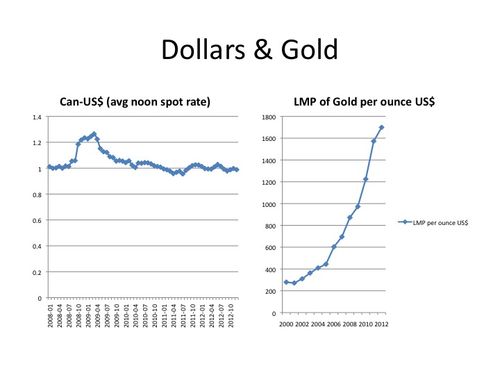
What do the indicators suggest? Well, the Dow Jones Industrial Average is a bit down over
the last few months but no collapse in the days running up to December 21st. It is definitely been on an upward trend since 2009. How about the value of the US dollar
relative to the Canadian dollar?
Well, again there has not been a major downturn in the value of our currency relative to the US dollar and things have been
pretty stable the last while. Of
course, all this could mean is that people simply do not expect the world to
end in Canada except with a lag. After all, there is
an old economic history joke I vaguely recall something to the effect that in Canada, the
nineteenth century did not end until 1950. This means I should consider a broader range of currencies
but there is so little time left before December 21st and this post has the most utility today. How about gold prices? Well, gold has gone up considerably
over the last few years. The
London Market Price of Gold has been rising steadily since 2000 but 2012 has
actually seen a slowdown in the growth rate.
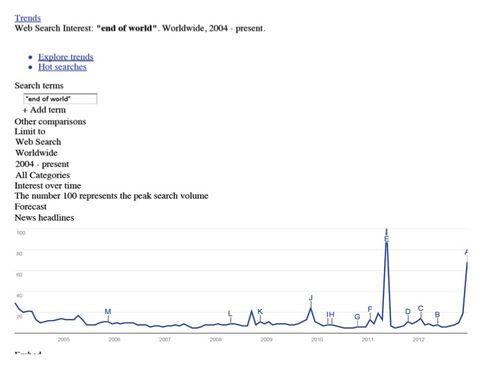
The ultimate indicator? Well, if you type in “end of world” in the Google search
engine, here is what you get (see below). There is a spike in search activity in 2012 but there
was a much larger peak in 2011.
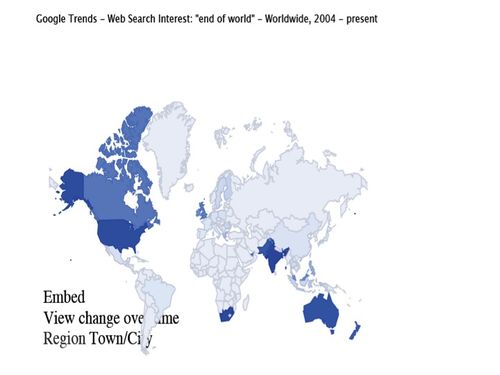
Perhaps the world ended then and we simply did not notice. More interesting is the fact that
search activity for this term is highest in North America, the UK, India,
Australia and South Africa (the darker the blue, the greater the search intensity). I
suspect it is partly a language thing. If
I go to Google Italia and type in “fine del mondo” I get Italy as the only hot spot for
end of world anxiety but there is an upward trend in 2012 with no 2011
spike. What should one do? In the midst of all this anxiety, I
think today is a good day to slow down and relax, maybe have a martini and wait
to see what tomorrow brings. My
prediction is tomorrow will be pretty much like today, ceteris paribus.
A Snapshot of Searching "End of World" Using Google Trends
Regional Variations from Google Trends and "End of World"


 Worthwhile Canadian Initiative
I reckon that if people believed that Mayan Calendar stuff, the US economy would have escaped the liquidity trap by now. Reminds me of that scam in Mordecai Richler’s Solomon Gursky, where he gets the farmers to think the world is ending, so they sell off their land cheaply.
I don’t really understand why gold would be of any value if civilization would collapse. You need some kind of centralized government or social system for money to have any use. If civilization has collapsed and you have a bunch of food and some other random survivor has gold are you really stupid enough to trade your food for a bunch of worthless yellow rocks?
Ha! Boundary condition for inter-temporally optimizing models.
There’s an interesting disconnect between believing in the imminence of the rapture and stockpiling baked beans.
Peter T: as John Pettigrue, Chief Justice of the SOuth CArolina Supreme Court said in early 1861: “South Carolina is too small to be a republick and too large to be an insane asylum.”
It also applies to a lot of other places…
@CBBB: “You need some kind of centralized government or social system for money to have any use.”
Not at all. Money will arise in any society engaged in trade. Cigarettes became money in WWII prison camps. And note: gold was valued before it was money, and was not given this value by governments.
I tend to side with Gene on that question. But if we define “social system” broadly enough, CBBB is I think correct. Without some sort of property rights and exchange, there wouldn’t be money. I can’t see money in a Hobbesian State of Nature, where you just grab stuff rather than buying it.
Cigarettes are no longer widely smoked, but I could see AA batteries becoming the currency of choice in the zombie apocalypse.