Smaug the dragon is typically viewed as a fiscal phenomenon, depressing economic activity by burning woods and fields, killing warriors, eating young maidens, and creating general waste and destruction. Yet peoples – whether elvish, dwarvish, or human – have considerable capacity to rebuild. Why did the coming of Smaug lead to a prolonged downturn in economic activity, rather than a short downturn followed by a period of rebuilding and growth?
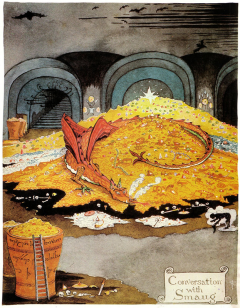 The full economic impact of Smaug can only be understood by recognizing that the dragon's arrival resulted in a severe monetary shock. On the left is shown Smaug's hoard. On the right, for purposes of comparison, are the gold reserves of the Bank of England. It is clear from a simple inspection of these two figures that the amount of gold coinage Smaug withdrew from circulation represents a significant volume of currency. This would, inevitably, lead to deflation and depressed economic activity.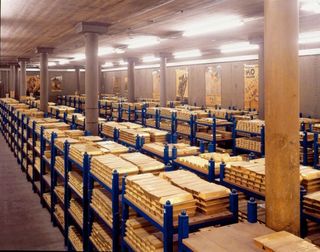
The interpretation of dragons as monetary phenomena is supported by the events occuring after the death of Smaug. Upon the great worm's demise, the wealth it had stockpiled was shared between the dwarves and others who had contributed to the fight. Much gold was sent to the Master of Lake-town; followers and friends were rewarded freely. The result was an immediate increase in the money supply, and a rapid growth in overall economic activity.
One has to ask whether or not a more innovative monetary policy framework could have ameliorated the impacts of the dragon-induced economic downturn. If the peoples of Middle Earth had abandoned their gold specie standard, and switched instead to a paper currency, they could have revived trade-flows without sacrificing so many lives. Unfortunately, the lack of a central bank, or indeed any but the most rudimentary monetary institutions, was a major obstacle to currency reform.
Dragons come. The question is how to respond to them.


 Worthwhile Canadian Initiative
1) There are prices and wages in feudal societies. Not everyone is a serf. There were lots of workmen and laborers. There has been a lot of research on prices back then with them best characterized as alternating periods of stability and waves of volatility, often associated with inflation (which they called cares, as opposed to a short term shortage which they called fames). There is a fair bit of evidence that these pricing cycles were partly driven by population cycles, but history is far from an exact science.
2) Why is everyone down on Smaug? He’s a job creator.
Kaleberg,
“2) Why is everyone down on Smaug? He’s a job creator.”
Absolutely the dragon is a job creator. He gives purpose to the trebuchet builders, the armorers, the sword smiths, and armed men who attack him. He gives purpose to the minstrels, the scribes, and the local bar keeps that write, sing, and tell stories of him. He gives purpose to the priests, bishops, and other clergy members that receive gold pieces for penance and absolution before an ill timed death. And lets not forget the grave diggers – their motto – people are dying to be here!!!
Smaug as job creator:
re gordon
Yes – the Persian kings hoarded gold as a reserve against military costs (they needed it in particular to pay for Phoenician fleets and Greek mercenaries). Alexander confiscated this wealth, and his officials then embezzled it. The tide of gold had measurable effects on prices and economic activity in the eastern Mediterranean
They are a bit hard to untangle, though, from the fact that the major export of Greece was mercenary soldiers, paid in gold. The older Middle Eastern economies (Babylonia, Syria etc) ran on a mix semi-public and private credit, using transferable clay tablets inscribed with the debt, the creditor and the current debtor. Very like modern commercial paper (we have some thousands of these tablets, but know very little in detail about how Greek commerce was conducted).
I would credit the effects of Smaug more to the initial losses and the continuing dampening fear of his activities. Laketown was one link in a chain from the factories of Erebus to the farmers of Rhun, branching to the Elves in Mirkwood. Loss of the factory diminished production all along the chain – bit like a city on the fringe of the US rustbelt.
Frances Woolley said: “However I’m not sure that the monetary institutions of middle earth were sufficiently sophisticated to handle a demand deposit system.”
Probably true, but when demand deposits are involved, the amount of medium of exchange in circulation can fall for reasons other than saving.
Surely the Wizards, as authority figures recognised and trusted by Men, Dwarves, and Elves, could plausibly set up a central bank? Gandalf could carry news of the paper money standard to the North, West and South…
I’m reading and really enjoying all of the comments, but since many of the commentators know far more about the political economy of middle earth than I do, and are so knowledgeable about macro/money, I have little to add other than please keep them coming.
Another real world example of a sudden increase in the money supply would be the impact of the discovery and mining of gold and (more importantly) silver in South America from about 1500 onwards. It led to high levels of inflation in Spain (whose empire the region largely was) as the treasure made its way back across the Atlantic. There was a close correlation between imports of treasure and rising commodity prices, particularly as Spain was a closed, protectist society at the time. You can read about it here: http://www.p12.nysed.gov/ciai/socst/ghgonline/units/4/documents/Lynch1.pdf Spain During the Price Revolution by John Lynch.
Great blog by the way, many thanks.
Nick Rowe said: Thanks Frances! Hmmm. I have been vaguely wondering if something similar might be going on in the US and UK and Japanese economies. Why isn’t there more deflation/disinflation? Because there’s a skewed distribution, with a fat tail, with a small probability of high inflation coming out of the recession? Must think more, and maybe do a post on this.
You got it Nick! We’ve got all these dragons, sitting on their ill gotten hoards of money, just waiting for the recession to end. As long as the recession lasts, there is no potential return to their investments, so they sit on their money. Once/should the world economy start to pick up again, we can expect a really nasty positive feedback cycle, as the Smaugs of the world start emptying out their hoards, and bidding up asset and commodity prices.
It will/should be a fictitious boom, of course, since in the resulting inflation consumer incomes would be expected to trail inflation, and their spending, as a percentage of monetary activity, must be expected to decrease. Hmm. This requires more thought. Why doesn’t this pseudo-boom happen anyway? An asset grab, waiting for the trigger. Anyway.
I think deflation has not been worse also because of the continued borrowing (from the Smaugs of the world) by governments and, so far as they are able, consumers. Since governments, some at least, are able to borrow at close to zero interest rates, this keeps the money supply from actually contracting. Of course, in the long run, this just increases the dragons’ hoards.
However… in a society that harbors fire-breathing creatures such as dragons… the peoples of Middle Earth would be in peril of having their cashflow incinerated. Much easier to use gold instead… after the adventure of retrieving it… it can be smelted back to it original form.
Is what I though seeing the movie, doesn’t matter if the dragon killed tons of dwarfs an destroyed their homes. The real problem was deflation and everything could be fixed again just printing paper money.
“Why did the coming of Smaug lead to a prolonged downturn in economic activity, rather than a short downturn followed by a period of rebuilding and growth? ”
I know this is a joke post, but the premises are still flawed. There was re-building and trade: the building of Lake-town, mediating trade with the Elvenking (remember the barrels?) and down the Running River to Dorwinion or beyond, and possibly with the Iron Hill as well.
Activity around the Lonely Mountain itself was depressed because Smaug would eat anyone near and his dragon-wastes or fire seem to despoil the environment.
Many thanks to gordon for the Middle Earth history outline — most helpful. I also agree with Frances that the best analogue with respect to the massive injection of specie into an economy is 16thC Spain — not a pretty picture, really.
I am not sure, however, that I buy Smaug’s removal of the hoard from circulation as his (?) most significant economic impact. The Dwarves were hoarding most of that gold to begin with — that’s how the treasure got there in the first place. Smaug didn’t gather it up and take it out of circulation, it was already there in a gigantic pile. Furthermore, Dwarves don’t behave as “rational economic actors” in the way that we pretend human beings do; nor for that matter do Elves, nor Orcs and so on. I am not sure that there is much (other than our mutual amusement, the value of which I rate rather highly) to be gained from the thought experiment unless you pretend that these fantasy beings are more like, than unlike, humans.
Back to Smaug — the destruction of lives and otherwise productive communities is his greatest impact. In that sense, he is not unlike the other nasty creatures that beset Middle Earth around this time (better described in gordon’s history than I could match), interdicting communication, travel and trade between the “nicer” elements (Dwarves, Elves, Hobbits and some humans).
Now, once Smaug is destroyed and the hoard disbursed, bring on the inflation, eh?
drs ” There was re-building and trade”
The existence of re-building and trade is perfectly consistent with there being a negative monetary shock. The question is not was there trade/wasn’t there trade, the question is whether or not the economy was operating at its potential.
Frances Woolley’s post said: “The question is not was there trade/wasn’t there trade, the question is whether or not the economy was operating at its potential.” (real AS)
Aren’t you assuming real AD is unlimited? What if it is not?
For a full explanation of the prolonged stagnation, we must also be aware of the non-monetary effects of Smaug. The presence of Smaug in the Lonely Mountain increased the cost of obtaining information on settlements near Erebor. As such, available information on the area east of Mirkwood was outdated, and the paths network itself became dilapidated leading to a concentration of trade activity around the Forest River.
There is not really any need for a set currency. One could use Barter or Contract barter trade to compensate.
The gold is externalized and is now not included in the ongoing trade economy.
If memory serves, all of that treasure was just sitting in the vaults anyway. Without any form of exchange note, that stuff was pretty much out of circulation for good. All Smaug did was decrease the potential purchasing power of a hoarding government.
Fascinating discussion, and I’d never really thought much about this. Here’s another snippet to consider: Thorin said that before the dragon, even the least well-off dwarf in Erebor had money to spend and to lend, and they both took human apprentices and accepted commissions from distant kings. They crafted everything from toys to musical instruments to jewelry to weapons and armor. So it sounds like the general population of dwarves was quite economically active in the region, in creating, spending, and lending wealth and spreading knowledge. Jackson’s film makes much of Thror’s personally hoarded wealth and his own similarity to Smaug, whereas the book implies that it was more the wealth of the community as a whole that attracted the dragon.
Another difference between book and movie that might affect the economic analysis is how many dwarves survived Smaug’s initial attack. In the book there are very few: Thorin, Balin, and a few of their companions, and Thrain and Thror. In the movie, we see a great disapora of hundreds of dwarves.
This is a great discussion! One point I’d like to make is that Laketown (Esgaroth) was in existence before Smaug’s destruction of Erebor and Dale. In The Hobbit’s Chapter 10, “A Warm Welcome” it is stated that Esgaroth had been a wealthy and powerful town before Smaug. Whether Smaug destroyed that Laketown at the same time he destroyed Dale isn’t clear, but the Esgaroth that Bilbo and the dwarves arrived at in 2941 was definitely a smaller place than an older town whose pilings could still be seen when the lake’s water level dropped.
Esgaroth was able to survive Smaug because it had access to other trading areas. “A Warm Welcome” states that goods were brought up the River Running (Celduin) from the South and carted around the falls at the Long Lake’s southern end. We don’t know what sort of societies lived along the Celduin and around the Sea of Rhun into which it emptied, though Thranduil and the Wood-elves were fond of wine from Dorwinion which was traded to them through Esgaroth. But apparently there were enough people (most likely Northmen like the Men of Dale and Esgaroth) who produced and traded goods to allow Esgarpth to survive the economic depression caused by Smaug.
Janet – thanks for those observations. I actually re-read (o.k., re-skimmed) the book before writing this post, and the “stylized facts” I had in my mind were those described in the book, not the movie. The point about the decimation of the dwarf population is made by Eric Crampton in his response to this post on Offsetting Behaviour – he makes the additional observations that the low fertility (fecundity?) rate of dwarves means their population only recovers very slowly from a Smaug-type catastrophe.
John – there is, I think, some mention of “notes” in the discussion of the trade in the Hobbit – I found it once but then couldn’t find it again. Do you remember? It’s clear that trade is important, but I don’t think the medium of exchange is mentioned.
I can’t find any mention of “notes” though I’ll keep looking. There is a sentence that reads “. . . but in the great days of old, when Dale in the North was rich and prosperous, they had been wealthy and powerful, and there had been fleets of boats on the waters, and some were filled with gold and some with warriors in armour…” Just below that is a statement that men from the South would take away some of the casks and barrels that had come down the river from the Wood-elves and fill others with goods that they had brought to be shipped back up the stream to the Wood-elves.
This sounds like a barter system has replaced monetary trade in the post-Smaug years, though of course money could be changing hands without being mentioned.
To clarify my previous comment: post-Smaug means after his arrival and take over of Erebor.
The film portrays the Dwarvian system of money as being quite frankly ridiculous. The Dwarves managed to fill a whole mountain cavern with gold yet several times they called it a ‘precious metal’. Surely the value of gold should have been so low due to the vast quantities available that your average dwarf could not possibly have even carried a bag of it just to buy a loaf of bread. This is of course assuming that the population of Dwarves is relatively small which I believe is a fair assumption because they didn’t manage to fend off a single dragon.
Alex: “Surely the value of gold should have been so low due to the vast quantities available”
This is certainly the case but only when bargaining between Dwarf and Dwarf. The fact that the Dwarves own all/most of the wealth gives them control and power over the circulation of the gold, therefore the metal can still be seen as precious in the eyes of Elves and Men who can only acquire it through transactions with the Dwarves.
Just a note- there has been an assumption that the mines in Erebor were gold mines, but nothing I am aware of indicates that this is so- only that the Ereborian dwarves “amassed” the horde due to their industry. It could very well be that Erebor is a massive iron mine or some other useful metal, or for some magical reason sits on a giant seam of coal allowing heavy industry under the mountain (indeed, we’re told that the industry of the Dwarves was formidable, aside from their mining prowess). So all we can tell from the text is that a massive & efficient center of industrial production was wiped out, and its treasury removed from circulation, not that a supposed inflationary gold mining operation was ceased.
Indeed, if the efficiency of dwarven manufacture combined with their legendary miserliness with respect to gold, I believe its more plausible that Erebor was a deflationary force on the region, slowly removing gold coin from circulation (non-Dwarf willingness to part with gold being higher on the margin) on one hand and on the other providing large quantities of manufactured goods (especially armaments)- ergo an increasing supply of goods and reduction of money supply = lower prices.
Also worth remembering is that the King Under the Mountain at the time of Smaug’s arrival possessed one of the Dwarven Rings of Power, which from the appendices IIRC had the effect of simply magnifying general dwarven tendencies, primary among them being a lust for hording gold (ala Smaug), and was considered a possible reason for Erebor’s outsized financial & material success. But given that, the notion that the pile o’ gold was (pre-smaug) inflationary and might potentially be disastrously inflationary post-restoration seem less supportable- Dwarves value gold per se, not simply as means to ends or as stores of value, the gold itself is the value. If a ring of power was exacerbating that, then again the Ereborians were not likely letting gold leave their halls but with great reluctance. Absent the ring of power exacerbating the hording instinct, you can imagine relatively looser monetary policy from the restored kingdom, but aside from an initial expenditure to finance reconstruction, the entirety of the horde would not be spent or released, and in short order would restart the deflationary forces of Erebor (selling goods for gold that is rarely returned to circulation). Unlike the 16th century Spanish inflation, theres no reason to believe that the Ereborians would simply use their wealth for consumption (and thus provide a classic inflation).
The macro-economic situation of the time was doubtless complicated. In the time before Smaug, the dwarven nation of Erebor would likely be best approximated as an industrial capitalist superpower coupled with an unfortunate, highly deflationary, mercantilist monetary regime. Perhaps not unlike Victorian England in Later Earth. On the one hand we hear of extensive mining by dwarves of mithrill and other industrial metals and widespread manufacture and artisan production of all kinds of durable goods. Weapons and armor, mostly, but also ornaments and other tradeables. Domestic demand in the kingdom under the mountains was doubtless high, dwarves being heavy users of both armamants and tools. The artefacts of dwarves were also “renowned” which clearly indicates that trade was taking place with several other Middle Earth civilizations.
But here enter the effects of Thror’s disatrous monetary regime. Although the dwarves extracted the majority of gold then mined in Middle Earth and converted it almost entirely to specie, extremely rigid cultural attitudes on monetary matters (somewhat reminiscent of present-day Germany) all but prevented capital investments and greatly restricted cash payments outwards from Erebor to any other sovereignties. This meant that the hoard of gold had significantly different macro effects within and outwith the Erebor economy. Under the mountain, excessive mining and minting of gold was per se a strong inflationary force. However, the massive expansion of the dawrven industrial economy party matched this monetary expansion, and Thror’s hoarding acted as a residual deflationary dampener. This most likely led to perfect price stability within the realm, which the central bankers of the day would doubtless have lauded for generations.
The disastrously short-sighted effects of Thror’s central bank mandate, however, were felt outside. By manufacturing extremely desirable goods while at the same time hoarding the inter-realm reserve currency and keeping it over-valued, Thror ensured that Erebor would maintain a persistent trade surplus with its regional partners and moreover that the volume of inter-realm trade would be but a small fraction of what it otherwise could be. Elves and men had to give the dawrves whatever gold they could scrape in exchange of mithrill swords, anvils, and such. Such gold would likely leave circulation and accumulate in Thror’s vault. Where cartloads of tools, weapons, or fine instruments could be shipped from Erebor as far as the Shire and Rohan creating huge multiplier effects on the peripheral economies, the flow was only a trickle. A true historical assessment of dwarven moneraty doctrine, therefore, would decry it as a massive deadweight loss.
As others have said, Smaug’s entry did not materially alter the prevailing macroeconomic parameters. Smaug had a short-term fiscal effect, a persistent dampening effect on confidence and trade, and posed latent risk that his demise or another low-probability event might produce an inflationary shock. Compared with the tight-fisted dwarf regime, his monetary position was not that different. His confidence effect on the economy was probably dominant, but even so, Smaug’s presence appears to have been a local market distortion, not affecting economic events in Lorien or Minas Tirith for example.
Had Thorin’s company single-handedly succeeded in displacing the dragon and resuming control of Ereborean monetary policy, one could fully have expected a return to the bad old days with a prosperous and highly advanced New Kingdon Under the Mountain unwilling to extend credit or trade significantly with the periphery. Thankfully, the inspired monetary intervention of Bilbo Baggins, supported by Gandalf policy guidance, convinced or obligated the dwarves to distribute the money supply relatively equally among the realms victorious in the Battle of Five Armies – a sort of Gandalf Plan for the reconstruction of the east. As expected, it ushered an era of rapid growth and widely shared prosperity lasting through the subsequent war against Sauron and perhaps beyond.
Pavlos has a comment stuck in spam.
Pavlos, I have simply got to take all of these comments and put them together into some kind of coherent piece for people to use in teaching. A “Gandalf Plan” – I love it!
Pavlos has got it entirely — bravo. The only thing I would add is that I believe the population of Dwarves was never very large to begin with in the 3rd Age, which suggests their influence would only be very regional.
I’m a historian not an economist but I’m enjoying this enormously.
In Lord of the Rings Gandalf states that the Mithril shirt Thorin gave Bilbo was worth ‘more than the Shire and all that is in it’. Bilbo then places the shirt in the Michel Delving museum where no one has any idea of it’s value.
Being a historian I’m still stuck on trying to figure out the value of the Shire (What are the correct assumptions about population density, GDP per capita and TFP; for example do hobbits produce and consume as much as 11th century English peasants?)
But there is another question-
Would it have made a difference if the inhabitants of the shire had been aware that the capital value of the Shire had doubled overnight? (and then when Bilbo took the Mithril shirt to Rivendell that it had halved overnight?) Of course the Mithril shirt is not in itself a factor of production, but if its ‘value’ in Middle Earth was known it could presumably be converted into such factors or used to fund the import of consumption goods. Is it in fact possible that Bilbo’s decision to leave the Shire was nothing to do with the One Ring but a fear that other hobbits might work out the value of the shirt and impose a Mithril tax?
Adrian: “Would it have made a difference if the inhabitants of the shire had been aware that the capital value of the Shire had doubled overnight?”
What a fascinating observation. That really raises profound questions about the nature and meaning of wealth.
Brian Doss:
What are you talking about? The dwarves still had to eat, and even if gold was hoarded, the dwarves would still have had to trade/barter with men for food & wine (the elves were essentially in their own self-sustaining closed economy). In fact, they may not even have been running a trade surplus. They could very well have been hoarding gold while still “leaking” enough gold out in to the general economy to avoid deflation in the general economy due to their mining.
It seems that about 35K BCE, there were 5 kinds of humans: Sapiens, Neanderthal, Denisovans, Flores ( aka Hobbits) and some remnants of Robustus.
What would have happened if all 5 had survived and developped technology and trade? Would we have the same clash of economic management as between species of Middle-Earth?
Via Peter N:
With regard to your previous post on dragon economics, the US is performing several massive experiments in the area in the US west coast.
Ordered by increasing scale they are:
1) The Mt.Rainier lahar experiment.
Mt. Rainier is an active volcano covered in ice and has a history of enormous debris flows called lahars. Think of an enormous river of wet concrete, filled with debris swept up in passing – huge trees, boulders and the like, roaring down to the sea. Anything man made caught in this is wept away and ripped apart like the result of an F4 tornado.
From Wikipedia:
“Mount Rainier is currently listed as a Decade Volcano, or one of the 16 volcanoes with the greatest likelihood of causing great loss of life and property if eruptive activity resumes.[29] If Mt. Rainier were to erupt as powerfully as Mount St. Helens did in its May 18, 1980 eruption, the effect would be cumulatively greater, because of the far more massive amounts of glacial ice locked on the volcano compared to Mount St. Helens[25] and the vastly more heavily populated areas surrounding Rainier.[30] Lahars from Rainier pose the most risk to life and property,[31] as many communities lie atop older lahar deposits. According to USGS, about 150,000 people live on top of old lahar deposits of Rainier.[9] Not only is there much ice atop the volcano, the volcano is also slowly being weakened by hydrothermal activity. According to Geoff Clayton, a geologist with a Washington State Geology firm, RH2 Engineering, a repeat of the Osceola mudflow would destroy Enumclaw, Orting, Kent, Auburn, Puyallup, Sumner and all of Renton.[24] Such a mudflow might also reach down the Duwamish estuary and destroy parts of downtown Seattle, and cause tsunamis in Puget Sound and Lake Washington.[32] Another Cascade Arc volcano with similar hazards is Mount Meager in southwestern British Columbia, Canada, which has produced several large landslides in the past 8,000 years, as well as an eruption 2,350 years ago that was similar in size to Mount St. Helens’ 1980 eruption.[33][34] Rainier is also capable of producing pyroclastic flows and lava.[32]
According to K. Scott, a scientist with the USGS:
“A home built in any of the probabilistically defined inundation areas on the new maps is more likely to be damaged or destroyed by a lahar than by fire…For example, a home built in an area that would be inundated every 100 years, on the average, is 27 times more likely to be damaged or destroyed by a flow than by fire. People know the danger of fire, so they buy fire insurance and they have smoke alarms, but most people are not aware of the risks of lahars, and few have applicable flood insurance.”[35]”
From Peter N con’t:
2) A larger low probability high damage disaster would be rupture of part of the Cascadia subduction zone fault system, with a Richter scale quake between 7+ and 9 with a possible accompanying tsunami. An earthquake in this range occurs on average about once every 370 years, so one is past due by that standard, but there have been quiet periods lasting well over 1000 years. I’ve seen estimates of a 10% to 15% chance in the next 50 years, but the current state of forecasting is poor.
Some of the possible target cities are built on soil subject to liquefaction, and such areas would be at high risk of catastrophic damage.
http://en.wikipedia.org/wiki/Cascadia_subduction_zone
3) Even worse would be a repeat of the 1862 floods. The damage would be immense – floods on the scale of the recent ones in Pakistan. It would be the most expensive natural disaster in history and probably produce a world financial crisis.
“The Great Flood of 1862 or Noachian Deluge was the largest flood in the recorded history of Oregon, Nevada and California, occurring from December 1861 to January 1862. It was preceded by weeks of continuous rains (or snows in the high elevations) that began in Oregon in November 1861 and continued into January 1862. This was followed by a record amount of rain from January 9th-12th, and contributed to a flood which extended from the Columbia River southward in western Oregon and through California to San Diego, and extended as far inland as Idaho in Washington Territory, Nevada and Utah in Utah Territory and Arizona in western New Mexico Territory.
It was climaxed by a warmer, more intense storm with much more rain that was made more serious by the earlier large accumulation of snow, now melted by the rain in the lower elevations of the mountains. Throughout the affected area, all the streams and rivers rose to great heights, flooded the valleys, inundated or swept away towns, mills, dams, flumes, houses, fences, and domestic animals, and ruined fields. An early estimate of property damage was $10,000,000.[1] However, later it was estimated that approximately one-quarter of the taxable real estate in the state of California was destroyed in the flood. Dependent on property taxes, the State of California went bankrupt. The governor, state legislature, and state employees were not paid for a year and a half.[2]”
http://en.wikipedia.org/wiki/Great_Flood_of_1862
How should such risks be valued? What is the financial NPV. What is the social utility NPV? How do they differ and why. What is the basis for such calculations?
Assume that by far the most part of the damage of global warming will occur after the year 2200. Would this really make the financial NPV of such damage low? If so does remediation have a poor ROI? If it does, is this a good argument for postponing it? Why not? What should be the numerical basis for deciding be?
It certainly looks like economics needs to work on long tail risk a bit harder.
This comment was submitted by PeterN.
In most societies where intrinsic-value coinage was used, gold was actually very rarely used in day to day transactions. Silver, copper and brass were the coins of everyday use, and to that extent the presence of a dragon guarding a hoard would have had next to no impact on the everyday economy, most of which would have been low-level trade in food and other necessities of life.
Of rather more importance is dragon biology. Smaug is depicted as being very like a typical reptile, yet as a flying animal he cannot be a typical reptile and have the ability to undertake powered flight. Moreover he is intelligent as well, so clearly something strange is going on. What I think is happening is that Smaug is a facultative homeotherm; most of the time he more or less hibernates letting his body rest at ambient temperature with a very, very low metabolic rate. When he wakes up, specialised muscle in his head will warm up just his brain, sharpening up the reaction speeds and thus thought speed just there, whilst conserving energy. To fly of course the entire dragon has to warm up, which is tremendously expensive in energetic terms hence Smaug’s greed and indiscriminate feeding.
This difference in metabolic rates comes with a cost, however. Immune systems don’t work well at low temperatures, so dragons cannot live in close proximity to each other as to do so would expose them to disease; they would thus then have to keep warm, which requires huge amounts of food, which then leads to conflict. No, dragons are fiercely territorial and very, very solitary animals. They also really love gold.
Given that this is the case, the best possible outcome would be to quietly sneak up on Smaug and try to negotiate with him. Setting up a low yearly tithe in gold, plus all the sheep or cows he chooses to eat in return for his not laying waste to the countryside around might work very well indeed, as it would permit the dwarfs to resume mining and the presence of one very dominant dragon in the region pretty much precludes the invasion of another one. Economic disaster is thus turned into economic triumph, with the slight downside that the dragon would pretty soon turn into a fiercely protected person, with a self-appointed bodyguard to keep would-be barbarian heroes well away from the benefactor of the new State.
Finally, even if the gold is protected by a well-fed and ferocious dragon, it is still possible to borrow against it provided one never actually has to pay up on the gold (if this occurs, legging it and leaving the debtor to collect is the best option…).
Dan H – ” it is still possible to borrow against it provided one never actually has to pay up on the gold” – in other words, effectively creating a paper currency.
Peter N – very interesting about the West Coast mountains.