My colleague, Steve Saideman, has a thing about milk in bags. On Saideman's Semi-Spew he claims that, as compared to gallon milk jugs, they're an "inferior technology." They're not even good for the environment because "bags in which milk may be delivered have no other purpose. A gallon jug, on the other hand, has a vast array of re-purposes."
The "real superiority", Steve argues, of gallon jugs is their ease of use:
one can simply open a gallon jug of milk and pour. If you have bought bags of milk, you need to get a container, make sure it is clean, open the bag without spilling anything (no crying necessary with a gallon jug), pour it into the container and then pour some of the contents into one's bowl of cereal.
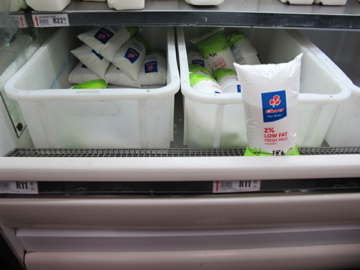
Steve, it turns out Canadians aren't the only ones using plastic bags. South Africans use them too. Photographic evidence is on the right.
Perhaps South Africa sells milk in bags because it too has a milk marketing board? Actually, South Africa's milk board was disbanded in 1994. According to the South African Milk Producers Association, "The South African dairy industry operates entirely according to free market principles."
I don't take the milk producers' claim entirely at face value, but let's say that there is enough competition in the industry that milk bags cannot be explained solely in terms of the South African milk industry's isolation from competitive pressures. So why do they exist?
I don't know, but here are two theories.
First, history matters. People who have grown up using milk bags find them easy and convenient to use (hint: don't pour the bag into another container; buy a purpose built milk-bag holder). Even if the milk board goes, the milk bags may stay.
Second, there are a fair number of people in South Africa who don't have much money. Milk bags use less materials than jugs, so are cheaper to make. Some people are willing to pay for convenience, some people aren't.
The cost-based argument is supported by the fact that South African jams, especially the more local flavours (e.g. melon and ginger) are often sold in cans, rather than glass jars.
The convenience of gallon jugs comes at a price – one that not everyone is willing to pay.
Update 1: Chris Auld wrote to Dan Wong of the BC Dairy Council and received this reply. Mr Wong explained that milk is not sold in bags in BC because of widespread cross-border shopping – consumers prefer milk sold in jugs, and be even more inclined to buy milk in the US if milk was not available in jugs in BC.
Update 2: A closer inspection of South African milk bags supports a price-discrimination type explanation. A one litre milk bags sells for 8 rand (around $1), a 2 litre milk jug sells for 20 rand (closer to $2.50). Given that the bag/jug cost differential is less than 50 cents, it seems likely that packaging types are being used as a way of getting those who are willing to pay more for milk to do so.


 Worthwhile Canadian Initiative
Andrew: Most milk out west, anyways, comes in cardboard cartons which can be easily flattened and put in recycling. Less commonly it comes in plastic jugs, which can also be put in recycling. There is no deposit for cardboard or plastic containers. One brand of premium organic milk comes in glass bottles, which have a one dollar deposit. I guess people buying that brand just really, really prefer their milk in glass bottles.
Our household goes through almost 30 liters of milk per week. Our principal consideration in milk packaging is recycling volume (cereal boxes are enemy #1). Milk bags beat cartons hands down.
I don’t know how much of a problem it is in Canada, but in Europe we think a lot about the rural flight, the slow death of the small villages of 50 to 500 people.
The mail office is long gone, churches operate for parishes of about 2000, a doctor for 1000, a discounter for 3000.
In Ontario a village is 2000, more like 4000 with the countryside people who drive in. It is that way it is, always was and will be in the future. Rural depopulation isn’t seen as such a problem here, the farmers who stay just add to their farm acreage.
I had an uncle who farmed and in his last years he rented his fields to the man who eventually bought them from his estate when he died.
As for churches, you need a catchment area of at least 5000 to make a church viable in Canada. There are no church taxes here, everything comes from voluntary donations. The United Church has lots of small rural churches in this part of Ontario between Cobourg and Kingston due to the evangelism activity of the Methodists 150 years ago. This area has been over-churched for decades and we are steadily consolidating them. I can show you lots of ares which are over-churched and need to consolidate and healthy churches that have a good catchment area and so are nearly always viable.
Some comments on things I forgot:
– tetra / pure-pak containers can be folded pretty efficiently, if needed, but most of the times I don’t need to. I throw them first, with other dry/clean stuff in a bin, and then take them out, on top with the other trash bag, like twice a week, before things get smelly. These US gallon jugs don’t compress like that on a daily convenience level.
– My understanding is, that we can burn the paks safely and cleanly with the usual remaining trash (we separate here 3 types of glass(white,green, brown), metals, paper(-like), the rest, and folks with a garden the organic stuff), and that this way it is LONG TERM SUSTAINABLE.
– When I read stuff on droughts / floods, Ogallala_Aquifer, I see typically time scales of 10, 30, 50 years. Here I see more time scales of 100 years (serious floods in Dresden), 500 years (Luther/Guttenberg), 2000 years. Hermann did tell Varus that the reach of the Roman Empire ends here, killing each and everyone of half the Roman army. The Gauls (Vercingetorix, French) did succumb, Britons (Boudica, Anglos), Belgii, Graeculi, Spain, Egypt …. We not.
– When we look abroad, where we can learn from: Finland (highest PISA scores, school sizes 50+), Sweden, Denmark, Dutch, …., Switzerland, Canada
@ Bob Smith
Since you mentioned it, I am now becoming aware of that in former times we had 0.5 liter milk package offerings, which are now practically gone.
@ Determinant
You are right, the sustainable village size here is about 2000 people as well ( I ll took a short sample median of 3300, hard cutoff seems to be 1000).
And the most critical economic criteria appears to be a school within walking distance.
But a village core, with some kind of a grocery, tavern, butcher, and “fresh milk” as one of the most critical items on the supply frequency / cost curve shows up larger on the psychological map of the much larger older part of the population.
As a long term infidel, I do not really care that much about the churches point of view, it just came up for me here, thinking the landscape, settlement patterns, and history, rhythm, traditions. We use the word “Gemeinde” (parish) for the lowest political unit here.
Our German farms now also have sizes more competitive to global markets, after reducing the agro employment from 10 % to 1%, after WWII. And just for folks who might be interested in that kind of information, german farmland goes at present for about 1.3x prime in Iowa (1 $/m^2), average wheat yields are 2.2x more.
To finish this of, the next economics nobel prize should go to the folks who invented tetra/pure-pak and long shelf life fresh milk.
One readability enhancement on my last post: “When I read stuff on droughts” should be “When I read anglo author stuff on droughts”
So I checked with the best source of wisdom, my mother, and she purchased the bags (in a pack of 3) because us kids could manage it. We were less likely to spill and if we happened to leave it out in the sun or on the porch or “accidentally” let the dog have a drink it was only 1.33 litres lost rather than 4.
Conclusion: Price – but not purchase price, the “price” of having milk that we could get ourselves from the fridge was lower than that of a larger container.
@Chris Auld
In Ontario, milk in bags is sold in 4L units. You buy a bag (outer packaging) that contains three smaller bags each 1.33L. The obvious comparision is alternative forms of packaging 4L. In other places, I’ve only ever seen 4L (or 1 US Gal = 3.7L) plastic jugs as an alternative, never cartons that large. (Which is not to say they don’t exist.) Back to Ontario, milk in smaller units (2L, 1L, & smaller) is normally sold in cartons (although plastic bottles for single-servings of less than 300mL are becoming common).
Milk sold in 4L units is cheaper per unit volume than that sold in 2L units, which is cheaper than 1L units, etc. It would be unfair to compare the 1.33L milk packages to 2L or 1L cartons — they are significantly cheaper!
It is interesting to read this thread and realise that the people in different parts of the world can’t quite picture as daily banality of each others’ lives as milk packaging… its funny what needs explaining! (Now, I need to go google UHT milk…)
There are other provinces in Canada beside Ontario, BC, and Alberta, you know! 🙂
They still sell bagged milk here in Nova Scotia, but most of the display space is taken up with jugs and cartons. It is more convenient to haul 4 L of bagged milk in the “cargo bay” of a stroller, compared to a jug, because it is nice and flat, rather than nearly cubic.
When we lived in Newfoundland (2000-2005), you couldn’t buy 4L jugs. My guess was that the price of milk, about twice what it was anywhere on the mainland, would have seemed astronomical for a 4L jug, so they only carried 2L cartons, so the sticker price would seem more reasonable. Not sure if any of that – relative price, or packaging – still holds, though.
Also funny, when we moved to Ontario, we couldn’t find the plastic holders for the milk bags at first – they were well-hidden in the store near the doors to the warehouse area. An employee looked perplexed when we asked where to get them, partly because we didn’t know what they were CALLED. I guess everyone who has grown up in Ontario already owns one of those and doesn’t need to buy them.
For the record, I grew up in Manitoba, and I have photographic evidence of milk bags from about 1980 (in a holder with the Safeway logo on it), but they were long gone by the time I was buying my own milk.
Bean – actually Steve Saideman’s original blog post was motivated by his experience in Quebec, and Jacques Rene Guigere and Stephen Gordon add Quebec voices above.
Thanks for adding the Nova Scotia perspective.
michael – one of my favourite things to do when I travel is visit a supermarket – it tells so much about a place.
I remember shopping with my mother when I was a child and my mother explaining the bag+pitcher system to a perplexed European visitor. I think that was the first time it occurred to me that people in other places else did it differently.
frances – So true! I like to do the same.
When I buy bags I cut the tip of the milk bag at a 45 degree angle to form a spout hole slightly smaller than a dime.
I agree with my good friend Determinant on that one. It is optimal and respect Coanda effect
http://en.wikipedia.org/wiki/Coand%C4%83_effect
, a basic fact of hydrodynamics usually overlooked by designer of kitchenware…
Jacques,
I actually think it is not the Coanda effect (mainly gases), but surface tension (mainly fluids). One way to discern would be the impact of velocity.
Jet stream effects are stronger with higher velocity, spilling the milk with dripping along the container works better at low velocity : – )
Genauer,
I am gratified to read that someone, somewhere, appreciates UHT milk products in cartons. I live in Arizona, and have lived in Manhattan and Tallahassee (Florida), and happily consumed 1.5 L cartons of skim, 1%, 2% and 4% (fully fatted?) Parmalat brand boxed UHT milk. I enjoyed the way it tasted chilled, and my fussy elderly father would even drink it at room temperature. Why is there such animosity expressed toward fine, hygienic, delicious and convenient UHT milk, do you think?
In Arizona, Manhattan and Tallahassee, we have milk in cardboard cartons of various dimensions, clear gallon jugs which are difficult to pour when full, and plastic bottles that are shaped like glass milk bottles were in the past. Institutional and restaurant settings use large 5 or 10 gallon milk in bags, just as Chris S. described. They are inverted and dispensed via tubing that resembles an udder.
Milk is still frozen! Someone mentioned that earlier. Said individual was correct: It is done in order to prevent spoilage e.g. for a month or so, in the situation where there is a milk sale. Milk defrosts well, as far as taste. It would be very nice to be able to freeze bags of milk rather than plastic bottles/ jugs. Milk bags sound like a sensible idea. I wish we had them in these parts.
@ Frances, determinant
I nearly forgot to come back on the price / income question.
According to https://www.cia.gov/library/publications/the-world-factbook/fields/2004.html Canada has an effective average purchasing power of 40.5 k$/year. Germany 38.1 or 6 % less. Then you have to consider, that the 20% in the East have still 20 % less productivity (means also non-government wages), and the West is within 2% of Canada : – )
We pay less for milk, but about 2x for gasoline (1.56 Euro/liter or 7.8 US $/gal)
and most people consume probably more gasoline than milk.
Even when you look at the US with their 48.3 average, or 19% more. Of this some 7 – 10% go more to the upper 5%, especially the upper 1%. For the remaining 10% they work allegedly 20 % more
http://www.ilo.org/wcmsp5/groups/public/@dgreports/@dcomm/@publ/documents/publication/wcms_104895.pdf (page 25)
of which probably only half is really true “working”, estimated from the years I was working in the US : – )
Now, which way are you better off? In depends on your money vs leisure preference.
The closer you look, the more it looks the same, at least in most western countries for the folks between the 15th and the 95th income percentile.
As a high income(at least in the past), single, “capitalist”, I should have been better off in the US, acording to conventional wisdom. But if you take a closer look, if one enjoys an urban life style (I dont need no gasoline for no car : -), and until recently no capital gains tax, I was actually some 10 -15% better off here. And if you take a “risk management” look at it, what happens, if something bad happens, like disability, this advantage even increases somewhat, but not dramatic, here.
Curious Ellie,
you made me look it up in more systematic detail.
I hope the following table is somewhat readable.
milk life time storage heating time vitamin
type (days) temperature deg C seconds loss comment
raw 1 ? 0 0 0% dangerous
fresh 5 – 7 fridge 75 30 <10% traditional
ESL 12 – 21 fridge 120 3 10 – 20 % new Europe standard
UHT 90 – 180 ambient 143 ~5 10 – 50% tasting less good to most people, “H-Milch”
Bottomline: you loose some more vitamins with the UHT, and for most of us, including me, fresh / ESL and full fat (3.5%) tastes significantly better.
If this is not the case for you, stick with the more convenient UHT.
http://ratgeber.t-online.de/frischmilch-esl-milch-oder-h-milch-die-unterschiede/id_48993576/index
Since I brought up rural flight earlier, the research institute is located in my little birth town (25 000 inhabitants). Distributing those institutes not just in larger cities we see as a way to stabilize a more homogenous settlement structure.
Frozen milk, interesting. My freezer is 17 liter. I use it practically only for half eaten packages.
I can shop here fresh food 7 days a week, within 5 min walking distance. So it is not unusual, to stand there on sunday noon, and wonder, what do I want to eat now.
The 45-degree angle method works well as the pressure of the liquid when you pour pushes against the bag and billows it out, thus stabilizing the spout hole. It works very much like a icing bag. You get a nice, tight, contained stream which doesn’t spill and is very controllable.
3.5% milk is called Homogenized or Homo Milk in Canada, much to the giggles and puzzlement of visiting Americans.
I received the following detailed and interesting response from Dan Wong at the B.C. Dairy Council:
— begin quote
You asked why milk is distributed primarily in bags in Ontario vs. cartons in other provinces. The answer is a combination of economics, market dynamics and regulation. Plastic milk bags first made their appearance in Canada in the mid-1970s and were introduced concurrently with the nation-wide adoption of the metric system. This led to some resistance in the marketplace (consumers felt it was being forced upon them) and strengthened the role of paperboard cartons as glass bottles (for the most part) disappeared from store shelves.
In the late 1980s, British Columbia in particular was confronted with a massive wave of cross-border shopping (not unlike today). The rigid plastic jug was already established in the United States, and began to show up in BC as a result of cross-border shopping. Its popularity led dairy processors in BC and Alberta to start selling milk in rigid plastic jugs. Consumer acceptance of the jugs was very high — in addition to being safe, convenient and easy to handle, they were positioned as the ‘price fighter’ in a suddenly competitive retail marketplace (retail price controls having disappeared in most provinces by the early 1990s). In a relatively short time, jugs supplanted plastic bags as the container of choice, along with cartons which continued to dominate the smaller (two litres and under) formats.
However, Ontario was still subject to a ‘legacy’ regulation which stipulated that companies distributing milk in rigid containers greater than two litres in size were required to charge a refundable deposit at point of sale. The regulation dates back to the 1960s and has had the effect of maintaining the market for flexible plastic containers (i.e., bags) in the province which manufactures them. Over time, dairy processors, who much like other businesses went through a protracted period of consolidation, standardized production in rigid plastic jugs (primarily four litres) and paperboard cartons (primarily two litres and under) throughout most of the country — except in Ontario where the regulation ensured that plastic bags continued to dominate the large formats.
Consumer acceptance of plastic bags is high in Ontario largely because that province has had limited exposure to plastic jugs. Cartons remain popular in all provinces primarily in the smaller formats. More recently we are seeing some ‘de-standardization’ as processors use packaging to differentiate their products — thus we are now seeing more small-format rigid plastic bottles and, in niche markets, glass bottles.
All the cool kids in America get their milk delivered now.
http://www.oberweis.com/
Chris, thanks so much for posting that! Frances
Pretty much as I expected,
after drinking ESL milk for 2 years, the slight taste preference for “traditional” milk is gone.
Tried 2 times now, in careful comparison, makes absolutely no difference anymore.