The message is clever, inspirational….
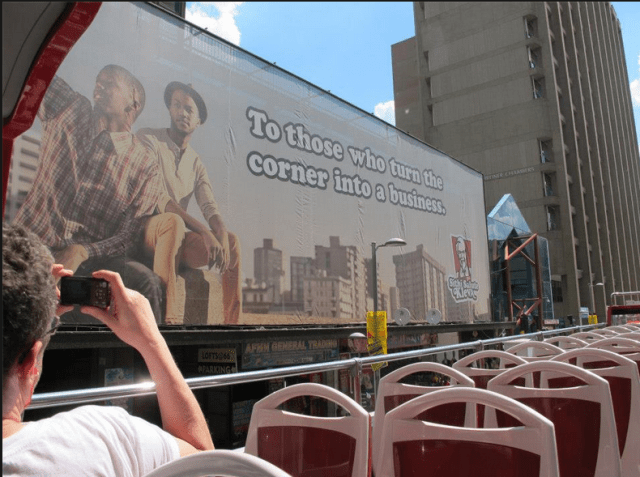
…and sponsored by Kentucky Fried Chicken. It's part of what is sometimes called the Americanization of South Africa – KFC outlets are sprouting up all over Johannesburg, from the tony Northern suburbs to the new malls of Soweto.
It's tempting to see KFC's (and MacDonald's) African invasion through the lens of race. After all, in the United States, MacDonalds and KFC specifically target advertising towards African-Americans. But a more probable explanation is that KFC experienced huge success after expanding rapidly into China, and is looking to duplicate that success elsewhere.
KFC expansion may be good for the company's profits, but is it good for ordinary South Africans? KFC is delicious, and making yummy food available to people should make them better off. On the other hand, fast food consumption has been linked to obesity (here and here, for example), and proximity of fast food restaurants has been linked to fast food consumption (here), suggesting that KFC may be bad for people's health.
But how much worse would KFC be than people's current diets? Right now Soweto has a market where free range chickens are raised in pens, and killed right before the consumer's eyes. Fresh fruit and vegetables stands (and just about every other sort of stand) are ubiquitous in downtown Johannesburg. It sounds like a locavore's dream. But is it hygienic? Convenient? Reasonably priced? Realistically, people seem to eat a lot of cabbage and samp (maize) – KFC would add quality protein (or protein, anyway).
There is also the economic impact of fast food restaurants. My host here tells me that KFC has created lots of new jobs – but how many people working at locally owned shops and restaurants has it displaced? This survey of international franchising doesn't reach any firm conclusions, and this survey is notable in its lack of any discussion of the overall economic impacts of franchising. I did, however, find one article by Adrian Tschoegl that argues McDonalds has a positive effect on economic development:
McDonald’s brings training in management, encourages
entrepreneurship directly through franchises and indirectly through demonstration effects, creates
backward linkages that develop local suppliers, fosters exports by their suppliers, and has positive external effects on productivity and standards of service, cleanliness, and quality in the host
economies.
So perhaps KFC will manage to grow the South African economy, as well as South African waistlines.


 Worthwhile Canadian Initiative
I’ve eaten Kentucky Fried twice. Once because it was the only food available. Once again because it might have changed (it hadn’t). I can’t imagine it improving anyone’s life unless they really needed something to remind them of what food should not taste like.
More seriously, the impacts of this kind of retailing are hard to calculate – and certainly not summed up in GDP. Worse food, worse health in some ways, better in others; jobs lost on local stores, and also with them local credit, local work experience, local neighbourhood watch, local variety. But other paths open. An ecologist would see a simplifying of the ecosystem, with greater rewards to one element at the expense of overall resilience.
I’m imagining myself as a pedestrian in Johannesburg, then looking and seeing a bunch of tourists taking photos of a KFC ad….
Like Peter T, I dislike KFC myself. But the arrival of the Colonel could be an epiphenomenon to what’s sometimes a happier story of growth and rising living standards. According to this study (also confirmed here), in 2002 only one fifth of the SA population regularly consumed at least 100% the required daily allowance of major macronutrients. Seventy percent of households said they regularly went hungry. (The paper actually addresses KFC specifically, and notes that SA is/was the only African country with major fast food chains.)
Now, I agree that a big infusion of junk food is bad, but we also have to ask, why KFC/McD’s and not something else? Why aren’t Whole Foods or some organic salad chain making huge inroads with SA consumers? Would they offer as much cheap protein? The denunciation of fast food chains entering poorer countries (like the recent Cinnabon setup in Libya) is like the hate-on for Wal-Mart. It offers a rough, rapid, convenient QOL boost for lower income people, without them having to listen to lectures about how it would be so much nicer if they just fabricated/cooked/grew it themselves in some kind of community artisanal facility funded by the Gates Foundation. As their standards rise, they may also get more educated, earn more, and become more selective. If you look at the huge rise in sugar consumption between the Elizabethan era and the Victorian era in the UK, you could easily look at those figures and predict that the whole population would be a mass of blubbery, black-toothed corpses by the start of the 20th century. That didn’t happen.
developing countries, fast food, and FUN
made me actually interested in development stuff, 30 years later, again
I’d really like to see Paul Campos go to town on that brochure from fastfoodmarketing.org. It looks like total alarmism; the very first sentence, “The research is clear: Consuming fast food endangers young people’s health” appears to be flatly false. (The research is anything but clear, and what research does appear to show health risks relates to heavy, frequent consumption, not just “consuming fast food.”)
What is “fast” food? Why does its being “fast” make it unhealthy? What is fundamentally wrong with having someone else cook your food for you? Or restaurants without table service? Or a short lapse of time between placing your order and getting your food?
In my UK childhood “chicken and chips” was a treat. Coming to Canada in the 70’s, and seeing you could buy chicken and chips at a takeaway for a reasonable price without waiting, made me realise I had come to the first world.
Nick – yes, fast food is a misnomer, the problem is lots of fried food, and food that’s high in fat. The slow braised pork belly I had in Melville was probably worse for me than KFC. I find that English visitors usually have that “I’ve come to the first world” reaction when they go to Tim Hortons. (So delicious! So cheap!)
Peter T: “An ecologist would see a simplifying of the ecosystem, with greater rewards to one element at the expense of overall resilience.” What I’m finding mindboggling now that I’m outside of Jozi is how amazingly diverse the South African ecosystem is. I guess if I’d thought about if I’d have realized that there are lots of different types of animals in Africa, but it isn’t until you get here that you realize how much more diversity there is here compared to, say, Waterton National Park or Algonquin Park. So I’ve been giving a lot of thought to precisely this issue – what makes some ecosystems more diverse than others, and some economies more diverse than others. Is the loss of other retailers akin to the loss of some useless mutation that the gene pool would be better off without, or is it making the system, as you suggest, more vulnerable.
Shangwen – the pedestrians, as far as I can make out, are just puzzled. The hop-on-hop-off buses have only been operating in Johannesburg for 2 weeks, and most people haven’t figured out what these strange almost completely empty buses are for.
Chicken and watermelon, that’s a Southern stereotype init?
And KFC..
http://www.youtube.com/watch?v=vFoBGtIVFBQ
Still services are the future.
Nick is on to something. And to turn the argument on its head, “slow food” in “fine restaurants” with meals prepared using butter and transfats with copious amounts of alcohol can have a high caloric and fat count.
But I thought that in a market economy we believe we are individually capable of making these decisions ourselves – including making decisions that may be sub optimal. (and we may make mistakes concerning our partners or investments or …)
Or if we decide to regulate KFC and fast food for health reasons, what about potato chips, ice cream, candy, frozen fried food and indeed any food that is deemed not healthy sold in grocery stores?
And if health of citizens is to be the policy objective, should we not compel obese people to enrol in exercise programs and compel drug addicts to enrol in rehab programs instead of safe injection sites?
Perhaps fast food is simply part of a larger category of “that which is self-evidently socially undesirable” including fossil fuels (that keep my house warm at -25 and propel my car at -25 to Carleton), Tim Hortons, American multinationals (except Hollywood film studios), fracking, financial service execs (except those in non profit institutions).
The country that gives us dead man donuts is worried about KFC? Care to do a fat and calorie count on poutine? Seriously, this will be status food for those who can afford it. Every big city I have been in across the world has had some form of fast food and it is not always the healthiest. If they can adjust the food to local tastes they will succeed. If not, they will eventually fold. What poorer countries may learn which could be of value, is the ability to franchise and provide uniform products. Obesity is not due solely to fast food, so let them sort it out and if they want to have a little KFC let them.
Steve
when did Gyros and Döner Kebab turn up in your places, if at all?
Locavorism and “slow food” is overrated, much as many city people don’t know about the country. Like when their cottage is robbed, they first thing they say is “where were the police!?!” Um, out here, the OPP only come when they are called. We don’t have that many of them.
You’ll never overcome Western Canada’s wheat advantages but it’s hardly “local”. People can judge what’s best for them.
Besides, quality is a rich man’s problem.
jb “that’s a southern stereotype” – which is why I found it so striking that KFC is the dominant fast food chain in South Africa.
I have to add a few things:
1) Fastfood chains can be a lot different country to country. For instance in Central Europe, Mc Donnalds is renowned for almost obsessive adherence to hygiene and quality of local ingredients. Having a friend working there on holidays (and watching Kitchen Nightmares) made me realize that the “quality” served in Mc Donalds (in terms of being prepared in clean and hygienic way) can be higher then in many “slow food” restaurants. And imagine my shock visiting McDonalds on my visit in LA – where the experience was – to put it mildly – not so great.
2) Anyway, fastfood chains in developing countries (I have experience from central Europe) tend to compete with whatever fastfood was there before – bistros, sandwicherias and wide variety of food stalls – not with serious restaurants. However fastfood chains brought larger scale, production methodology and other improvements that forced these old established “quickfood” chains to adapt and improve. Overall I see it as an improvement.
3) As mentioned, health risks depend on the type and ammount of fastfood you consume – you can grab a sushi set at Nordsee if you wish so. However if an alternative to having a fastfood burger is preparing ready-to-cook chicken vindaloo in microwave oven, maybe the burger is not such a bad option in the first place.
“the problem is lots of fried food, and food that’s high in fat”
I would argue that there is a lot better evidence that the problem is the batter and the high amount of sugar in the bread, soda and potatoes that usually go along with such a meal.
The fat hypothesis doesn’t seem to be well supported, but is amazingly tenacious.
That pork belly was probably better for you. Unless it had a sweet glaze.
I agree with J.V. Dubois in that the benefits of introducing fast food to poor countries are underestimated. This is a bit like Paul’s comments on the “poor whites” post. If my own children were suddenly forced to live in a world where they would struggle to get more than 50% their required nutrition, I’d be thrilled for them to eat lots of KFC.
You can compare this to the post-WWII availability of cheap protein in east Asia, where land for livestock and the ability to get meat to market was heavily damaged, but cities in places like Korea and Japan had access to lots of protein in US Army rations such as Spam, tinned baked beans, and hot dogs. I’m sure many nutritionists would be horrified that kind of salty, high-fat food, but it’s better than starving or subsisting on a maddeningly dull diet. The utility gained by an increase in variety–regardless of nutrition–is also important to note.
Interesting that we all thought it was so great when the poor white people behind the iron curtain got to choose to eat fatty, salty fast food. “Look! They are Free(TM)”! But when it’s poor black Africans, the impulse seems to be to wring our hands and wonder if they wouldn’t be better off if they had less choice and just stuck with killing chickens in the dirt in the markets of their shanty towns.
I wonder if somewhere in Soweto there is are a bunch of people sitting around worrying about the nutritional value of my lunch?
when did Gyros and Döner Kebab turn up in your places, if at all?
They are marginal in North America, compared to the ubiquitous hamburgers and KFC.
Maybe a better example is sushi.
Fast food : two problems: 1) sugar. Our descendants will wonder why we didn’t ban that abomination sooner alongside tobacco…2) eating fast force your insulin level to rise too fast.
Fast food need not be KFC. SUBWAY seems to be planning a major expansion in SA
http://www.subway.co.za/
Gyros and Döner kebab are ubiquitous in Québec lebanese restaurants as shawarma and shishtaouk pita.
@ J.V.Dubois
Nordsee still looks very much like a German outfit. Not even the name is internationally combatible. I buy fresh mussels from them, tpyically in November. It is one of the few things, which still adhere to the seasons.
Sushi was still pretty special 10 years ago, here around. Now it is pretty common.
What other people claim, with McDonalds you pretty much know what you get, what can not be said about Gyros and Döner all the time. There are price wars, especially in Berlin, and this is not good for consistent quality.
@ Determinant
to get some acceptable Döner in NY State, I had to go deep into Brooklyn, all the other “Greek Diner” had it from a hotplate. Not OK.
Well, I think I realized it around 1998, that I am culturally imprinted, that a real lunch has to be a) warm, and b) eaten with a fork and a knife, from a solid plate.
The freshly killed chicken I should have a look at/taste of. In Taipeh, I would have gone eating in Snake Alley, if the others hadn’t chickened out.
The message I’m getting from the comments is – it’s complicated. How good/bad fat is depends a lot on the type of fat, how active the person eating the fat is, their overall calorie intake. Any evaluation of the goodness or badness of KFC depends critically upon what is the alternative.
Johannesburg reminded me a lot of US big cities – which is interesting, how apartheid plus years of embargoes plus the ANC leads to….Atlanta?
Striking too it is that KFCs in France make more money than anywhere else in the world.
http://online.wsj.com/article/SB10001424052748703866704575223892236926372.html
Apparently having them eat cake all the time is not considered bling bling anymore. Guess Boris was right, the sans culottes are back in power.
Wonder if they pay a lot in taxes?
And what about the Colones workers, Jeff Mcenery did a brief stint there, here’s his experience:
But regarding diet.In my home country Danish chefs have returned to their roots in the “New Nordic Kitchen”, with its fish, game, berries and herbs. They also make “Stone Age food”, where processed carbohydrates such as flour and pasta are avoided.
The Viking drinking is optional.
jb,
you got me with your missing “l”, but the movie was fun.
While talking about MY lunch preferences, I forgot, why I brought up Döner in the first place.
Because the combo is actually a pretty balanced meal, if done right, and the meat not being a fat conglomerate.
Soo, if you are in Europe, and have a chance to get a halal version, try it.
Halal, is it meat you looking for?
Döner; been there, done that. Although I prefere İskender kebap.
If for some obscure reason you should find yourself stranded in Copenhagen Harry’s place, a hotdog stand frequented and endorsed by at least two former prime ministers, is recommended
http://www.harrysplace.dk/
And if you fancy a slow beer try Vinstue 90
http://www.vinstue90.dk/
Although if you are German, this might be very much like home.