This post is premature. It's too early to say for sure. And I don't have any real answers to explain this (possibly non-) event. I'm trying to fit together a number of things that have been puzzling me.
The first puzzle is why inflation targeting failed. The Bank of Canada succeeded in keeping inflation on target, but keeping inflation on target failed to prevent the recession.
The second puzzle is why inflation did not fall below target during the recession. Why was inflation so persistent? Did inflation targeting make inflation stickier?
(The first and second puzzles are closely related. You might say they are just different ways of looking at the same puzzle.)
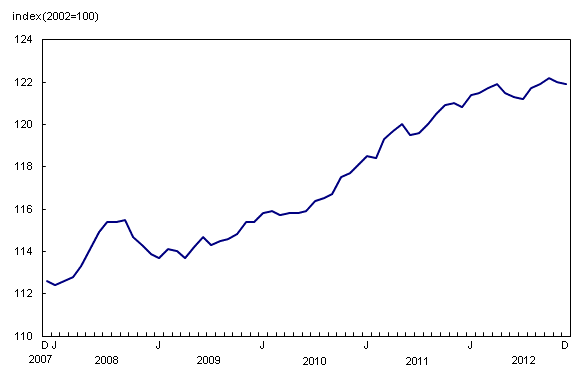
And now a third related puzzle seems to be emerging, though it's still a little too early to say for sure. Just as the economy has more or less recovered from the recession, with the unemployment rate back down to 7.1%, inflation seems to be finally falling well below target.
Here is Chart 4 from Statistics Canada's December CPI release, showing seasonally adjusted CPI:
Here are some more data from the Bank of Canada, showing various measures of core and headline inflation.
Any way you measure it, inflation has been falling, and falling below target, over the last few months. The price level (both total and core) was about the same in December as 8 months previously. Inflation seems to have fallen to zero.
This post is about Canada, and the Canadian picture-puzzle is clearer (to me anyway). But I don't think Canada is alone.
8 months is not long enough to say for sure. But it looks like inflation might finally be doing what it was supposed to have done a couple of years earlier. If so — if this recent trend is in fact a trend — why the long lag? Are the supertankers of the Phillips Curve finally turning south, nearly 4 years after the canoes jumped south? Just as the recession is finally ending?
[My blogging will probably continue to be very light in the next few weeks.]


 Worthwhile Canadian Initiative
Nick,
Good question. Given that the policy rate is at 1% and they didn’t cut last week, the answer seems to be that that’s what the Bank wants. But why do they want that? Maybe they are targeting house prices? Maybe some nominal rates do matter and maybe mortgage rates are one of them.
Or more precisely, maybe they are targeting consumer debt.
Would the increased value of the Canadian dollar have counteracted possible inflation?
Nick – a few reactions, which may or may not be relevant.
In the 1990s, the rapid expansion of Walmart had a measurable impact on US CPI. Could Amazon and cross-border shopping be having a real impact on Cdn CPI?
It strikes me that the measurement error in calculating the price level is probably greater than 1%, which makes it really hard to know whether or not any of these puzzles reflect real macro puzzles, or are just an artifact of the data. E.g. sales of $1,100 apple notebooks are going up; sales of other, $800 notebooks are going down. So the average price people are paying for computers goes up. Does this mean the price of computers is going up? Or to take another example, people switch from buying real books to electronic books downloaded on kindle or kodo (or is it kudu – I’m thinking more African antelope at the moment). What does this do to CPI? As the housing market cools off, newly built homes in the suburbs don’t sell, but downtown Vancouver real estate keeps its value – what does that do to CPI?
Also, is zero inflation a good thing or a bad thing. If relative prices are changing, and price reductions are costly due to nominal downwards price rigidity, then I’d figure zero inflation is a bad thing.
Good luck with the administrating – hang in there.
I don’t really understand why inflation targeting is supposed to prevent recessions? Inflation targeting is supposed to keep inflation in check which is an important necessary (but not sufficient) condition for balanced growth. There are plenty of other things that can create a recession that inflation targeting won’t solve. This seems like an unreasonable burden of proof placed on inflation targeting by the market monetarists to criticize inflation targeting for an outcome inflation targeting was never claimed to guarantee.
More thoughts…
But then, of course, when debt level targeting causes disinflation that just shows you what a bad policy that is when you are barely above the ZLB. Consumer debt is supposed to be managed by CMHC. If this is not just a blip, it could be a very dangerous turn of events. The only silver lining is that they seem to already have begun exchange rate management and they could ramp it up if we get seriously liquidity trapped. But if that coincides with a US downturn it’s not going to be popular in Washington.
Frances,
Unless the Bank knows that there suddenly is a bias in the inflation measure then they shouldn’t be letting it drop.
Frances,
Also, zero inflation is bad because it lowers the nominal natural rate. That makes it more likely the we get liquidity trapped. We urgently, critically need more inflation, not less.
All your questions can be answered by recognizing that the way we measure inflation is horrifically flawed.
@ Nick
“This post is about Canada, and the Canadian picture-puzzle is clearer (to me anyway). But I don’t think Canada is alone.”
What I think is:
a) the spill over from other countries like US and Europe
In Europe the Recession has clearly not reached bottom yet. I see your picture of the canadian canoe, swimming in the wake of the US / EU supertankers as appropriate
b) what is your favourite Canadian housing index, link? And how does this go into the various inflation indices, together with the very rapidly falling interest rates?
Trying to explain to Scott Sumnner some 9 month ago, how that goes ino the US indices was instructive
c) I am at present trying (http://worthwhile.typepad.com/worthwhile_canadian_initi/2013/01/what-is-going-on-with-the-bank-of-canadas-balance-sheet.html?cid=6a00d83451688169e2017d40a4f6b2970c#comment-6a00d83451688169e2017d40a4f6b2970c) to quantify such a spillover effect with Kostas for a timed event last year. It just got a little more complicated, so it is still Work in progress.
d) if the Bank of Canada is running an implicit peg to the USD, as I say, you dont have to worry about inflation that much anyways.
@ Robert McClelland
please provide detailed evidence for your completely unspecific allegation, that the official inflation numbers are “horrifically flawed”. I ll give you some 0.2% systematic bias in the direction which pleases you, some total 1% fluctuation, due to various reasons, over a time scale of a year. For more I want to see evidence.
I had such discussions several times. It ALWAYS turned out, that the allegation were pretty unfounded.
This is one of the few things, I agree with Paul Krugman : – )
If the Phillips curve involves a long distributed lag on unemployment, that would explain the sluggish response of inflation, right? Say a big recession drives down the underlying inflation rate only a tiny bit in the very short run (and it’s subject to other influences — noise if you will — so it might not fall at all for a few years), but it has a gradual impact over time, so that, provided there is not a full recovery, the general trend of the inflation rate will tend to be downward (and again, due to other influences, we might not see this in the data for several years).
K: the BoC says it is targeting 2% inflation (except in the very short term) and I have no reason to disbelieve them. Maybe they are fudging a bit, and letting forecast inflation fall below target for other reasons, or maybe they think the current fall in inflation is just a blip. But that is not the question here. The question is, as Andy puts it, why is there (or why does there appear to be) such a long distributed lag in the Phillips Curve?
Andy: yep. But doesn’t the lag seem to be longer than we thought it was, or than it was in the past? Maybe because inflation targeting itself has made the lag longer (inflation stickier)?
qmanrei: That would maybe explain it, except the Loonie has, if anything, been depreciating a little over the last couple of years.
Frances: It might be some special price shocks, but none come obviously to mind. House prices barely show up in the CPI, except very slowly and indirectly via “owners equivalent rent”.
I hanging in there on the admin! They gave me a laptop so I can drill down into DataCubes during budget meetings, and join the modern world. But I still haven’t destroyed any committees yet for you.
Robert: whether or not a measure of inflation is “flawed” depends on what you want to use it for. But in this case it doesn’t really matter, because we haven’t changed the way we measure inflation, but it isn’t responding the way we used to think it did (or doesn’t seem to be).
genauer: Maybe Canadian inflation is finally falling because inflation is finally falling in other countries. But that just pushes the same question back to those other countries.
Best source of Canadian house prices is Teranet-National Bank. It’s a Canadian version of Case-Shiller.
@ Andy & Nick,
a lot of (social) contracts in Europe are / have been on explicit inflation tracking,
and often on not ex-Food energy, like the FEDs favourite PCE ex food and energy (mine too, for the US). It is often even worse, there are some , e.g. in the UK with some RPI plus 0.5%, well, with some historic justifications, …., but at present more like a NGDP on stereoids.
This means that explicitely some 50% government sector, and implicitely some more, minus the few official cutbacks, … are/were effectively short circuiting the Phillips curve, deep into 2012, in the most cases in Europe,
and from my gut feeling, at least 30´% of the US as well.
Sooo, for Europe the explanation is frustatingly simple and clear, so far.
And now comes the question, how independent prices (beyond real estate) are independent in Canada.
In the moment I see the effects of the FED QE tsunami spilling into the last hamlets in Germany and Malaysia, personally. But enough of this, focus is Canada, and I will see whether something comes out of this petroleum idea.
Nick: But in this case it doesn’t really matter, because we haven’t changed the way we measure inflation
It does matter if inflation is now rising or declining due to an influence that is not measured. Essentially what I’m saying is economists need to first check to see if their measuring stick is still accurate. I have a hunch it’s not due to either some previously unidentified influence or possible even a new influence.
“The first puzzle is why inflation targeting failed. The Bank of Canada succeeded in keeping inflation on target, but keeping inflation on target failed to prevent the recession.
The second puzzle is why inflation did not fall below target during the recession.”
If the BoC’s ratio of assets to money falls by 2%/year, while at the same time the BoC fails to issue enough new money to accommodate the needs of business, then inflation will stay on target while you get a recession.
Meanwhile, if the recession has little or no impact on the BoC’s balance sheet, then the recession will not affect the inflation rate.
I suspect Mike Moffatt’s answer would be that the Bank of Canada’s monetary stance has been too tight over the past couple of years. I’ve been reluctant to adopt that view, but it’s getting harder to resist.
HST? Looks like an upturn in the rate of growth of CPI in 2010, when it was introduced in Ontario and BC, and moderation after the first year, which might be savings getting passed on and the shock having passed.
“The first puzzle is why inflation targeting failed. The Bank of Canada succeeded in keeping inflation on target, but keeping inflation on target failed to prevent the recession.”
No! I say it again, Nick, inflation targeting did not fail because there was a recession. Inflation targeting was never intended to do more than deliver a framework of price stability (with perhaps a little leeway for output stabilisation if the inflation targeting was “flexible”) – which it did – within which the non-monetary economic authorities were supposed to promote and stabilise real economic activity. It was the non-monetary authorities which failed, essentially because their jobs, like fiscal and structural reform and financial regulation, were politically costly. Last time, I quoted you the ECB line; this time I will offer Bernanke’s view from his book on inflation targeting: “the maintenance of low and stable inflation is important, perhaps necessary, for achieving other macroeconomic goals” (note “necessary”, not “sufficient”).
“I suspect Mike Moffatt’s answer would be that the Bank of Canada’s monetary stance has been too tight over the past couple of years. I’ve been reluctant to adopt that view, but it’s getting harder to resist.”
That is my answer. I wish I had been wrong last year, but I don’t think I was.
But why did they make that mistake? I really don’t know. My best guess is that the BoC’s model doesn’t adequately account for political risk and the situation in Europe. But I don’t put a lot of weight on that guess.
It’s possible that something broke with our inflation measurement. But given NGDP data, that opens up more questions than it answers.
1. If we’re understating inflation, then why is RGDP growth so low?
2. If we’re overstating inflation, then RGDP growth is reasonable.. but then how do we explain unemployment?
Bank of Canada has been too tight over the last 12-24 months.
There have been significant international developments over this time: expanding QE, EU recession, slowdown in China…even Australia has been cutting rates. Resource prices have been dropping while Canadian GDP growth has been modest. All the while the Bank has stood pat while beating their chest that rates were imminently going up. One of the results is an overvalued Canadian dollar that whittles away our trade position.
Why? The Bank has been fixated with the sideshow of consumer debt. End of story. As someone noted above, this is not the Bank’s responsibility.
genauer: “Sooo, for Europe the explanation is frustatingly simple and clear, so far.”
Not to me. You lost me.
Robert: OK. We can’t rule out the possibility that the definition of “inflation” that works best in the Phillips Curve is different from what Statistics Canada measures, and that that difference suddenly mattered more over the last few years.
Mike Sproul: Your model seems to me to have a horizontal AD curve and a vertical AS curve, and that the recent recession was caused by an AS/supply shock. That’s not how I see the recent recession. It looked to me like deficient AD>
Rebel: you are setting a very low bar for “successful” monetary policy. Sure, monetary policy cannot prevent bad weather and earthquakes etc. But it can (if we get it right) prevent deficient aggregate demand. And if IT cannot prevent deficient AD recessions, we need to change it.
Mike and Mark: if this current downtrend in inflation is more than just a blip, then we will be able to say that the BoC had monetary policy too tight over the last year or two. But yes, that still leaves us with the question: given the history on unemployment and RGDP, why did inflation not fall earlier, and start falling now?
From Sep 2011 to Dec 2012 yoy CPI has fallen from 3.2% to 0.8% while the UR has changed from 7.2% to 7.1% (and was at 7.4% in Oct). Avg. annualized GDP growth has been about 1.5% over the last 4 quarters.
That’s tight policy imo.
To me, this has mostly to do with events outside Canada, especially in China. Inflation all over the world did not fall much in this recession because China’s massive stimulus effort ended the recession there almost before it got started. (It did get started a bit – you read stories early on about factory closings and mass migrations back to the countryside, but it was very short lived.)
China’s massive and growing demand for resources kept commodity prices rising, which drove inflation everywhere despite lack of demand in other countries.
Recently, China took steps to cool its economy, which to me accounts for any small dip in inflation. I understand that those cooling efforts now seem to have done their job and we can probably expect a return to rapid growth in demand for resources.
Nick Rowe: “Sure, monetary policy cannot prevent bad weather and earthquakes etc. But it can (if we get it right) prevent deficient aggregate demand. And if IT cannot prevent deficient AD recessions, we need to change it.”
Hmmm. Does that mean that the inflation target was too low?
Nick:
Are you sure that your puzzles are puzzles?
The data are clear that, in all inflation targeting countries for the past couple of decades, the relationship between inflation innovations and your favourite measure of the cycle (output gaps? NAIRUs? markup?) is quite a loose one. Some (but not all) claim that the latter add nothing to inflation forecasts. To qualify as a puzzle, I think you need to show that the deviations of inflation from forecast are larger than what we would have predicted based on past experience.
Put another way, isn’t what we’re seeing completely consistent with the kind of performance that we should have expected from inflation targeting?
Footnote: I’m happy to cite empirical studies on inflation forecasting and the fit of Phillips Curves if you want to get into that.
From Sep 2011 to Dec 2012 yoy CPI has fallen from 3.2% to 0.8% while the UR has changed from 7.2% to 7.1% (and was at 7.4% in Oct). Avg. annualized GDP growth has been about 1.5% over the last 4 quarters.
That’s tight policy imo.
Reasoning of this sort bothers me. It is a logical fallacy, specifically Affirming the Consequent. Simply because output falls, inflation falls and unemployment rises does not mean monetary policy is tight. Monetary policy might be ineffective and there is no recognition of how strong or weak monetary policy might be in a given set of circumstances, or that the relative strength might change at a moment in time.
Perhaps we are, as Keynes put it, “trying to push a piece of spaghetti uphill”.
Simon: I am comfortable with the idea that, if the BoC is targeting 2% inflation at a 2 year horizon, then the 2-year ahead forecast for inflation should always be 2%. No current information should help us forecast 2-year ahead inflation. But 2 year ahead information should help us forecast 2 year ahead inflation.
Nick:
Let me try to be clearer.
Given the relationship we see between activity measures (pick your favourite) and short-term inflation forecasts, how much variance reduction in that activity measure should we have expected from a policy of stabilizing the (medium-term) inflation rate?
How different is that from what we see?
A few loosely related points…
First, I’m not sure if it’s right to assume that falling inflation is a delayed response to monetary policy. The way I see it, you could just as easily argue that things have deteriorated in the last 6-12 months and disinflation is the leading indicator of excessively tight monetary policy. Unemployment hasn’t moved much in the past year and maybe it’s about to start rising. Employment data is hard to read because it’s pretty noisy on a short term basis.
Second, I wonder if inflation is so well anchored that the Bank really doesn’t have much knowledge of how much they can actually affect it via rates policy. Maybe it’s like a tanker that just stays on course. Sometimes the captain turns the wheel one way or the other in anticipation of winds and waves but the boat never really changes course. He may be a great captain, but for all we know the wheel isn’t even connected to the rudder, or maybe he would have had to move it 10 times as much to get any effect.
Maybe that’s an additional benefit of level targeting, especially NGDP: they actually have to do something most of the time so they get a lot more feedback about just what it takes to steer the ship at any given moment.
Last (and somewhat OT) I cannot fathom what the Bank could possibly be thinking right now, unless they are trying to bring the housing market down easy. The only relevant measure that seems at all on target is the 10-year break even rate which is currently trading around 2.04%. But by all reasonable short-term measures, and especially given the risk of being so close to the ZLB, easing looks like a no-brainer to me at this point. Why are they not cutting?
yeah, you reminded me, that I have to put more effort into writing normal English.
And Normal defined as in “understandable at least by the 5% versed in economics” : – )
My main thrust is basically the same as Simon:
Where is the problem?
Half a percentage point deviation in inflation targeting, over less than one year?
The tight number, I came up earlier for McClelland, was an integral 1% times 1 year for detecting signal from noise.
Besides running the peg, the BoC should pretty much do nothing in the moment, you also have to keep a firm hand on the tiller, and not switch too often. Sorry, that I do not have something better in the moment than to refer to
http://en.wikipedia.org/wiki/Statistical_process_control, especially the references.
Both Canada and German Unemployment are close to long term equilibrium, give the level of our social systems. If we would live alone on this planet, we should have rates at 4%, with Canada slowly rising to not crash the exaggerated housing market, and Germany going as a starter to 5%. Doesnt happen, because we dont live alone.
Like Simon and Determinant say, the underlying mechanisms for the phillips curve are completely broken. Good, in most ways.
In contrast to 1929 – 1933, we did not have a cumulative 30% deflation, and a breakdown of international trade, something we in Germany actually associate more often with “austerity”
@ Nick,
Since my post on Europe, 4 days ago, was too cryptic.
Lets take as an example Spain, 2.9% inflation, 26% unemployment, huugh, looks terryfying, doesn’t it, and how does that fit on a phillips curve?
http://www.reuters.com/article/2012/12/12/us-spain-pensions-idUSBRE8BB0VF20121212
Take a look at their pension system, because I think that is also typical for their wage sector.
They have to wien the system of the inflation indexing, because it is long term too generous/expensive. The Nordics took that step in 1993, we in 2003. The Spanish demographics is really not that different.
The Socialist did it 2 times by exception rule, but the Conservative Rajoy reversed, because he had promised it the pensioners to win the elections. 2 Step forward, one step back.
And this 4 years into the crisis. This year he takes kind of a half step, only 1 – 2 %, but he did raise VAT http://www.vatlive.com/european-news/european-vat-rates-on-the-increase-review-the-major-changes/
like so many others, after finding out, that he can not raise income taxes anymore without serious side effects.
In companies, it is the same, they tried to get rid of those they do not absolutely need, but fouling it up with the existing employees with some wild wage cut attempt would be pretty stupid in most cases.
Where should some deflation come from?
I swear, you guys are like the police, pursuing the guy you just know is guilty, tunnel vision all the way. It’s got to be a macro thing, right?
Here’s a clip from a news story summer of 2010:
“Canada’s annual inflation rate increased to 1.8 per cent for July, boosted by the HST, after a one per cent rise in June.
Prices were affected by the introduction of the harmonized sales tax in Ontario and British Columbia, and a two-percentage-point increase in Nova Scotia’s HST, Statistics Canada said Friday.”
The fall of in the rate of growth of prices since would also be consistent with the HST as a significant factor, as you get past the anniversary date jump and the savings passed on occur with a lag over time.
I’m not saying this solves your mystery, but I’d suggest it might be a considerable factor.
Determinant, I would say that if everything you describe happened then money is indeed too tight.
I was using the variables Nick was discussing. If I was Scott Sumner I would just say that average quarterly nGDP growth has averaged 3.0% annualized over the last four quarters. The reason inflation growth has been slowing for over a year is that money is too tight.
I don’t think monetary policy is ineffective right now.
Jim Sentance:
I certainly agree with you that this discussion is a bit bizarre, and a pretty good example of how economists can get their heads stuck in the clouds, looking at their models and data and failing to notice the real world out here. One very big thing going on out here is the entry of China and India into the industrialized world economy. That’s a lot of people starting to consume more and more resources, driving up commodity prices. You just can’t have a reasonable discussion of inflation under these circumstances if you ignore that.
Paul,
I’d certainly agree that commodity prices have been a factor as well.
“monetary policy…..can (if we get it right) prevent deficient aggregate demand. And if IT cannot prevent deficient AD recessions, we need to change it.”
Two questions for Nick:
(1) Do you think that monetary policy can prevent deficient AD recessions while inflation remains within a reasonable target range – ie “flexible” inflation targeting, or do you have to drop inflation as a constraint?
(2) Do you think that monetary policy is the only / best way to prevent AD recessions?
I think I can see one way in which monetary policy can prevent deficient AD recessions – by using inflation to reset misaligned prices, but it seems to me that this would generate moral hazard, and I guess that is not in macroeconomic models, because it is something that builds up over several cycles and is hard to observe. But from looking at the UK, I think moral hazard is perhaps the most crippling economic factor of all – ie household debt is a big problem, but as long as debt keeps paying off (because your housing assets are not inflated away), household debt will quickly re-grow to take up any slack created by inflation. In short, if using monetary policy cannot be used to prevent AD recessions without raising average inflation, I would be against using it as the main macroeconomic tool.
RebelEconomist:
It seems very clear to me that monetary policy can prevent most AD recessions, but not all. Think about the money supply. Loosely speaking, that’s just the total of the bank accounts of all people and businesses in the country. If prices remain constant and you boost the money supply, at least some of those bank accounts must have risen, making the owners more likely to spend. If there’s slack in the economy, you can surely remove it that way.
Prices are obviously not constant, but they are not infinitely flexible either. If they were, and aggregate demand fell for whatever reason, prices and wages would just fall, and that would boost consumption because the real value of the money supply would have risen. Everybody would have more spending power in their bank accounts, even if the nominal value was the same. If we lived in such a flexible-price world, AD shocks would quickly self-correct. But here in the real world, prices cannot adjust so easily, and they exhibit downward rigidity. With no policy response, AD can be depressed for a long time.
Monetary policy can usually fix such situations, but it has an important limitation. The central bank is limited to producing money for lending, and it gets that money out into the real economy through lending. Producing money for lending reduces interest rates, and the interest rate cannot go below zero. If the bank gets the rate down to zero, and still has not injected enough money to remove a severe AD shock, it has a problem. Injecting more money will not make borrowers borrow more. Instead, the money just piles up as excess bank reserves. Take a look at excess bank reserves in the U.S. right now and you’ll see what I mean.
Under such circumstances, fiscal policy is one solution.
I agree unreservedly with your analysis, Paul. Many people have come to the same conclusion, but it’s unpopular for political reasons. Fiscal policy is lefty and monetary policy is right-wing. It depends on what your opinion on debt and spending is.
I looked up more data on crashes. 1990 Japan, 1998 in Asia, 1929, etc.
It is practically always the same, after a long streak of calm, people run up a bubble, nearly always together with stocks, within 3.5 – 4.5 years, by a factor of 2, or for newcomers to the game, a little more. This is (nearly) always accompanied by a lot of cheap credit, often because of measures to ammeliorate prior small recessions. And then comes the Minsky moment. Prices not only correcting by a factor of 2, but some more.
Lesson: dont create the bubbles.
Here is some more quantitative data from (prior) 1929
Click to access milres35.pdf
Click to access Depression_Mar_Apr1992.pdf
If somebody has better data, especially in tabulated form, and also for US house prices from 1918 or so on, I would be interested.
When I look at financial data (e.g. the Scorecard) from UK and other EU states, I ll get this itchy feeling too. This UK productivity puzzle smells so fishy.
Genauer:
I agree that it would be nice never to create bubbles. But it’s going to happen again and again and again as long as human nature remains human nature. We won’t learn from the past any more than the Japanese learned from their ancestors never to build in a tsunami-prone area. (The ancestors really tried in some areas, even setting up stones marking past high-water marks with warnings to their children, which were, of course, ignored.)
What I really wish is that we could learn to deal with the aftermath of the bubbles. It’s not rocket science. If the collapse is too big to handle with monetary policy, you have to use fiscal policy, and you have to use enough of it to get the economy back to where monetary policy works normally (i.e. with interest rates comfortably above zero). Too little fiscal policy gets you where many countries are today – stuck at zero interest rate, with unemployment still high.
@ Paul
maybe you expand a little bit, what you mean with “fiscal policy” more specifically.
I can imagine, that we are actually pretty close.
Before I get started with just another one of these german examples, with which I can get on the nerves of some people so well : – )
@ Determinant, RebelEconomist, Paul, Simon
Naaah, I cant withstand. Let us first have a look at
1. household debt
http://de.slideshare.net/genauer/consumer-debt-9349151
The UK and Canada look frightening, and these are data only until 2008 (I plan to make updates to several presentations end of march, april 2013, when the new CIA world factbook, and the OECD data for 2012 are out. As far as I understand, the trajectories for UK, CAN, DE should follow roughly the pathes shown here.
Canada should be around 170% now, and I do not really understand the UK, eeerm I actually just hope this!
Germany did a turnaround around 2000.
This kind of plot was actually used by Warren Brussee to write his “The Second Great Depression, 2007 – 2020”, and that was before the house price bubble really went off, I mentioned that here already. When people realize that they can not go on upping debt by 5% every year, but maybe pay down 5%, of course you get an AD recession. But ever increasing debt is not a long term stable solution. My understanding is, that the FED was only watching the interest cost of this, and not the absolute amount.
We insisted 15 years ago on government debt limits. We all now know that this is not sufficient.
Consequences :
2. Scorecard / Sixpack
Most readable form, from my perspective:
http://ftalphaville.ft.com/2012/02/14/879781/whos-the-most-imbalanced-of-all-eu-members/
Looking at a lot more parameters now. And we should add percentage of people employed in the construction sector to this.
6% for Canada, 5 % for Germany, formerly 15% for Spain, overbuilt for years, what should these 10% people, not needed for the next ten years there, do now? A 45 year old construction worker will not become an iPad game programmer.
Quite a number of Euro countries, especially small ones, were found to be lacking the ability for financial oversight, planning, therefore:
3. Central ECB financial supervision
But that has disadvantages as well.
4. Student loans
We had only small (500 Euro) tuitions, eliminating that now, in the overwhelmingly public universities, and publicly administered loans at very generous conditions. If studies do not work out, not nice, but not a financial catastrophe. If people get good wages, we ll tax them then : – )
5. Pensions
Germany had some good years. But the pensions rise this year only 1% in the West, 3% in the East, we cut the contributions to 19%. That leaves then some (20 -19%) /19% = 5% relative buffer for bad times ahead.
Stabilizing, ameliorating, prohibiting personal catastrophes everywhere. Prepared over long times, by fiscal policies and not ever more weird monetary.
6. Inflation
We keep this in the target zone 2 +/- 0.5%. That means, that the southerners will have less of it, 1%, after they VAT increases flowed through. And the northerners a little more , 2.5 -3% for lets say 3 -5 years. Equals out for the whole Eurozone. As it should be, and is part of the ECB doctrine.
We are getting the situation under control, slowly, systematically, long term sustainable.
3 things-
1. Import price inflation from the US: US inflation displays considerable persistence- see Gordon (2008) etc. US inflation is often modelled including up to 24 lags. This sounds strange to many econometricians, but if you try it yourself you will find 24 lags minimising AIC and BIC in a simple univariate model of US inflation. Imports aside, Canadian inflation may demonstrate similar persistence- I know the US does, but haven’t looked at this for Canada.
2. Overly tight monetary policy in 2012: Canadian monetary policy was tight in 2012 compared to an implied Taylor rule estimate. Despite the fact that the overnight rate has been locked at 1 per cent for around 30 months.
3. Output/ employment persistently below reasonable estimates of full capacity.
Genaur:
I am not very familiar with the German economy, so I hope you will correct any misperceptions. I see Germany as having gotten through the 2008 collapse fairly well due to 3 things – a lack of a serious housing bubble, very good automatic stabilizers, and strong manufacturing exports to China. I would certainly count those automatic stabilizers like strong support for companies to retain workers at reduced hours as fiscal policy.
Canada escaped fairly well due to well regulated banks, lack of a serious housing bubble, and strong commodity exports. Here, again, the role of China was important. Its rapid, massive stimulus effort kept its own economy from collapsing and helped much of the rest of the world indirectly. Without that, I am convinced we would be looking at a much grimmer picture.
I agree that the household debt situation is a potential problem, but that’s what you get if you use monetary policy. Monetary policy can only work if low interest rates encourage people to take on more debt. This is one reason that I question the use of monetary policy as the main stabilization tool. It tends to create instability by encouraging people to take on debt in one recession, which can lead to a bubble in the recovery, thus sowing the seed for the next recession.
I do not really subscribe to your suggestion that skills mismatch is a serious problem. I believe that if demand is high enough, people will find jobs they can be trained to do. My main reason for thinking so comes from the history of the end of the great depression in Canada. During the depression, many had been telling stories about skills mismatches, but once the war hit, Canada’s largely agricultural economy was turned into a weapons manufacturing powerhouse almost overnight. Factories were often staffed by women who had no manufacturing experience at all. Once the government threw caution to the winds and began borrowing and spending heavily on the war effort, the depression was over. Skills mismatches were sorted out very fast.
A 45 year old construction worker may not become an ipad programmer, but if the demand for workers is there, he may well become a factory worker, while a computer science student who has been working in the factory because of no job opportunities becomes an ipad programmer.
Paul: “During the depression, many had been telling stories about skills mismatches, but once the war hit, Canada’s largely agricultural economy was turned into a weapons manufacturing powerhouse almost overnight. Factories were often staffed by women who had no manufacturing experience at all.”
Very good point/example/argument.
Someone (you, Livio, Scott Sumner, or someone, but not me) should do a blog post on that point. I assume it works for the US as well.
Nick:
I am sure it does work for the U.S. Paul Krugman has made this point before. I find that history interesting and have read a bit about it in the past. I will try to find the time for a little more research.
things, I actually wonder about:
does anyone of you have any shop floor experience?
did any of you ever program for money (/per hour), as an individual or in an company?
I’ve worked on the floor of a factory and as a programmer.
University fail > factory quit > university degree > programmer.
Paul:
Many people have made the point that when AD increased in WW2 employment increased too. Nothing new there.
The point that WW2 required a massive intersectoral reallocation of demand and labour, yet it did not see structural unemployment increase, is obvious now you have said it, but somehow I missed seeing the importance of that obvious fact before. If ever there should have been a time for an absolutely massive increase in skills mismatch unemployment, WW2 was it, yet it didn’t happen.
I didn’t know that “During the depression, many had been telling stories about skills mismatches…”