I’ve been doing some data exploration on public sector
spending and societal outcomes and have some preliminary results that have
caused me to puzzle about what they might mean. I’ve been looking at annual data for OECD countries (33
countries) over the period 2000 to 2010 and the relationship between public
sector size and crime rates.
Public sector size is defined as total government expenditure as a share
of GDP. The crime variables were
the number of homicides per 100,000 of population and the number of burglaries
per 100,000 of population. The
data is from the OECD and is essentially unbalanced panel data. The results for homicides did not
surprise me but that for burglaries did.
In Figure 1, I plot a LOWESS smooth (0.8 bandwidth for both
figures) of the relationship between the government expenditure to GDP ratio and
the homicide rate. In Figure 2 it
is the relationship between the government expenditure to GDP ratio and the burglary rate. The smoothed relationships do not control for
any other variables including time but then it is also not a very long time period. Figure 1 (data
for the years 2000 to 2010) shows that as public sector size increases, the
homicide rate first drops sharply and then levels off. This does not seem an unreasonable
relationship to me. As public
sector size grows, societal infrastructure in health, education and spending on
law enforcement is put in place that essentially improves life and opportunity
and can result in a less violent society.
Most of the gains seem to occur as public sector size grows to about 40
percent of GDP and then after that there seem to be no further declines in
homicide rates as public sector size increases.
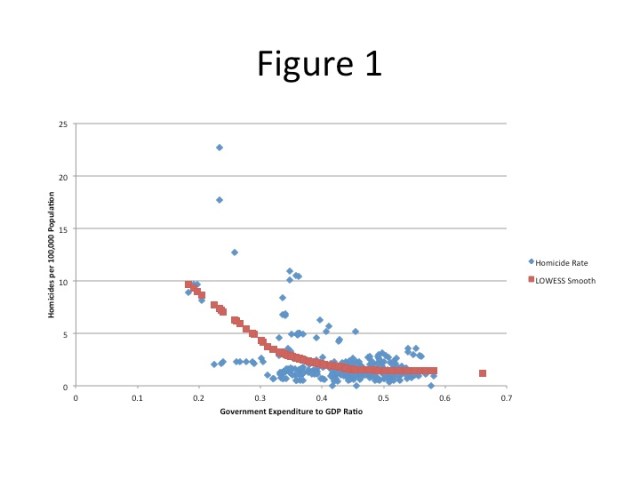
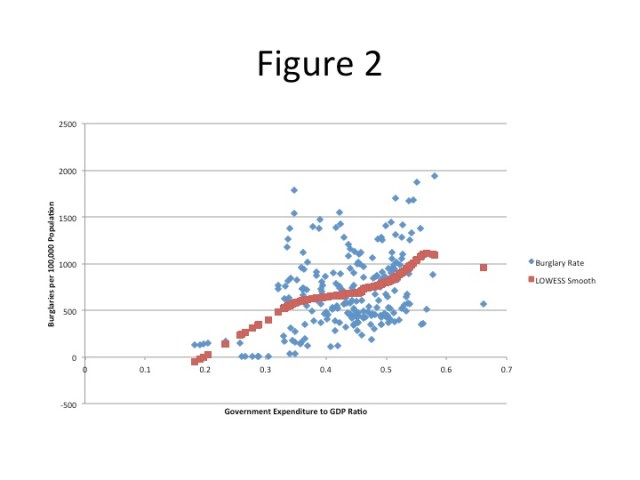
Figure 2 (data for the years 2003 to 2010) is more
puzzling. As public sector size
increases, burglaries per 100,000 of population actually rise. Again, I’m not controlling for
any other variables but why would a larger public sector be accompanied by more
property crime? The average annual
burglary rate over this period ranges from a low of 29.2 burglaries per 100,000
of population for South Korea (average G/GDP ratio of 27.4%) to a high of 1,625
burglaries per 100,000 of population for Denmark (average G/GDP of 54.3%). As an additional note, Canada’s
burglary rate averaged 733 per 100,000 of population with a G/GDP ratio of
41.1%. Could this be a function of
general resources devoted to crime reporting? Is it a function of how these property crimes are reported
in different jurisdictions? I've found a few articles dealing with the determinants of residential burglaries with explanatory variables like population density, severity of punishments, gains from the crime, etc… I found a working paper on the econometric analysis of burglaries in Ireland that finds a larger population share of young males correlated with more burglaries and higher aggregate consumption spending associated with fewer crimes. However, I have not come across anything relating crime to general levels of public sector size or spending. Is
anyone aware of any other literature in this area that might help provide an explanation?
Related articles


 Worthwhile Canadian Initiative
I would expect higher burglary rates and higher government spending both with higher gdp. Everyone is equal in poverty. More government spending would provide a larger middle class and more worthy of robbing.
Who in the OECD has 0.2 G/GDP ratio? Unless you mean central government only, it is not the USA — but who else could have those homicide rates?
That may seem unresponsive to your question, but it may point to data-comparability issues that require a lot more thought before you go trying to explain patterns based on substantive stories.
try to 3d the charts over time and add a colour shift for income disparity over time
My guess is the same as Lord’s – that homicide falls with GDP and (reported) burglary rises.
Another possibility is that burglary and homicide tend to be inversely correlated (e.g. I think burglary is higher in Canada and homicide is higher in the US) because people don’t rob houses if they’re likely to get shot in the process – would you rob a house if you figure the owner is likely to be sleeping with a loaded gun by the bed? Much safer to rob houses in Canada where worse case scenario is you get caught, not that you get killed.
What stats are you using? Reported crime or crime surveys? The latter tend to show much less marked variations than the former – which tend to be driven by, inter alia, insurance coverage (the insured report theft, as this is required to claim; the uninsured do not). So there is a broad link between greater equality, a larger middle class, more insurance and more reported theft. A confounding factor is that burglary and similar property crimes stats are also heavily driven by some kinds of drug use epidemics, which tend to go in roughly 15-20 year cycles. In short, more digging before you leap to on any hypotheses.
Peter & Mike:
Just some quick points. The government expenditure and GDP data is from the OECD. The government expenditure variable is total general government expenditure. As for the OECD country with an G/GDP ratio at just over 20%, it is Mexico. As for the crime data, they are from the United Nations (http://www.unodc.org/unodc/en/data-and-analysis/statistics/crime.html). The burglaries are the number of police recorded offenses. Thank you for the points and comments. They are quite helpful.
Frances:
The point are an inverse correlated between property crime and homicides is interesting. Canada has a much lower average homicide rate than the US in this data (1.8 vs 4.8) but the burglary rates were only a bit higher (734 vs 724).
Perhaps there’s a link between public spending and burglary reporting that’s confounding your statistics. If more spending leads to “better” cops (or at least cops who are perceived as being “better”) people might be more likely to report minor crimes. For instance, if better paid cops are less likely to demand a bribe to investigate a reported crime, burglary reporting should rise as police wages (presumably as part of a broader increase in public sector wages) rise.
And, I suppose, the same might be true in reverse for homicides. Better paid cops could increase the likelihood of murderers being caught. If better paid police officers means you can’t beat a murder wrap by slipping the local investigator a few thousand bucks to lose the crucial evidence, you might be less inclined to murder people.
Mind you, I’m not sure sure about the homicide relationship. Just eyeballing your chart (and, I admit, the old Eyeball Mk 1, isn’t exactly a sophisticated tool), the relationship seems to be largely driven by a hefty spike of murders at the 0.2 GE/GDP range i.e., Mexico. Given that parts of that country have basically been a war zone during the observation period, I’m not sure I’d want to draw too many conclusions from it.
The first thing that comes to mind for me is that Japan and Korea are fundamentally different from European nations and her settler colonies in more than just government sice.
That should pretty much sum up the Oecd (Japan, Korea, Europe + colonies).
This internet web site is actually a walk-through for all the info you wanted about this and didn’t know who to ask. Glimpse here, and you’ll surely discover it.
nfl jerseys
http://louisvuittonhandbags8.is-great.net/