As you probably all know, the Reinhart-Rogoff 2010 study found economic growth slows
when the debt to GDP ratio exceeds 90 percent. They used data for 44 countries over a 200-year period and
found the relationship between debt and real GDP growth was weak for debt to GDP
ratios below 90 percent. However,
above 90 percent, economic growth dropped considerably more. Thomas Herndon, an economics graduate
student at the University of Massachusetts-Amherst, has challenged this
result. Using the Reinhart-Rogoff
Data data, he found that economic growth slows but not as dramatically as the
Reinhart-Rogoff result. Well, the
recent debate over the relationship between debt and economic growth has
spurred me to do my own quick analysis.
My data is from the World Economic Outlook Database 2012
(WEO 2012) produced by the International Monetary Fund, which provides as
assortment of variables including GDP and net debt for 186 countries over the
period 1980 to 2011. As well, the WEO 2012 database also had a conversion rate
to put valuations into US Purchasing Power Parity dollars. I worked out per
capita GDP in US PPP dollars and compared the average annual growth rates in
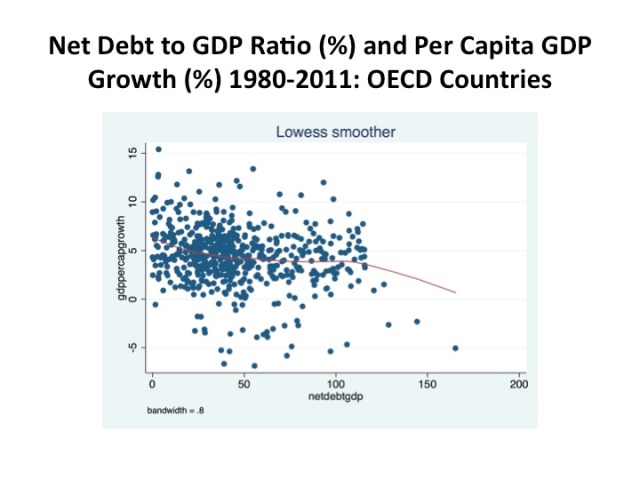
per capita GDP to the net debt to GDP ratios for just the OECD countries. Here
are the results of a LOWESS smooth between the growth rate of per capita GDP
and the net debt to GDP ratio. Note that this first smooth is only for net debt to GDP ratios that are 0 or higher. For example, Chile, Finland and Norway are countries that have experienced negative net debt to GDP ratios.
There is a negative relationship between the ratio of net
debt to GDP and per capita income growth when the net debt to GDP ratio is positive with a steeper drop-off after
reaching a debt to GDP ratio of about 110 percent. However, the vast bulk of the observations are for debt to
GDP ratios below 100 percent.
Moreover, in the range below a net debt to GDP ratio of 100 percent, the
relationship is negative but is fairly gently sloped. As well, no other variables are being controlled for. So is there a negative correlation
between net debt to GDP and economic growth? Yes. Do high
debt to GDP ratios slow economic growth? Well, that does not have an answer based on what I can
see. There seems to be an
association between high debt and lower growth but you cannot really conclude from
just a simple correlation between economic growth and net debt to GDP ratios
that one causes the other. It is disturbing that the negative correlation between these two variables without any attempt to control for other factors has carried so much weight in the "policy debate" world.
By the way, if you are interested in the LOWESS smooth that includes the negative net debt to GDP ratios, here it is.
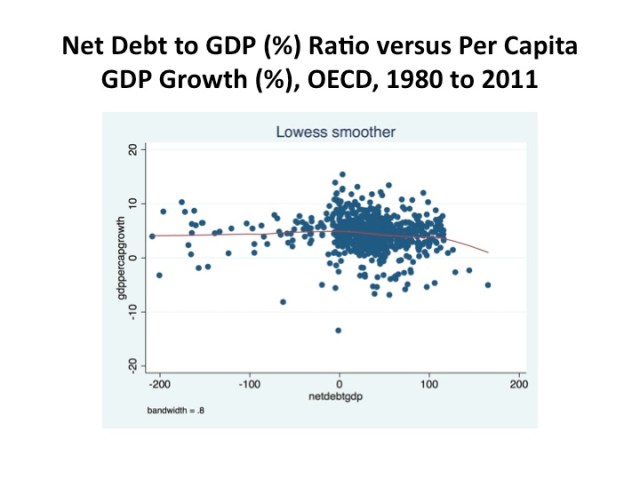
What is interesting here is that when the net debt to GDP ratio is positive, there is a negative correlation between higher net debt and per capita GDP growth. However, having really large negative net debt to GDP ratios (as in the case of Norway) does not seem correlated with large increases in the growth rate. I had alot of fun with these plots.
Related articles


 Worthwhile Canadian Initiative
Interesting. Each dot represents one country for one year, right?
Do you know: which countries and years are those 5 dots in the South-East part of the shotgun pattern? (the ones with debt/GDP over about 110% and lower growth). Are all 5 one country?
Nick:
It times series cross-section – each dot is a country for one year. Not sure about those dots. I think its Greece as the last dot is about a 160% debt/GDP ratio.
Even if high debt to gdp “caused” lower growth, it would be easy to learn the wrong lesson from it as the desire to not allow debt to increase could force spending cuts that result in lower growth. More accurately it would not be high debt but low or negative growth in debt that could cause it. So is the lesson to be learned from the flatness that fiscal stance has little effect on growth?
Shouldn’t Japan be somewhere on this chart with a 200% debt / GDP ratio?
Krugman sketched a similar graph, with countries labelled:
which suggests that the corners of the graph tend to be filled with particular countries.
Doug:
Japan in 2011 has a net debt to GDP ratio of 126 percent but its per capita GDP growth rates are positive albeit very low.
Thanks for that Dave. Was surprised to see the debt to GDP ratio for the UK so high but Krugman starts in 1950.
1) You need to look at the components of total debt, since increasing national debt often is a transfer of debt from the private to the public sector.
http://research.stlouisfed.org/fred2/graph/?g=hEz
maybe you try to do some kind of dimensional analysis.
high debt is typically not some kind of one year event [/sarcasm off]
and how does your “lowess” kind of provide some estimate for statistical error assessment?
Could you draw for example some 2 or 3 sigma curves around the median?
median vs average, like R/R ?
“It is disturbing that the negative correlation between these two variables without any attempt to control for other factors has carried so much weight in the “policy debate” world.”
Say that again. I hadn’t read the original Reinhart-Rogoff paper until today. I was shocked by unsophisticated level of the analysis. Not even obvious, simple econometric things like controlling for country and period effects. As for the now-infamous coding error…looking at their Figure 2 the first thing I’d think of doing is to drill down into the data to determine how there could be such a large discrepancy between the average and median growth rates for the 90%-plus debt/GDP observations and nothing similar for the other debt/GDP classes. Really…yikes.
Genauer:
LOWESS is a curve fitting/smoothing technique that is resistant to outliers but a drawback is that there is not a convenient battery of error assessment/significance tests.I like using it because it is useful in data exploration and provides convenient visual summaries of relationships that are not sensitive to functional form. However, the technique is not useful in multiple dimensions of variables. I would have to start running regressions. Depending on how my time shapes up I might consider going beyond data exploration and doing some additional work on this topic.
I think that debt on its own will probably not have a very big effect on growth in the short run. The government expenditure to GDP ratio is more important as a determinant of short term economic performance. Public debt can affect this via debt service costs but lately interest rates have been low. As well, the composition of the debt in terms of how much is domestically held may also be a factor.
Mixing up Eurozone countries and countries which issue their own currencies render studies of the Rogoff sort and the above sort even more questionable. An EZ country that becomes indebted to foreigners has to endure austerity (i.e. poor economic growth) in order to get its costs down and hence improve its balance of payments and hence repay external debts. That raises unemployment.
In contrast, a country with its own currency can just devalue. That WILL cause some austerity in that the price of its imports rises. But it needn’t cause any big increased unemployment.
So studies of the Rogoff sort amount to some extent to saying, “the US better not get too indebted, else it will suffer high unemployment due to its inability to devalue the US dollar”. Hilarious.
Reinhart and Rogoff’s paper didn’t actually say “90% debt to GDP causes low growth”. But it was breathlessly reported in the press as if it did. Because that’s what mostly centre-right pundits and politicians wanted to hear, and still want to hear.
Now it turns out that even the correlation may be weaker than they reported. No one who holds power is listening. Only Japan seems to be showing any sign of reversing its previous disastrous course, and it took them over two decades to wake up.
@ ralph
I think your argument is actually 100 + x% wrong, with x a small number : – )
Since the data sets go only up to 2009, one year before the first bailout crisis, one can argue, that some countries like Italy and Spain did NOT get into crisis BECAUSE of Euro membership, despite having very high (> 100%) debt.
@ all
At least not in Europe, anybody believes, that just one simple parameter, with a simple threshold is any kind of “the picture”.
Even the official
http://epp.eurostat.ec.europa.eu/portal/page/portal/excessive_imbalance_procedure/imbalance_scoreboard
contains 11 parameters to be officially watched, with official limits for red/yellow/green.
@ tyronen
What Japan is doing now, is very risky, unchartered water.
Some folks (FT, I think) called it a Pearl Harbor decision.
genauer:
Spain didn’t have particularly high levels of debt pre-crisis. I couldn’t quickly dig-up a graph comparing Germany, but here’s a table from the world bank. As you can see, pre-crisis Spain had a lower debt to GDP than Germany.
oops …. and the link is here
patrick,
what did I say, 11 parameters, just as the official version
@patrick
Spain’s private sector debt, however, was 202% of GDP, and much of it was classic Minsky Ponzi debt. Spain blew up its public sector debt with a combination of bank bailouts and falling tax revenue.
Here’s a technical discussion:
Peter N, fair enough. But how often do people point to private sector debt and wage their fingers?
Whether debt incurred in prior periods raises or lowers growth in later periods depends on whether it is used productively or unproductively. Borrowing money to invest in a bridge that lowers transportation costs for its users more than the the taxes paid by taxpayers to build and finance it creates an asset that generates positive economic returns that contribute to sustainable growth. Building a bridge to nowhere turns valuable cash into an asset (a useless bridge)that does not provide valuable transportation services that offset the taxes. This use of debt lowers growth and growth potential. The taxpayers still must repay the debt with future income to retire the bond but but the bridge to nowhere produces no income stream (cost savings)to offset the increased taxes paid to build the bridge.
If you borrow money to pay one man to dig a hole in the morning and another fill it up in the afternoon, you will wear out the shovel, making you poorer, but you will have nothing to sell, and without something to sell, not way to pay the men tomorrow. Low growth is a symptom of the unproductive use of assets, not necessarily debt. But government mispricing of private debt and misusing public debt to finance unproductive public investments does contribute greatly to slow growth now and represents a drag on future growth potential.
Nick,
The GDP growth rate is not a function of the “level” of debt. It is a function of the interest rate on that debt and the accelerating or decelerating rate of growth of debt.
This comes straight from the velocity of money calculation:
Velocity = [ Interest Rate * ( 1 – Liquidity Preference ) + Acceleration of credit growth ] / Liquidity Preference
What typically happens as debt growth approaches 90% or 100% or 110% of GDP is that economic policy makers start looking at those numbers and realizing that “growing” your way out of debt is a losing battle.
Peter N said: “Spain’s private sector debt, however, was 202% of GDP, and much of it was classic Minsky Ponzi debt. Spain blew up its public sector debt with a combination of bank bailouts and falling tax revenue.”
Patrick said: “Peter N, fair enough. But how often do people point to private sector debt and wage their fingers?”
Well, people should, but most of them are stuck in a 1970’s frame of mind. They think as long as private sector currency denominated debt is not producing price inflation (or just as important wage inflation), then currency denominated debt does not matter. Actually, both private and gov’t currency denominated debt matter because they are about MOA/MOE.
Doug M said: “Shouldn’t Japan be somewhere on this chart with a 200% debt / GDP ratio?”
Livio Di Matteo said: ”
Doug:
Japan in 2011 has a net debt to GDP ratio of 126 percent but its per capita GDP growth rates are positive albeit very low.”
If 200% is gross debt, then I think gross gov’t debt should be accounted for somehow.
Curmudgeon_Killjoy, what if private debt and gov’t debt are being used to allow the lower and middle class to spend more than they are earning and used to prevent price deflation?
For what it’s worth:
“total debt has actually grown in all the world’s largest mature economies since then, except for the United States, South Korea and Australia. This is due mostly to rising government debt.”
As of 2011, Germany, Canada, Australia and the US had effectively identical total debt to GDP ratios of around %280
Before I say a few other things,
I am actally wondering, whether anybody here would be interested to talk through some other papers, Cobb-Douglass 1928, and Solow 1957.
They have the advantage, that they contain the data in a very compact way, are not seting of this nowaday nearly universal political biasing, but are also relevant for being put into a lot of economics stuff today, DSGE models and so.
But the issues of where are the data from, what kind of assumptions are acceptable or not, what to do with “special” data points. That is all there.
Added plus, Nobel prize winner Solow is still alive, so possibly worth to piss a little at : – )
And Douglass had an interesting CV and 1948 followup paper.
this guy can draw confidence bands around lowess
http://www.nextnewdeal.net/rortybomb/guest-post-reinhartrogoff-and-growth-time-debt
And he was kind enough to include a do file. Thanks Genauer.
Hi – just wondering what you thought of Reinhart and Rogoff’s column in the NY Times today. http://www.nytimes.com/2013/04/26/opinion/debt-growth-and-the-austerity-debate.html?pagewanted=all&_r=1&
Arindrajit Dube was one of the very few constructive contribution in the HAP scandal.
Reinhart / Rogoff did some tremendous work to collect and compile a lot of difficult datasets. I remember how my data collection for german gasoline prices went.
That there is one excel imperfection and some discussion of weighting opinions, does not justify the behavior of HAP.
And Dube is trying to make the best, being constructive and giving valuable additional analysis, including careful data and code documentation.
And since the attempted character assasination of Reinhart/Rogoff in the last week irked me so much (not by Livio, just to avoid any misunderstandings of people who do not read carefully), I like to add this link:
http://www.cyniconomics.com/2013/04/22/hap-vs-rr-vs-the-pundits-scoring-the-reinhart-rogoff-dispute/