The car is in decline. The Economist says so, and so does the New York Times.
Cars are boring; bikes are cooler. Here are the top 10 reasons why.
10. Cars are for stuff
People from the pre-computer era have books, DVDs, TVs, stereos, big photo albums, board games, and playing cards. They need cars to transport their stuff.
Cool people have digital stuff. They can fit their entire music collection in a bicycle pannier.
9. Cars are for suburbs, and suburbs are boring.
Why buy a car in order to commute to a suburb that's miles away from clubs, museums, galleries, theatres, indie movie houses, parks and all the other things that make life worth living?
People don't need big houses in the suburbs any more any more (see point 10 above).
8. Bikes are a guy thing.
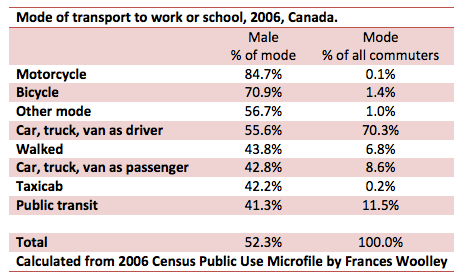
Seventy-one percent of Canadians who bike to work or school are men. (The same pattern – the masculinity of cycling – is found in the 2009-10 Canadian Community Health Survey data, and in international studies).
As feminist scholars such as Nancy Fraser have argued, androcentric social norms "privilege traits associated with masculinity". There is "pervasive devaluation and disparagement of things coded as 'feminine.'" Translation: guy stuff is cool.
7. Hawkwind wrote a song about a bicycle.
6. Bikes are dangerous.
Only about 1.4 percent of Canadians cycle to work or school, but cyclists account for 2.7 percent of traffic fatalities in this country.
There's a real chance of getting killed on a bicycle. That makes it kind of thrilling.
5. Cycling requires skill.
Technology is slowly taking the skill out of driving a car – automatic transmissions, automatic parallel parking, automatic braking, automatic everything. Cars that drive themselves may soon become a reality.
No one is looking to develop a driverless bike any time soon.
4. Cars are stupidly expensive.
Hundreds of dollars for insurance. Hundreds or thousands on maintenance, or hundreds or thousands on depreciation. Gas. Parking.
Twenty-somethings are struggling with student loans. They're trying to establish themselves in a tough job market. A car is an expendable expense. Yet when cars become the province of the middle-aged, they lose their cool.
3. Bikes are fixable
A moderately skilled person can fix her own bike. The parts are standard and interchangeable. There are no computer diagnostics; just nuts and bolts, dirt and grease.
2. A bike of one's own
Many people share their cars – with the other drivers in their family, with passengers, with whoever needs to be transported from A to B. But one's bike is one's own.
1. Bicycles could save the planet
Cycling is more energy-efficient than any other form of transportation, even walking.
Then there's the wind in your face – or your hair, if you ride without a helmet (see point 6 above) – and the joy of riding with no hands on the handlebars.


 Worthwhile Canadian Initiative
Patrick, the survey was done in late October or early November, I believe. In Edmonton we have two government-occupied office buildings near the legislature, and a couple CBD ones, as well as a bit in the suburbs.
My read on it initially (when Edmonton trumped Vancouver for cycling) was that maybe “clear and cold” weather/roads is easier for cycle commuting than rain. Certainly a challenge in Vancouver is having a place to dry wet cycling gear once at work.
“it is extremely difficult and rare to damage property or injure people on a 20lb bicycle”
It’s not the 20lb bicylist that worries me, it’s the 200lb rider. I’ve known a number of people who have been seriously hurt after being hit by cyclists in the city. And of course, part of the mandatory car insurance for drivers is coverage in the event that THEY get injured, which is surely every bit as important (if not more so) for cyclists. If nothing else, the risk of higher insurance premiums would probably be a better driver for helmet use than government legislation (since you’d expect insurers to offer the same sort of discounts for helmet wearers as they offer for winter tire users).
As an aside, I’be curious as to what the breakdown of the cost of your minimum coverage insurance policy is in terms insurance that would be different as between car drivers and cyclists. Cyclist insurance might not be a cheap as you think.
But I also think that part of the upside of imposing insurance or licensing requirements is that it would actually get cyclists to think of themselves as “drivers”.
As an aside, there’s nothing wrong with be a helmet scold, it’s the same as being a seat-belt scold.
The Gov’t occupied building near the legislature would be ideal for commuters from the Strathcona and Glenora area, which are both quite posh. Assuming Gov’t employees tend to be well educated and well paid, they may live in those nearby areas.
I know nothing about doing surveys, but I wonder if asking people in late fall after a summer of biking skewed the results? If you asked in early spring before biking becomes possible again (say March or April) if you’d get the same result. And believe me, virtually nobody (except the truly hardcore or hard-up) is biking in Edmonton in winter. Cool or not. It simply isn’t possible.
It also occurs to me that there are many wealthy areas outside of the core. Parts of St. Albert and Sherwood Park, for example. Plenty of very nice examples of German engineering can be seen heading for the downtown from these areas every morning. No bikes though. Not many people will bike 30 or 40 KM to work and back. I see the ones from Sherwood Park taking kid 1.0 to school in the AM. We even saw a DB9 today. Very cool car. Great sound from that that big V12.
Patrick, Wendy – I used the 2006 census PUMF to figure out the average % of people commuting by bicycle in each Canadian city and put it in a new post.
Nick: final recommendation. From Tadoussac, up the 172, down the 170 so you can see Cap-Éternité, Cap-Trinité and L’anse-St-Jean ( the village on the old $1000 bill.) West back to Baie-St-Paul and up the 381 ( mountains are even more majestic and no truck traffic).Then 170 toward Alma, 169 then 155 through the Chambord gap and down the St-Maurice valley. Back on the 40 and 417.Lot of driving but I presume you won’t do it twice. Unless you want to do it ten times…
Of course you could add le tour du Lac ( around Lac-St-Jean) or north on the 167 to Chibougameau and Abitibi and down the Ottawa river. But that would be a week.
Darren,
5. For every video rsj produces showcasing an irresponsible cyclist, I can probably find a thousand showcasing careless
Yes, but this video is representative of bicyclists. The “typical” bicyclist:
1) passes on the right
2) lane splits (drives between lanes)
3) does not wait for the light to turn green before crossing the majority of intersections
4) does not signal prior to slowing down or turning to notify traffic behind and to their sides
5) drifts into blind spots of other cars/cyclists
6) does not wear a helmet
7) is not insured
8) is not licensed
9) illegally crosses medians or double stripes
10) Believe that their own superior “skill” excuses them from wearing safety gear, engaging in defensive driving, or staying out of other people’s blind spots.
This is not the occasional bad apple. In fact, I guarantee that you, Darren, are guilty of doing the majority of the above — violating the rules of the road because you think that they do not apply to you, even though you demand your “right” to use the road along with those who do obey the rules.
While you can find examples of irresponsible/reckless drivers who also break these rules, there are mechanisms to impose costs on and ban these behaviors via increased insurance payments and finally license revocation. Drivers are not angry at cyclists, as a group, because of some irrational reason. It is a rational response to a dangerous and reckless element on the road, one which causes everyone else to increase their defensiveness as they try to guess which moving violation the cyclist will commit next.
The most dangerous person is one who has less regard for their safety than those around them. This disrupts the flow of the road and places a burden on everyone else.
There is a reason why the bad apples in the auto world tend to come from the same demographic as the bad apples in the cycling world — younger, risk-seeking males.
But because cycling is so dangerous as a means of transportation, all other groups self-select out leaving the majority of cyclists as members of this demographic. In order for traffic to move smoothly, everyone needs to go at approximately the same speed, everyone needs to drive defensively, and people need to be willing to wait in line or yield to others, rather than trying to cut across or between traffic.
Cyclists really don’t belong on the same streets as cars, and most people immediately recognize this. The remainder — those who insist on cycling in traffic — are the same risk-seeking group that others drivers hate when they are behind the wheel. The same testosterone driven reckless behavior is a danger regardless of what the means of transportation happens to be, except that it is almost exclusively this demographic that comprises the population of urban cyclists.
Obviously those recreating on bicycles in parks or on rural roads is another matter.
rsj -“As it stands, I’ve never seen a cyclist who obeys traffic laws. The traffic laws are something that can be turned on and off. When the road is not crowded, they are part of traffic, but when the road is crowded with vehicles, they can suddenly stop being part of traffic and pass cars by travelling between lanes or on the sidewalk.”
The right response has already been given to this: what car driver obeys traffic laws?
I read your comments and thought that you were perhaps a little delusional. Then I watched the video you posted, and I agree that the cyclist is terrible and a menace. If this is the way most people bike in the US (assuming this is where you’re from), I can sympathize. Though I doubt it. As it stands, those roads are just not meant to be biked on: a bike lane is needed. That looked terrifying to me, and I wouldn’t want myself or anyone I know to cycle through that city.
I’ve lived in two different countries, call them A and B. Both tend to have room for bikes on the road (no car-lanes going all the way to the footpath). But country A is a much nicer place to bike than B for two reasons:
1) Many more people in general bike, so drivers are both more used to seeing and dealing with cyclists on the road, and drivers are more likely to be cyclists themselves (empathy could cure all the ills of the world)
2) Flexibility. In A, cyclists can go on the road or on the foothpath, where they are considerate of pedestrians. With this flexibility, in country A it’s easy to avoid a dangerous, busy intersection by hopping on the footpath and using a pedestrian crossing. Which gets me out of the way of cars, and makes us both happier and safer. In country B, people yell at me for trying to keep out of dangerous situations.
Care to explain exactly why cyclists shouldn’t be allowed flexibility, provided they are respectful of pedestrians? I also suggest you investigate some of the countries where bike commuting flourishes before prescribing a ban on bikes.
Just to back up my point that, at least in some places, it can work:
http://en.wikipedia.org/wiki/Cycling_in_Copenhagen
rsj: 7) and 8) cannot belong on a serious list of bad biker habits. Not can 6). What business of yours is it whether someone wears a helmet or not?
If you think that video is representative of the typical cyclist, I really want to know where you live. And unless you personally know Darren, it is bad form to presume how reckless he is as a cyclist.
You’re absolutely right when you say cyclists should not share the road with cars. You’re dead wrong when you say bikes should be limited to recreation parks. They shouldn’t share the road because they should be in cycle lanes, not car lanes.
3 things:
1. the cost and space argument
Both are limited, and that means that in most places there is just one lane, which is shared by everybody, lorry, car, motorbike and bicycles.
Only in places, where sufficient demands warrant 2 lanes or 3 or an extra lorry or bike lane, those are build.
A lot of urban culture was destroyed in the 60ties in many US places, by making them car friendly. It does not only consume a lot of space, it hacks communities into anonymous, disconnected pieces. This is not the goal, ast least not here around.
2. The streets were historically shared, to say this is now not longer possible, because dangerous rsj’s are driving around, s not acceptable
That means that only participants can be allowed, who interact responsibly
3. at least here in Germany they build repeatedly the bike lanes in ways, which actually endanger the bikers at right hand turns, due to visibility, short term visibility of the biker traffic lights, u-turns, and the expectation of car drivers, that bikers than behave like pedestrians.
At least here I do not see many bikers endangering pedestrians
When I read the continued rant of rsj here, I think he is a public safety danger and should be removed from the normal streets, until he gets some reeducation in tolerance.
rsj – “Yes, but this video is representative of bicyclists. The “typical” bicyclist:….”
The big problem for cyclists is that they’re invisible to drivers (see book “The invisible gorilla” explains the psychology behind this phenomenon). It seems that law-abiding cyclists are even more invisible than the law-breakers.
There are multiple ways of getting from outer Ottawa to the downtown core by bicycle – on cycle paths, on quiet side streets, or on major roads. It’s the extreme cyclists – the ones who have a high tolerance for cars and danger – who go on the major roads. Cyclists like me, who mostly obey the rules (except when faced with the insanity that is Carleton campus’s traffic calming – sorry), will only very rarely cross your path, because we’re the ones who will take a route that’s 5 or 15 min longer to avoid traffic.
A point by point refutation of rsj’s “guarantee” that I violate various “safe cycling practices” which he, in many cases, appears to have made up based on his own personal sense of what behaviour cyclists deserve to be able to engage in.
“1) passes on the right”
– Not illegal in my jurisdiction… in fact I had a friendly conversation about this with an entire pack of trained Toronto Police officers on bikes .. who were all busy passing cars on the right.
Section 150 of the Ontario HTA only refers to motor vehicles, and in any event says it’s OK if the pavement is wide enough for two vehicles. Of course it usually IS in my case, since I’m a bicycle!
It appears to be legal in many other jurisdictions as well:
http://forums.roadbikereview.com/general-cycling-discussion/passing-cars-red-light-okay-212151.html
“2) lane splits (drives between lanes)”
Nope, unless I’m correctly passing a right turning vehicle on the left (the number one rookie cyclist error, passing right turning cars on the right).
“3) does not wait for the light to turn green before crossing the majority of intersections”
Nope, never, though I do notice a lot of cyclists doing that and I find it irritating.
“4) does not signal prior to slowing down or turning to notify traffic behind and to their sides”
I signal whenever there’s anyone around me who might care what I’m about to do and can’t already figure it out (ie: at a red light, I presume you already know I’m stopping).
That probably sounds very cavalier to you, but it is exactly what Section 142 of the Ontario HTA requires.: and if the operation of any other vehicle may be affected by the movement shall give a signal plainly visible to the driver or operator of the other vehicle
“5) drifts into blind spots of other cars/cyclists”
Do I hover off the rear wheel of a moving car while we’re both moving forward? No, why would I do that? However, it’s not clear how I (or any other vehicle) could avoid the blind spot of another vehicle while overtaking or being overtaken.
“6) does not wear a helmet”
False, although helmets are not legally required in my jurisdiction.
“7) is not insured”
The non-existent and unnecessary “bike insurance”, you mean? My homeowner’s liability insurance? My workplace benefits? My Ontario Health Insurance?
“8) is not licensed”
My up to date Ontario G license that I’ve had for almost 30 years, you mean? Or the non-existent bicyclist license? Or my graduation certificate from CANBIKE? Please advise. You seem to have all the answers so help me out.
“9) illegally crosses medians or double stripes”
Nope.
“10) Believe that their own superior “skill” excuses them from wearing safety gear, engaging in defensive driving, or staying out of other people’s blind spots.”
Nope, while I believe my competence is the most important component in my safety (and actually, knowledge of the rules of the road and best practices is part of what I MEAN by skill and competence), in fact I virtually never go out without my day glo vest (folds into a pocket at work) or jacket, lights at night, and helmet.
The funny thing is, if you simply wanted to argue there’s a lot of room for improvement in cyclist training and behaviour, I’d agree with you 100%. Your clear and obsessive hatred of cyclists, fueled by ignorance and a twisted sense of motorist entitlement, is not particularly common even among drivers, but one **** like you is one too many in my book.
rsj: “Cyclists really don’t belong on the same streets as cars”
I see: you don’t want bicycles on “your road”. Our discussion of the actual laws, and of cyclist behaviour, is irrelevant. It doesn’t matter what the law is and it doesn’t matter how “defensively” we operate. You want us gone.
“In order for traffic to move smoothly, everyone needs to go at approximately the same speed, everyone needs to drive defensively, and people need to be willing to wait in line or yield to others, rather than trying to cut across or between traffic.”
Perhaps, but where does this happen? Not in downtown Toronto where I do my riding. Streetcars stop in the middle of the road (I bet you’d hate those too… the passengers should all be driving cars!), delivery vans, buses, and taxis stop where they will, taxis will pull u turns to pick up a fare, etc. (and bike lanes are just convenient parking spots for those users). Any adult cyclist is easily faster than the average speed of city car traffic. You are slowing ME down, not the other way around.
rsj, Darren, everyone,
Let’s try to keep the discussion focused on the underlying economic issues, i.e. what determines the demand for bicycles and cars, and what social and economic changes might explain what appears to be a decrease in 20-somethings demand for cars.
It occurs to me that the discussion rsj is having is not very pertinent to how cool bikes are. Greasers were cool in the 1950s despite being drunks, law-breakers, rascals, and thugs. In fact, that was part of their appeal.
In my own experience, I can agree with rsj that there appear to be more bad bikers than good ones. ESPECIALLY in Ottawa. But I have also experienced more bad drivers than good ones, and some pedestrians whose behavior could only be explained by a psychological evaluation and toxicology report. Again, none of this speaks to how cool any of those people were.
And let’s not forget that some days I am an awesome driver, biker, or pedestrian, and other days I break the rules. It would be great if we were all perfect, all the time, but…
Today, some Candian research in the British Medical Journal:
“Reductions in the rates of admissions to hospital for cycling related head injuries were greater in provinces with helmet legislation, but injury rates were already decreasing before the implementation of legislation and the rate of decline was not appreciably altered on introduction of legislation. While helmets reduce the risk of head injuries and we encourage their use, in the Canadian context of existing safety campaigns, improvements to the cycling infrastructure, and the passive uptake of helmets, the incremental contribution of provincial helmet legislation to reduce hospital admissions for head injuries seems to have been minimal.”
Shangwen: improvements are minimal but given the extremely low-cost, it’s probably tremendously cost-effective.
I’ll leave answering RSJ’s comment to Darren, who is doing a better job than I could.
Regarding the “Biking is for crazy young men”, please consider this 2009 Scientific American article. It seems that it is for crazy young men, until a certain critical mass is reached and safer infrastructure is built and better attitude from drivers is achieved.
http://www.scientificamerican.com/article.cfm?id=getting-more-bicyclists-on-the-road
In the U.S., men’s cycling trips surpass women’s by at least 2:1. This ratio stands in marked contrast to cycling in European countries, where urban biking is a way of life and draws about as many women as men—sometimes more. In the Netherlands, where 27 percent of all trips are made by bike, 55 percent of all riders are women. In Germany 12 percent of all trips are on bikes, 49 percent of which are made by women
“If you want to know if an urban environment supports cycling, you can forget about all the detailed ‘bikeability indexes’—just measure the proportion of cyclists who are female,” says Jan Garrard, a senior lecturer at Deakin University in Melbourne, Australia, and author of several studies on biking and gender differences.
Women are considered an “indicator species” for bike-friendly cities for several reasons. First, studies across disciplines as disparate as criminology and child rearing have shown that women are more averse to risk than men. In the cycling arena, that risk aversion translates into increased demand for safe bike infrastructure as a prerequisite for riding. Women also do most of the child care and household shopping, which means these bike routes need to be organized around practical urban destinations to make a difference.
Nick, nice try, but here’s my cool ride :o)
winter cyclist, represent! 🙂
Somebody else may have raised this… What has happened to wages and employment of the 20-something crowd over time? Just because they are riding bikes doesn’t mean they would choose to do so if they had other options.
FWIW, I rode my bike and took the bus in my early twenties …. Until I could afford a car. Not sure bike riding made me cool (to be honest, nothing could make me cool, but that’s not relevant ;). It was just signalling that I was too poor to do anything else. Chicks don’t usually dig poor.
Maybe biking is cooler if your other means of transport is loud and German.
Patrick – I think that falls under #4 in the original post – declining wages/high student loans.
Simon – paradise!
@ Jacques,
I remember “les lignes” only from “Die hard”, when I drove with the car to Montreal, 1997, it was in the middle of a snow storm, and the boarder guard got on my nerves with MS word questions, at midnight, until I explained him, that I am in the business of making computer CHIPs, with my 5 year travelling salesmen Visum : – )
When you mentioned the ENA’s students training for limo service, I decided to take a little detour on my shopping today, and walked by the office of my prime minister (http://www.sk.sachsen.de/index.html)
And I counted 57 bikes, 6 motorbikes, and 46 cars in front of that. That would make 190 – 57 – 6 – 46 – ca 10 for vacation, sickleave, etc. = 71 coming with the tram or on foot, ….., or the limo, but I doubt that a lot : – )
I also added a picture of my defense minister, who could be a good chancellor, I met on a bike trip 2 years ago to the slide share link.
@ Patrick
Do you think, people working for the prime minister of Saxony can afford a car?
Well, it’s been a long time since I’ve been in touch with what 20-somethings think of as “cool”, but I can tell you that where I live, cycling CLEARLY dominates every other form of transportation for trips less than 5km. (in a big city, that’s a lot of potential destinations). It’s cheaper than everything except walking, it’s more reliable and more pleasant than public transit most of the time (public transit in Toronto is in steady decline), and it’s far, far, far more fun and less frustrating than driving (congestion is getting worse in general, and Toronto is the sixth most congested city in North America, and no, rsj, that’s not because we have too many cyclists). Oil is now at $100, and car ownership just looks silly to me, for where I live and where I go. (renting/autosharing/taxis take care of the exceptions).
If I lived in the burbs the equation would no doubt change. As the 20-somethings move out there to start their families (if they do), they’ll cycle less, but they’ll still cycle.
Frances: “It’s the extreme cyclists – the ones who have a high tolerance for cars and danger – who go on the major roads.”
I’m not sure I would characterize myself this way. High tolerance for cars, yes. High tolerance for danger? Heck no. I’m in my 40s and would prefer to live until 90 if possible. I honestly do not think that cycling in the city in a competent, visible, predictable, and vehicular manner is particularly dangerous, and I further think those skills are easily acquired by adults. (some arterial roads with high speeds and minimal shoulders are pretty uncomfortable and unpleasant to ride on even for me, and yes, I’d avoid those when possible). There is the odd cyclist fatality, but given some of the incompetent cyclist behaviour I see on a daily basis, I don’t find that particularly alarming…. it’s pretty easy to chalk most of those incidents up to cyclist error or simple bad luck. You can die as a pedestrian, in a plane, in a car, on transit, or watching the Boston Marathon…. you can’t stop living.
Frances – But #4 sounds anti-cool to me. Being poor doesn’t sound cool. The bike would be cool only if you can afford to have the expensive car and then choose to ride a $4000 carbon fibre mountain bike instead.
genauer – Dunno. Do many 20-something Canadians work for the PM of Saxony?
Patrick, of course they can, those are the highest paid public service jobs.
And I think “cool” is not the main point. Settlement structure is.
If you live 25 km outside the center in cold Canada, of course you will take the car, not only in winter.
I also had a car in Munich, when public transport in the evening was like 20 min waiting, one change, and some 1 h 15 min one way, in the evening (the physics department, behind the nuclear reactor was outside, and not yet connected to to subway). And with the car it took door to door 20 min.
Simple economic and convenience facts.
The point is, how do you structure city centers and settlement structures.
If your city is barren office land, criss crossed with highways, like Poughkeepsie, NY, nobody will live there.
If this is offices intermingled with shops and living, it is big fun. Then you have things in walking distance, office, shops restaurants, doctors, my taylor, personally made shoes around the corner. And some neighbors who make sometimes some noises, yes. And the bike and public transport are just extensions of that.
If you can’t stand your fellow countrymen, you have to settle outside, I prefer to live in the inside, grow old with neighbors, in about a dozen years I will buy an e-bike (no coolness problem here), in a few decades I will push my rollator along the street, without the fear to be run over by rsj : – )
I will sit in the sun at the Elbe, and have a coffee and a cake and bitch about the young people, the tourists and the new prime minister, and her ugly hair : – )
But you have to build or keep your cities accordingly, today.
and then to come by car is rural , redneck, uuuuugh, Kansas, do they still teach creative Design? : – )
Coming out of lurk mode to make a point I haven’t seen yet regarding the maleness of various alternative transportation modes: Helmets ruin hair.
I’ve tried off and on to commute by bike, but mandatory helmet laws (not to mention rain and wind), are the killer here. If you are a woman, and work in an industry where looking nice and professional is important, then commuting by bike adds a spectacular degree of difficulty. You have to spend quite a bit of time on hair repair when you get to work, and you need a place where you can do this. (Ideally with a blow dryer and a large mirror.) And that’s not even mentioning transporting good clothes, shoes etc. in bike panniers in some way they won’t get wrinkled or otherwise destroyed. Nearly impossible!
Just to tie my previous post more directly into the conversation, in Toronto, now, cycling isn’t a “poor person thing” (though many poor people cycle). A bicycle doesn’t say “poor” anymore. A bicycle says “smart and fit” (especially if you’re wearing the gear and look competent, not drunk and broke). It’s BETTER than driving and BETTER than transit (faster, more convenient, more fun). I can afford a bus pass. I can afford a car. I don’t have them because I don’t want them.
In fact, by cycling into the core you signal that you are rich enough to be able to afford to live close enough to make that a practical choice. I know plenty of people who own $500+k homes and ride bicycles.
(And I met my wife at a bike club… some chicks dig it! 🙂
Darren – sure, but instead of accessorising with an e.g. $150K M3, you’re accessrorising with a $500K house. Either way, the bike needs to be tarted-up to make the chicks dig you.
Jacques Rene: those roads sound lovely, but I’ve only got 4 days this time. I really need to retire!
Simonc: that’s just a bike! But boy, that road is beautiful (in a Land Rover).
Ginna – the hair/clothes issue is definitely a major one for female cyclists. I received a picture via email from another lurker who keeps a daily tally of the number and gender of the commuter cyclists he meets during his ride home. His graph seems to indicate that the ratio of female/male cyclists is seasonal, that is, women are more likely to cycle when the weather is better, which fits with the clothes, shoes etc being an issue hypothesis.
It’s also interesting that a number of the towns with high numbers of cyclists are ones with primarily public sector employers – Victoria, Kingston, Ottawa, etc – where a person’s pay/promotion/job security is less likely to be contingent upon looking good and dressing well at work. I sure notice fewer women with au naturale grey hair when I’m in Calgary, where relatively more people work in the private sector.
Darren: “A bicycle says “smart and fit””
Exactly.
Nick: lol! I’m afraid there are no Land Rover in south eastern Cuba. 🙂
Ginna: That’s exactly why my friend (male!) only wears his helmet on his way back from work.
Frances: What about “cities that were built before the car existed”? These cities typically have a core where work and residences are closer to each other, whereas newer CMAs (or CMAs that expanded a lot) were created with the car in mind. This still doesnt explain Halifax, which is both old and has a smaller population.
Darren: In Toronto a 500+k home is a starter home. And given the explosion of condos in or near the downtown core, proximity to the core isn’t a particularly good signal of wealth.
And a bicycle says “fit”, not neccesarily “smart” (just as a Jaguar says “rich” not “smart”)
Frances: “It’s also interesting that a number of the towns with high numbers of cyclists are ones with primarily public sector employers – Victoria, Kingston, Ottawa, etc – where a person’s pay/promotion/job security is less likely to be contingent upon looking good and dressing well at work”
Type of job might also play into it. The prospect of riding your bike home from work after a day in a factory or on a contruction site is probably less attractive than if you spent a day riding a desk. It’s interesting that some of the “low” cycling cities in your other post are either cities with traditionally significant manufacturing industries (Oshawa, Windsor, Hamilton) or booming construction industries (Toronto, Calgary, Edmonton).
Nick: leave the office as soon as you can,let’s say 17.00 and go via 417 and 40 straight to Québec where you should arrive by 22.30(going from Montréal to Québec on the 138 is a project unto itself). First day should be enough to cover both islands (Orléans in the morning and Aux-Coudres in the afternoon)and go to Tadoussac. Restaurants are better in Baie-St-Paul than La Malbaie ( except the luxury ones sometimes not open at noon at this time of year.) You have three days left to meander and finally reach Trois-Rivières (and then a fast evening drive to Ottawa.) You might even be able to go through the Mauricie National Park when you reach Shawinigan. In that case, enter through St-Jean-des-Piles and when you exit at St-Mathieu, go through the village and turn right on 351 East leading you to A40. ( You will save a lot of time.)
If I was driving, I’d go from the 362 to St-Joseph-de-la-Rive (for the ferry to Isle-aux-Coudres)via the Côte-de-Misère (Misery Hill). It’s faster than through Les Éboulements and La Grande Côte. But you’re not a local and I don’t want you to abruptly cease your driving-teaching-blogging career on that 1400 feet high 20% grade…
“just as a Jaguar says “rich” not “smart””
Dunno about that … the new XKR with the supercharged V8 is quite a car. I’d happily have one to tart-up my bike.
One of my brothers often let me drive his XKR. Whatever their natural color, any woman beside me always turned blonde…
It’s odd to think of someone on a bike as signaling wealth. Cycling to work is done by 0.7% of the population in the U.S., a 30% decline from 1% in 1985.
Four times as many people walk to work as bike to work, and seven times as many take public transportation as bike to work, and of course those who bike to work have, on average, substantially less income than those who drive to work, and even have less income than those who take public transportation to work (census data). Perhaps Canada is different, but in the U.S., bicycling to work generally does mean that you cannot afford a car, although how people want to be perceived, and how they are perceived is a different matter.
In the urban core areas, the situation is a bit different. For example, in San Francisco county, less than 20,000 people commute via “bicycle, taxicab, or other”. 41,000 walk. 138,000 take public transportation (what I do), and 202,000 take “car, truck, or van” to work. Total worker population is about 433K, with the rest working at home. Almost as much public transportation as driving! Again, the income breaks down as you would expect, with those commuting by bicycle earning substantially less, on average, less than all other groups.
And of course, I am still waiting to hear whether Darren waits for the light to turn green before proceeding, whether he lane splits, passes on the right, or wears a helmet.
Of course we know the answer — cyclists have a “right” to be on the road, but obeying traffic laws is optional.
In the decade or so that I have lived in the urban core, I have never seen a cyclist come to a full stop at a red light and wait for it to turn green before proceeding. Nor have I ever seen a cyclist wait in traffic along with everyone else — they will always ride between the cars (which is illegal), possibly with only a foot or so of clearance on either side — but watch the anger when a car passes them with a foot or so of clearance. Bycicles are allowed to closely pass cars but not the other way around.
I take the metro line to work (it goes underground and becomes the subway), and bicycles are forbidden. Once a week, some cyclist (always male) tries to sneak their hefty bike onto the metro, shoving aside the other patrons — always via the backdoor. They know it is illegal, but they keep trying to do it. Then the conductor has to stop and tell them to get off, some sort of argument ensues, while the rest of us are trying to get to work.
I’d also like to hear how cyclists have “special skills” that obviate the need for bicycle helmets, signal lights, or rear view mirrors.
There is an interesting article on the BBC entitled “The psychology of why cyclists enrage car drivers”, which I believe is fairly spot on:
http://www.bbc.com/future/story/20130212-why-you-really-hate-cyclists
“Driving is a very moral activity – there are rules of the road, both legal and informal, and there are good and bad drivers. The whole intricate dance of the rush-hour junction only works because people know the rules and by-and-large follow them: keeping in lane; indicating properly; first her turn, now mine, now yours. Then along come cyclists, innocently following what they see are the rules of the road, but doing things that drivers aren’t allowed to: overtaking queues of cars, moving at well below the speed limit or undertaking on the inside.
You could argue that driving is like so much of social life, it’s a game of coordination where we have to rely on each other to do the right thing. And like all games, there’s an incentive to cheat. If everyone else is taking their turn, you can jump the queue. If everyone else is paying their taxes you can dodge them, and you’ll still get all the benefits of roads and police.”
rsj,
I do not know in what kind of neighborhood you live.
Here people, especially bicycle riders behave nicely.
And the black biker can not ride the same metro as white rsj?
Than you built tramways and metros, that taking bikes with them is possible, like here.
And we finance that with parking fees of:
lets see, 2.5 x 4.8 m x 2x for getting in and out, x 10000 $ / m² in the metro area x 6 % interest x 2 for lighting, police, air contamination = 200$ / month
Genauer,
Please apologize for your racist comment.
Really, really final plug for Upper North Shore-Saguenay Fjord tourism industry. Unlike lodging establishments, most restaurants are not yet open. Among the good ones, only the William, inside the Hotel Tadoussac
http://www.hoteltadoussac.com
and La Galouine
http://lagalouine.com/?lang=en
are open.
When you leave toward the 172, juste at the top of the hill leading from the village and ferry, past the Chantmartin restaurant, stop at the Casse-Croute du Connaisseur
http://www.tripadvisor.fr/ShowUserReviews-g155036-d1125089-r139193534-Le_Casse_Croute_du_Connaisseur-Tadoussac_Quebec.html
a greasy spoon lodged in a derelict dairy truck. Hamburgers and fries are so good, that, a few years back, a prominent Miami lawyer had the habit, one weekend each August, of flying to Montréal and drive to Tadoussac, get his burger and fries and fly back home…The former owner has retired. He called everyone “Tremblay” , (maybe because half the Saguenay area is named Tremblay) and collected 40 years worth of order slips in a barrack beh ind the truck…The current crew is not as good as old Claude Lapointe but it’s still worth the stop.
rsj – still waiting to hear why whether cyclists wear helmets or not is any of your business. You think cyclists should have indicators like everyone else? What sort of a joke is this? If there is a systematic issue with people not knowing what cyclists are doing (I’ll indicate if cars are around. Though if I’m stopped in the middle of the road waiting to turn, I don’t leave my arm out. I think most people can figure out what I’m doing)then the resolution to make sure cyclists stick their arms out. Little indicator systems would be less visible than arms! What an insane proposal.
You’ve never once seen a cyclist not run a red light? Never, ever, ever?…..Come on.
People who decide to bike rather than drive aren’t cheating the system. They’re benefiting everyone else. I’m willing to bet a lot that a car driver imposes a much larger negative externality on others than a cyclist does.
I’ve never seen anyone with an attitude anywhere near as bad as yours. It’s absolutely fascinating.
rsj,
well, I would like to hear from other Canadians, especially Jacques, whether my comments would be construed as “racist” .
Because what I see here from you is endless slander and discrimination of a minority, you don’t like.
The first time, one time this is fun, but not when it goes on endlessly.
And he we shape the answer to such behavior my way.
It is now more than 30 years that I participated in my first bike demo, and that included some acts of civil disobedience.
Jason,
Your attitude is pretty indicative of not understanding the principles of defensive driving. It is not up to you to decide whether you need to indicate. You always indicate. You always stop at a stop sign. Even at night. Even if you don’t see anyone else. That’s the whole point of defensive driving. Because one time out of 100, there will be someone there, and you wont see them, and there can be an accident. So you always wear a helmet, you always stop, and you always indicate. It is not an option. It is not up to you to decide when to obey the traffic laws and when not to obey them. If you want to have the privilege (it is not a right, it is a privilege) to be on the road, then indicate whenever you are on the road. If you don’t think you have the temperate to sit at night at a red light, even with no one in sight — and not run it — then don’t use the road. Because the one time out of hundred is not worth the additional seconds of lost waiting time. Even if it is your own life only that is at risk, it is still not up to you to decide when you want to follow the laws and when you don’t.
The fact that you think it’s “insane” is important. And when one person doesn’t engage in defensive driving, it puts more pressure on everyone else on the road to accomodate them. When I commuted by car, I always stopped at red lights, I always indicated, even if I didn’t see anyone else. I drove defensively, as do the vast majority of car drivers on the road. Bicyclists, as group, still see the regulations as not applying to them.
“… always turned blonde”
When I was a young man driving around the dirt roads of the Eastern Townships, it was well known among my peers that a well executed Scandinavian flick would immediately cause a young lady passenger to be overcome with desire for the driver and to immediate shed all her clothes. Of course, poor execution would land you knocking a farmer’s door at 2am to ask him to get the tractor to pull you out of the ditch and set your car right side up, and that would have a distinct chilling effect on any potential romance.
You just can’t do any anything that cool on a bike.
What does it even mean to always indicate on a bike? If I’m changing my position on the road, or changing roads, I will indicate. If I’m sitting in a turning lane in the middle of the road, I’m not going to leave my arm sticking out as cars leave their blinkers on. Have you tried stopping and starting a bike with one arm? It would cause accidents.
Your comments that I must always wear a helmet are uninteresting. I thought we were trying to discuss and debate the reasonable behaviour of cyclists, and the expectations we should have. And then I was interested in hearing your argument that cyclists everywhere should wear helmets. But you’re not saying that. You must be fine with European cyclists not wearing helmets. You’ve just reverted to saying cyclists must never, ever do anything that breaks the law in their country. Which of course is ridiculous. Have you ever driven a car 1km/hr over the limit?
Rules are guidelines, that we should try to follow. And because life is complicated, judgement should be situational. You are the policeman in this video (http://www.youtube.com/watch?v=bzE-IMaegzQ). You are the person who learns of Kant’s categorical imperative, and refuses to lie to the Nazis knocking at your door in search of the Jews hiding inside your house.
Right, Kant. You are not following the law for the greater good. The issue about wearing helmets is that 1) in many jurisdictions they are required, and 2) not wearing a helmet is evidence of risk-seeking behavior and poor judgement. Yet you want to only follow the laws of the road when it is convenient for you, but demand a right to use the road at all times. The whole point of always signalling is that your judgement can be wrong, and so you err on the side of safety. Defensive driving is always about erring on the side of safety; about waiting a bit and preferring precaution and prudence over your own convenience. And you insist that you don’t need to wear a helmet, wondering why I pointed this out in the discussion. You are arguing in bad faith.
Really, we can ask why are there are any regulations for using the road? Why can’t anyone just use their own judgement? After all, they are going to look out for their own best interest, which clearly is avoiding an accident, so why have any regulations? And the answer is that 1) People massively overrate their own skills, 2) Many people are risk-seeking and have a low regard for their own safety, and 3) as many must share the road, we need to coordinate everyone’s actions, rather than letting people decide for themselves whether it is OK to drive between lanes or pass on the right. The fact that there are regulations that all vehicles using the road must follow means that it is not up to the individual driver to decide whether or not signalling to potential vehicles behind them is necessary. This necessarily means that in many cases, they are signalling and no one is behind them. But the small chance that someone is behind them that they are unaware of outweighs the risk that they signal in vain. That is basically a trade off that is made for you when you decide to use the road. The right to decide when to signal is taken away from you in exchange for using the road. If you don’t like this trade off, or don’t agree with it, then don’t use the road. On the road, everyone has to make the same trade offs, regardless of their idiosyncratic preferences. The fact that the population of bike riders is heavily weighted towards risk-seeking individuals only strengthens the case that they must follow the rules of the road even when their own best judgement says this is unnecessary.
I question your reading comprehension. I don’t follow the laws only when/because it’s convenient. I follow the laws when it’s safe. And that’s not always the case. This is why I talked about the importance of having flexible laws (so that one can bike on the footpath when it is safer). This is why I posted that video showing that, clearly, following the strict letter of the law can lead to ridiculous and dangerous situations.
I think you must have such a strong impression of what every biker is like (Taking advantage of the system! Cheaters! Leeches! Do whatever they want, whenever they want!)that whatever I write and argue goes right over your head.
I never once talked about whether wearing a helmet is a good idea or not. I’ve been asking for an ethical justification by you for why cyclists should have to wear helmets. So your point 1) is uninteresting, as I know they are required by law in many countries, but I want ethical arguments, not pointing at laws. And 2) is not an argument for requiring them. Or not a full argument. If an adult engages in risk-seeking behaviour and poor judgement, should society take away their choice regarding something that for the most part affects no one else? If you’re going to argue for paternalism, then you need to actually have an argument.
Aside from this, do you have some studies that quantify exactly how much helmets help safety? It’s not implausible to think that wearing motorcycle helmets in cars would improve safety even more. Shall we require that by law? But of course there’s great inconvenience with such a law. Should we require that people walk around in giant inflatable rubber safety suits and ban cars? You know what, those who leave their homes are engaging in risk-seeking behaviour and poor judgement. We should control their decisions.
The point is that, even if we accept your paternalism, there’s a trade-off between safety and well-being in the form of convenience. Helmets are a bit of a hassle, and may put some people off biking. I’ve seen nothing to indicate that you understand:
1)Paternalism is controversial and needs justification
2) Safety-enhancing laws can make people’s lives worse off in other ways
To suggest that someone who doesn’t want to wear a helmet needs to get their life under control is simply out of line.
Jason,
dont feed him,
he is just trolling, nobody is as stupid and freedom hating, at least not openly.
Jason,
The ethical argument is that we, as a society, have decided to take certain decision making freedom away from drivers and force them to follow certain rules precisely because if they used their best situational judgement they would reach the wrong decisions in some cases and would not err on the side of safety.
That is more, not less true, of cyclists.
You are at a red light at night and there is no traffic. It is an empty intersection. Why can’t you run the red light? Why can’t you exercise your own judgement? What is the “ethical” argument forcing you to sit at an empty intersection? Who would it harm?
The answer is that engineers put a red light there because there is a small chance that you wont see oncoming traffic, and so you have to wait. You do not know with certainty whether the intersection will be empty or not. Your own judgement may underweight safety. And so we (as a society) have decided to force you to wait anyway, whether you like it or not.
If you really don’t want to wait, lobby to get the red light removed, or converted to a flashing red at night. But the decision is made collectively, as it governs everyone on the road.
And everyone who uses the road needs to submit to this judgement and err on the side of safety. They can be even more cautious, but they cannot be less so.
Cyclists are not willing to submit, and the proof of that is the tired arguments that are always trotted out “Well, it’s really situational as to whether I need to wait at the light or not. I would see if there was traffic. I have great hearing! I would only hurt myself”. The fact that they try to make these arguments shows that they have no business being on the road, because the whole point is that a minimum safety bar has been set for them that is out of control. They need to exceed this bar if they wish to use the road.
I do not need to try to convince you to wait, nor am I going to get into a debate as to whether running red lights is OK sometimes. That’s not the point, and in any case, no one cares whether you think its OK or not because your judgement isn’t very good. We only care about what the civil engineer thinks is prudent, and we follow that bar as the minimum safety standard.
The real issue is are you willing to submit to the rules of the road or not?
Drivers, with a system of monitoring and penalties, are weeded out when they violate the rules, in the sense that those who do not wait are progressively pushed out of the road by paying higher insurance premia or having their license revoked.
In this way, we kick out those who are not willing to suspend their own judgement and err on the side of safety even if they think the risk is too low. We don’t get all the bad actors, but we get most of them.
Most drivers wait at red lights, even in empty intersections and with no one looking. That is an amazing piece of social engineer. And because they do, they are safer, because every once in a while, the intersection really isn’t empty.
Cyclists, on the other hand, because they are not subject to the same licensing and monitoring regime, are not weeded out. Moreover, because cycling is so dangerous, it attracts risk seeking individuals who are, frankly, horrible judges or risk and reward. Therefore cyclists as a group don’t follow the same rules. That is why they don’t wait at the red lights, and why they are more likely to get injured.
If you point this out to them, they start arguing the specifics– “what is the point of waiting when there is no traffic.” — with the core argument flying over their heads — your own judgement isn’t good enough to decide for yourself whether you need to wait. In fact, your judgement is substantially below average (otherwise you wouldn’t be cycling), and even the average person’s judgement is just too erratic to make stopping at red lights optional.
On the road, people have to be more cautious than their best judgement would dictate. That means that they need to do ridiculous things like wait at an empty intersection. And it also means that when one group refuses to submit to the rules that everyone else must follow, a lot of anger is directed at that group. It’s not like auto drivers enjoy waiting at red lights. But they do, and you need to, also.