Physician spending has been highlighted as one
of the fastest growing expenditure categories in Canadian health care
spending. The increase in supply of physicians, rising fees and the
increasing utilization of health care per capita are recognized as important
and intertwined factors driving expenditure for physician services. Despite perceptions of a shortage of
physicians, the supply of physicians in the 1990s was relatively stable and
since 2000 there has been some growth in Canadian physician numbers. Yet, according
to OECD statistics for 2009, at 2.4 practicing doctors per 1,000 of population
Canada ranks 27th out of 40 countries. Indeed, the range is
from a high of 6.1 for Greece to a low of 0.2 for Indonesia. Between 2000 and 2009, Greece went from 4.3
to 6.1 doctors per 1000 population while Canada went from 2.1 to 2.4. So, does having more physicians always result
in improved health outcomes?
Well, this is a
complicated question and I cannot provide a satisfactory answer without a
fairly exhaustive empirical study.
However, I thought the following offering might be of interest. The OECD provides data on the number of
physicians as well as some health outcome variables for its members in its Health at a Glance publication. For the year 2009, I obtained the following
variables:
1. Life expectancy at birth, years
2. Infant mortality rates, deaths per 1000 live
births
3. Cancer mortality rate. Malignant neoplasms, deaths per 100,000
population (separately for males and females)
4. Practicing physicians, Density per 1,000
population (head counts)
5. Total health expenditure per capita (public
and private) in US PPP dollars.
I then proceeded to quickly see what the
relationship between these variables and the number of physicians per
1,000 of population might be using a simple LOWESS smooth (0.8 bandwidth). The plots generated are interesting. First, as the number of physicians per 1000
population rises, total health spending per capita also rises though it starts
to level off once you reach about 4 physicians per 1,000 (Fig1). More physicians does mean more health spending so recent increases in Canadian medical graduates mean that spending could be poised to take off again in the not too distant future. Second, having more physicians is associated with
longer life expectancy at birth but the relationship becomes flat at about 3
physicians per 1,000 population (Fig2).
Third, more physicians are associated with a declining infant mortality
rate but again the relationship levels off after 3 physicians per 1,000
population is reached (Fig3).
Figure 1
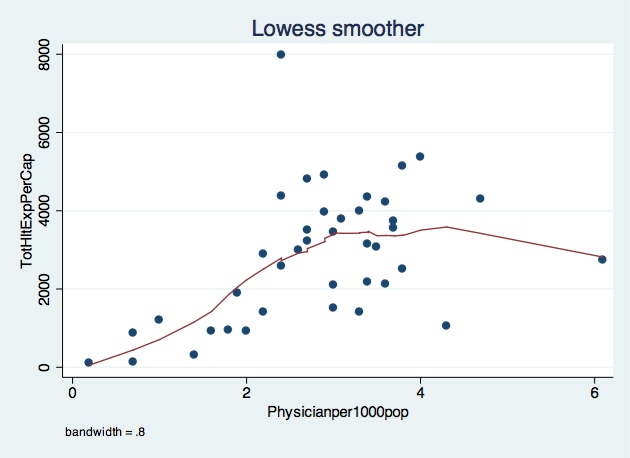
Figure 2
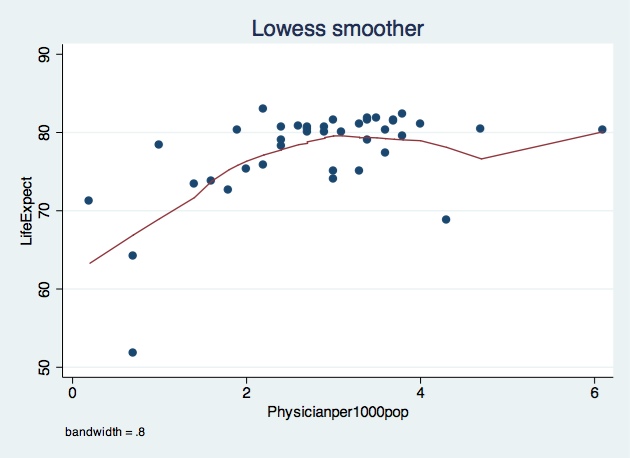
Figure 3
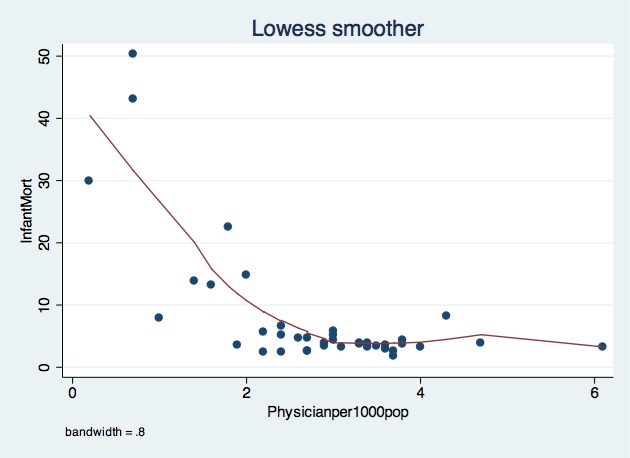
Figure 4
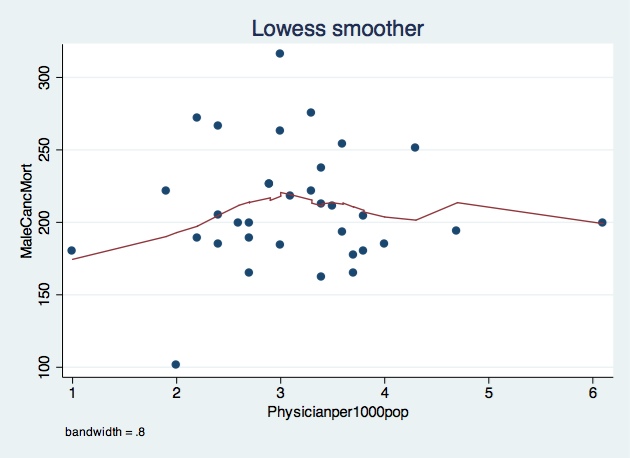
Figure 5
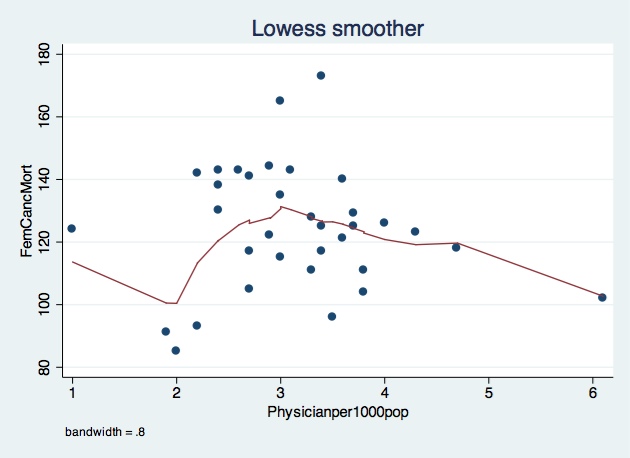
However, when it comes to cancer deaths, the
results are a little murkier. For males,
when it comes to their cancer mortality, I’m not sure it matters too much what the per capita number of physicians is. There seems to be a slight inverse u-shaped
relationship with the cancer death rate first increasing and then declining
(Fig4). The inverse u-shape is somewhat
more pronounced for females. Does having more physicians per capita at first
simply result in many more cases of cancer being diagnosed and treated which
then results in higher mortality rates? At
2.4 physicians per 1,000 population, Canada would be just at the point where increasing
physician numbers might be associated with declines in cancer mortality rates –
assuming of course you would want to base your health policy decision making on
a simple bivariate technique using one year of OECD data.
You cannot really draw any firm policy
conclusions from the limited data and technique in this blog post. It would be useful to look at more health
outcomes – for example there was OECD data for heart disease mortality – as well as break out
the physician variable into GPs and Specialists – and of course add more years of data. Running regressions controlling for confounding factors would be the next step. However, I would imagine looking at the relationship between
health expenditures, health care resources and health outcomes is a useful area
for health policy decision makers looking for evidence on what to spend more –
or less – money on.
// <![CDATA[
// <![CDATA[
// &lt;![CDATA[
// &amp;lt;![CDATA[
// &amp;amp;lt;![CDATA[
// &amp;amp;amp;lt;![CDATA[
// &amp;amp;amp;amp;lt;![CDATA[
// &amp;amp;amp;amp;amp;lt;![CDATA[
var sc_project=9080807;
var sc_invisible=1;
var sc_security=&amp;amp;amp;amp;amp;quot;4a5335bf&amp;amp;amp;amp;amp;quot;;
var scJsHost = ((&amp;amp;amp;amp;amp;quot;https:&amp;amp;amp;amp;amp;quot; == document.location.protocol) ?
&amp;amp;amp;amp;amp;quot;https://secure.&amp;amp;amp;amp;amp;quot; : &amp;amp;amp;amp;amp;quot;http://www.&amp;amp;amp;amp;amp;quot;);
document.write(&amp;amp;amp;amp;amp;quot;&amp;amp;amp;amp;amp;lt;sc&amp;amp;amp;amp;amp;quot;+&amp;amp;amp;amp;amp;quot;ript type=&amp;amp;amp;amp;amp;#39;text/javascript&amp;amp;amp;amp;amp;#39; src=&amp;amp;amp;amp;amp;#39;&amp;amp;amp;amp;amp;quot; +
scJsHost+
&amp;amp;amp;amp;amp;quot;statcounter.com/counter/counter.js&amp;amp;amp;amp;amp;#39;&amp;amp;amp;amp;amp;gt;&amp;amp;amp;amp;amp;lt;/&amp;amp;amp;amp;amp;quot;+&amp;amp;amp;amp;amp;quot;script&amp;amp;amp;amp;amp;gt;&amp;amp;amp;amp;amp;quot;);
// ]]&amp;amp;amp;amp;amp;gt;
// ]]&amp;amp;amp;amp;gt;
// ]]&amp;amp;amp;gt;
// ]]&amp;amp;gt;
// ]]&amp;gt;
// ]]&gt;
// ]]>
// ]]>

Related articles


 Worthwhile Canadian Initiative
I think segmenting physicians into at least two categories would be helpful. GP or Family Dr and specialist. a rising share of specialist would likely be closely related to rising costs even with flat numbers per 100,000 pop.
Good point Chris.
One thing of interest would the interaction of GP/FD or Specialist with expenditure to see if outcomes are improved by having more specialists, even after controlling for expenditure levels. If possible, a dummy variable for the country being considered may be useful, particularly if time series data is available for the set of countries under consideration.
Health care policy in nations with very high numbers of docs is different enough that I am not sure you can infer much just from the difference in the number of docs.
Steve
One thing to consider is how many hours physicians work. However many years ago, doctors were mostly male and worked more hours. Now a large fraction of new doctors are women who may work less in child-raising age. (My old GP was an example of that. She is now practicing full time, but she took a chunk of time off.)
Given also that the macho nonsense of residents and young doctors working 80 hours/week is being scaled back (thank heavens) it takes more docs than it used to to do the same work.
Anecdotal sure, but I found the benefit I got at the margins in health care services for me and my family came from nurses and nurse practitioners who could help the doctors.