The Department of Finance's Fiscal Monitor has been a useful tool in keeping track of the federal government's spending and revenues is a timely fashion. I've been using 12-month moving sums to account for seasonal patterns in revenues and spending, and they've been useful check to see if federal finances are consistent with budget projection.
I say 'has been', because for the second year in a row, Finance has changed its accounting rules without restating the historical data. The furthest they will go is that when they publish the numbers for a given month, they'll restate the numbers for the same month of the previous year. This means that it takes a year for them to get around to providing a consistent series of numbers going back one year before the accounting change.
Finance changed its accounting rules in April 2012, so I had to wait a year before I could put together 12-month moving sums with data collected under the new regime. And they just repeated the trick, adopting new, 'better' accounting practices as of April 2013.
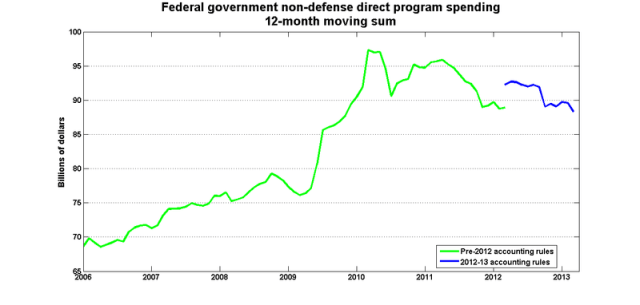
It will be another year before I can put together 12-month moving sums using the new rules. In the meantime, here are the numbers I've been able to put together using the rules before 2012 and for 2012-13.
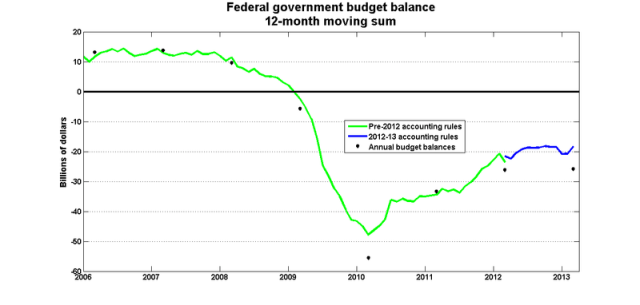
The revision in the April/May 2012 FM made a lot of sense: tax credits were added to the spending numbers instead of being subtracted from revenue. This shift didn't affect the budget balance in any given month, so there's no discontinuity in April 2012:
Reclassifying tax credits as expenditures instead of subtracting them from tax revenues created a jump in the revenues numbers:
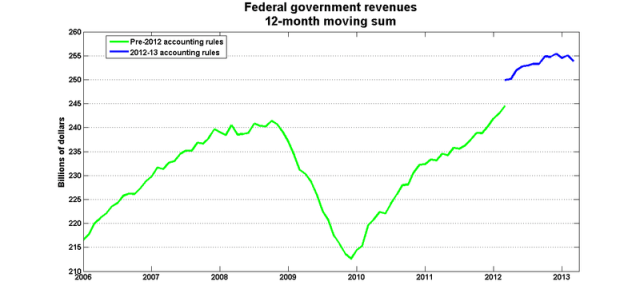
Revenues appeared to grow more slowly in 2012-13, but since the slowdown occurred after the structural break, it's not clear what sort of conclusions can be drawn.
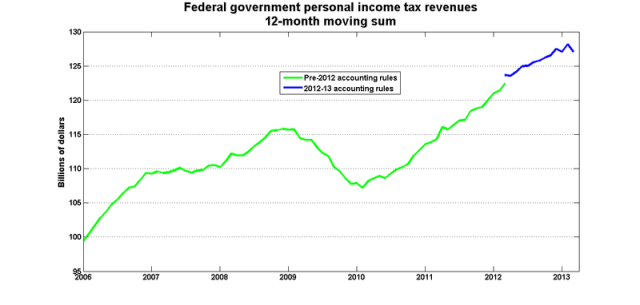
This graph breaks out personal income tax revenues:
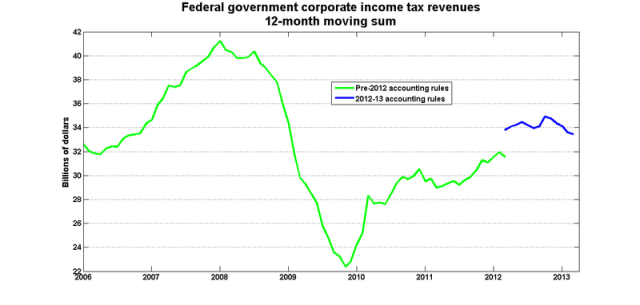
Corporate income taxes:
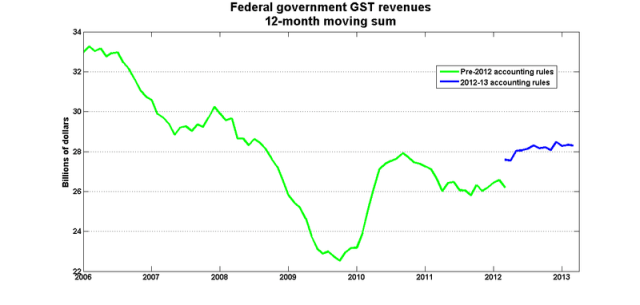
GST:
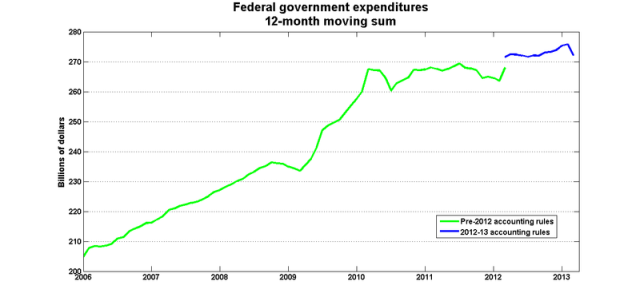
On the expenditure side, there's a jump at the break, but the pattern is the same as the previous two years. The federal government has held nominal spending roughly constant for three years now.
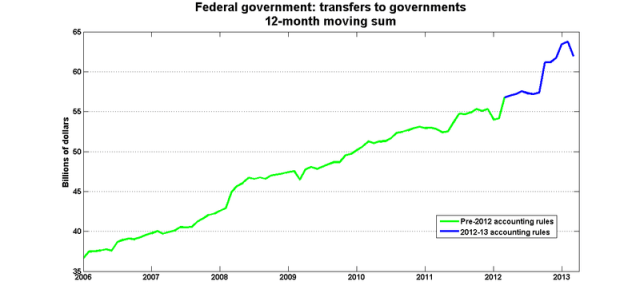
Transfers to othe rlevels of government weren't affected by the change, and they've continued to grow steadily:
Same thing for transfer payments to individuals:
There was a spike in defense spending in March 2012 that was repeated in March 2013:
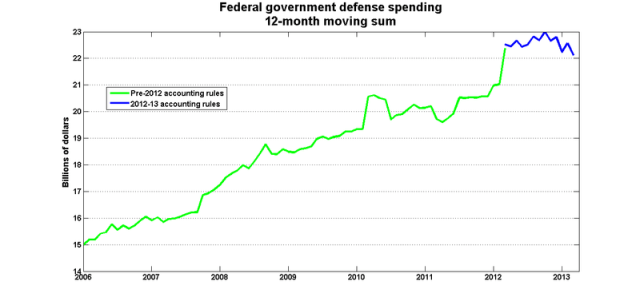
Non-defense program spending fell during 2011-12, and fell again during 2012-13; the accounting change simply shifted the path up:
Changing accounting rules twice in two years without updating the historical series is not the sort of behaviour generally associated with good governance and transparency.


 Worthwhile Canadian Initiative
Perhaps your expectation of rationality and transparency from the Department of Finance was not rational?
I recommend a few episodes of “Yes, Minister” to cheer you up.
Apparently, Kevin Page is setting up a Fiscal Institute at Ottawa U. Changes in accounting rules like this may be something the institute will pursue.
As someone who has worked in the inner circles of these types of things, I can assure you that this was not unintentional. And it is not unique to one political party or another.
Accounting rules would be welcome, although apparently they already follow them. But don’t take my word on that, I’m no accountant.