According to the recently released results of the National
Household Survey, the top 1% of Canadians aged 15 and over earn $191,000 a year
and tend to be predominantly male, university educated, married, most likely
over the age of 45, and live in larger metropolitan centers. It would appear that little has changed since
the nineteenth century when it comes to the determinants of affluence.
I do not have income data from the nineteenth century but I
do have wealth data. The data is for
7,156 census-linked probated decedents for the years 1892 and 1902. Here is a comparison of the wealth and
characteristics of the top and bottom one percent of late nineteenth century
Ontario wealth holders.
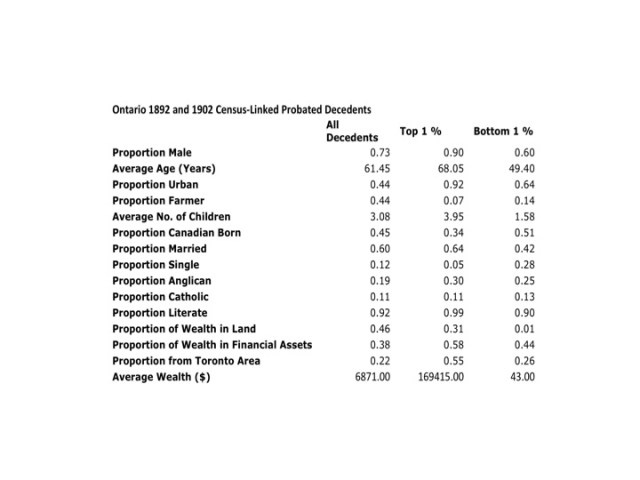
Well, it turns out that in the nineteenth century, wealth elites
were also more likely to be male, married, urban and older. In addition, they were not very likely to be
farmers, had larger families, often foreign-born (meaning the UK), often
Anglican and more literate (better educated).
Not surprisingly, Ontario’s nineteenth century wealth elite was also concentrated
in the Toronto area. Who says the past
is not relevant when it comes to social and economic insights?
// <![CDATA[
// <![CDATA[
// &lt;![CDATA[
var sc_project=9080807;
var sc_invisible=1;
var sc_security=&quot;4a5335bf&quot;;
var scJsHost = ((&quot;https:&quot; == document.location.protocol) ?
&quot;https://secure.&quot; : &quot;http://www.&quot;);
document.write(&quot;&lt;sc&quot;+&quot;ript type=&#39;text/javascript&#39; src=&#39;&quot; +
scJsHost+
&quot;statcounter.com/counter/counter.js&#39;&gt;&lt;/&quot;+&quot;script&gt;&quot;);
// ]]&gt;
// ]]>
// ]]>


 Worthwhile Canadian Initiative
One very interesting and big difference I noticed: the top 1% had far more children than the bottom 1%. Part of that may be a function of age, but the age difference doesn’t seem big enough to explain much of it. This immediately reminded me of:….dammit, I’ve forgotten his name. Wrote a book recently, finding the same thing using English probate records.
Of course: Gregory Clark “A farewell to alms”.
I would like to know what percentage of them have been employed by the public sector.
Nick:
Very wealthy families in the 19th century could usually afford a large family because they could employ servants to help look after them.
RP Long:
Unfortunately an “employed in the public sector” variable was not a variable I originally coded.
If the data is available in Canada, it would be interesting to know what degree they majored in. Our department uses the results from the 2010 American Community Survey to promote the major (economics is the second most common undergrad for the top 1% in the U.S). It would be nice to have Canadian data.
This is a sociology question. Are there any sociologists reading this blog?
“Part of that may be a function of age, but the age difference doesn’t seem big enough to explain much of it”
Well the “married/single” gap is probably not an insignificant explanation for that gap. Moreover, the impact of the age gap may be more significant if it reflects a different distributions of deaths. People who die young are probably more likely to be located in the bottom 1% of the wealth distributions and less likely to have kids or spouses (wealth, kids and wives being things we tend to accumulate over time), so will pull down. The bottoms 1%, is probably skewed towards people who died young, which shows up in the kids and married numbers.
RPLong: “I would like to know what percentage of them have been employed by the public sector.”
Of the current 1%? I had the same thought. It’s interesting, if you scroll through the Ontario Government’s sunshine list, there’s a small, but significant chunk, of public sector employees earning over the $191,000 threshold – crown attorneys, judges, hospital managers, professors (accounting, business, law and engineering professors do quite well, but I saw a few economists and sociologists on that list), some senior public health manager. Hard to argue with many of those salaries, and all-in-all not people your average Occupy protestor have in mind.
Derek: “If the data is available in Canada, it would be interesting to know what degree they majored in.”
They must have some degree data, because I read a story earlier indicating that a significant chunk of the 1% had business (29.2%), engineering (11.4%), medical (14.5%) or law degrees (7%). Although there’s no doubt a fair bit of overlap there (business grads with law degrees, doctors with engineering degrees), the professional degrees seem to do quite well for themselves. The must have more detailed data, since they were able to break the “medical” category up between vets, dentists and everyone else (forget operating on humans, apparently its more profitable to work on poodles).