This is a graph of real Canadian median family incomes:
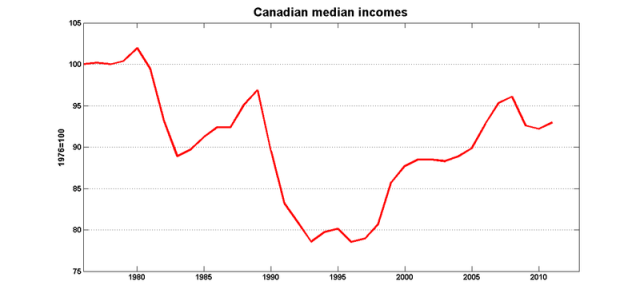
What do you think the relevant trend is for current policy?
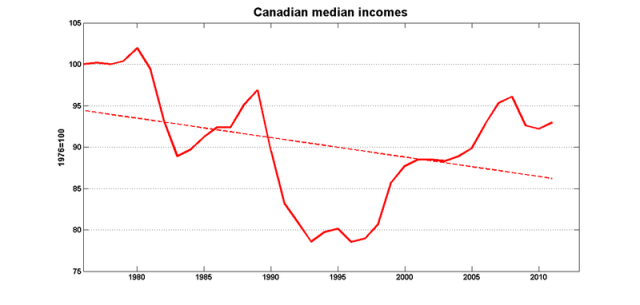
The federal Liberals are developing themes around the problems of the middle class, and if you draw a regression line through those data, you get a negative trend:
But that's not how I see it: I see a structural break around 1995 or so. Median incomes fell during the 1980s and during the first part of the 1990s, and have been recovering since then. The recent positive trend has not completely reversed the ravages of the first part of the sample:
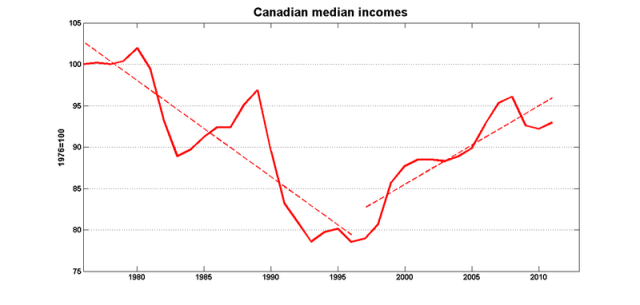
Lots of things changed around that time: public finances were gotten under control, inflation went from being high and variable to being low and stable, NAFTA came into force, and the tax system became more growth-friendly with the introduction of the GST. This is not an unanimous view – Miles Corak, for one, disagrees.
But I still think it's the correct way of looking at the data, and I had a counterfactual to illustrate why. Suppose that profile were inverted – would we say that the relevant trend was the positive growth rate over the entire sample, or the decline over the past 15 years of so? I was toying with the idea of writing a post to that effect, but then I saw the US median family income data released last week:
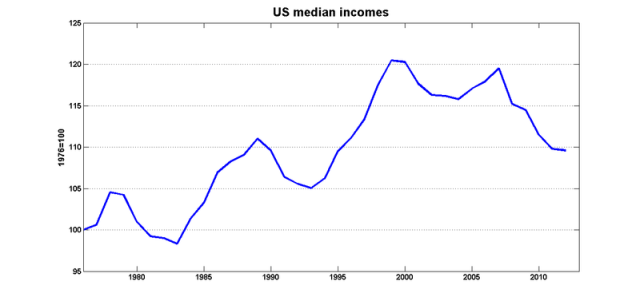
This is almost exactly a mirror image of the Canadian trajectory. A regression line through the entire sample shows a positive trend:
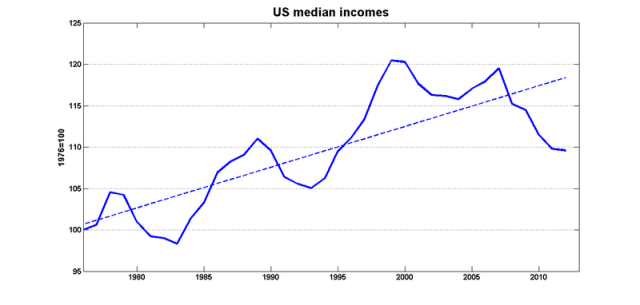
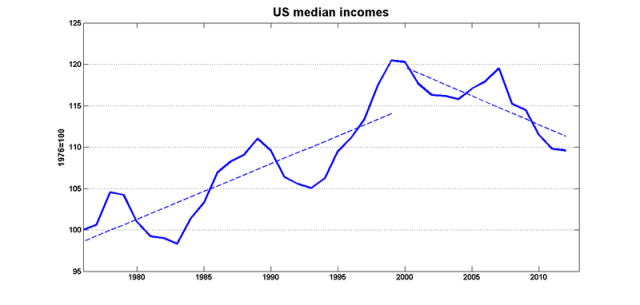
I don't think many people would accept the claim that the relevant trend for US policy-makers is one of sustained growth in median family incomes. I think more would agree that some sort of structural break occurred around 1999:
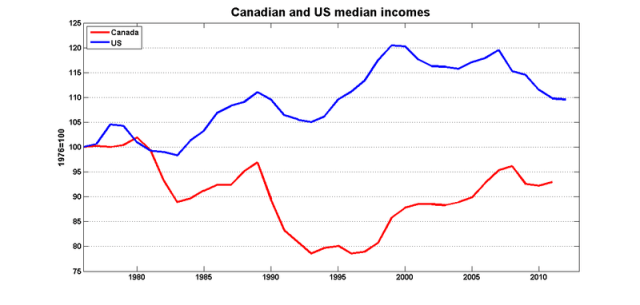
Here are the two series in one graph:
Which trends do you see? These ones?
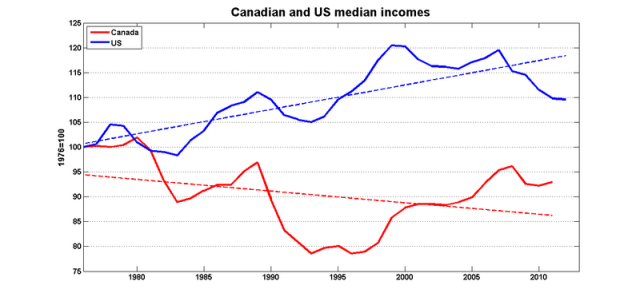
Or these ones?
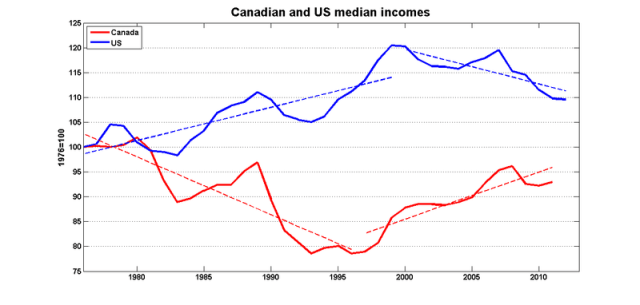
Whatever your choice, Canadian and US median incomes have different trends.


 Worthwhile Canadian Initiative
Where can the data sources be found? I shared this with a math geek friend of mine who would like to try a polynomial fit and some extra math for kicks.
Stephen:
Excellent post. This is related to the “Great Canadian Slump” post I made some time ago here: http://andolfatto.blogspot.com/2010/12/great-canadian-slump-can-it-happen-in.html
You are focussing on median incomes, but something similar is evident in the broad labor market statistics.
How about, you calibrate both curves with their respective long term average and then take a regression against a commodity price index, or just brent oil?
That would go a long way in explaining things.
My understanding (I am not an economist) is that U.S. median family income has increased mainly due to increased female participation in the labor force. I don’t think the real U.S. median wage is any higher now than it was in 1973.
Conbining David’s labour force participation and Stephen’s family income data sets might yield something interesting.
EI/UI policies have been raised, but since we’re discussing family rather than individual incomes, the rate of female participation and the timing of any changes cannot be neglected.
I think you should start your analysis with global demand for commodities, rather than some public policy variables.
The story is slightly more complex. Median family incomes are driven by changes in many types of income including investment, property etc, changes in participation rates and even industry mix variables. That makes either simple – no problem statements or big problem statements more complex. I plotted this morning the LFS median wage rate for selected occupations. Management rises like a rocket but the general median wage is also rising as is the occupations unique to manufacturing etc. The issue is a more complex mix including the distribution of types of income and types of jobs and even the geographic issue comes in the problem. Some will say that should all get equalized out. The winners can compensate the losers but that does not happen. See her discussion of Free Trade http://economix.blogs.nytimes.com/2013/08/05/the-free-trade-blues
I screwed up the reference to Nancy Folbre in my previous post. She is referring btw to free trade discussions but the issue holds for many policies related to trade and industrial structure. If anyone is remotely interested in the chart, you can find it on posts on linkedin or twitter (@jciconsult). The data are on Cansim 282-0070 if you want to look at other occupations.
“EI/UI policies have been raised, but since we’re discussing family rather than individual incomes, the rate of female participation and the timing of any changes cannot be neglected.”
No, although, if we’re measuring family income, you also have to look at changing family structure. There’s been a sharp drop in the proportion of families that are “two-adult” families, and a sharp rise in the number of families that are “one-adult” families (either single parents, or just singles). So, in that context, family income would drop precipitously even if individual incomes stayed the same, simply by virtue of having fewer workers per family.
Another question is what impact does aging having on family incomes? You’d think an aging population would cause family income to drop if only because incomes tend to fall in retirement (even if oldsters can live quite well by drawing down capital or because they have fewer expense).
Bob,
there is now the “OECD equivalence scale” which should adjust for (changing) family size. It is used routinely since many years in Germany for income considerations, like the DIW SOEP panel.
Novice question time – Do these figures take into account non-income benefits such as healthcare provision, or is that not relevant here?
I’m surprised that nobody talks about inflation here. Up until 1991, inflation was 4% or more. Starting in 1992, inflation, all of the suddens, fall to 2% or less (except one year at 2.2%) for the remaining of that decade.
http://www.statcan.gc.ca/tables-tableaux/sum-som/l01/cst01/econ46a-eng.htm
I know that Stats Can has changed their methodology many times over the years and every time it was with the purpose of reducing the CPI (IMO). Anybody here can demolish this inflation theory or is it possible?
I have to add that the period between 1975 and 1995 saw a huge number of female joining the work force (the proportion of working female was increasing yr after yr). The first graph tells me that during that period the median family income came down by 20%. It seems almost impossible to believe unless, maybe, they were over estimating the inflation rate at that time.
A couple of questions about the data: is this disposable household income? Where are these data from?