The last two times I’ve taught my quantitative economic history course, I have assigned a micro-data collection project based on the 1901 Census of Canada. All in all, this data collection was a good experience for the students given they got some direct experience collecting primary data, coding it and then analyzing it. Moreover, I now have a small data set of household heads from the 1901 Census with data on age and total earnings. The 1901 Census asked what the earnings were from an occupation or trade as well as any extra earnings from other than the chief occupation or trade. As a result, I have been able to construct age-earnings profiles that unlike modern ones show rather steep declines in earnings after the mid-forties. Modern profiles show relatively moderate declines after age 50.
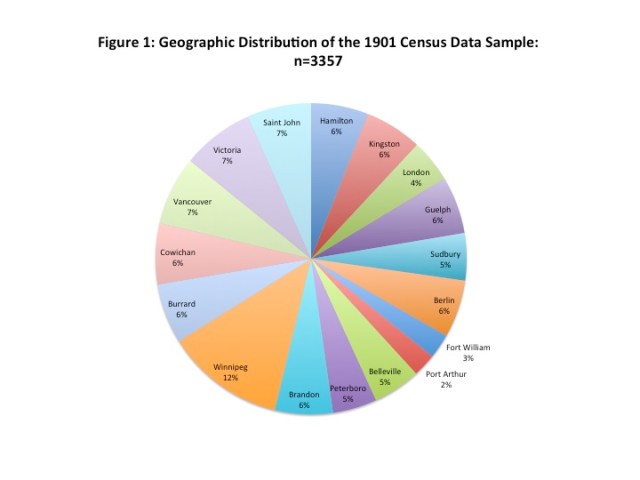
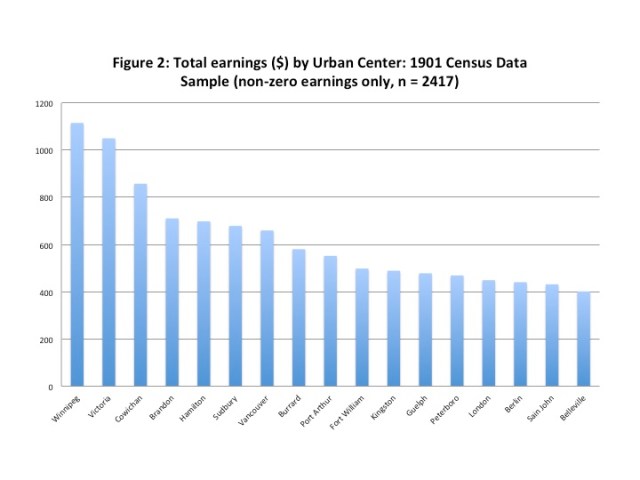
There are 3,357 individuals in this small data set: 91 percent are male; the average age was 44 years with a range from 15 to 91 and average total earnings were $488.96. About 72 percent reported non-zero total earnings. Since it is not always possible to ascertain if zero reported earnings actually means zero or if there was non-compliance, I have decided to drop the zero earnings from the analysis. The data is spread out over urban centers across Canada as the accompanying Figure 1 shows but much of the data is from Ontario. When the earnings are ranked by urban center, there is a strong east to west gradient with earnings generally higher in the west and lower in the east (See Figure 2).
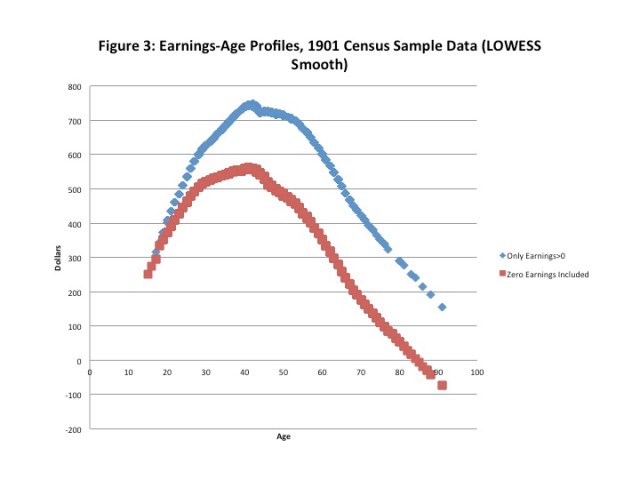
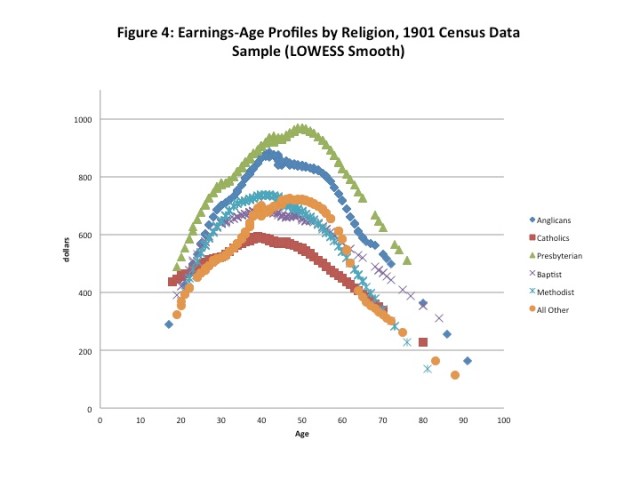
The earnings-age profiles are estimated using LOWESS and are quite interesting. Figure 3 plots the overall earnings-age profile for only earnings greater than zero as well as a profile including the zero earnings and they show similar peak ages and similar rates of decline. Once age 40 was reached, earnings began to decline quite rapidly. Figure 4 plots the profiles (only for earnings>0) by major religious affiliation and they show quite different levels of income across the denominations though rapid rates of decline after peak earnings. However, the peak seems to vary a bit by group. Catholics, Baptists, Methodists and Anglicans all reach peak earnings at about 40 years of age but Presbyterians do so at about age 50.
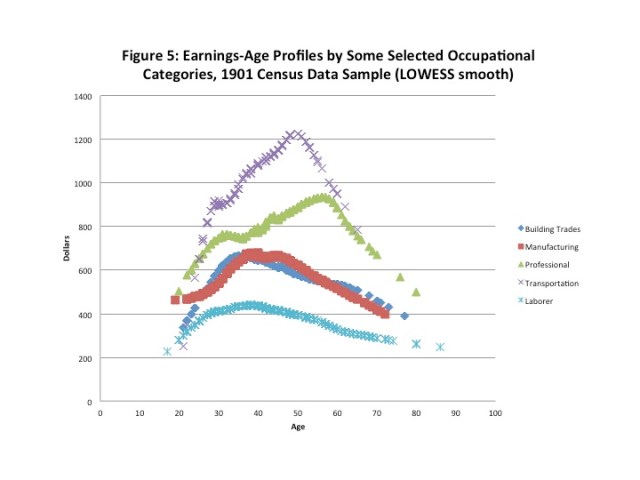
Finally, Figure 5 plots the profiles again for a few of the occupational categories. These five categories account for nearly 50 percent of the people in the data set with general laborers the largest at 15 percent of the individuals. In terms of peak incomes reached, professionals and transportation workers seem to do the best. Professionals reach their income peak at about age 60 whereas transportation workers do so at age 50. Individuals employed in manufacturing, building trades and general labor reach their peaks at or just before age 40. The high income level in transportation (which includes utilities and communications by the way) seems a bit odd relative to professionals (teachers, doctors, lawyers, etc..) but then transportation was a big growth sector in the nineteenth and early twentieth century as railway infrastructure was being put into place.
Of course the next step is regression to estimate earnings-age profiles while controlling for many of these characteristics. I’m looking forward to the completed student term papers…
UPDATE: December 5
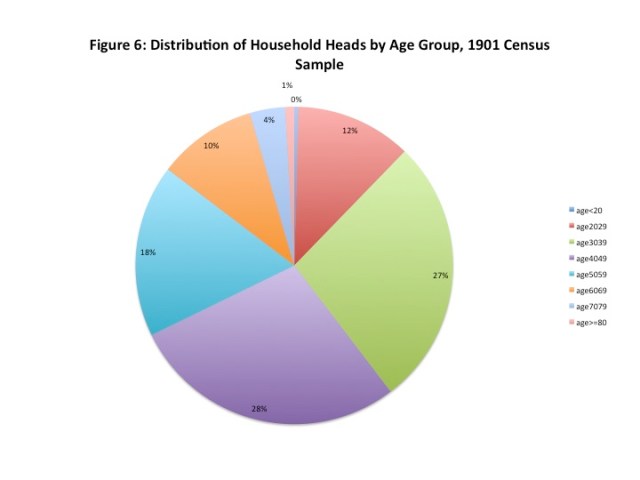
In response to Donald's query about the age distribution of the individuals in the data, see Figure 6 below.
// <![CDATA[
// <![CDATA[
// &lt;![CDATA[
// &amp;lt;![CDATA[
// &amp;amp;lt;![CDATA[
// &amp;amp;amp;lt;![CDATA[
// &amp;amp;amp;amp;lt;![CDATA[
// &amp;amp;amp;amp;amp;lt;![CDATA[
var sc_project=9080807;
var sc_invisible=1;
var sc_security=&amp;amp;amp;amp;amp;quot;4a5335bf&amp;amp;amp;amp;amp;quot;;
var scJsHost = ((&amp;amp;amp;amp;amp;quot;https:&amp;amp;amp;amp;amp;quot; == document.location.protocol) ?
&amp;amp;amp;amp;amp;quot;https://secure.&amp;amp;amp;amp;amp;quot; : &amp;amp;amp;amp;amp;quot;http://www.&amp;amp;amp;amp;amp;quot;);
document.write(&amp;amp;amp;amp;amp;quot;&amp;amp;amp;amp;amp;lt;sc&amp;amp;amp;amp;amp;quot;+&amp;amp;amp;amp;amp;quot;ript type=&amp;amp;amp;amp;amp;#39;text/javascript&amp;amp;amp;amp;amp;#39; src=&amp;amp;amp;amp;amp;#39;&amp;amp;amp;amp;amp;quot; +
scJsHost+
&amp;amp;amp;amp;amp;quot;statcounter.com/counter/counter.js&amp;amp;amp;amp;amp;#39;&amp;amp;amp;amp;amp;gt;&amp;amp;amp;amp;amp;lt;/&amp;amp;amp;amp;amp;quot;+&amp;amp;amp;amp;amp;quot;script&amp;amp;amp;amp;amp;gt;&amp;amp;amp;amp;amp;quot;);
// ]]&amp;amp;amp;amp;amp;gt;
// ]]&amp;amp;amp;amp;gt;
// ]]&amp;amp;amp;gt;
// ]]&amp;amp;gt;
// ]]&amp;gt;
// ]]&gt;
// ]]>
// ]]>


 Worthwhile Canadian Initiative
Teaching and doctoring were not as well paid back before teachers unions and medicare. I have a fair number of both in my family line and that’s certainly the story I get.
Interesting project.
Why am I unsurprised by the differences in the age of peak earnings by (broad) occupations?
I’m interested in the number of people by age as well. Is there a tendency for the size of the age cohorts to drop significantly with age?
Interesting.
“The high income level in transportation (which includes utilities and communications by the way) seems a bit odd relative to professionals ”
– a number of the professionals would be teachers earning next to nothing
– doctors hadn’t fully got that whole licensing thing working at this point, also there wasn’t nearly as much third party payment
– I’m wondering how many people who owned their own taxi/truck/boat etc are included in the transportation numbers? I’m wondering if perhaps wages in transportation have a return to capital element?
On the peak of earnings at a young age – if a man is being paid his marginal product of labour, and he’s working in a job that involves physical strength – yup, that’s when earnings are going to peak. That things don’t work this way now says a lot about the way that wages are determined, and a lot about the changing nature of work.
Jim:
Point about unions is interesting – I suppose one could argue that the spread of unionization in the twentieth century probably mitigated steep declines in age-earnings profiles after age 50.
Donald:
Have updated the post with a figure on the distribution of the individuals by age categories. Ages 20-69 account for most of the observations.
Frances:
That is a good question about the transportation numbers. Don’t know.
Transportation number: railway workers?
Catholics: Franco ( called at the time “white n!””/$%) and recent Italian and Slavic immigrants?
I am surprised a little bit about the 40 years peak. Given the high mortality among adult up to mid-century, wouldn’t that mortality slow the reported decline, as the lower-paid-high physical worrkload die, like my grandfather?? Or did it make a horrible situation just less horrendous, the way the high poverty rate among elderly women hide the high mortality of poor men?
Jacques:
Actually, while mortality rates were high in the late nineteenth century if you made it to age 20, you could expect to make it into your 60s. Half of deaths were typically children under age 5.
Sorry. Posting too fast between exam copies…Should have checked data. Don’t tell my students…
Life insurers still did brisk business in the ’50’s-’60’s selling life protection to mid-30-mid=40 couples with images of dead husbands. (The father of a childhood friend made a good living with his white shroud…This is what I had in mind). Maybe they or at least their customers had not internalized the new data.
Transportation number: railway workers?
Catholics: Franco ( called at the time “white n!””/$%) and recent Italian and Slavic immigrants?
Not in this data set. The only towns with significant Francophone populations would be Winnipeg and Sudbury. The Province of Quebec and eastern Ontario isn’t in this set.
Second, Catholic does not equal Francophone, as the Catholic School System in Ontario will tell you. It means Irish, especially at this time, with a dash of Italian and Polish out west.
called at the time “white n!””/$%
You’re confusing a Le Devoir article from the 1950’s with history. Quebec was “That Priest-Ridden Province”. Canadian discrimination had far more of a religious tinge to it than linguistic. See the Orange Lodge.
The Irish at that time would still have been at the low end of the socio-economic scale. I can recall driving in a car with my Grandmother (born in the 1890’s) through Perth, Ontario and having her describe the obviously working class part of town as the Irish part.