Canadian retailers have recently been concerned that the Canada Border Services Agency has been too lenient with cross-border shoppers in the wake of the increase in duty free limits in 2012. While it is true that cross-border trips have grown substantially over the last decade, I’m not sure they should be that concerned.
The traditional barometer of Canadian cross-border shopping is Canadian travelers returning from the United States by automobile – both same day and one or more night travelers. The accompanying figure* provides the number of Canadians returning from the USA by automobile since 1972. In 1991, both same day and one or more night auto trips by Canadian residents peaked at the highest annual number ever recorded – at 59.1 million and 14.2 million respectively. These numbers collapsed over the 1991 to 2002 period with drops of 65 and 46 percent largely driven by a depreciating dollar. Numbers began rising again after 2002 with same day trips up 55 percent and one or more night trips up 83 percent between 2002 and 2013.
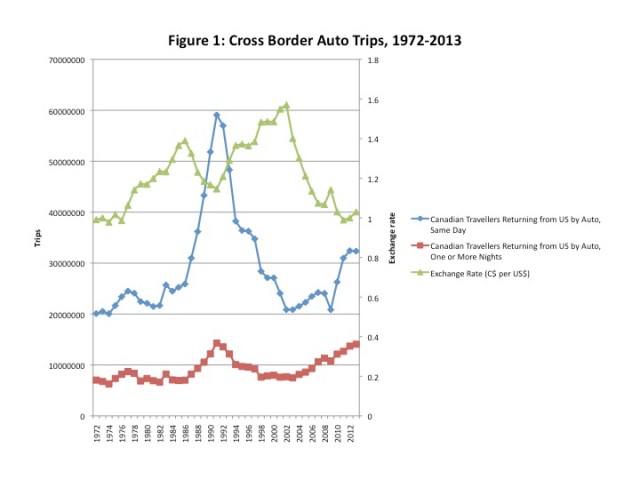
Despite any lamentations from Canadian retailers, cross-border shopping today is a much smaller problem than it was during the early 1990s particularly if measured by same-day auto trips and certainly on a per capita basis given population growth. Same day auto trips did surge after 2009 but they appear to have leveled off over the last two years.
Where there might be some concern is with one or more night auto trips. These have been on an upward trend since the dollar began appreciating in 2002 and they are almost where they were in 1991. As well, given that they have continued to climb over the last few years while same day trips stalled could mean longer trips are being subsituted for shorter ones – given the new exemptions were not extended to same trip trips. However, it is difficult to blame all the growth on longer auto trips on cross-border shopping given that longer trips are also done as part of a vacation rather than simply to shop.
Given that the Canadian economy has fared reasonably well over the last few years, it should not be a surprise that Canadians are taking more vacations in the United States. After all, one can argue that a road trip to the United States is a logical and convenient tourism experience for Canadians (90 percent of whom live within 100km of the border) making a visit the U.S. a long-standing part of the Canadian cultural experience.
*Data Sources:
v37426 Canada; United States dollar, noon spot rate, average
v129490 Canada; Canadian travellers returning from United States by automobile, total
v129491 Canada; Canadian travellers returning from United States by automobile, same day
// <![CDATA[
// <![CDATA[
// &lt;![CDATA[
// &amp;lt;![CDATA[
// &amp;amp;lt;![CDATA[
// &amp;amp;amp;lt;![CDATA[
var sc_project=9080807;
var sc_invisible=1;
var sc_security=&amp;amp;amp;quot;4a5335bf&amp;amp;amp;quot;;
var scJsHost = ((&amp;amp;amp;quot;https:&amp;amp;amp;quot; == document.location.protocol) ?
&amp;amp;amp;quot;https://secure.&amp;amp;amp;quot; : &amp;amp;amp;quot;http://www.&amp;amp;amp;quot;);
document.write(&amp;amp;amp;quot;&amp;amp;amp;lt;sc&amp;amp;amp;quot;+&amp;amp;amp;quot;ript type=&amp;amp;amp;#39;text/javascript&amp;amp;amp;#39; src=&amp;amp;amp;#39;&amp;amp;amp;quot; +
scJsHost+
&amp;amp;amp;quot;statcounter.com/counter/counter.js&amp;amp;amp;#39;&amp;amp;amp;gt;&amp;amp;amp;lt;/&amp;amp;amp;quot;+&amp;amp;amp;quot;script&amp;amp;amp;gt;&amp;amp;amp;quot;);
// ]]&amp;amp;amp;gt;
// ]]&amp;amp;gt;
// ]]&amp;gt;
// ]]&gt;
// ]]>
// ]]>


 Worthwhile Canadian Initiative
There are a couple of possibilities for why cross-border shopping is less significant than it was in the day:
(I) The internet and cheap shipping. I shop a lot in the US, but never in person. I must be Amazon.com’s best customers. And a lot of US retailers who don’t have retail operations in Canada will ship their products free of charge to Canada. So why would I bother shopping in Buffalo.
(II) 9/11. Tighter border security and documentation requirements make it a lot less convenient to travel than it once was.
(III) Increased competition in Canada. In 1989 the big Canadian retailers were, what, Eatons, Woolsworth, Sears, Zellers, Kmart, byway, HBC, Simpsons? How many of those still exist? HBC, in a very modified form (apparently so did Woolsworth – in the form of Foot Locker). It wouldn’t be surprising if the Canadian retail market were much more competitive now then it was 25 years ago.
Bob: Those are good reasons. No internet shopping in the early 1990s. If you have to go through the hassle of getting a passport to cross the border – which was not the case in the early 1990s – then you are going to visit for a longer trip rather than same day trips. The other big difference between then and now is that Walmart and Target are now in our market- retail has changed over two decades.
Yeah, target and walmart were the two big ones I had in mind.
But if you shop online and have goods shipped backed to you get hit with GST/HST and other taxes. Second for very big US retailers the US Corporate Tax system and lower Canadian corporate rates actually encourages them setup brick and mortar presence in Canada or Canadian specific websites. The later wasn’t true 20 years ago.
Tim,
Yes, but the selection at US online retailers is much more extensive that Canadian ones (compare the inventory at amazon.com vs. amazon.ca, it’s not even close), and they are often more competitively priced. True, you have to pay tax on the importation of goods at the border, although you’d pay them anyhow, but the CRA has not developed an effective means for taxing online purchases of intangible property (ebooks, music, video games). In theory there’s a self-assessment obligation, but I suspect non-compliance is universal. Plus, some foreign retailers are not exactly scrupulous in their customs compliance procedures. I once ordered a suit from a Hong Kong company, who shipped it to me described as a $20 gift – to avoid duties and taxes on importation. It was a nice suit, but I didn’t order from them again, but not everyone is as scrupulous as I am.