CIHI has just released its latest report on physicians – Physicians in Canada 2013 – and the key findings can be summarized as follows: (1) For the 7th year in a row, the number of physicians in Canada increased, reaching 220 per 100,000 population in 2013. (2) In 2012–2013, total payments to physicians in Canada grew 3.5%, reaching $22.8 billion—the lowest growth in more than a decade. –– The average gross payment per physician was $328,000, virtually the same as in the previous year. (3) The average cost paid to physicians per clinical service was $58.15. (4) Family physicians billed an average cost per service of $43.35, while specialists billed $77.69.
I suppose that in one sense this is good news in that while physician numbers are rising, their costs are not rising as quickly as previously. Indeed, the total number of physicians rose 3.4 percent while total expenditure on physicians rose only slightly more at 3.5 percent. Whether this is a permanent or short-lived trend remains to be seen. Moreover, it should be noted (as shown in this earlier post) that Canadian per capita physician numbers are still quite low relative to other OECD countries.
However, having more physicians with billing numbers does set the stage for renewed physician expenditure growth down the road should policy and circumstances allow it. As well, even though the number of physicians has been rising faster than population, there is substantial variation in per capita physician numbers across the country as well as their growth rate.
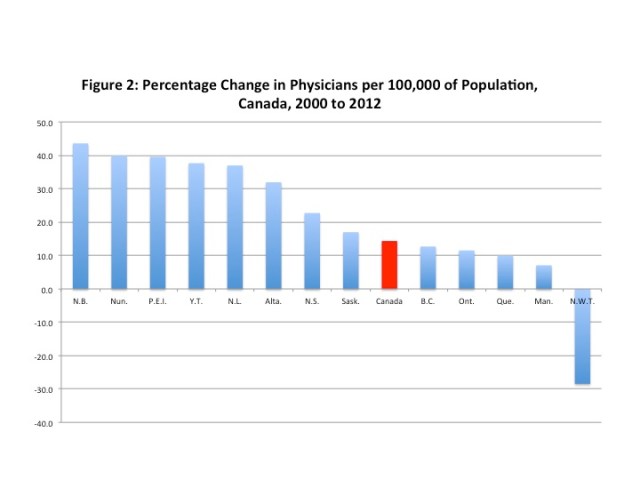
Figure 1 plots physicians per 100,000 of population for each of the provinces and territories in 2012 and they range from a high of 250 in Nova Scotia to a low of 36 in Nunavut. It should be noted that if specialists alone are considered (not shown), Nova Scotia in 2012 also has the highest per capita number of specialists, followed by Quebec, Newfoundland and Labrador and then Alberta. If you look at the growth rates for physicians per 100,000 over the 2000 to 2012 period in Figure 2, the highest rates of physician supply deepening were in New Brunswick, Nunavut, Prince Edward Island and The Yukon. The lowest growth was in B.C., Ontario, Quebec and Manitoba with a decline in the Northwest Territories. 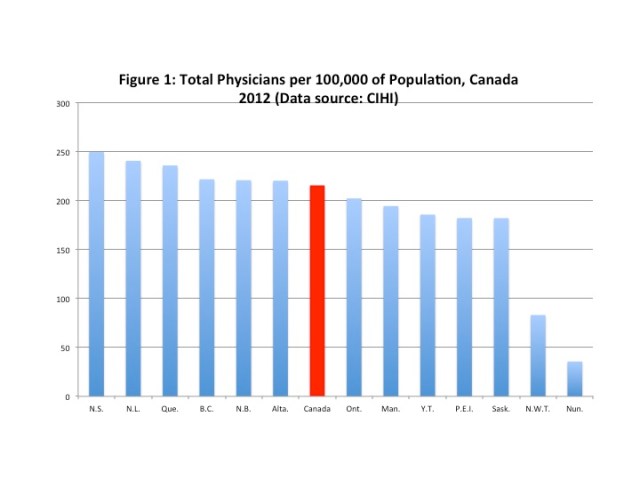
Living in Ontario, I suppose I find Ontario’s performance quite interesting in terms of its physician number evolution over time. In 1980, Ontario was tied with Quebec for the second highest number of physicians per capita – B.C. was first. Today it is below the Canadian average in 7th place. When it comes to specialists, in 1980 Ontario ranked third in specialists per capita – after Quebec and B.C. By 2012, Ontario had dropped down to 6th place – after Nova Scotia, Quebec, Newfoundland and Labrador, Alberta and New Brunswick.
However, Ontario’s decline in the provincial physician number rankings does not appear to have affected its position in the ranking for gross payments. Average gross clinical payments per physician in 2013 ranged from a low of $261,000 in Nova Scotia to a high of $371,000 in Ontario. What is also interesting is that the concentration of specialists in Ontario’s largest city is much more intense than in Canada’s other large cities. According to the 2012 numbers, the number of specialists per 100,000 in Toronto was 303 (317 in 2013) compared to 216 in Montreal (220 in 2013) and 262 in Vancouver (282 in 2013). The Toronto area also has the highest number of family physicians per capita compared to other health regions in Ontario at 175 per 100,000 in 2012 and 174 per 100,000 in 2013.
If you are a doctor, Ontario is a good place to be. If you need a doctor, Toronto is good place to be.
// <![CDATA[
// <![CDATA[
// &lt;![CDATA[
// &amp;lt;![CDATA[
var sc_project=9080807;
var sc_invisible=1;
var sc_security=&amp;quot;4a5335bf&amp;quot;;
var scJsHost = ((&amp;quot;https:&amp;quot; == document.location.protocol) ?
&amp;quot;https://secure.&amp;quot; : &amp;quot;http://www.&amp;quot;);
document.write(&amp;quot;&amp;lt;sc&amp;quot;+&amp;quot;ript type=&amp;#39;text/javascript&amp;#39; src=&amp;#39;&amp;quot; +
scJsHost+
&amp;quot;statcounter.com/counter/counter.js&amp;#39;&amp;gt;&amp;lt;/&amp;quot;+&amp;quot;script&amp;gt;&amp;quot;);
// ]]&amp;gt;
// ]]&gt;
// ]]>
// ]]>


 Worthwhile Canadian Initiative
I am baffled by the top place of NB, unless they were starting from some baseline of absolute misery prior to the measure. The next four are very small jurisdictions, as is the last. QC is not in a good place–the absolute number of physicians immigrating into that province is the same as Manitoba’s, which is 1/8 the size.
I do think that a breakdown by CMS would be more useful (I downloaded the data and CIHI doesn’t report that). A recent study in the US found that large increases in physician and nurse supply (YOY growth larger than population growth) disproportionately benefited large urban centres.
Shangwen:
I found the numbers for the Atlantic region interesting. I think part of what is happening is that total physician numbers in the Atlantic provinces have been increasing at rates comparable to other provinces but their population growth rate is very low compared to Ontario, Alberta or BC. As a result, they have caught up in their physician/population ratios over time.
I suspect a part of the moderation in cost increases is due to the trend for doctors to work less and have a better work/life balance.
The Nova Scotia numbers don’t surprise me much, they have a medical school/teaching hospital and act as a bit of a regional center for more specialized medicine. Toronto’s numbers are probably high for similar reasons.
“I suspect a part of the moderation in cost increases is due to the trend for doctors to work less and have a better work/life balance.”
That’s probably a factor. I know a number of doctors who have pointed to the increase in the number of woman in the medical profession as changing the expectations of what the practice of medicne is supposed to be.
This does illustrate the dangers of looking at inputs (number of doctors), rather than outputs (amount of medical service provided) in measuring costs.
I gather it’s not just women who are looking for more balance either.