I suppose I have become somewhat obsessed with Ontario’s economy and its performance but here I go again with a few comparisons. Ontario is strategically located on the Great Lakes-St. Lawrence waterway adjacent to the huge population of the US northeast. Its neighbours are trade partners and markets as well as economic competitors. How does Ontario stack up to its immediate American and Canadian neighbors – namely, Minnesota, Wisconsin, Michigan, Ohio, Pennsylvania and New York, and then Manitoba and Quebec?
With 13.6 million people, Ontario has the second largest population after New York State, which has 19.7 million people but the fourth largest economy coming behind New York, Pennsylvania and Ohio. As a result, Ontario’s per capita GDP is lower than one might expect edging out Michigan, Manitoba and Quebec but behind New York, Minnesota, Pennsylvania, Wisconsin and Ohio. (See Figure 1) When it comes real per capita GDP growth, Ontario and Michigan not surprisingly have been the worst performers. (See Figure 2) Both are highly dependent on automobile manufacturing and this sector was hit hard during the last decade. Between 2000 and 2013, real per capita GDP grew the most in Manitoba and New York State at 19 percent each. Next came Pennsylvania, Minnesota and Quebec at 12, 11 and 10 percent respectively. At the bottom came Ohio, Ontario and Michigan at 7, 5 and -3 percent respectively.

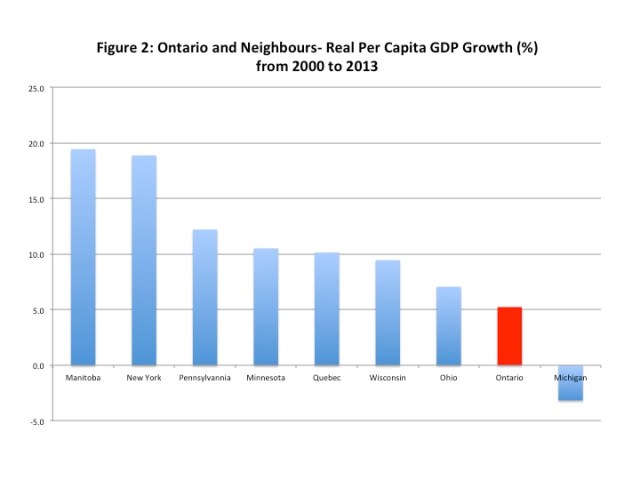
When it comes to these economic performance indicators, relative to its neighbors in what has become a highly integrated and competitive North American economy, Ontario has delivered a mixed performance. Despite having the second largest population of its immediate neighbors, Ontario has only the fourth largest economy and sixth highest per capita output. Moreover, its per capita output growth was the second lowest of this comparison only ahead of Michigan.
I suppose that could be a good marketing slogan for the government economic development people at Queen's Park: Ontario-at least we are doing better than Michigan.
Data Sources for Figures 1&2: Statistics Canada, US Bureau of Economic Analysis, US Census Bureau. US PPP$ conversion index from IMF World Economic Outlook Database.
// <![CDATA[
// <![CDATA[
// &lt;![CDATA[
// &amp;lt;![CDATA[
// &amp;amp;lt;![CDATA[
// &amp;amp;amp;lt;![CDATA[
// &amp;amp;amp;amp;lt;![CDATA[
var sc_project=9080807;
var sc_invisible=1;
var sc_security=&amp;amp;amp;amp;quot;4a5335bf&amp;amp;amp;amp;quot;;
var scJsHost = ((&amp;amp;amp;amp;quot;https:&amp;amp;amp;amp;quot; == document.location.protocol) ?
&amp;amp;amp;amp;quot;https://secure.&amp;amp;amp;amp;quot; : &amp;amp;amp;amp;quot;http://www.&amp;amp;amp;amp;quot;);
document.write(&amp;amp;amp;amp;quot;&amp;amp;amp;amp;lt;sc&amp;amp;amp;amp;quot;+&amp;amp;amp;amp;quot;ript type=&amp;amp;amp;amp;#39;text/javascript&amp;amp;amp;amp;#39; src=&amp;amp;amp;amp;#39;&amp;amp;amp;amp;quot; +
scJsHost+
&amp;amp;amp;amp;quot;statcounter.com/counter/counter.js&amp;amp;amp;amp;#39;&amp;amp;amp;amp;gt;&amp;amp;amp;amp;lt;/&amp;amp;amp;amp;quot;+&amp;amp;amp;amp;quot;script&amp;amp;amp;amp;gt;&amp;amp;amp;amp;quot;);
// ]]&amp;amp;amp;amp;gt;
// ]]&amp;amp;amp;gt;
// ]]&amp;amp;gt;
// ]]&amp;gt;
// ]]&gt;
// ]]>
// ]]>


 Worthwhile Canadian Initiative
It would be interesting to prepare the same GDP comparisons using a measure of private sector GDP (i.e., ex government spending).
Interestingly, the right wing in Ontario claims that the province’s weak attempts at a not purely austerity approach to the general crisis and its particular problem of once being the industrial heartland of the country and now being gutted by the loss of good manufacturing jobs (to Mexico, the U.S. South, China etc etc) that unless “public spending is reined in” the province will “end up like Michigan”, whereas if you had to put a fine point on it, it is the lack of stimulus and government intervention in the economy that has got Michigan where it is, not the other way around, and is one of the key factors in Ontario “not being as bad off as Michigan”.
If this is a Canadian economics blog, why do you use American spellings?
sorry for the run-on sentence and garbled syntax. You get my point.
@PG: Well, all that stimulus in Ontario has just put it ahead of Michigan. Would like to see a cost benefit on that at some point given the size of Ontario’s deficits and debt. Would also be interesting to look at the fiscal situation of Ontario’s American neighbours. As for American spellings, I must admit it is a bit of a challenge to always compose in “Canadian” English given word processors and auto-correction that turns “neighbours” into “neighbors” among other things.
The German 2 cents:
that GM, Ford, Chrysler performed substandard is not the fault of the Canadians
Perhaps Kansas would be of interest if one is looking at the approach taken to fiscal policy.
Kansas adopted austerity in 2011 under Governor Brownback, and promptly saw the growth rate of real GDP go from 3.8% in 2011 to 0.4% in 2012 and then 1.9% in 2013. Kansas also had the woeful experience of having its credit rating dropped in 2014 to Aa2 – the same credit rating that is given to Ontario.
http://www.statista.com/statistics/187882/gdp-of-the-us-federal-state-of-kansas-since-1997/
A couple of points:
1) I’m not surprised that Ontario has under-performed against “its neighbors in what has become a highly integrated and competitive North American economy” given the exchange rate rose from the high 60-cent range to over 101-cents in 2012.
2) Some of this may be affected by choosing 2000 as the base year. Ontario real growth averaged an unsustainable 5.7% between 1997 and 2000, vs. 4.4% in the US, and was set for a slowdown in coming years.
3) Ontario population rose 16% over this period, by far the highest. Next closest was Manitoba and Quebec at 10%. New York, the best performer per capita, was up 3.4%.
4) PPP-adjusted GDP is the acceptable metric, but the PPP values seem funny. With a PPP exchange of 83 cents in 2000 vs. 81 cents in 2012, is it true that in 2000 my dollar could buy more stuff in Canada relative to a US dollar in the US than it could in 2012?