The Canadian Institute for Health Information (CIHI) has just released their 2015 report on health expenditure trends and they show that total nominal health expenditure in Canada continues to grow (1.6 percent in 2015) but at a slower rate. Health spending (public and private) has reached $219.1 billion dollars or $6,105 dollars per capita. As well, the total health expenditure to GDP ratio is at 10.9 percent – down from its peak of 11.6 percent reached in 2010.
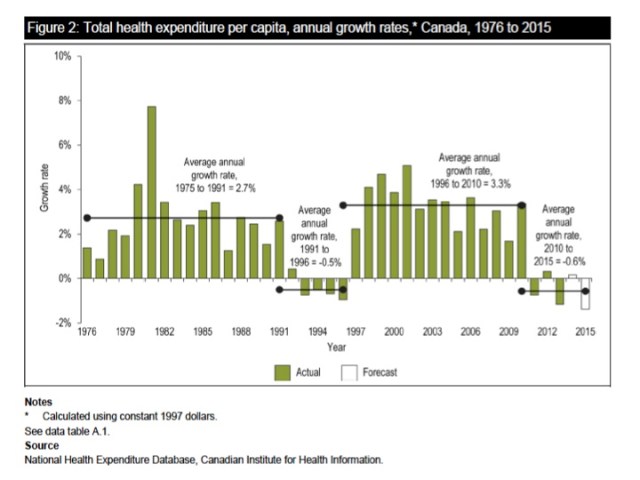
Figures 1 and 2 taken from their annual report illustrate the recent past and the underlying trends. The CIHI report notes that after accounting for inflation and population growth real per capita health spending is expected to drop 1.4% in 2015. Indeed, we have not seen a period like this since the early 1990s. The accompanying narrative divides real per capita health spending trends since 1975 into four periods:
· 1975 to 1991: A period of sustained growth in health spending. The average annual growth rate was 2.7%, with a spike of spending growth in the early 1980s.
· Mid-1990s: Total health expenditure declined by an annual average rate of 0.5% during this period of fiscal restraint. Those of us of a certain age will recall this was the era that saw the arrival of the Canada Health and Social Transfer (now the Canada Health Transfer and Canada Social Transfer) and the cut to federal cash transfers.
· Late 1990s to 2010: This period of reinvestment in health care saw health spending increase by an average rate of 3.3% per year.
· 2011 to 2015: In this period of fiscal restraint, total health expenditure has declined by an annual average rate of 0.6%.

Of course, narratives and stories are a function of the data available. One can take an even longer-term view of health spending in Canada and that is done in Figure 3. Using total health expenditure from the CIHI since 1975 and total health spending numbers obtained from Historical Statistics of Canada for the period 1926 to 1974 (sum of Series B504 to B512), I have plotted real per capita health spending. The numbers from Historical Statistics of Canada are provided in the categories of hospitals, physicians, dentists, prescription drugs, and other personal health spending and vary in completeness with the most complete coverage from 1960 to 1975. Total health spending was deflated using the CPI ($2002) with the CPI and population numbers obtained from Statistics Canada.

I would say that in a manner reminiscent of ancient Gaul, the longer-term narrative in Figure 3 divides the Canadian health expenditure story into three parts. From 1926 to 1959 – or the pre-modern public funding era – real per capita expenditure growth appears brisk. Especially with the impact of some of the war years and immediate post-war years, the result was an average annual growth rate of 4.7 percent. If one takes out 1940 to 1946 and 1928 (which sees a strange spending spike) the growth rate drops to 3.2 percent.
The next period is the arrival of the era of the expansion of public health care spending with the Hospital Insurance and Diagnostics Act in 1957 (which funds provincial hospital care) and then the Medicare Act in 1966, which extended the funding to physician care. There is a major real per capita spending increase in 1960 – 61 percent -which to me marks a structural shift and the debut of the public health care system in Canada. Real per capita spending grows at a higher rate than the previous period. Despite attempts at cost control in the late 1970s (with the onset of Established Program Financing) I would argue this period exists to end of the fiscal crisis of the early 1990s – when there are the first consistent declines in real per capita spending. Average annual growth in real per capita total health spending for the period 1960 to 1996 is 5.3 percent. In contrast, the period 1975 to 1996 only sees an average annual growth rate of 2.5 percent. Growth rates are particularly pronounced during the golden age of public health care from 1961 to 1976 with the average growth rate approaching 6 percent.
After the fiscal crisis of the early 1990s and health spending declines, real per capita total health spending begins growing again in 1997. This I would term the second era of the expansion of public health care spending. After the restraint of the early 1990s, which brought an end to the increases of the first era, spending growth resumes but at a reduced average rate of growth despite the 2004 Health Accord, which comes with annual federal health transfer growth of 6 percent. The average annual growth rate of real per capita total health spending from 1997 to 2015 is actually the lowest of the three eras at 2.8 percent. However, before the slowdown that started in 2011, marking the end of this third era, the period 1997 to 2010 sees average annual real per capita growth of almost 4 percent.
What remains to be seen is what the fourth age of health care spending in Canada will bring in the wake of the recent declines in real per capita health spending. As the case in the mid 1990s, these declines are correlated with a slowing of the Canadian economy in the wake of a major recession. I would venture that at some point in the next couple of years, the era of recent declines in real per capita spending will eventually come to an end and spending growth will resume. The real question is what the growth rate will be especially given that the transfer growth rate reduction slated for 2017 may be revisited by the new Liberal government. Whether the growth rate is lower or higher than the 1997 to 2015 period is going to be as much a political decision as one driven by demographics and economics.
// <![CDATA[
// <![CDATA[
// &lt;![CDATA[
// &amp;lt;![CDATA[
// &amp;amp;lt;![CDATA[
// &amp;amp;amp;lt;![CDATA[
// &amp;amp;amp;amp;lt;![CDATA[
// &amp;amp;amp;amp;amp;lt;![CDATA[
// &amp;amp;amp;amp;amp;amp;lt;![CDATA[
var sc_project=9080807;
var sc_invisible=1;
var sc_security=&amp;amp;amp;amp;amp;amp;quot;4a5335bf&amp;amp;amp;amp;amp;amp;quot;;
var scJsHost = ((&amp;amp;amp;amp;amp;amp;quot;https:&amp;amp;amp;amp;amp;amp;quot; == document.location.protocol) ?
&amp;amp;amp;amp;amp;amp;quot;https://secure.&amp;amp;amp;amp;amp;amp;quot; : &amp;amp;amp;amp;amp;amp;quot;http://www.&amp;amp;amp;amp;amp;amp;quot;);
document.write(&amp;amp;amp;amp;amp;amp;quot;&amp;amp;amp;amp;amp;amp;lt;sc&amp;amp;amp;amp;amp;amp;quot;+&amp;amp;amp;amp;amp;amp;quot;ript type=&amp;amp;amp;amp;amp;amp;#39;text/javascript&amp;amp;amp;amp;amp;amp;#39; src=&amp;amp;amp;amp;amp;amp;#39;&amp;amp;amp;amp;amp;amp;quot; +
scJsHost+
&amp;amp;amp;amp;amp;amp;quot;statcounter.com/counter/counter.js&amp;amp;amp;amp;amp;amp;#39;&amp;amp;amp;amp;amp;amp;gt;&amp;amp;amp;amp;amp;amp;lt;/&amp;amp;amp;amp;amp;amp;quot;+&amp;amp;amp;amp;amp;amp;quot;script&amp;amp;amp;amp;amp;amp;gt;&amp;amp;amp;amp;amp;amp;quot;);
// ]]&amp;amp;amp;amp;amp;amp;gt;
// ]]&amp;amp;amp;amp;amp;gt;
// ]]&amp;amp;amp;amp;gt;
// ]]&amp;amp;amp;gt;
// ]]&amp;amp;gt;
// ]]&amp;gt;
// ]]&gt;
// ]]>
// ]]>


 Worthwhile Canadian Initiative
I know this might be a stupid question but are you comparing like with like when you look at total expenditure on health care as a % of GDP? There is no “total expenditure” method of calculating GDP. There is a “final expenditure” method but that is a different concept. It looks like healthcare and social care together are less than 7% of GDP measured by the output measure of GDP.
The trends over the long term may be the same, but there also a lot of trends within GDP measurements too.
I don’t suppose there’s any way to attribute health dollars to specific age groups, is there? Given that older Canadians are known to be the target of the vast majority of health care spending, it would be interesting to adjust for the changing demographics in order to identify how the spending on comparable individuals is changing over time.
CCPA did a BC centric review of the same data pool.
Austerity comes to BC’s health care system
by – Marc Lee
http://www.policynote.ca/austerity-comes-to-bcs-health-care-system/
http://www.policynote.ca/austerity-comes-to-bcs-health-care-system/
James:
I agree that there are a lot more measurement issues when it comes to GDP and health spending especially prior to 1960. However, a health spending to GDP ratio is a pretty standard way of looking at the “size” of health spending.
Colin:
Health spending is broken up by age group by the CIHI. You can go to their site and get the report and see the current breakdown. Per capita spending is essenti ally u-shaped with respect to age. Very high under age 5, then comes down, is flatfor a while and starts to rise with age with larger increases after age 65.
Internet Stranger:
Thank you for the reference.
Livio
Thx. I still worry that if you added up all types of spending as a % of GDP you’d get to 200%. Just because something is “a standard way” doesn’t mean it’s right. Ask Nick Rowe about monetary policy for a start! I thought you might at least have a look. No matter.
Just in case, here’s the link: http://www.statcan.gc.ca/tables-tableaux/sum-som/l01/cst01/gdps04a-eng.htm
That gives an interesting perspective on the provincial kvetching about the Harper government’s proposal to cap health care transfers at the rate of growth of nominal GDP (which, presumably will be reversed by the Justin Bieber government so that federal transfers continue to grow at 6% a year).
I’m a lot more pessimistic on that, I expect the USA is going to head into recession within 12 months. I know a lot of people will bag me out on that, but the “recovery” has been weak and seems like there’s a fair bit of mal-investment out there. China has a chunk of bad debt to clear out of the system and they are stubbornly resisting it, Europe are still in the grip of ridiculous Keynesian tomfoolery. Put this together and the resource supply countries aren’t going to have a whole lot of customers in the near future.
Yes, I do understand that Canada is more than just resources, I’m told you guys have a software industry… diversity is great, you will be needing that.
Tel: I was just curious.
Tel and Bob: you two are wandering waaaay off-topic. Job Guarantee is just on-topic, since it’s (a hybrid of) fiscal (and monetary) policy. And it’s sorta Keynesian, if we stretch “keynesian” a bit.
Oooops! Ignore my above comment, it’s TOTALLY off-topic. Posted it on the wrong thread.
I forgive you Nick… and it’s likely I’ve gone about as far communicating with Bob as anyone is ever likely to.
Hey, speaking of health spending, don’t forget to give a review of Bob Murphy’s new book. He really values your opinion, you might even shake a free copy out of him.