Notes prepared for a Session in Honour of Robin Boadway II: Emerging Issues in Tax and Transfer Policy, held at the Canadian Economics Association meetings in Toronto, June 1, 2024.
The fundamental principles of optimal tax analysis have not changed greatly over the past 50 years. The constraints faced by tax policy makers have.
The sources of taxable income have shifted. In 1976, the earliest year for which data is available, men's wage and salary income made up almost two-thirds of "market income" – income coming from employment, self-employment, private pensions, and investments. Now it accounts for less than 50 percent.
Women's wage and salary incomes now contribute substantially more to the tax base than they did in the 1970s. This matters to the extent that it changes the elasticity of labour income. Generally speaking, female labour supply is more elastic than male labour supply (for recent evidence see Michael Keene (gated) or this 2008 ungated article by Meghir and Phillips) The more elastic an income base, the greater the economic costs – in terms of distortions to people's behaviour, reductions in well-being, deadweight loss – of taxing it. Hence the changing composition of the income tax base potentially impacts the ability of governments to raise income tax revenue, and the relative desirability of capital v. income taxation.
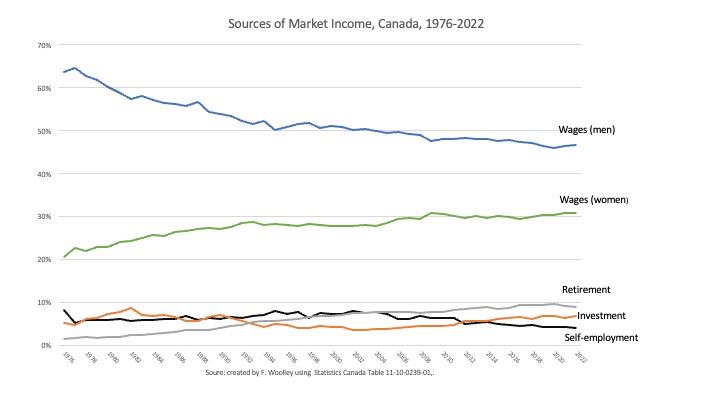
Population aging is one reason why men's male and salary income now accounts for a smaller share of the income tax base: the decline in overall (male plus female) wage and salary income shown above reflects an increase in retirement income share. But what does a decline in the number of workers relative to the number of retirees mean for tax policy?
Generally speaking, when people get older, they spend more than they earn. Thus it is possible to partially offset the fiscal impacts of population aging by taxing spending more – by, for example, increasing GST/HST/other sales taxes – and taxing income less (see, for example, Achou et al ungated here). But while the right tax policy choices might be fairly clear, how to implement them is less so. For a government, increasing the GST is political suicide. The big tax policy question is not "what policies should be adopted?" but rather "how can we build a political consensus around good tax policies?"
The tax treatment of retirement savings raises similar political challenges. Registered Retirement Savings Plan (RRSP) contribution room was expanded in the 1990s and 2000s, partly in anticipation of demographic change. In 2002, Marcel Mérette optimistically wrote, " the deferral of tax payments through [RRSPs and similar programs] nicely offsets the spending pressure arising from health care and public pensions during a demographic transition toward an aging population."
Today Canadians are allowed to contribute to RRSPs until age 71, after which point the funds must be converted into a Registered Retirement Investment Fund (RRIF) and gradually withdrawn – triggering tax liabilities. There's only one problem: people don't like drawing down their retirement savings, and they especially don't like paying tax on those withdrawals. Evidence from the US here and also here finds that, given a choice, a substantial number of people would make less than the required withdrawals from their registered retirements accounts (IRAs in the US, RRSPs/RRIFs in Canada). There is a never-ending stream of proposals to reduce the taxation of deferred savings by, for example, raising the age at which an RRSP must be converted to a RRIF to 75, eliminating mandatory RRIF withdrawals altogether, or exempting the first $160,000 of RRIF savings from withdrawal rules.
Various groups also advocate for selective carve-outs that reduce the effective tax rate on RRIF withdrawals. For example, the Senate Commission on Aging, responding to submissions from finance professionals, recommended withdrawals from registered retirement savings plans should have no impact on eligibility for, or the amount of, federal income-tested benefits and tax credits. The Canadian Medical Association has suggested that the scope of tax-free RRSP and RRIF withdrawals be expanded to include monies used to fund long-term care expenses for either the RRSP investor's own care or a family member's care.
The point here is not to debate the merits of, for example, adjusting the RRIF withdrawal schedule. It makes sense to update the RRIF withdrawal schedule in line with changing demographics. The point is that no matter what RRIF withdrawal rules are in place, there will be continual political pressure to reduce required withdrawals – and the tax that must be paid on them. It is a time inconsistency problem: people sign up for the benefits of RRSP deductions, but when presented with the quid pro quo, taxable RRSP/RRIF withdrawals, attempt to renege on their promise to pay. Again, the challenge is not working out the best tax policy. The challenge is finding politicians able to withstand pressure and stick with that policy.
Further insight into the changing politics of income taxation can be gained by looking at who pays the taxes in Canada:
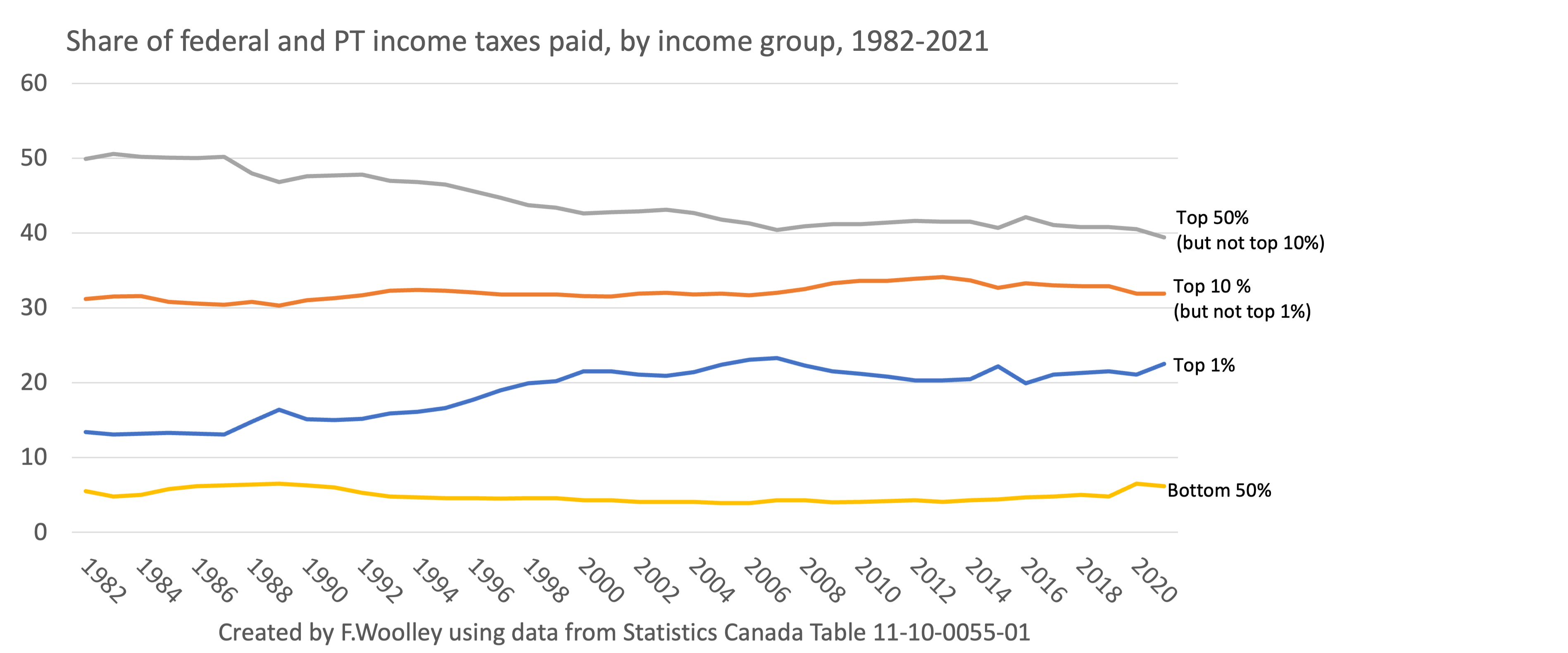
The top one percent of the income distribution pays 22.5 percent of all income taxes (.csv data file here). The top 10 percent – adding together the blue and orange lines on the chart above – pays over half. The share of the top 1 percent has increased substantially since the 1980s, not because Canadian governments have suddenly decided to tax the rich, but rather because the share of income going to the top 1 percent has increased so much. The share of taxes paid by those in the 50th through 90th percentiles of the income distribution has dropped because of a hollowing out of the middle class – as this group's incomes have stagnated, their share of the tax burden has fallen.
The shifting of taxes (and incomes!) to the top 10 percent of taxpayers changes the politics of taxation. A straightforward median voter model would suggest that, now that the median voter pays a smaller share of the total tax burden, they will be more likely to support tax-and-spend policies. Recent experience suggests politics are not that simple: right-wing populist parties can create an alliance between the wealthiest tax payers and lower income voters on "wedge" or "culture war" issues, such as trans rights – and then, when elected, cut taxes. Again the challenges of tax policy are political: the more the burden of income taxation falls on a small(ish) group of tax payers, the greater the incentives for that group to organize and campaign for reductions in their taxes.
But we need tax revenues if we want to have nice things. Population aging is placing increased demands on health and long-term care systems. Over the past four decades, the cost of things governments buy has increased about one third more than the cost of things households buy (see here). Tax revenues need to increase just to provide the same level of government services. So what is to be done?
First, one could increase the tax base by growing the economy. Indeed, much public finance research over the decades has focussed on how to make the tax system more efficient – which generally means growth-enhancing. Yet there are few low-hanging fruit in the tax policy space. Most tax reforms that have the potential to grow the economy without having major costs in terms of reduced equity, forgone tax revenue, or widespread political opposition have already been implemented. The greater potential for economic growth comes from non-tax policies, such as increased immigration. Just as the tax system is widely used to achieve goals other than raising government revenue, broader fiscal and social policies can be used to bolster the tax system.
Alternatively, revenues and expenses could be brought into alignment by reducing the cost of government. There are some good ways of reducing the cost of government, and some not-so-good ones. For example, restricting the salaries of mobile, skilled, public sector workers, thereby inducing them to quit and take up better-paid employment elsewhere, is not a very effective way to save money in the medium- to long-term. There is scope for governing Canada more effectively: by using technology to reduce the costs of, say, enforcing traffic regulations, or by reducing duplication of effort between federal, provincial/territorial and local governments. But it will take cooperation and political will.
A third option is to rely more on non-traditional revenue sources. At the CEA session where I presented the ideas outlined in this post, Lars Osberg made the case for introducing an inheritance tax. Others have proposed introducing wealth taxes. Canada could rely more on property taxes and user fees – e.g. congestion charges and tolls – than it does at present.
Yet ultimately the fundamental challenge facing tax policy is a political one: there is a divergence between the level of services people expect governments to provide and their willingness to pay the taxes needed to support those services. Somehow we've gone from seeing taxation as a patriotic duty to reviling the very existence of taxes:
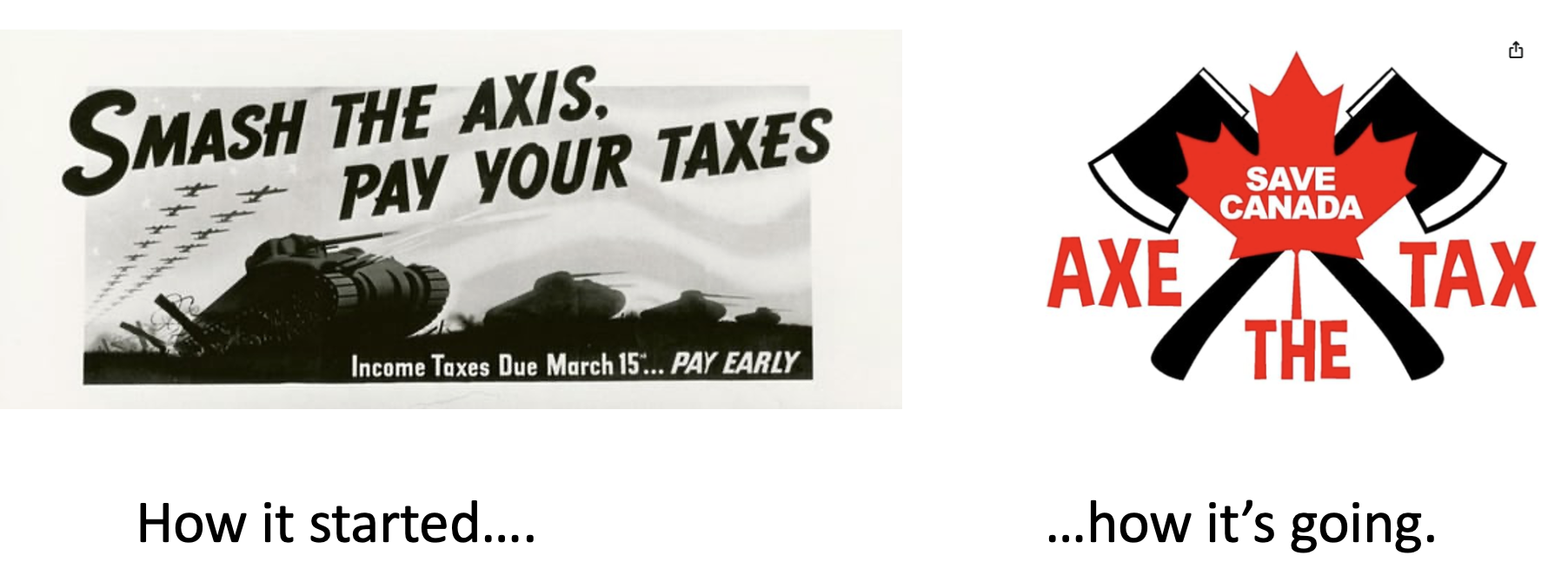
(HT to Tammy Schirle for suggesting this juxtaposition).
In short, taxation has a public image problem.
So what is to be done?
Part of the answer is to make paying taxes easier and less painful. Easier means, for example, automating income tax filing whenever possible. Identifying the barriers people face when accessing CRA's My Account portal and eliminating them. Creating a Canadian equivalent of the US EZ pass system to make paying road tolls quick and painless (and don't sell off tolls roads and the subsequent revenue streams for a fraction of their present discounted value).
Less painful also means making taxes payments smooth and predictable – no surprises, no large unexpected bills. Canadian Emergency Response Benefit repayments are an example of what I mean by painful taxation: some of those who received CERB benefits in error are now being asked to pay back hundreds, thousands, or even tens of thousands, of dollars, and may lack the wherewithal to do so. CRA does offer accommodation and repayment plans, but as my colleagues Jennifer Robson and Saul Schwartz argue, the CRA "It is not well equipped to provide “soft services” to help with complex needs or to provide transparent benefit review."
The best way to make a tax painless is to make it invisible. The contrast between European and Canadian attitudes towards value added taxation can be readily explained by the much greater visibility of the GST – European value added taxes are included the price of goods sold, while the GST is not. Public finance textbooks often list "transparency" one of the characteristics of a good tax system. The unpopularity of highly visible taxes, however, suggests that it might be possible to have too much of a good thing.
Another part of the solution might be to make taxpayers feel good. A person who makes a $1,000 donation to the local food bank is showered with thanks, praise, and pictures of hungry-yet-adorable children, but a person who pays $1,000 in taxes gets little appreciation.
One way of making people feel better about the taxes they pay – and for building political support for taxation in general – is by bundling policies, that is, making explicit the link between taxes paid, revenues, and the nice things that governments do . It won't be easy, but we can at least take the first step: admitting we have a problem, and start talking about tax politics.


Thanx for this. Does the transparency of indirect taxes apply to the federal fuel consumption levy.
While I appreciate the merits of transparency of indirect taxes, it does make daily life more tiresome than Europe and even Australia. It is even worse in restaurants, where one has to add a tip and then a consumption tax to a bill that is inclusive in Australia and Europe.
Hi Gavin,
Great point about the federal fuel consumption levy. Michael Smart gave a fascinating talk in the Boadway festschrift session on carbon taxation, link here or if that doesn’t work here showing that actually real gasoline taxes have if anything declined since the introduction of the carbon price. Basically provincial governments have reduced gas taxes to offset the federal carbon tax. So if people actually knew how much they were paying in gas taxes, and how that had changed over time, perhaps the issue wouldn’t be quite so politically charged as it is!
If Parliament allocates a budget to a department and they draw it down, then that is now ‘100% borrowed’ according to MMT. Let’s say that’s the health service and they are trying to hire nurses, but there aren’t any. So the budget remains unspent. That ‘new money’ can’t cause inflation.
Now let’s say another department is able to hire one person at the price they want to pay, which means 20% of that spend is recovered in tax (say). But that person is a hoarder and saves all they receive. We now have one extra transaction, and a whole bunch of saving which shows up as ‘government borrowing’. Yet the private sector has only been denied the output of one individual with no downstream transactions. (edited)
Run that on to the next hop, and the individual hired spends what they receive but the next person down the chain is the hoarder. We’ve now recovered 36% of the original spend in tax, but redirected two transactions. The rest is ‘government borrowing’.
And so on down the chain. As the money is respent further, and therefore more tax is raised, more transactions are induced. And its the transactions induced that are potentially inflationary if they can’t be matched by increased production.
Nice to see you posting again! And good post.
Thanks Declan!